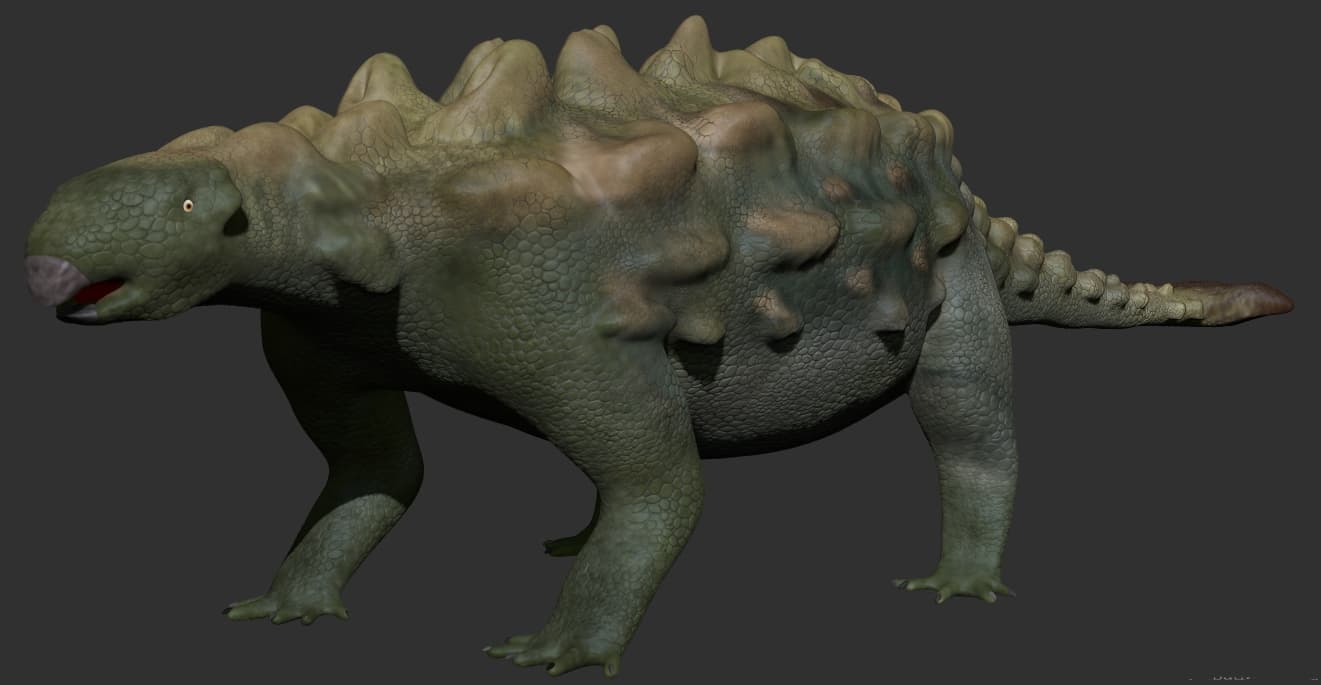
Anodontosaurus
Anodontosaurus lambei was an armoured ankylosaur from Alberta, described in 1929 and dated to 72.8 to 67 million years ago. At 5 to 5.5 metres and 1.5 to 2.5 tonnes, its name means toothless lizard — misleading, since it carried small teeth at the back of its jaws. Long treated as Euoplocephalus, it was reinstated as a distinct genus in 2013.
Playable in Path of Titans
See Anodontosaurus lambei's stats, abilities and role on our survival server.
Anodontosaurus lambei lived in the Late Cretaceous, roughly between 72.8 and 67 million years ago (late Campanian to middle Maastrichtian). Its presence is documented in the Horseshoe Canyon Formation of Alberta, Canada, a sedimentary sequence that yields a particularly diverse fauna from the final chapter of the dinosaur age. At that time, North America was split into two landmasses by the Western Interior Seaway, a shallow sea extending from the Gulf of Mexico to the Arctic. Anodontosaurus shared its environment with other ankylosaurs like Euoplocephalus, along with hadrosaurs, ceratopsians, and theropods, in a coastal ecosystem of dense forests and marshy lowlands.
The first specimen of Anodontosaurus lambei was described in 1929 by Charles M. Sternberg, from material collected in the Horseshoe Canyon Formation. The type species name honors Canadian paleontologist Lawrence Lambe, a pioneer in the study of Albertan dinosaurs. For decades, Anodontosaurus was considered a junior synonym of Euoplocephalus tutus, another ankylosaur from the same region. Victoria Arbour and Philip Currie, through revisions published from 2013 onward, reinstated the genus by demonstrating that morphological differences — particularly the shape of the tail club and the arrangement of cranial osteoderms — were sufficient to distinguish the two taxa. In 2017, Penkalski and Blows described a second species, A. inceptus, from more fragmentary material.
Anodontosaurus measured approximately 5 to 5.5 meters long, with an estimated mass between 1,500 and 2,500 kg, placing it among mid-sized ankylosaurs. Its body plan was extremely low-slung, with the belly close to the ground and a barrel-shaped armored trunk. All four limbs were short and heavily built, well-suited to supporting the considerable weight of the osteoderm covering. The skull was wide, flattened, and triangular when seen from above — proportionally larger relative to the body than in many other thyreophorans. Shoulder height likely did not exceed 1.5 meters.
A strict herbivore, Anodontosaurus fed on low-growing vegetation: ferns, creeping flowering plants, mosses, and young shrub growth. Its very name — from Greek for 'toothless lizard' — is misleading: it did have small leaf-shaped teeth, just poorly developed, set at the back of the jaws. A horny beak at the front of the snout handled cropping and tearing, while the teeth provided minimal processing before swallowing. Like most ankylosaurs, it could not chew efficiently and relied on a voluminous gut to ferment and break down plant fibers. Its extremely low posture restricted feeding to within roughly one meter of the ground, pointing toward a niche as a dedicated ground-level browser.
The Horseshoe Canyon Formation, where Anodontosaurus fossils were found, represents a deltaic and coastal environment with floodplains, conifer forests, and wetlands. The climate was warm-temperate and more humid than modern Alberta, with distinct seasons. Sedimentary evidence points to proximity to the Western Interior Seaway, creating a habitat of wetlands interspersed with dense forest patches. Late Campanian–Maastrichtian Alberta was a mosaic of coastal marshes, araucarian and redwood forests, fern prairies, and angiosperm ground cover. These vegetation-rich, low-canopy environments suited a heavy, armored browser perfectly.
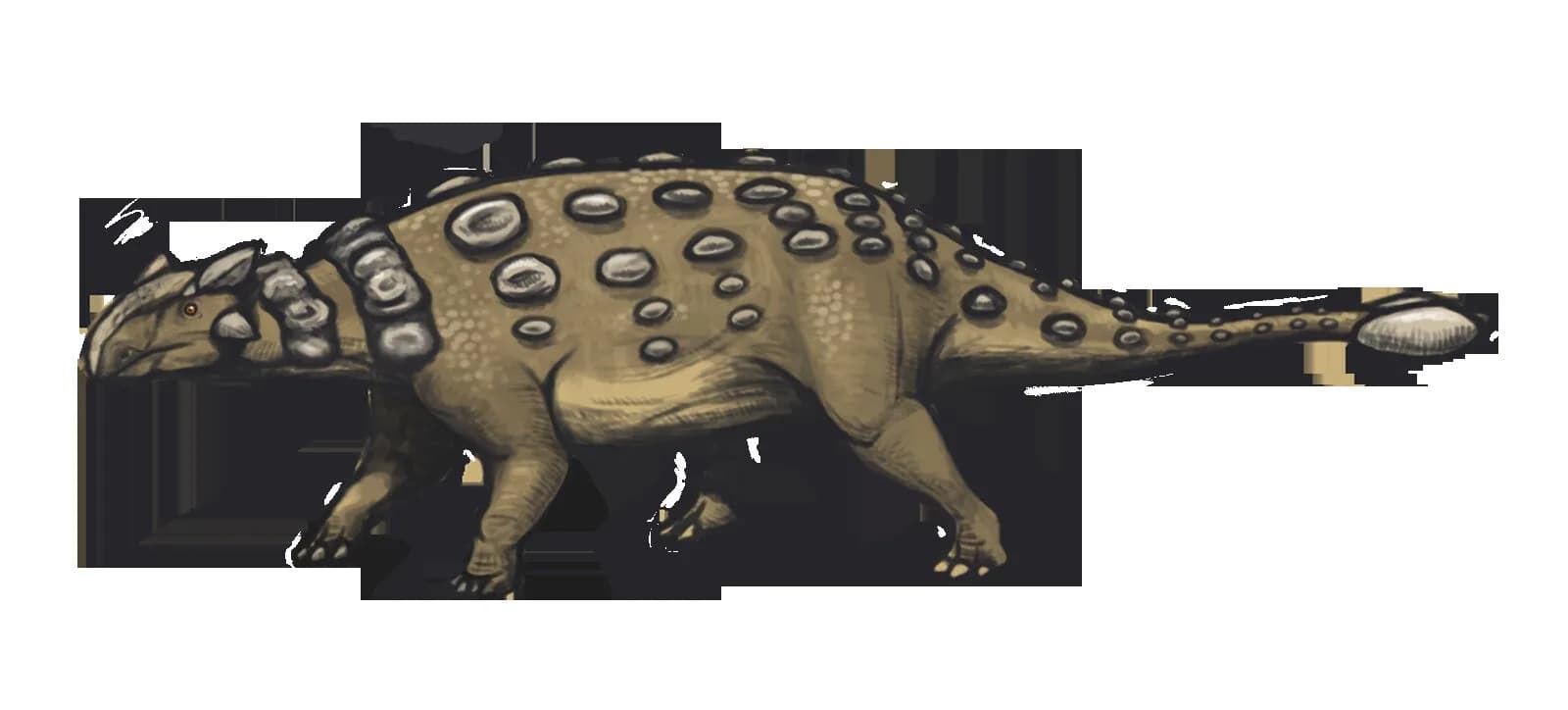
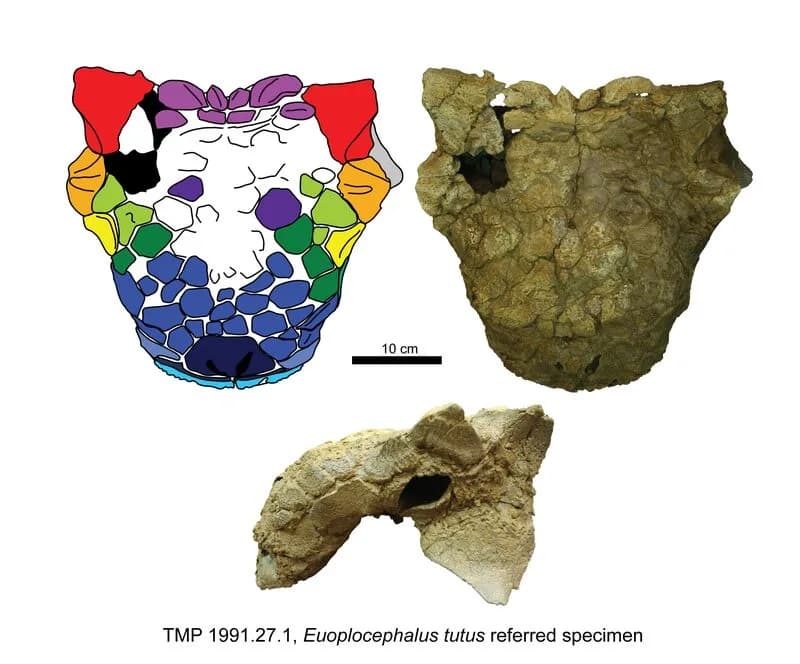
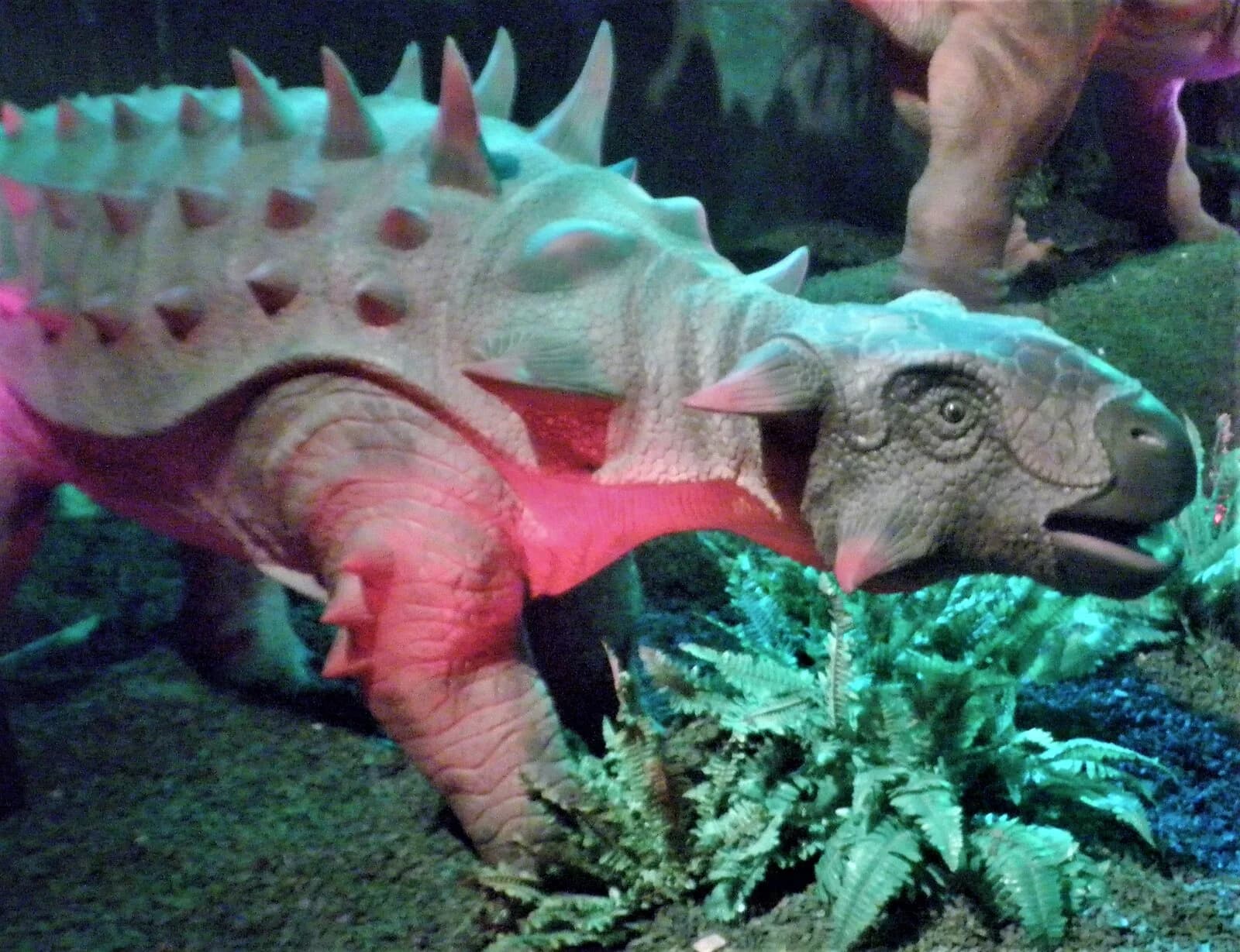
Anodontosaurus bears one of the best-documented armor suites among North American ankylosaurs. The ossified integument included several types of osteoderms: caputegulae (interlocking polygonal plates) covering the skull, semicircular neck bands arranged in transverse rows, and smaller osteoderm rows along the back and flanks. A distinctive row of supraorbital plates — positioned behind the eye — is one of the diagnostic features of the genus identified by Arbour and Currie. The tail club of Anodontosaurus is broad, laterally flattened, and bears prominent pointed lateral horns, distinguishing it from the more symmetric club of Euoplocephalus. The distal portion of the tail was partially stiffened by ossified tendons, converting the last third into a ballistic lever. The skull, entirely sheathed in osteoderms fused to the underlying bone, formed a near-impenetrable facial shield.
The tail club of Anodontosaurus functioned as an active percussion weapon rather than purely passive protection. Biomechanical analyses on closely related ankylosaurs (Arbour et al.) demonstrate the tail could be swung laterally fast enough to fracture the limb bones of a tyrannosaur-sized predator. Contrary to a common assumption, distal tail rigidity did not prevent quick deployment: proximal muscles generated substantial rotational torque, and the club acted like a weight at the end of a flail. Anodontosaurus was probably solitary or lived in loose small family groups, as suggested by the absence of mass accumulations of specimens. Its complete armor made fleeing unnecessary against most predators: its defensive strategy involved lowering itself to protect the unarmored belly, then deploying the club if a predator came close enough.
Anodontosaurus belongs to the order Ornithischia, suborder Thyreophora, family Ankylosauridae, and subfamily Ankylosaurinae. Within the Ankylosaurinae, it is a close relative of Ankylosaurus magniventris (its geographic and temporal successor), Euoplocephalus tutus, and Dyoplosaurus acutosquameus. The internal phylogeny of North American Ankylosaurinae has been revised multiple times: some analyses place Anodontosaurus within a clade of broad-club forms (Dyoplosaurus + Anodontosaurus + Ankylosaurus), separated from narrower-club forms such as Euoplocephalus. Two valid species are recognized: A. lambei Sternberg, 1929 (type species) and A. inceptus Penkalski & Blows, 2017.
Although Anodontosaurus and Euoplocephalus are frequently confused — both from the same geological formation and broadly similar in body plan — several characters separate them clearly. Anodontosaurus has a wider tail club with more pronounced lateral horns, giving it a diamond-shaped profile when viewed from above. Its cranial caputegulae are arranged differently, with the supraorbital row noted above being particularly diagnostic. Compared to Ankylosaurus (late Maastrichtian, ~66 Ma), Anodontosaurus is roughly five million years older and considerably smaller: Ankylosaurus could exceed 6.5 meters and 6,000 kg. Nodosaurus, a nodosaurid entirely lacking a tail club, represents a separate evolutionary branch of armored thyreophorans and confirms that the club was not universal across the group.
The type material of Anodontosaurus lambei came from exposures along the Red Deer River in Alberta and is held at the Canadian Museum of Nature in Ottawa. Additional specimens — including partial skulls, axial skeleton elements, and isolated osteoderms — have been collected from several Horseshoe Canyon Formation localities. Preservation quality varies: osteoderms and the tail club survive particularly well due to their high mineral density, while limb bones are often fragmented or scattered. The reinstating of the genus by Arbour and Currie (2013) relied on systematic comparison of specimens previously assigned to Euoplocephalus, showing that several of them actually belonged to Anodontosaurus. The Royal Tyrrell Museum of Palaeontology in Drumheller, Alberta, also holds material attributed to this genus.
Anodontosaurus remains little known among general audiences despite its genuine paleontological importance. It has not yet appeared in major dinosaur games (The Isle, Path of Titans) or the Jurassic Park/World franchise, unlike its more famous cousin Ankylosaurus. Freely licensed paleoart of the species is rare, reflecting its low profile in popular science. Yet its study contributed directly to clarifying North American ankylosaur taxonomy — a group whose revisions since 2010 have substantially reshaped our understanding. For fans of armored dinosaurs, Anodontosaurus offers a concrete illustration of the challenges of paleontological systematics: distinguishing two closely related species in the fossil record demands careful analysis of dozens of morphological characters.
| Period | Crétacé supérieur / Late Cretaceous |
| Era | Mésozoïque / Mesozoic |
| Age | 72,8–67 Ma |
| Location | Amérique du Nord / North America (Alberta, Canada) |
| Length | 5–5,5 m |
| Height | ~1,5 m |
| Weight | 1 500–2 500 kg |
| Diet | Herbivore |
| Discovery | 1929 |
Anodontosaurus lambei was long confused with Euoplocephalus tutus because both come from the Horseshoe Canyon Formation in Alberta. Victoria Arbour and Philip Currie (2013) showed that Anodontosaurus has a broader tail club with pronounced pointed lateral horns, and that the arrangement of cranial caputegulae — particularly the supraorbital row behind the eye — differs significantly.
Anodontosaurus lambei measured 5 to 5.5 meters long with an estimated mass of 1,500 to 2,500 kg. Its defense relied on two complementary mechanisms: a full suit of ossified osteoderms protecting the back and skull, and a tail club capable — according to biomechanical analyses — of fracturing the limb bones of a tyrannosaur-sized predator with a lateral swing.
The name Anodontosaurus lambei (from Greek meaning 'toothless lizard') reflects the condition of the original material described by Charles Sternberg in 1929, where teeth were absent or barely visible in the jaws. The species did have small, poorly developed leaf-shaped teeth at the back of its jaws, but its horny beak at the front mainly handled cropping and tearing low-growing vegetation.
Information on this page is based on peer-reviewed scientific publications.
3D life reconstruction of Anodontosaurus lambei
Петр Меньшиков (Petr Menshikov), CC BY-SA 4.0, via Wikimedia Commons
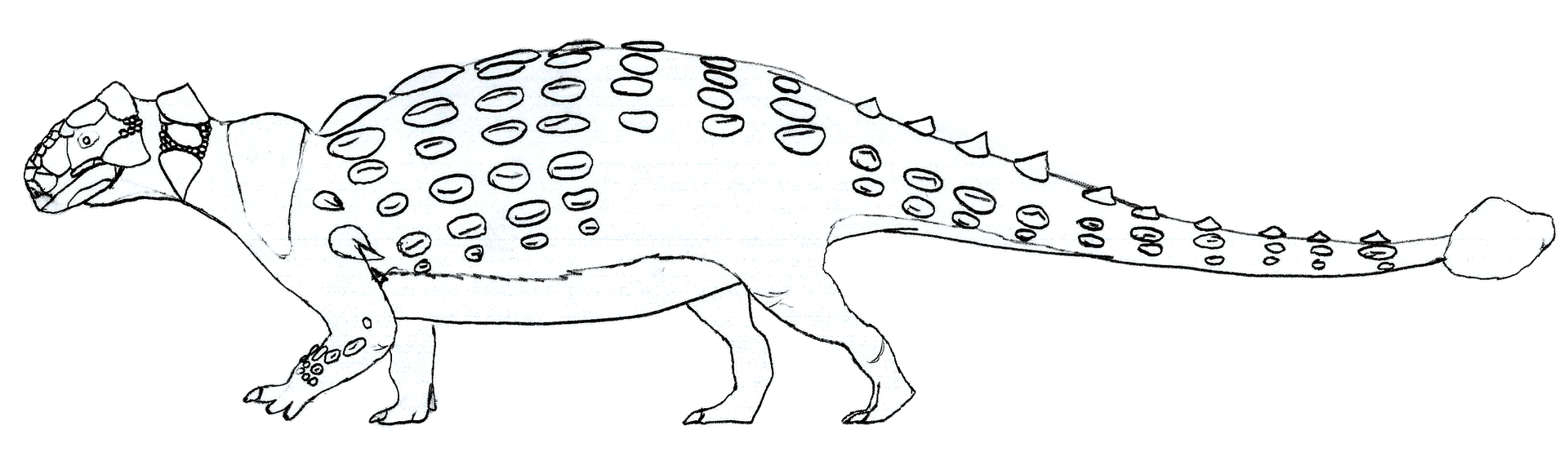
Anodontosaurus lambei — lateral and dorsal skeletal view (size comparison)
Levi bernardo, CC BY-SA 3.0, via Wikimedia Commons