Euoplocéphale
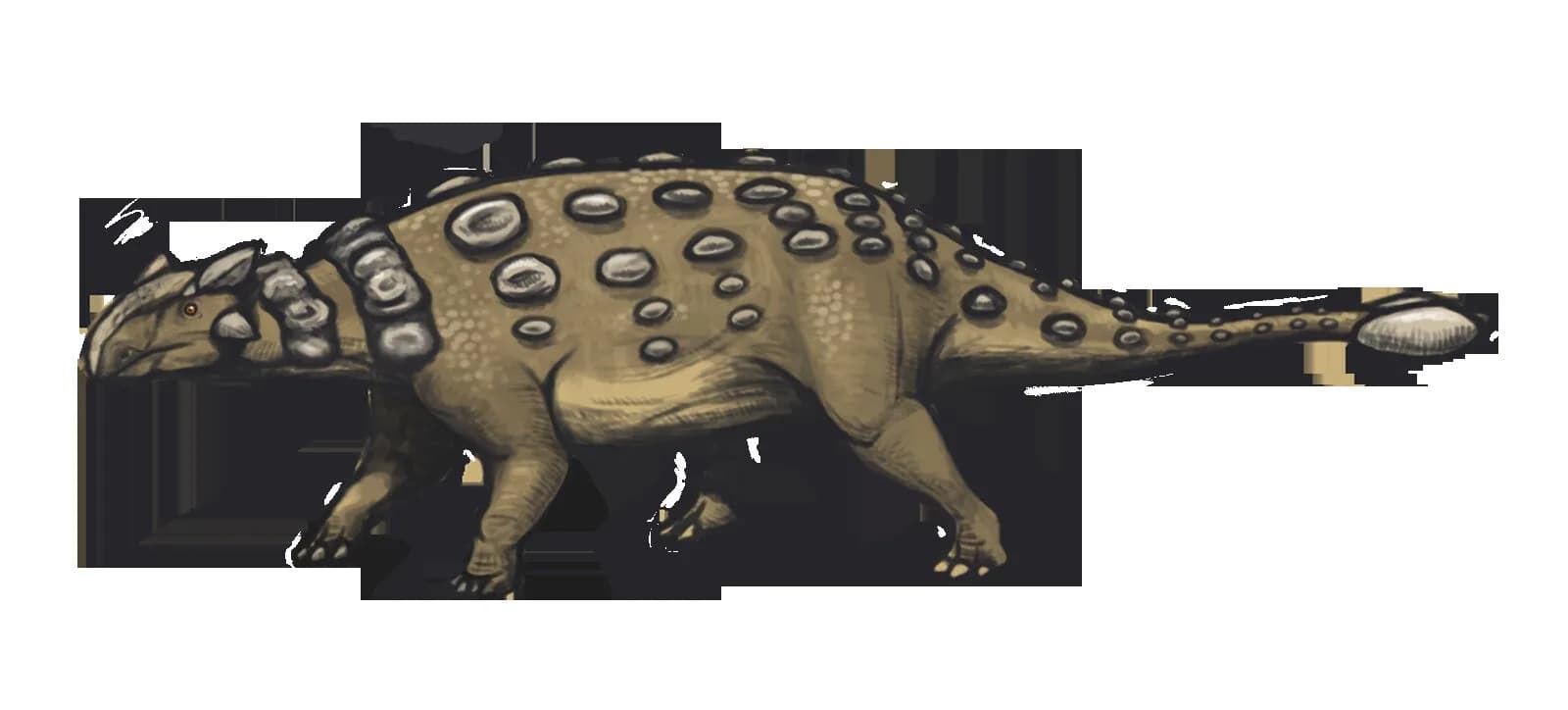
Euoplocephalus tutus took armour as far as the eyelids: hinged bony plates closed over its eyes, a device with no equivalent among dinosaurs. About 6 metres long and 2 to 3 tonnes, described in 1902, it lived 76 to 67 million years ago in Alberta and Montana. Calculations give its tail club an impact force of several thousand newtons.
Euoplocephalus lived in the Late Cretaceous, approximately 76 to 67 million years ago, spanning the Campanian and Maastrichtian stages. This longevity of nearly 9 million years makes it one of the most persistent ankylosaur genera in the North American fossil record. It belongs to the family Ankylosauridae, the group of ankylosaurs equipped with a tail club. Euoplocephalus was contemporary with Tyrannosaurus and Triceratops, thriving in the rich ecosystems along the Western Interior Seaway. It represents one of the best-known ankylosaurs thanks to over 40 specimens discovered in the badlands of Alberta, Canada.
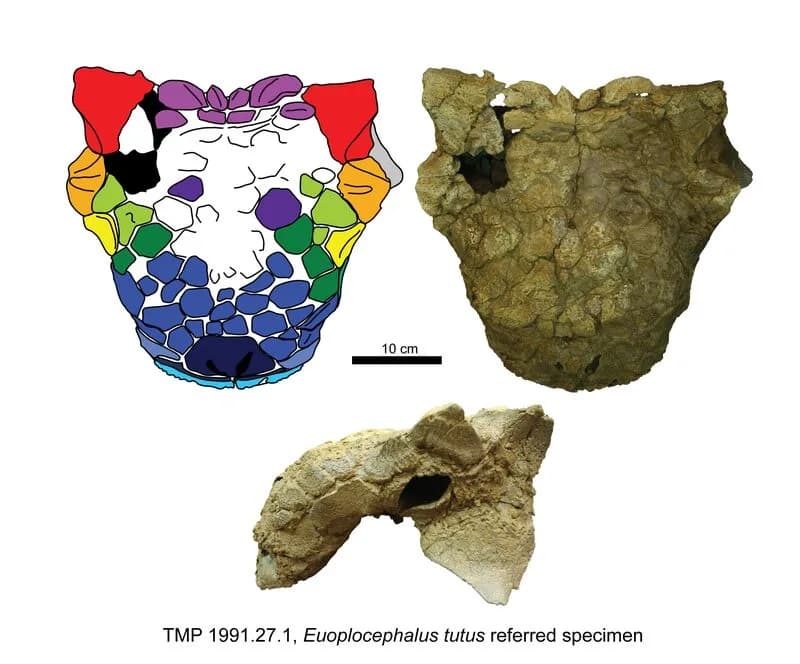
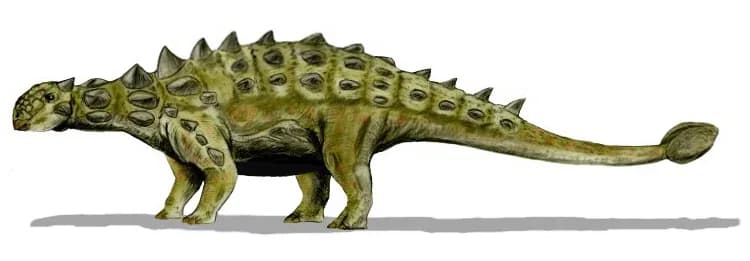
Euoplocephalus measured approximately 6 meters in length, about 2 meters tall, with an estimated weight between 2 and 3 tonnes. Its massive build and low posture made it a true living tank on the Cretaceous plains. Its wide, flat skull measured about 45 centimeters long and was entirely armored, including the eyelids covered with articulated bony plates that could snap shut for protection. The tail club could measure up to 60 centimeters in diameter and was reinforced by fused vertebrae — a formidable weapon capable of breaking a predator's bones with a single lateral swing.
A strict herbivore, Euoplocephalus fed on the low vegetation of the Late Cretaceous plains of North America. Its wide, rounded beak was adapted for non-selective browsing of ferns, horsetails, mosses, and small angiosperms growing abundantly in the humid undergrowth. Its simple, small teeth indicate low masticatory ability — digestion relied on prolonged microbial fermentation in a voluminous gut, similar to the digestive process of modern hindgut fermenters like rhinoceroses. The animal's wide thorax housed a massive digestive system capable of processing large quantities of nutrient-poor plant material throughout the day, sustaining its considerable body mass.
Euoplocephalus inhabited the vast coastal plains of western North America, primarily in what is now Alberta, Canada, and Montana, United States. Its environment bordered the Western Interior Seaway, with a warm and humid subtropical climate that supported dense and diverse vegetation. The Dinosaur Park and Horseshoe Canyon formations represent floodplain environments with meandering rivers, extensive swamps, and mixed forests of conifers and angiosperms. These lush ecosystems supported a diverse fauna of ceratopsians, hadrosaurs, and tyrannosaurs that coexisted alongside Euoplocephalus in one of the richest Late Cretaceous communities known.
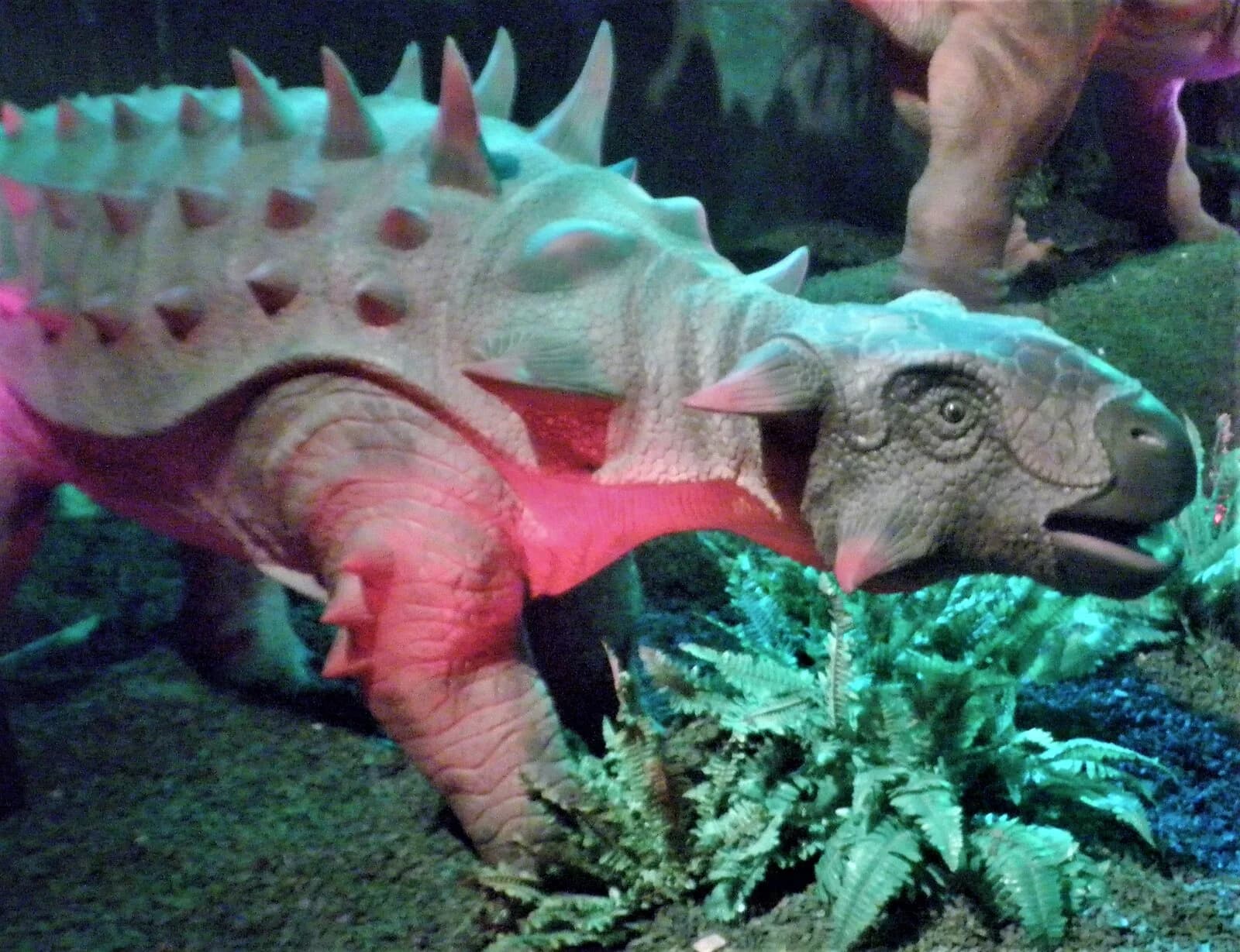
Euoplocephalus anatomy embodies the pinnacle of defensive evolution among dinosaurs. Its entire body was covered with a mosaic of osteoderms forming a nearly impenetrable armor of interlocking bony plates. The skull was particularly fortified: even the eyelids were armored with articulated bony plates, a protection unique in the animal kingdom. The tail club was powered by powerful muscles and ossified tendons that stiffened the distal half of the tail into a rigid handle. Blunt horns adorned the posterior corners of the skull. The palate was deeply vaulted with sinuous nasal passages, possibly related to thermoregulation or enhanced olfactory capacity for detecting approaching predators.
Euoplocephalus was probably a primarily solitary animal, as suggested by the absence of bone beds containing numerous individuals. Facing a tyrannosaur, its defense consisted of crouching to the ground to protect its unarmored belly and swinging its tail club with devastating force capable of generating several thousand newtons of impact. Biomechanical calculations estimate that the club could break a predator's bones, including the metatarsals of a large tyrannosaurid. The armored eyelids could close to protect vulnerable eyes during confrontations. Its considerable mass and comprehensive armor made it virtually invulnerable to frontal attacks from even the largest theropods.
Euoplocephalus tutus was first described in 1902 by Canadian paleontologist Lawrence Lambe under the name Stereocephalus, renamed in 1910 because the name was already used for a beetle. The name Euoplocephalus means 'well-armored head' in Greek (eu = well, hoplon = armor, kephalos = head). With over 40 specimens discovered in the Dinosaur Park and Horseshoe Canyon formations, it is one of the best-represented ankylosaurs in the global fossil record. Fossils come primarily from Alberta, Canada. Recent taxonomic revisions have led to the separation of several genera including Anodontosaurus and Scolosaurus, reducing the diversity once attributed to Euoplocephalus.
| Period | Crétacé supérieur / Late Cretaceous |
| Era | Mésozoïque / Mesozoic |
| Age | 76-67 Ma |
| Location | Amérique du Nord (Alberta, Montana) / North America (Alberta, Montana) |
| Length | ~6 m |
| Height | ~2 m |
| Weight | 2-3 tonnes |
| Diet | Herbivore |
| Discovery | 1902 |
Euoplocephalus tutus measured about 6 meters long and weighed 2 to 3 tonnes. This Late Cretaceous ankylosaur (Campanian, ~76-68 Ma) lived in present-day Alberta, Canada and Montana, USA. With osteodermic armor covering its entire body, it was the best-armored and best-known ankylosaur of North America.
The tail club of Euoplocephalus tutus was formed by osteoderms fused around the distal tail vertebrae, creating a rigid bony structure that could weigh several kilograms. Biomechanical studies show a lateral blow could generate enough force to fracture the bones of a large theropod like Gorgosaurus. It represents one of the most effective defensive weapons of the Mesozoic era.
Yes — Euoplocephalus tutus had ossified eyelids, a unique characteristic among ankylosaurs. These moveable bony shields protected the eyes during predator attacks. Its name means 'well-armored head' (Greek: eu 'well' + hoplon 'weapon/shield' + kephalé 'head'). This extra protection underscores the extreme degree of defensive ossification in this animal.
Euoplocephalus tutus reconstruction
Nobu Tamura, Wikimedia Commons, CC BY-SA
Euoplocephalus bony armour
Wikimedia Commons, CC BY-SA