Ammonite
Ammonites were a group of spiral-shelled cephalopods present in every ocean from 400 to 66 million years ago. Their shells ranged from one centimetre to 2.5 metres across in Parapuzosia seppenradensis. Their name comes from the Egyptian god Ammon, depicted with coiled ram horns — exactly the shape of their shell.
Ammonites (order Ammonoidea) first appeared during the Devonian period, approximately 400 million years ago, and thrived in the world's oceans for over 330 million years. They spanned three major geological eras — the Paleozoic, Mesozoic, and part of the Cenozoic — surviving several mass extinctions, including the devastating Permian-Triassic extinction that wiped out 96% of marine life. Ammonites reached their peak diversity during the Jurassic and Cretaceous periods, when they became the most diversified mollusks in the oceans. Their reign ended abruptly during the Cretaceous-Paleogene (K-Pg) extinction event 66 million years ago, the same cataclysmic event that killed the non-avian dinosaurs. They remain among the most important and most studied fossils in the history of paleontology.
Ammonites displayed an extraordinarily varied range of sizes, from tiny species barely one centimeter in diameter to absolute giants like Parapuzosia seppenradensis, whose shell reached 2.5 meters in diameter — the largest shelled cephalopod that ever existed. Most species measured between 5 and 30 centimeters, roughly the size of a dinner plate. Their planispirally coiled shell was divided into internal chambers separated by partitions called septa. The living animal occupied only the last chamber, known as the body chamber, while the anterior chambers served as a sophisticated buoyancy system. This diversity in size reflects the thousands of species that populated the oceans over more than 300 million years.
Ammonites were active predators of ancient seas, feeding primarily on small crustaceans, plankton, small fish, and other marine invertebrates. Like their modern cousins the nautiluses, they probably possessed tentacles equipped with suckers to capture prey, as well as a powerful horny beak (called an aptychus) capable of crushing crustacean shells. Some species were likely opportunistic scavengers, feeding on carcasses that had fallen to the seafloor. Smaller species probably specialized in zooplankton and marine larvae, while giants like Parapuzosia likely hunted more substantial prey. Isotopic analyses of their shells suggest that different species occupied varied ecological niches within the water column.
Ammonites populated virtually every ocean on the globe, from shallow tropical waters to abyssal depths. They are found on every modern continent, testifying to their truly worldwide distribution during the Mesozoic. Some species were pelagic, swimming in open water far from coasts, while others preferred shallow coastal waters and continental shelves. The Western Interior Seaway of North America, the Tethys Sea (ancestor of the Mediterranean), and the epicontinental seas of Europe harbored particularly diverse ammonite communities. Their ability to control buoyancy through their chamber system allowed them to move vertically within the water column, exploiting different depths according to feeding or reproductive needs.
Ammonite anatomy was dominated by their spirally coiled shell, divided into chambers by partitions (septa) whose junction line with the outer wall formed patterns called suture lines. These suture lines evolved considerably over time: simple and wavy in primitive Devonian forms (goniatitic sutures), they became progressively serrated (ceratitic sutures in the Triassic) and then extraordinarily complex and fractal in advanced Cretaceous forms (ammonitic sutures). A tube called the siphuncle passed through all chambers, allowing the animal to regulate the amount of gas and liquid in each chamber to control its buoyancy — a system analogous to the ballast tanks of a submarine. The animal itself, a soft-bodied cephalopod, occupied the body chamber with its tentacles, eyes, and horny beak.
Ammonites were active swimmers that propelled themselves by jet propulsion, expelling water through their hyponome (siphon) like modern squids and nautiluses. Their gas-filled shell gave them neutral buoyancy, allowing them to hover in the water column with minimal energy expenditure. Some species probably undertook daily vertical migrations, rising toward the surface at night to feed on plankton and descending to deeper waters during the day to escape predators. Reproduction likely involved marked sexual dimorphism: smaller forms (microconchs) were probably males, and larger ones (macroconchs) females. Like modern nautiluses, they probably laid eggs on the seafloor. Their main predators included mosasaurs, ichthyosaurs, and certain large fish.
Ammonites are among the most widespread, most collected, and most scientifically important fossils in the world. Their name derives from the Egyptian god Ammon, often depicted with ram's horns evoking the spiral of their shell. The French naturalist Jean-Baptiste Lamarck was one of the first to describe them scientifically in 1799. Their critical importance in geology lies in their role as index fossils (or stratigraphic fossils): thanks to their rapid evolution and wide geographic distribution, each species characterizes a precise geological period, allowing geologists to date rock layers with great accuracy. Thousands of species have been described, distributed across hundreds of genera. They are found on every continent, including Antarctica. Some deposits, such as those at Lyme Regis in England (where Mary Anning made her famous discoveries), Madagascar, and Morocco, produce spectacularly preserved specimens, sometimes with their iridescent nacre still intact (ammolite).
| Period | Dévonien au Crétacé / Devonian to Cretaceous |
| Era | Paléozoïque–Mésozoïque / Paleozoic–Mesozoic |
| Age | 400–66 Ma |
| Location | Mondial (tous les océans) / Worldwide (all oceans) |
| Length | 1 cm – 2.5 m (diamètre coquille / shell diameter) |
| Height | Variable |
| Weight | Variable |
| Diet | Carnivore |
| Discovery | 1799 |
Parapuzosia seppenradensis, a Late Cretaceous ammonite (~85 Ma), holds the record with a shell diameter reaching 2.5 meters — the largest shelled cephalopod ever known. Exceptional specimens of this species are displayed in several European museums. Most ammonoids measured 5 to 30 centimeters; giants represent only a fraction of the thousands of species that existed over 330 million years.
Ammonites regulated their buoyancy through the siphuncle, a tube passing through all chambers of their coiled shell. By adjusting the amount of gas and liquid in each chamber via this tube, the animal moved vertically in the water column — a system analogous to submarine ballast tanks. This adaptation allowed them to colonize all ocean depths for 330 million years.
Ammonoids are the ultimate stratigraphic fossils: their rapid evolution and worldwide distribution mean each species characterizes a precise time slice. Suture lines — the junction between septa and the outer wall — evolved from simple Devonian curves to extraordinarily complex fractal patterns in the Cretaceous. A geologist can date a rock layer to within a few million years by identifying the ammonite species it contains.
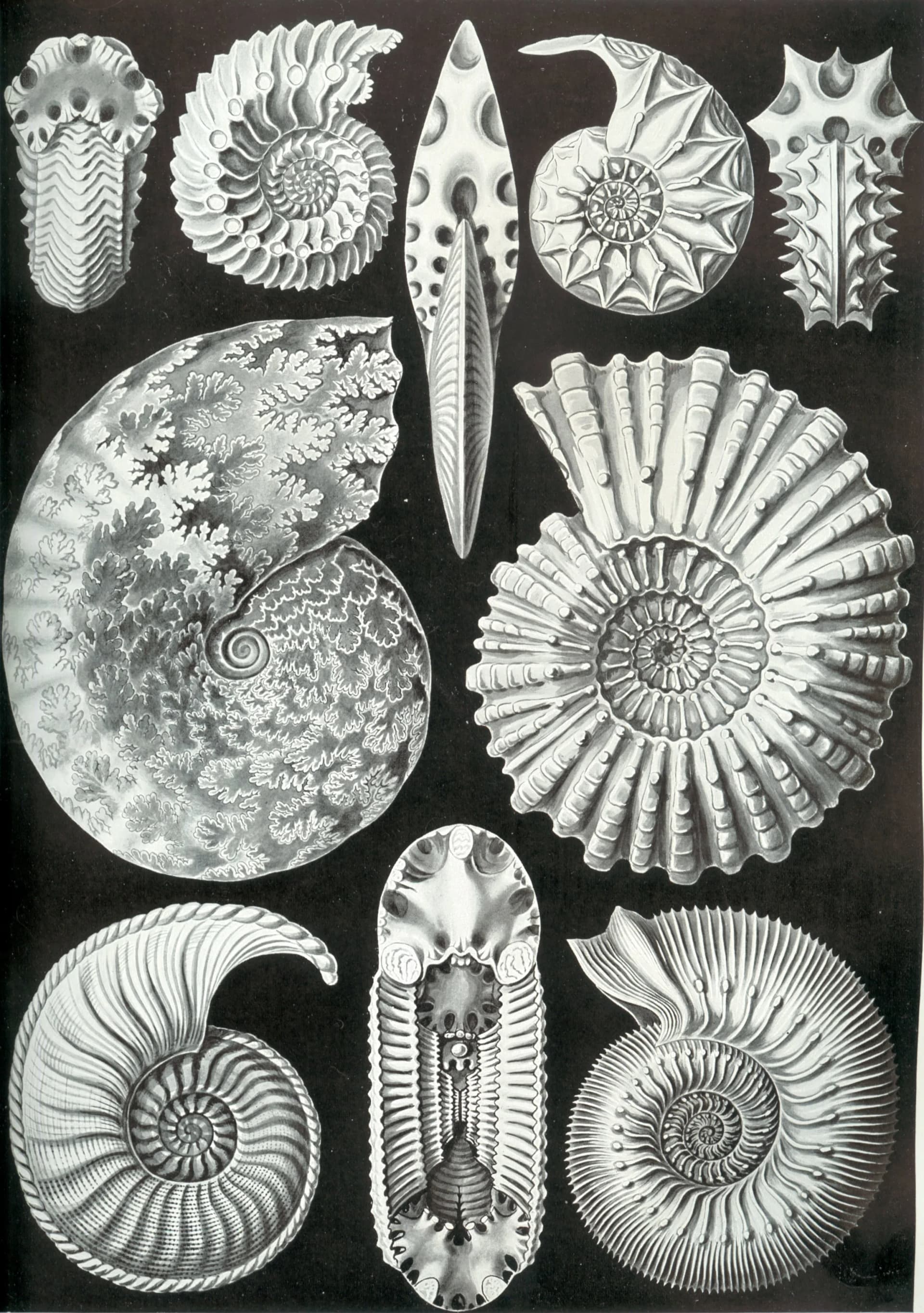
Illustration of various ammonite species by Ernst Haeckel
Ernst Haeckel, Public domain, via Wikimedia Commons
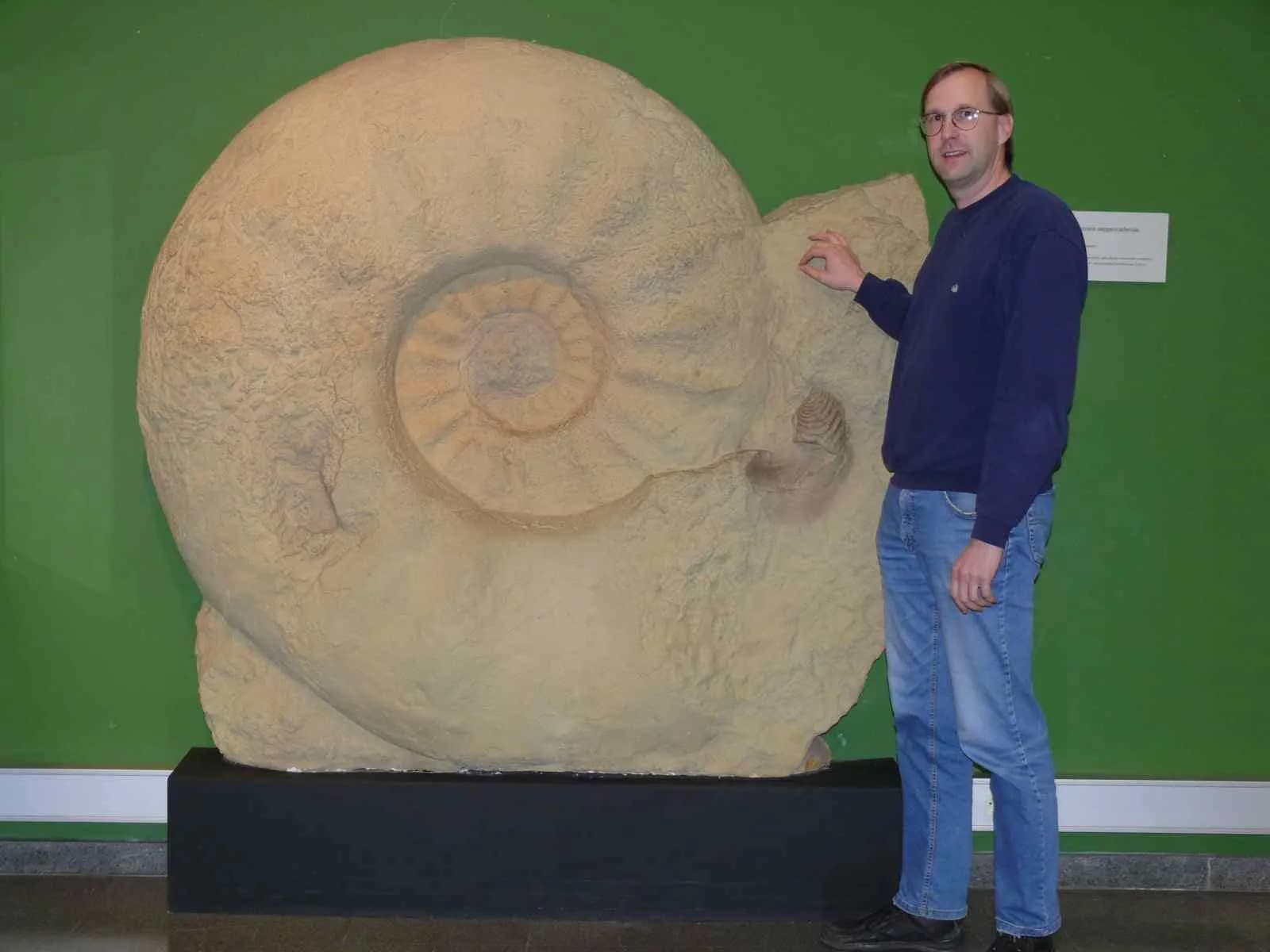
Giant fossil of Parapuzosia seppenradensis, the largest known ammonite
Gunnar Ries, CC BY-SA 2.5, via Wikimedia Commons