Thalassomedon
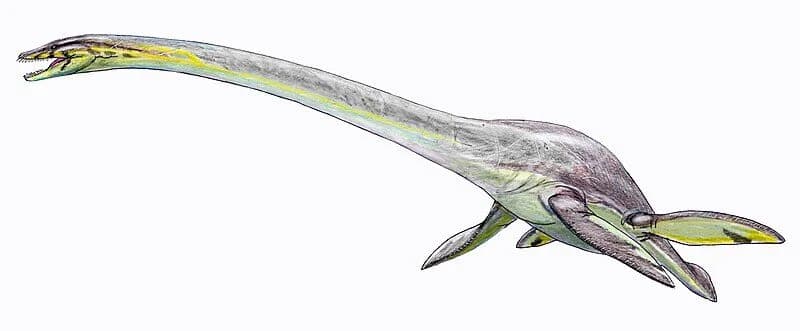
Thalassomedon haningtoni carried a 6-metre neck, half its total length, supported by sixty-two cervical vertebrae. This plesiosaur, 12 metres long and 3 to 5 tonnes, hunted around 95 million years ago in the inland sea that then split North America in two. Its name means « lord of the sea » in ancient Greek.
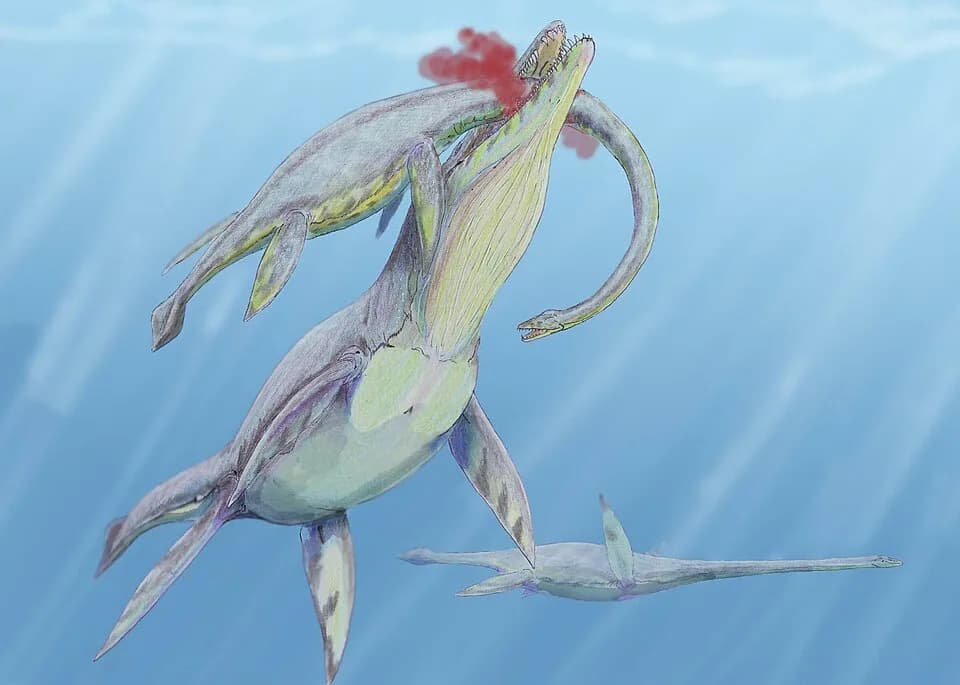
Thalassomedon haningtoni lived during the Late Cretaceous, approximately 95 million years ago, during the Cenomanian age. This long-necked elasmosaurid plesiosaur is one of the largest representatives of its family, swimming in the Western Interior Seaway that divided North America in two during the Cretaceous. Its name means 'lord of the sea' (Greek: thalassa 'sea' + medon 'lord'), a well-deserved title for this marine giant. Thalassomedon belongs to the elasmosaurids, the plesiosaur family characterized by an extremely elongated neck with a record number of cervical vertebrae. It coexisted with a diverse marine fauna including primitive mosasaurs, sharks, giant fish such as Xiphactinus, and other marine reptiles.
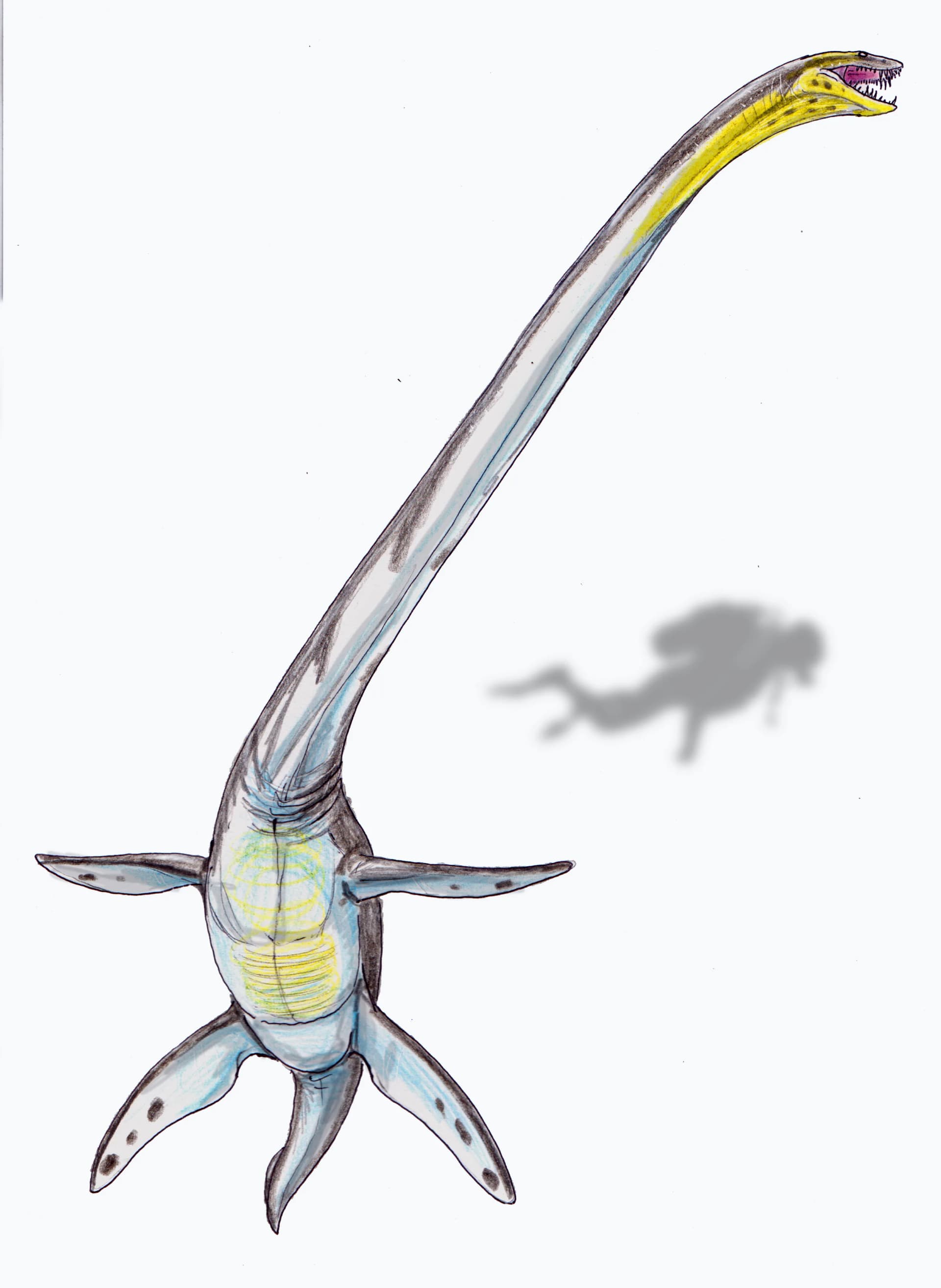
Thalassomedon was one of the largest known elasmosaurids, with an estimated total length of about 12 meters. Its most spectacular feature was its extraordinarily long neck measuring about 6 meters — half the total body length. This neck contained 62 cervical vertebrae, one of the highest counts among all plesiosaurs. The skull was relatively small compared to the body, measuring about 47 centimeters, with long, thin teeth adapted for catching fish. The trunk was compact and wide, housing the vital organs and powerful flipper muscles. The four flippers were broad and powerful, each measuring approximately 1.5 to 2 meters long. Its estimated weight was between 3 and 5 tonnes. Gastroliths (stomach stones) found with fossils may have served as ballast for buoyancy regulation.
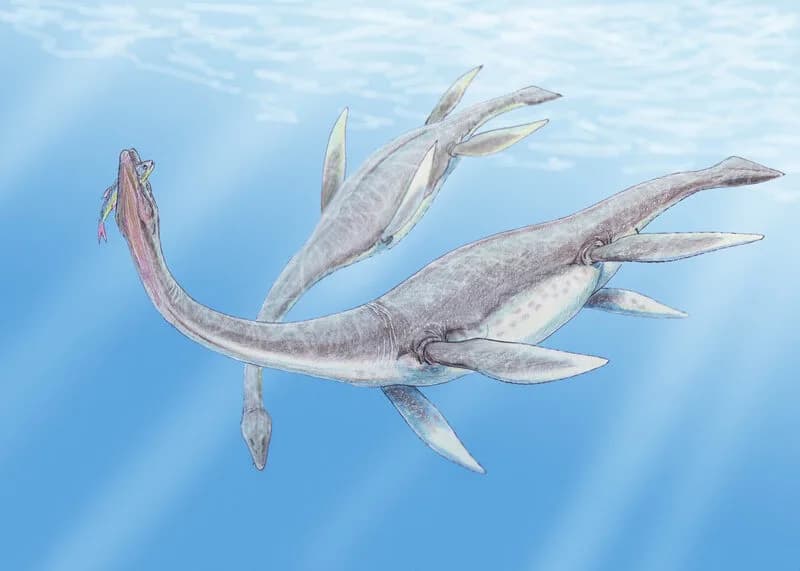
Thalassomedon was a specialized piscivore, using its extraordinarily long neck as a mobile trap for catching fish. Its long, thin, pointed teeth interlocked when the jaws closed, forming an ideal cage for trapping slippery fish and cephalopods. The remarkable length of its neck allowed it to approach fish schools stealthily without its massive body scaring them away: the small skull at the end of the neck could penetrate into a fish school while the body remained at a safe distance. Gastroliths (polished stomach stones) found in association with fossils suggest they served either as ballast for buoyancy regulation or as digestive aids to grind fish bones and cephalopod shells.
Thalassomedon lived in the Western Interior Seaway, a vast epicontinental sea that divided North America in two during the Cretaceous. This sea extended from the Gulf of Mexico to the Arctic Ocean, reaching a maximum width of about 1,000 kilometers and an average depth of 200 to 300 meters. The waters were warm and nutrient-rich, supporting exceptional marine biodiversity. Thalassomedon fossils come primarily from Colorado and Kansas, in sediments of the Graneros Formation and associated formations. It shared its habitat with primitive mosasaurs, the giant fish Xiphactinus (5 meters), sharks, sea turtles, and other plesiosaurs. The seafloor was carpeted with abundant invertebrate life that sustained the food chain.
Thalassomedon anatomy was dominated by its spectacular neck, one of the longest in all of animal history. The 62 cervical vertebrae were individually shorter than in short-necked animals, but their exceptional number produced a total neck length of 6 meters. Each cervical vertebra articulated with the next via flat surfaces allowing moderate flexibility, enabling the neck to bend laterally and vertically but without the flexibility of a snake. The skull was small and light, with large orbits indicating good vision and a rostrum lined with long, sharp teeth. The trunk was wide and rigid, with ribs forming a robust rib cage. Gastroliths — polished stones found in the abdominal region — were probably intentionally swallowed to serve as ballast for buoyancy control.
Thalassomedon behavior is reconstructed from its functional anatomy and by comparison with better-documented elasmosaurids. The central question is how it used its extraordinary neck. The most accepted hypothesis is the 'stealth trap': Thalassomedon swam slowly beneath a fish school, using its long neck to project its small head into the school from below, the fish not perceiving the danger because the massive body remained far away. Rapid neck movements, combined with the element of surprise, allowed it to capture fish individually. Another hypothesis proposes that the neck swept laterally through fish schools. Reproduction likely involved viviparity, as suggested by plesiosaur fossils preserving in utero embryos.
Thalassomedon was described in 1943 by American paleontologist Samuel Welles from fossils discovered in Baca County, Colorado. The name means 'lord of the sea' (Greek: thalassa 'sea' + medon 'lord, master'), and the species was named in honor of Wesley Hanington. The holotype specimen, housed at the Denver Museum of Nature and Science, comprises a remarkably complete skeleton including the skull, most of the vertebral column, and flipper elements. Polished gastroliths were found in the abdominal cavity of the specimen. Other specimens attributed to Thalassomedon or related forms come from Kansas and other Great Plains states. The Denver Museum displays a mounted skeleton reconstruction that impresses visitors with its spectacular neck length.
| Period | Crétacé supérieur / Late Cretaceous |
| Era | Mésozoïque / Mesozoic |
| Age | ~95 Ma |
| Location | Amérique du Nord (Colorado, Kansas) / North America (Colorado, Kansas) |
| Length | 12 m |
| Height | ~2 m |
| Weight | 3-5 tonnes |
| Diet | Piscivore |
| Discovery | 1939 |
No. Thalassomedon haningtoni was an elasmosaurid plesiosaur — a Late Cretaceous marine reptile (95 Ma) belonging to the order Plesiosauria, an entirely distinct lineage from dinosaurs. Plesiosaurs evolved independently and coexisted with dinosaurs without being related to them. Thalassomedon swam in the Western Interior Seaway that divided North America into two continents.
Thalassomedon haningtoni had 62 cervical vertebrae — one of the highest counts among plesiosaurs — for a 6-meter neck representing half its total 12-meter length. The most accepted hypothesis is the 'stealth trap': it swam slowly beneath fish schools and projected its small head (47 cm) into the school while its massive body remained at a safe distance, fish failing to perceive the danger.
Gastroliths (polished stones collectively weighing several kilograms) were found in the abdominal cavity of the Thalassomedon haningtoni holotype, housed at the Denver Museum of Nature and Science. Two main hypotheses coexist: these stones served as ballast to regulate buoyancy and maintain the animal at an optimal hunting depth, or as digestive aids to grind fish bones and ammonite shells in the stomach.
Thalassomedon, a long-necked plesiosaur
Wikimedia Commons
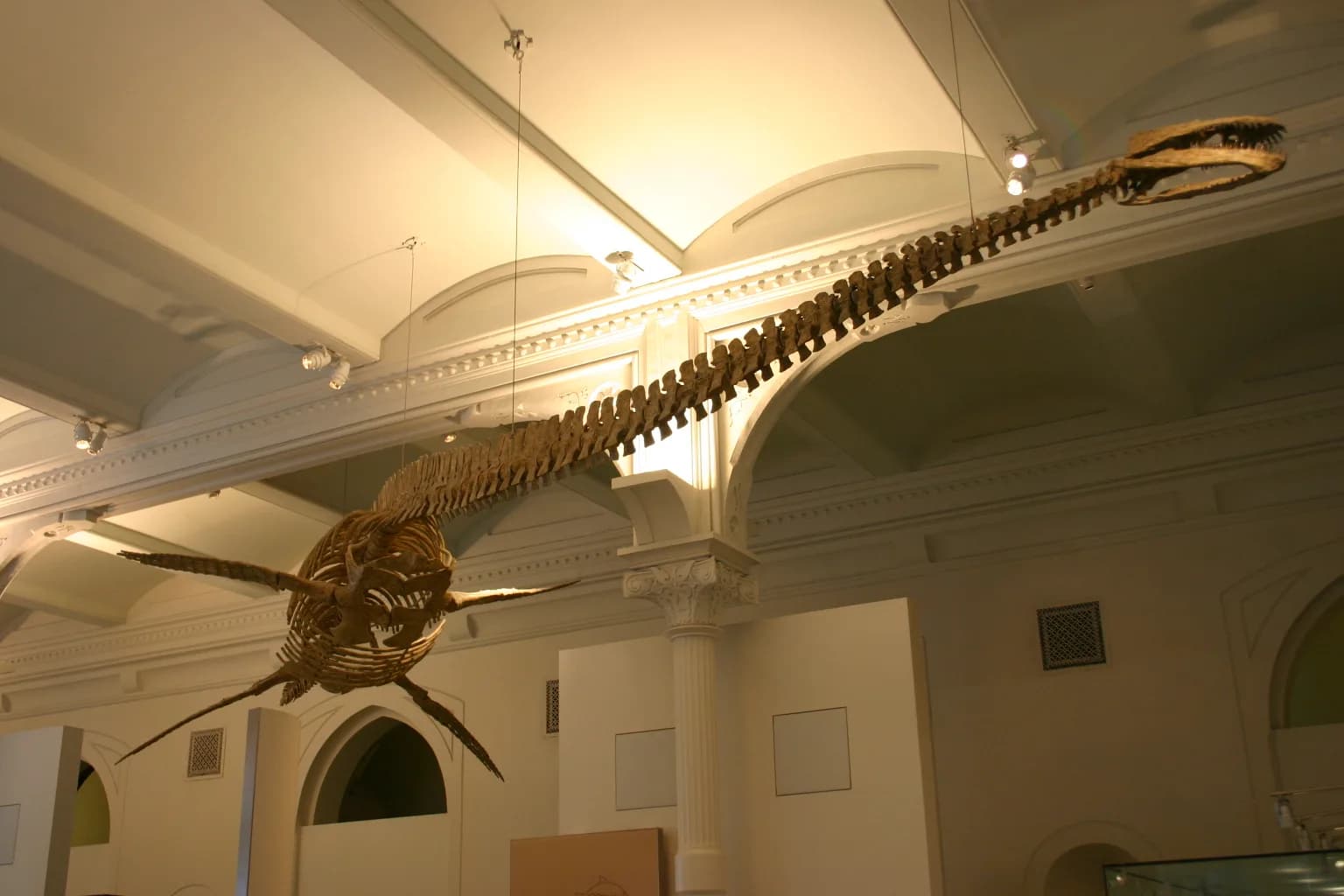
Thalassomedon haningtoni, a giant of the Cretaceous seas
Wikimedia Commons