Albertacératops
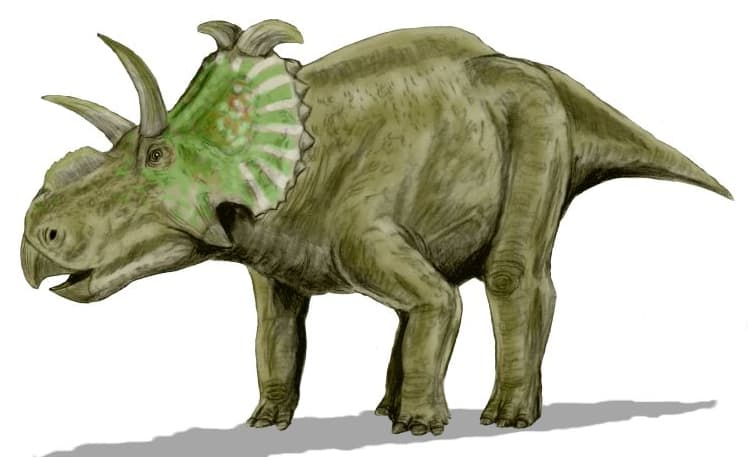
Albertaceratops nesmoi was a herbivorous ceratopsian from Alberta, described in 2007 and dated to around 77.5 million years ago. At 5.8 metres and 3 to 3.5 tonnes, it is a centrosaurine with long brow horns — a trait normally reserved for ceratopsines such as Triceratops. Its species name honours Cecil Nesmo, the Alberta rancher whose land held the site.
Playable in Path of Titans
See Albertaceratops nesmoi's stats, abilities and role on our survival server.
Albertaceratops nesmoi lived in the Late Cretaceous, during the Campanian stage, approximately 77.5 million years ago. This period corresponds to the peak diversification of ceratopsids in North America, a continent then split into two landmasses by the Bearpaw Seaway. Campanian Alberta was a warm, humid coastal plain drained by countless rivers winding toward this epicontinental sea, providing highly productive habitats for large herbivores. Albertaceratops shared its ecosystems with a diverse fauna including hadrosaurs, ankylosaurs, and the earliest large tyrannosaurs of the Laramidia subcontinent.
The species was described in 2007 by paleontologist Michael J. Ryan, based on a nearly complete skull excavated from the Oldman Formation in Alberta, Canada. The holotype specimen (CMN 57081) had been spotted years earlier during fieldwork in the province's badlands. Ryan placed the genus within Centrosaurinae, inside the large family Ceratopsidae, noting from the outset the unusual morphological combination of its cranial ornaments. The specific epithet 'nesmoi' honors Cecil Nesmo, an Alberta rancher whose land facilitated access to the region's fossil deposits. The original description appeared in the Journal of Paleontology and immediately sparked debate in the scientific community regarding the genus's exact phylogenetic position.
Albertaceratops reached approximately 5.8 meters in length with an estimated mass between 3,000 and 3,500 kilograms, making it a medium-to-large ceratopsid for its group. Its robust build and massive skull, characteristic of ceratopsids, accounted for a significant proportion of its total body mass. The bony neck frill was moderately sized compared to more derived relatives like Styracosaurus, but bore characteristic curved spines along its upper margin. Its forelimbs, shorter than the hindlimbs, gave it a slightly forward-leaning posture typical of heavy ceratopsids, well-suited for grazing low vegetation.
An exclusive herbivore, Albertaceratops fed on the dense vegetation of Campanian coastal plains, including ferns, primitive palms, cycads, and the flowering plants (angiosperms) then undergoing rapid diversification. Its very robust, parrot-shaped horn-covered beak allowed it to sever woody stems and tough leaves that few other herbivores could process. Teeth arranged in continuously replacing batteries efficiently ground highly fibrous plant material. The low position of its head and the robustness of its neck suggest a preference for low to medium vegetation, between ground level and approximately one meter high.
The Oldman Formation of Alberta, from which Albertaceratops remains were excavated, represents an environment of subtropical to tropical humid alluvial plains dotted with river meanders, marshy zones, and gallery forests. During the Campanian, present-day Alberta's latitude was around 55–60° north, but globally much warmer temperatures created a mild climate without severe winter frost. Oldman Formation sedimentary deposits record fluvial depositional cycles, with alternating sand and clay beds reflecting rivers with variable regimes. This type of habitat, rich in vegetation and permanent water, supported high densities of herbivores and, consequently, predators such as Gorgosaurus.
The most remarkable anatomical feature of Albertaceratops is the combination, unique among primitive Centrosaurinae, of two well-developed elongated supraorbital horns (above the eyes). In most centrosaurines, orbital horns are reduced or absent, with the nasal horn being the dominant ornament — the opposite of derived ceratopsines like Triceratops. Albertaceratops thus possesses frontal horns comparable to those of a ceratopsine, constituting an unusual evolutionary mosaic. Its nasal horn is short and widened at the base, flanked by a prominent nasal osseous spur forming a characteristic ridge. The frill bears along its upper margin curved hooks (epiparietal and squamosal ossifications) recurved backward and downward, an arrangement unique to the genus. These multiple ornaments suggest active sexual selection, with individuals using skull appearance to signal status or attract mates.
Like the vast majority of ceratopsids, Albertaceratops was likely a gregarious animal living in herds of varying size depending on season and resource availability. Bone beds from the Oldman Formation and neighboring formations show that dozens of individuals could die together, probably during river crossings during floods or during droughts concentrating animals around the last water sources. The diversity and complexity of its cranial ornaments — long frontal horns, nasal spur, frill spines — suggest developed visual communication within the group, allowing intraspecific recognition, social hierarchy, and sexual display. Ritualized combat between males, comparable to that of modern cervids, could have mobilized the horns for frontal clashes or lateral pushing. Its heavy gait and imposing morphology offered passive protection against predators, and a healthy adult represented a difficult prey item for any tyrannosaur of its time.
Albertaceratops belongs to the order Ornithischia, the clade Ceratopsia, the family Ceratopsidae, and the subfamily Centrosaurinae. Within Centrosaurinae, it is considered a basal or near-basal member of the clade, making it a valuable representative for understanding the early stages of this group's diversification. Successive phylogenetic analyses since 2007 have generally confirmed its centrosaurine position, though some analyses placed it in slightly different positions depending on included characters. Its mixture of primitive traits (basal phylogenetic position) and derived traits (long orbital horns resembling ceratopsines) illustrates the concept of evolutionary mosaic, where different body parts evolve at distinct rates. The close relationship with Medusaceratops lokii, described in 2010 from the same stratigraphic region, raises questions about the boundaries between these two genera.
Albertaceratops's phylogenetic position within Centrosaurinae makes it a pivotal genus for understanding the divergence between Centrosaurinae and Ceratopsinae. Centrosaurus apertus, the reference centrosaurine, possesses a dominant nasal horn and very reduced orbital horns — the exact opposite of Albertaceratops. Pachyrhinosaurus, a more derived and geographically close centrosaurine, has completely lost horns in favor of massive bony rugosities (a flat rostrum). Compared to ceratopsines like Triceratops or Chasmosaurus, Albertaceratops shares the length of orbital horns but differs in having a shorter, less elaborate frill. This genus thus illustrates that large frontal horns are not exclusive to ceratopsines and may have evolved convergently or represent a more widespread ancestral state than previously thought.
Fossil material of Albertaceratops is limited to a few specimens, including the holotype — a nearly complete skull housed at the Canadian Museum of Nature in Ottawa (specimen CMN 57081). Fragments attributed to this genus have been reported from other Oldman Formation localities and potentially from adjacent formations in Montana (USA), suggesting a broader distribution than Alberta alone. The Oldman Formation is stratigraphically well-documented, allowing precise dating of deposits through intercalated volcanic ash layers (bentonites). The Royal Tyrrell Museum of Palaeontology in Drumheller, Alberta, also holds reference material and displays skull reconstructions. The relative scarcity of Albertaceratops fossils compared to cousins like Centrosaurus (known from thousands of specimens) is likely due to preservation biases and lower prospecting intensity at corresponding stratigraphic levels.
Albertaceratops is relatively little known to the general public compared to iconic ceratopsids like Triceratops or Styracosaurus, but it has gained increasing recognition in amateur paleontology circles since its 2007 description. Several Canadian and American museums include reproductions or casts of its skull in their galleries dedicated to Cretaceous dinosaurs of North America. Its unusual morphology — bridging characteristics of the two major ceratopsid subfamilies — makes it an instructive subject for illustrating the complexity of cranial ornament evolution in horned dinosaurs. Artistic reconstructions by Nobu Tamura and other scientific illustrators have helped spread an accurate image of the animal among paleontology enthusiasts.
| Period | Crétacé supérieur / Late Cretaceous |
| Era | Mésozoïque / Mesozoic |
| Age | ~77,5 Ma |
| Location | Amérique du Nord / North America (Alberta, Canada) |
| Length | ~5,8 m |
| Height | ~2 m |
| Weight | 3 000–3 500 kg |
| Diet | Herbivore |
| Discovery | 2007 |
Albertaceratops nesmoi, described in 2007 by Michael Ryan, is unique among primitive Centrosaurinae for its two well-developed elongated supraorbital horns — a trait normally associated with ceratopsines like Triceratops. Most centrosaurines have a dominant nasal horn and reduced orbital horns. This evolutionary mosaic, on a ~5.8 m, 3,000-3,500 kg specimen, illustrates how horns can evolve convergently in distinct lineages.
Most likely yes. Bone beds from Alberta's Oldman Formation show dozens of individuals dying together, suggesting gregarious behavior among ceratopsids of this Campanian region (~77.5 Ma). The complexity of Albertaceratops nesmoi cranial ornaments — frontal horns, nasal spur, frill spines — indicates developed visual communication within the group for hierarchy and sexual display.
The Albertaceratops nesmoi holotype (CMN 57081), a nearly complete skull, is housed at the Canadian Museum of Nature in Ottawa. It was excavated from Alberta's Oldman Formation and described in 2007 by paleontologist Michael J. Ryan in the Journal of Paleontology. The epithet 'nesmoi' honors Cecil Nesmo, the Alberta rancher whose land gave access to fossil deposits.
Information on this page is based on peer-reviewed scientific publications.
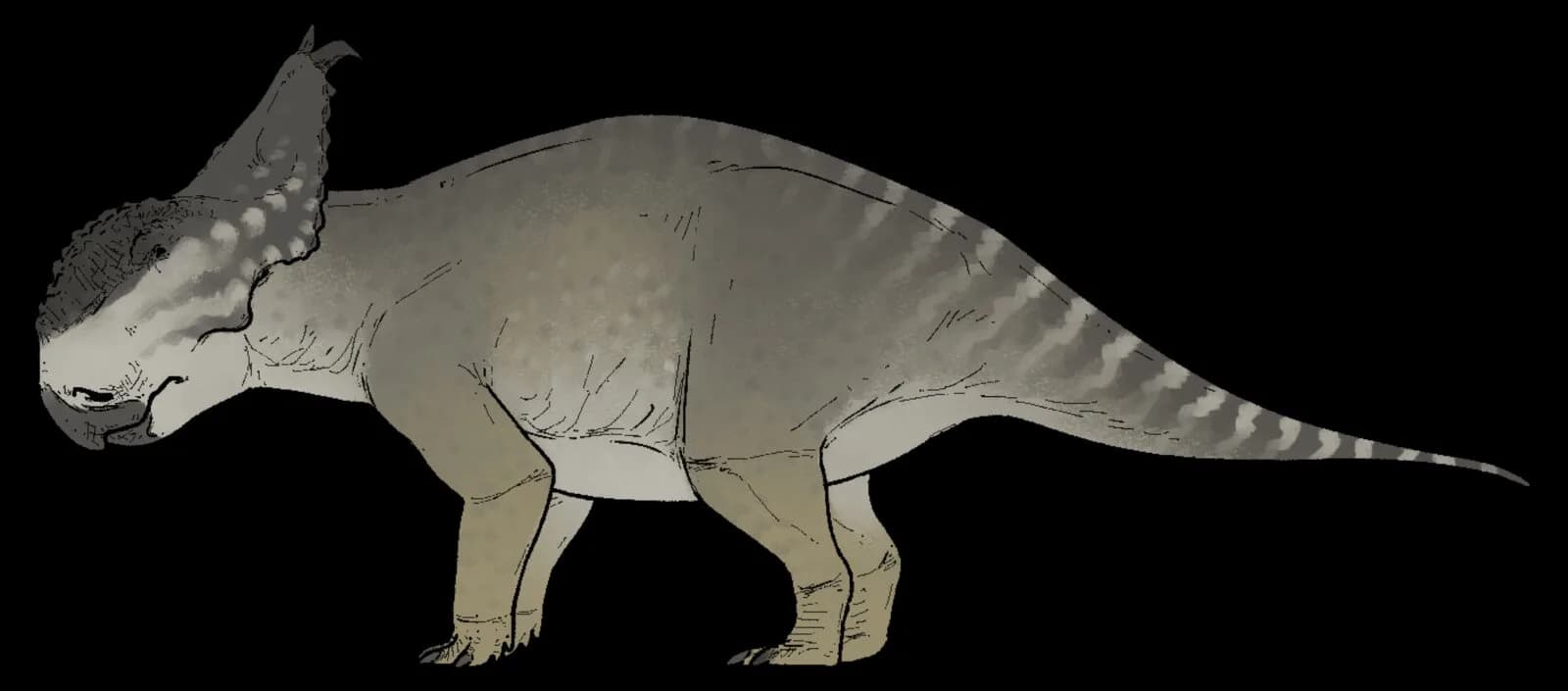
Life reconstruction of Albertaceratops nesmoi
Nobu Tamura, CC BY 2.5, via Wikimedia Commons
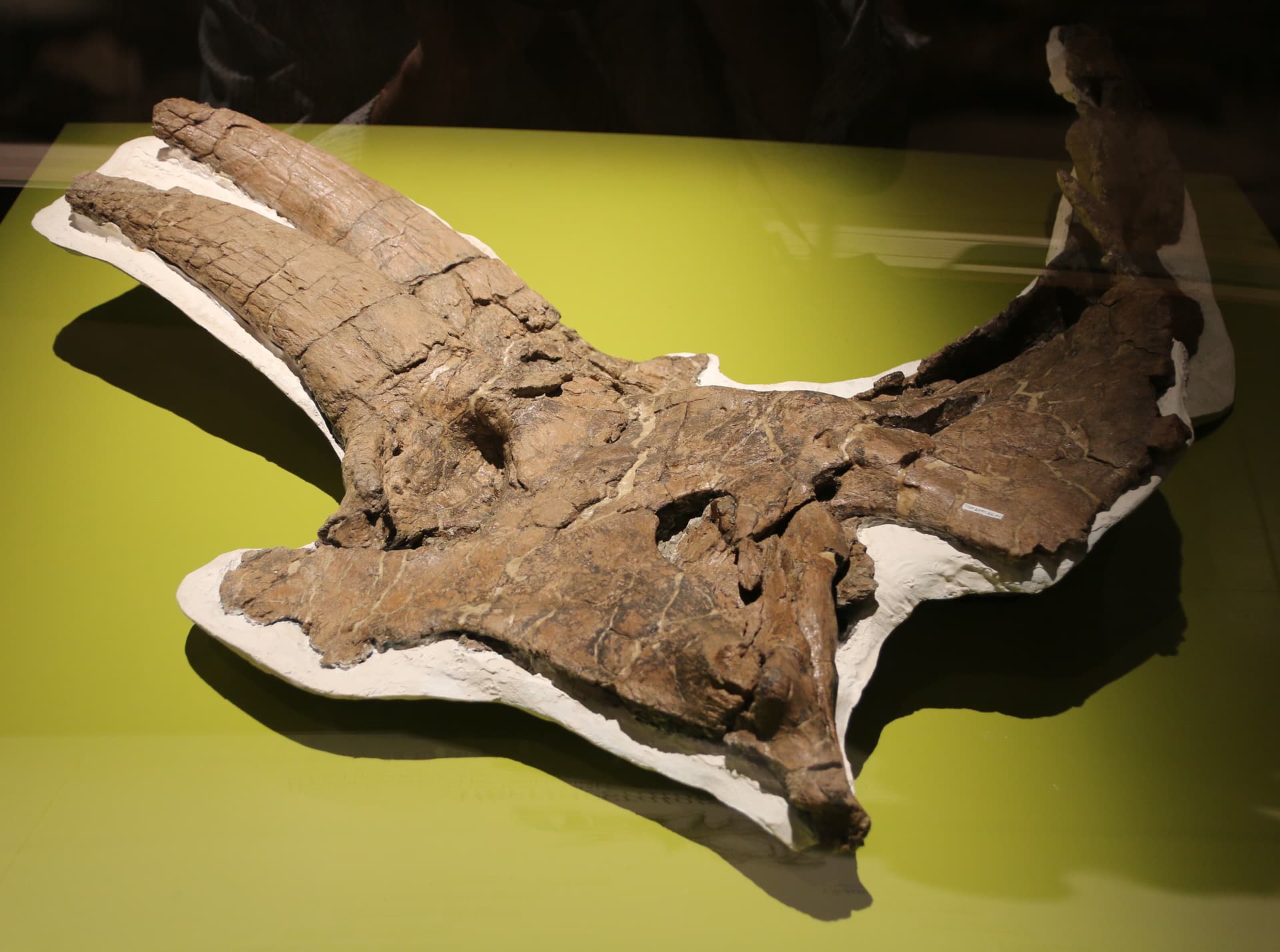
Albertaceratops nesmoi skull, photograph by Nick Longrich
NickLongrich, CC BY-SA 4.0, via Wikimedia Commons