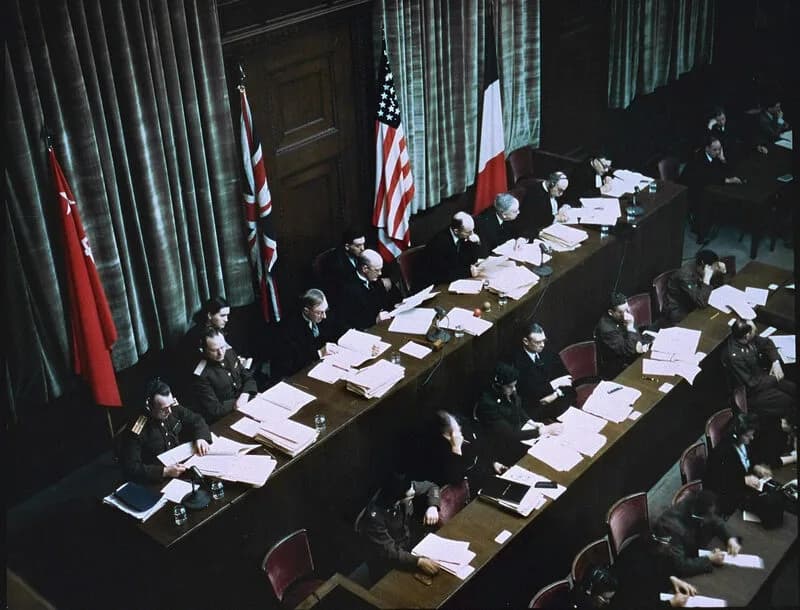
The Nuremberg Trials constituted the first international military tribunal in history, judging the principal Nazi leaders for war crimes, crimes against humanity, and crimes against peace. Twelve defendants were sentenced to death, establishing the fundamental principle that individuals are responsible for their actions even when obeying superior orders.
The idea of trying Nazi leaders emerged progressively during the war. As early as 1942, Allied governments created the United Nations War Crimes Commission. The Moscow Declaration of October 1943, signed by Roosevelt, Churchill, and Stalin, announced that war criminals would be tried in the countries where they committed their crimes, while 'major criminals' whose acts had no precise geographical location would be tried by an international tribunal. Churchill initially preferred summary execution of the principal Nazi leaders, but the Americans and Soviets insisted on a formal trial. US Secretary of War Henry Stimson and prosecutor Robert H. Jackson argued for a trial that would establish a historic legal precedent. The London Charter, signed on August 8, 1945, by the four Allied powers (United States, United Kingdom, USSR, France), created the International Military Tribunal and defined four charges: conspiracy, crimes against peace, war crimes, and crimes against humanity — this last category being a major legal innovation. Nuremberg was chosen as the trial venue for its symbolic value (the city of great Nazi rallies) and because its Palace of Justice was one of the few buildings still standing in Germany.
The trial opened on November 20, 1945, before a tribunal composed of four principal judges and four alternates representing the four Allied powers. British judge Geoffrey Lawrence presided over the proceedings. Twenty-four defendants were indicted, representing the political, military, economic, and ideological spheres of the Nazi regime. Among the most notable: Hermann Göring (the Reich's number two), Rudolf Hess (Hitler's deputy), Joachim von Ribbentrop (Foreign Minister), Albert Speer (Armaments Minister), Wilhelm Keitel and Alfred Jodl (military chiefs). Chief American prosecutor Robert H. Jackson delivered a masterful opening statement, declaring that 'the real complaining party at your bar is Civilization.' The prosecution relied on a mountain of documentary evidence — the Nazis having meticulously archived their own crimes. Films from concentration camps, screened in the courtroom, shocked the entire world. The trial lasted 218 session days, during which 236 witnesses were heard and 300,000 sworn statements were collected. Defense strategies varied: some defendants pleaded ignorance, others invoked obedience to superior orders, Göring defended the regime with arrogance, while Speer admitted partial responsibility. On October 1, 1946, the tribunal delivered its verdict: twelve death sentences by hanging, three acquittals, three life imprisonment sentences, and four prison terms.
The executions took place on October 16, 1946, in the gymnasium of the Nuremberg prison. Ten of the twelve death sentences were carried out by hanging; Göring committed suicide by swallowing a cyanide capsule hours before his execution, and Martin Bormann was sentenced in absentia (his body was not identified until 1972). The bodies were cremated and the ashes scattered in the Isar River to prevent the creation of any Nazi pilgrimage site. The Nuremberg Trials were followed by twelve subsequent trials (the Subsequent Nuremberg Trials, 1946-1949) judging doctors (the Doctors' Trial), jurists, industrialists (Krupp, IG Farben), officers (Einsatzgruppen), and senior officials. These trials established the 'Nuremberg Code' on medical ethics, prohibiting experimentation on human subjects without consent. The Nuremberg Principles, adopted by the UN International Law Commission in 1950, established that international crimes engage individual responsibility and that obedience to orders does not constitute a valid defense. These principles founded modern international criminal law and led to the creation of the International Criminal Tribunal for the former Yugoslavia (1993), for Rwanda (1994), and finally the permanent International Criminal Court at The Hague (2002).
The Nuremberg Trials represent a founding moment of international law, but they are not free from criticism. The principal objection is that of 'victors' justice': the judges and prosecutors exclusively represented the victorious powers, and certain comparable crimes committed by the Allies — area bombing of German cities, the atomic bombs on Hiroshima and Nagasaki, the Soviet Katyn massacre — were not examined. The presence of a Soviet judge was particularly problematic, as Stalin's USSR had committed mass crimes comparable to those being judged. The principle of non-retroactivity of law was also contested: the defendants were tried for crimes — notably 'crimes against humanity' — that were not legally defined at the time of their commission. Defenders of the trials respond that the acts judged were clearly contrary to existing international law (The Hague and Geneva Conventions) and to fundamental principles of human conscience. Judge Jackson acknowledged that 'the extent to which these nations submit to the rule of reason rather than the rule of force will determine whether we shall have peace.' Despite these imperfections, Nuremberg established the essential precedent that political and military leaders are not above international law, a principle that continues to shape the global legal order.
The Nuremberg Trials are among the best-documented events in history. The complete trial transcripts, published in 42 volumes as 'Trial of the Major War Criminals before the International Military Tribunal,' are accessible online. The diary of American psychologist Gustave Gilbert, who conversed daily with the defendants, offers a remarkable insight into their psychology ('Nuremberg Diary,' 1947). Prosecutor Telford Taylor's memoirs ('The Anatomy of the Nuremberg Trials') constitute an indispensable legal reference. The documentary film 'The Last Days of Nuremberg' and the filmed trial archives preserve an extraordinary visual testimony. The Nuremberg Memorial, inaugurated in the very Palace of Justice where the trials were held, welcomes 100,000 visitors annually. Harvard University and the US Holocaust Memorial Museum archives hold major collections. French historian Annette Wieviorka's 'Le Procès de Nuremberg' and Joseph Persico's 'Nuremberg: Infamy on Trial' offer accessible and rigorous syntheses. The US National Archives have digitized thousands of original trial documents.
The Nuremberg Trials ran from November 20, 1945, to October 1, 1946, before the International Military Tribunal. Twenty-four Nazi leaders were indicted; the tribunal delivered twelve death sentences by hanging, including Hermann Göring and Joachim von Ribbentrop, three life sentences, four prison terms, and three acquittals.
The Nuremberg Trials established that individuals are personally responsible for their actions even when following superior orders. The Nuremberg Principles, adopted by the UN International Law Commission in 1950, founded modern international criminal law and led to the creation of the International Criminal Court at The Hague in 2002.
Nuremberg was chosen for its symbolic value: it was the city of great Nazi rallies where the regime had staged its power. Its Palace of Justice was one of the few buildings still standing in Germany. Judging the regime's crimes in the very city of its celebrations gave the tribunal additional political and moral resonance.
Information cross-checked against Wikipedia and reference historical works.
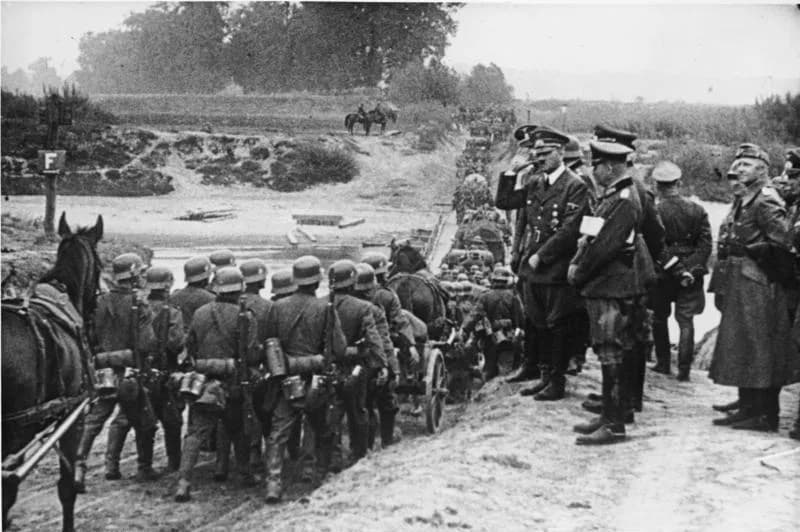
Invasion of Poland
The invasion of Poland by Nazi Germany on 1 September 1939 triggered World War II. In barely five weeks, German and then Soviet forces crushed the Polish army, applying the Blitzkrieg doctrine on a large scale for the first time. Britain and France declared war on 3 September.
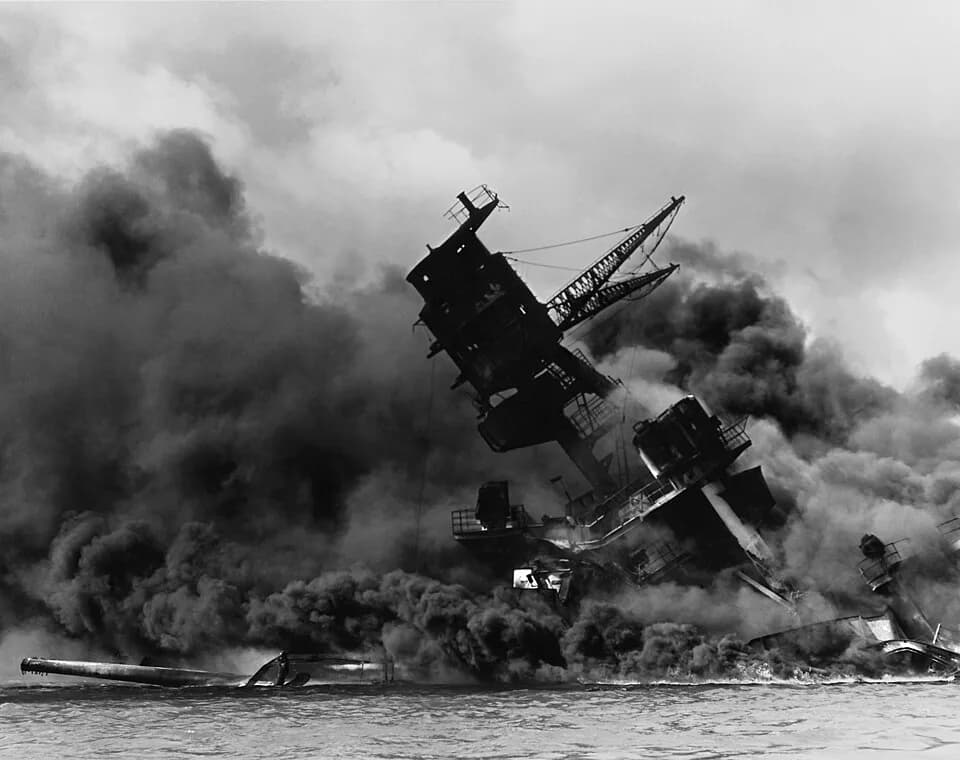
Attack on Pearl Harbor
The surprise Japanese attack on the American naval base at Pearl Harbor on December 7, 1941 triggered the United States' entry into the war. This event transformed an essentially European conflict into a true world war and ultimately sealed the fate of the Axis powers.
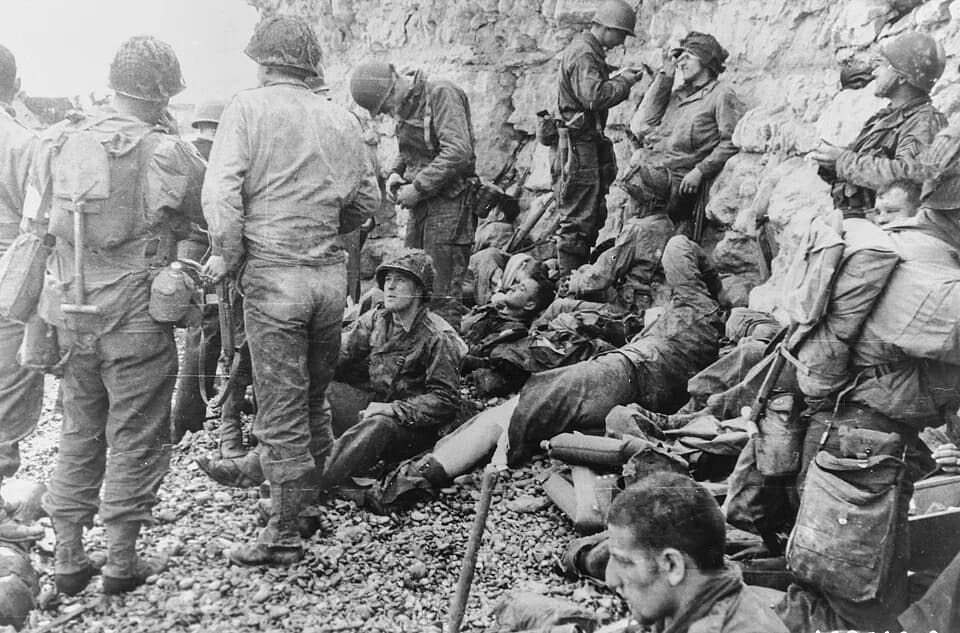
D-Day — Normandy Landings
On June 6, 1944, the largest amphibious operation in history landed 156,000 Allied soldiers on the beaches of Normandy. D-Day opened a second front in Western Europe and marked the beginning of the liberation of France and Western Europe from Nazi rule.
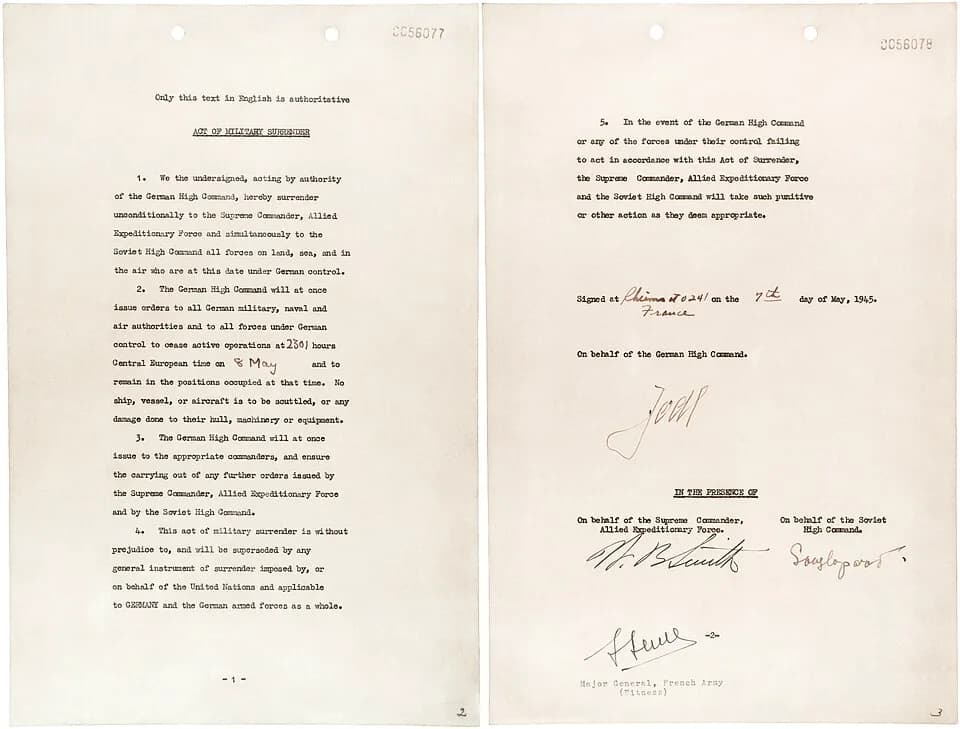
Surrender of Germany
On May 8, 1945, Nazi Germany surrendered unconditionally, ending the war in Europe after nearly six years of conflict. This event, celebrated as Victory in Europe Day (V-E Day), marked the fall of the Third Reich and the beginning of a new geopolitical era.
