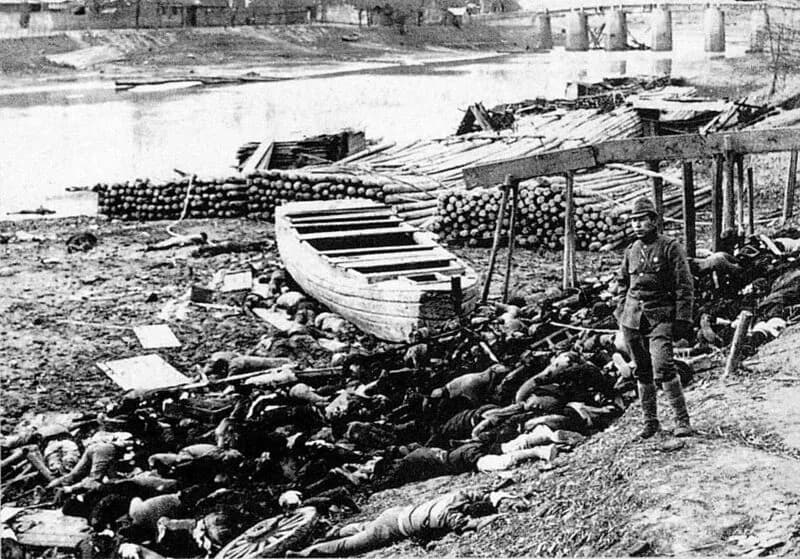
The Nanjing Massacre, also known as the 'Rape of Nanking,' is one of the worst war crimes of the 20th century. After the Imperial Japanese Army captured the Chinese capital in December 1937, Japanese soldiers committed six weeks of systematic atrocities — mass murder, rape, and looting — killing between 200,000 and 300,000 civilians and prisoners of war.
The Second Sino-Japanese War, erupting in July 1937 with the Marco Polo Bridge Incident, represented one of the most devastating conflicts in Asian history. Imperial Japan, engaged in a policy of continental expansion since the invasion of Manchuria in 1931, sought to subjugate China through a rapid war. The Battle of Shanghai (August-November 1937) was a fierce three-month fight where Chiang Kai-shek's best Chinese divisions were decimated against Japanese air and naval superiority. Approximately 250,000 Chinese and 40,000 Japanese soldiers were killed or wounded. The brutality of Chinese resistance at Shanghai enraged the Japanese command and troops, creating a desire for revenge that would manifest at Nanjing. After Shanghai's fall, the Japanese army marched on Nanjing, capital of the Chinese Nationalist government. Chiang Kai-shek evacuated the government to Chongqing in the interior. General Tang Shengzhi was ordered to defend Nanjing with approximately 100,000 poorly equipped and demoralized soldiers. The city, surrounded on three sides by the Japanese and backed against the Yangtze River, was in a strategically indefensible position.
On December 13, 1937, the Imperial Japanese Army entered Nanjing after General Tang ordered a chaotic retreat. What followed was six weeks of systematic horror. Japanese soldiers carried out mass executions of prisoners of war and male civilians suspected of being disguised soldiers. Groups of hundreds, even thousands of prisoners were lined up along the Yangtze River and machine-gunned, or used for bayonet practice. Execution methods included beheading, live burial, and forced drowning. Rape was systematic and of terrifying scale: between 20,000 and 80,000 women and girls, from ages 7 to 70, were raped, often by groups, then frequently murdered. Prince Yasuhiko Asaka, uncle of Emperor Hirohito and commander of the Nanjing offensive, bore direct responsibility. Japanese officers organized beheading contests reported by the Japanese press itself. The International Safety Zone, established by Western residents under the leadership of German businessman John Rabe (a Nazi Party member who used his status to protect Chinese), saved approximately 250,000 civilians. Rabe, dubbed the 'Chinese Schindler,' risked his life by physically interposing himself before Japanese soldiers.
The exact death toll of the Nanjing Massacre remains debated, but estimates converge between 200,000 and 300,000 dead. The International Military Tribunal for the Far East (Tokyo Tribunal, 1946-1948) accepted the figure of 200,000 murdered civilians and 20,000 cases of rape. General Matsui Iwane, commander of the Central China Expeditionary Force, was sentenced to death and executed for his responsibility in the atrocities, although he belatedly attempted to restore order. Prince Asaka, protected by his status as a member of the imperial family, was never prosecuted — General MacArthur granted immunity to the imperial family as part of the American occupation of Japan. The massacre had immediate diplomatic repercussions: world public opinion, informed by Western journalists and diplomats present in Nanjing, turned against Japan. The United States began hardening its position toward Tokyo, a process that would lead to the 1941 oil embargo and, ultimately, to Pearl Harbor. The trauma of Nanjing remains an open wound in Sino-Japanese relations. Every year on December 13, China commemorates the massacre during the National Memorial Day, and the Nanjing Massacre Memorial, inaugurated in 1985 and expanded in 2007, receives millions of visitors.
The Nanjing Massacre raises fundamental questions about the nature of mass violence and responsibility in wartime. Several factors explain — without excusing — Japanese brutality. The Imperial Army cultivated a military culture founded on contempt for prisoners of war (the bushido code considered surrender the ultimate dishonor), systematic dehumanization of the Chinese enemy in propaganda, and a paradoxically brutal discipline toward its own soldiers. The rage accumulated during Chinese resistance at Shanghai, ambiguous orders from command, and the absence of sanctions against initial atrocities created an environment where violence became self-perpetuating. The question of Emperor Hirohito's responsibility remains controversial: some historians believe he was informed and tacitly approving, others that he was isolated by his staff. Japanese denialism regarding Nanjing remains a major problem. Some right-wing Japanese politicians and intellectuals dispute the number of victims or deny the massacre's reality, regularly provoking diplomatic crises with China and South Korea. Japanese school textbooks treat the event minimally, unlike German textbooks on the Holocaust. This asymmetry in memory work between Germany and Japan continues to weigh on international relations in East Asia.
Sources on the Nanjing Massacre are abundant but long remained underexploited in the West. John Rabe's diary, discovered in 1996 and published as 'The Good Man of Nanking,' is a devastating firsthand account written by a Western witness at the heart of events. American missionary Minnie Vautrin also kept a detailed diary of her efforts to protect women at Ginling University. Reverend John Magee filmed the atrocities with a 16mm camera, creating one of the first visual documents of war crimes. The work that revived worldwide interest is Iris Chang's 'The Rape of Nanking' (1997), a bestseller that brought the massacre to the attention of Western audiences, though some historians criticize certain inaccuracies. The Tokyo Tribunal archives provide sworn testimonies and documentary evidence. Chinese archives at the Second Historical Archives of China in Nanjing preserve thousands of survivor testimonies. Japanese war diaries, including some written by soldiers who participated in the massacres, offer the perpetrators' perspective. The Nanjing Massacre Memorial collected depositions from more than 5,000 survivors before their passing. The works of historians Masahiro Yamamoto, Bob Wakabayashi, and Daqing Yang offer balanced analyses drawing on Chinese, Japanese, and Western sources.
The Nanjing Massacre (December 13, 1937 - January 1938) claimed between 200,000 and 300,000 civilian and prisoner-of-war victims according to estimates. The Tokyo Military Tribunal (1946-1948) accepted the figure of 200,000 murders and 20,000 cases of rape. General Matsui Iwane was sentenced to death. Prince Yasuhiko Asaka, Emperor Hirohito's uncle and commander of the Nanjing offensive, was never prosecuted, protected by immunity granted to the imperial family by General MacArthur.
John Rabe was a German businessman and Nazi Party member who led the International Safety Zone in Nanjing during the December 1937 massacre. He used his Nazi Party status and swastika flag to deter Japanese soldiers from attacking refugees. His zone saved approximately 250,000 civilians. His diary, discovered in 1996 and published as The Good Man of Nanking, is a devastating firsthand account.
The Nanjing Massacre remains sensitive because some right-wing Japanese politicians dispute the death toll or deny the massacre's reality, regularly provoking diplomatic crises with China and South Korea. Japanese school textbooks treat the event minimally, unlike German textbooks on the Holocaust. Every year on December 13, China commemorates the massacre during the National Memorial Day.
Information cross-checked against Wikipedia and reference historical works.
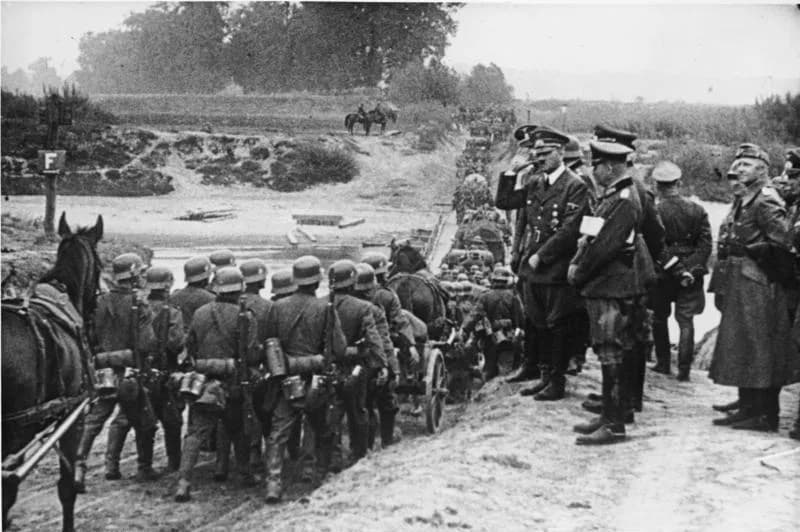
Invasion of Poland
The invasion of Poland by Nazi Germany on 1 September 1939 triggered World War II. In barely five weeks, German and then Soviet forces crushed the Polish army, applying the Blitzkrieg doctrine on a large scale for the first time. Britain and France declared war on 3 September.
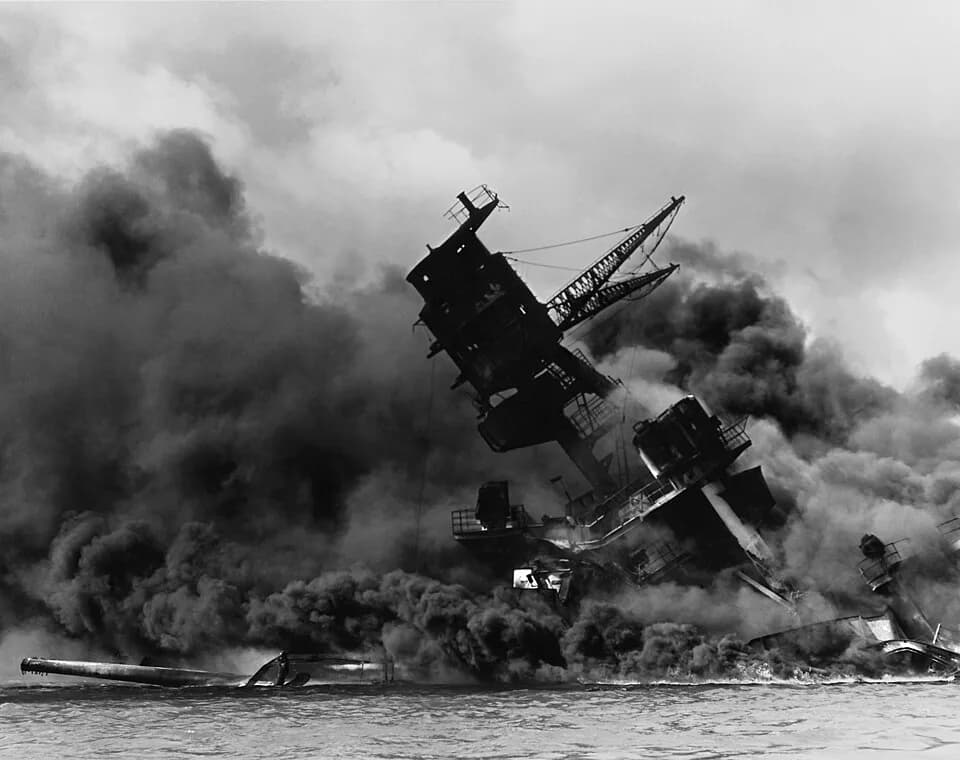
Attack on Pearl Harbor
The surprise Japanese attack on the American naval base at Pearl Harbor on December 7, 1941 triggered the United States' entry into the war. This event transformed an essentially European conflict into a true world war and ultimately sealed the fate of the Axis powers.
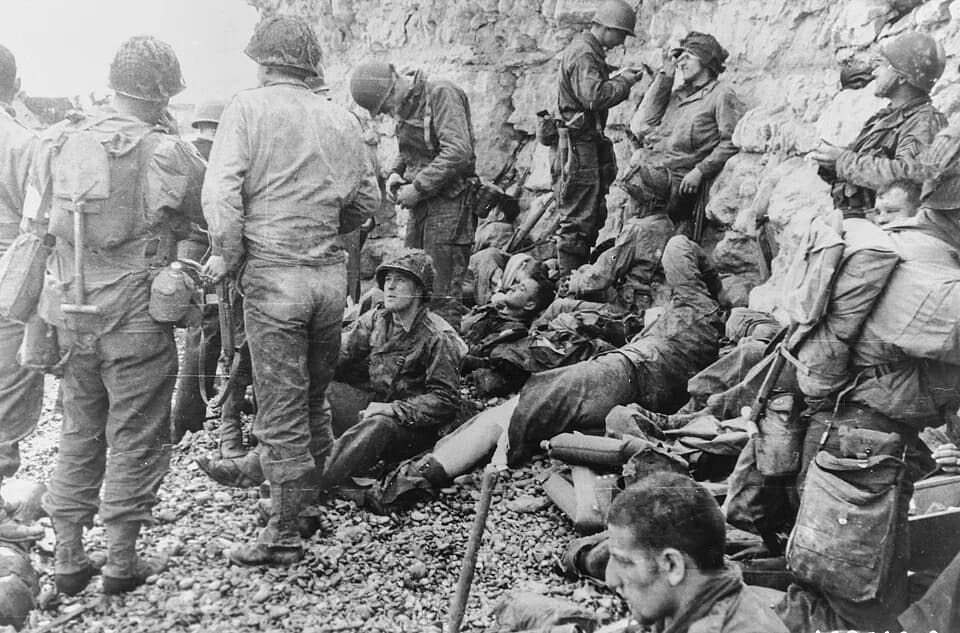
D-Day — Normandy Landings
On June 6, 1944, the largest amphibious operation in history landed 156,000 Allied soldiers on the beaches of Normandy. D-Day opened a second front in Western Europe and marked the beginning of the liberation of France and Western Europe from Nazi rule.
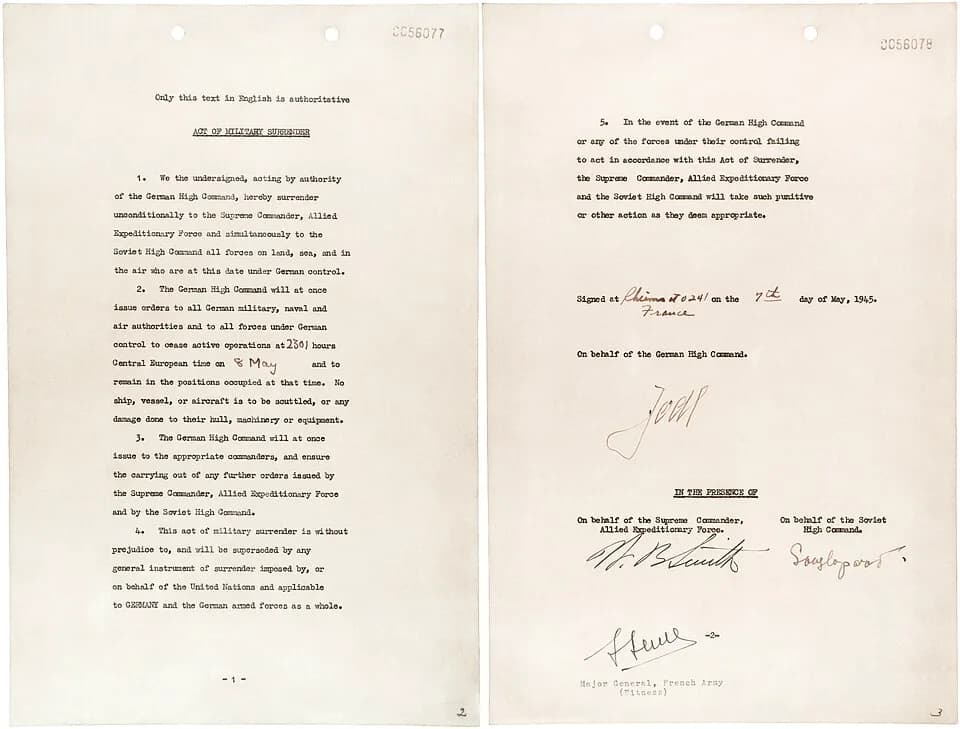
Surrender of Germany
On May 8, 1945, Nazi Germany surrendered unconditionally, ending the war in Europe after nearly six years of conflict. This event, celebrated as Victory in Europe Day (V-E Day), marked the fall of the Third Reich and the beginning of a new geopolitical era.
