Tropéognathus
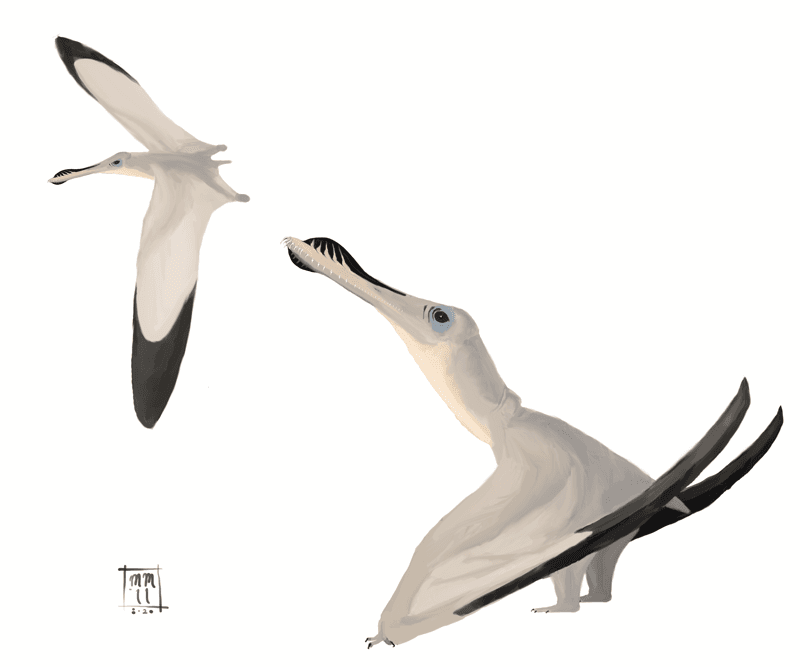
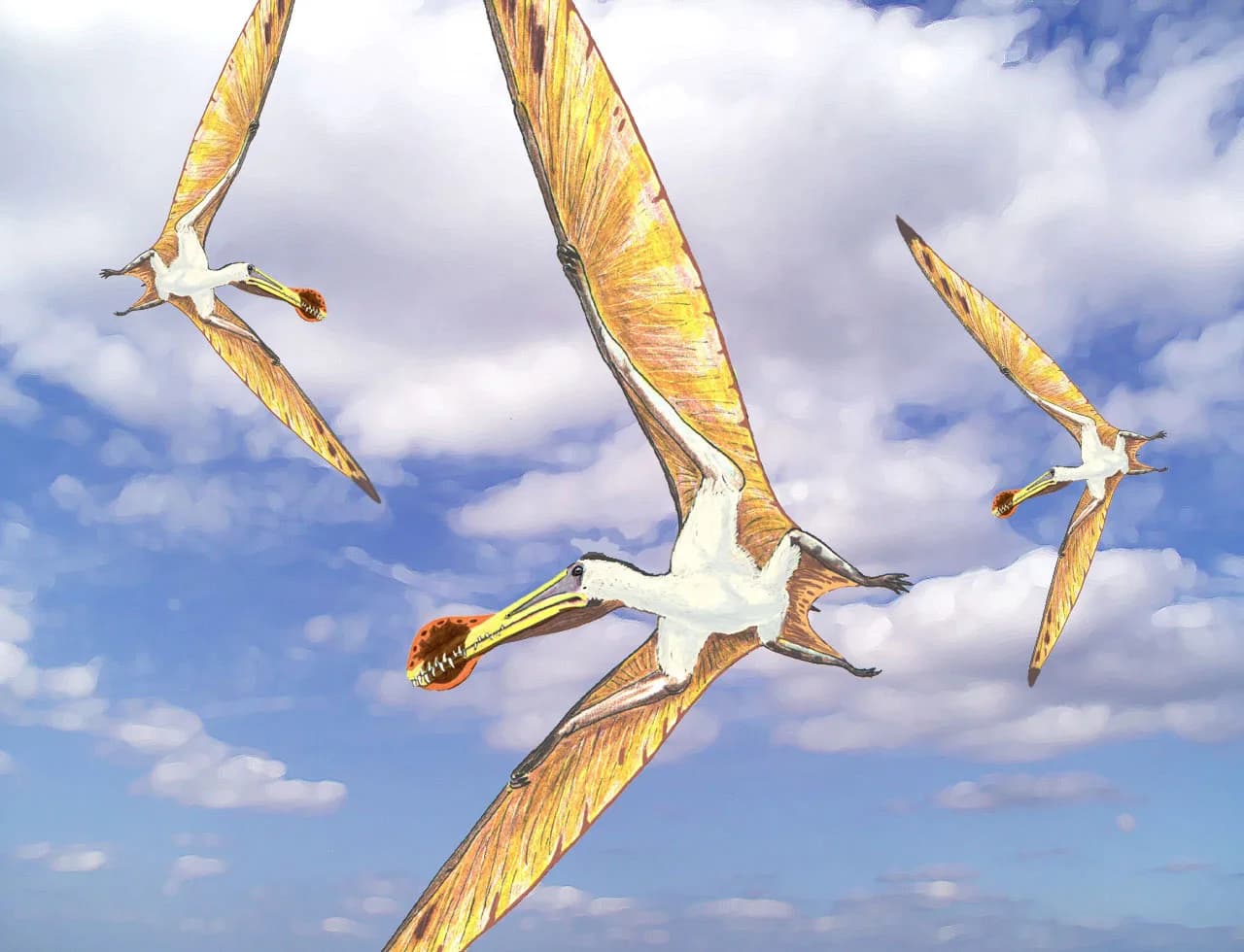
Tropeognathus mesembrinus carried a keel-shaped crest at the tip of each of its two jaws, a structure unique among pterosaurs: it most likely steadied the beak as it cut the water. With an 8.2-metre wingspan and 50 to 75 kilograms, it was among the largest flying animals of the Early Cretaceous. It fished in Brazil around 110 million years ago.
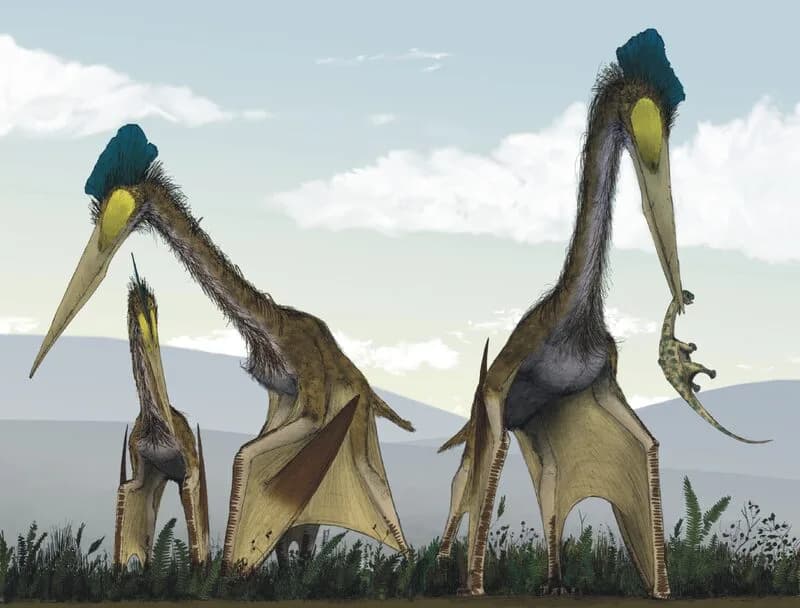
Tropeognathus mesembrinus lived during the Early Cretaceous, approximately 110 million years ago, during the Albian age. This giant Brazilian pterosaur is one of the largest flying reptiles of the Early Cretaceous and the biggest known pterosaur from the Araripe Basin's Santana Formation. Tropeognathus belongs to the ornithocheirids, a family of pterodactyloids specialized in open-sea fishing characterized by distinctive bony crests on the jaws. It thrived in the tropical environment of the nascent South Atlantic, when Brazil and Africa were progressively separating. The Araripe Basin in northeastern Brazil was then bordered by warm, shallow seas harboring an abundant marine fauna that formed the dietary base of this large aerial piscivore. Tropeognathus represents the peak of size among ornithocheirid pterosaurs before the emergence of giant azhdarchids like Quetzalcoatlus in the Late Cretaceous.
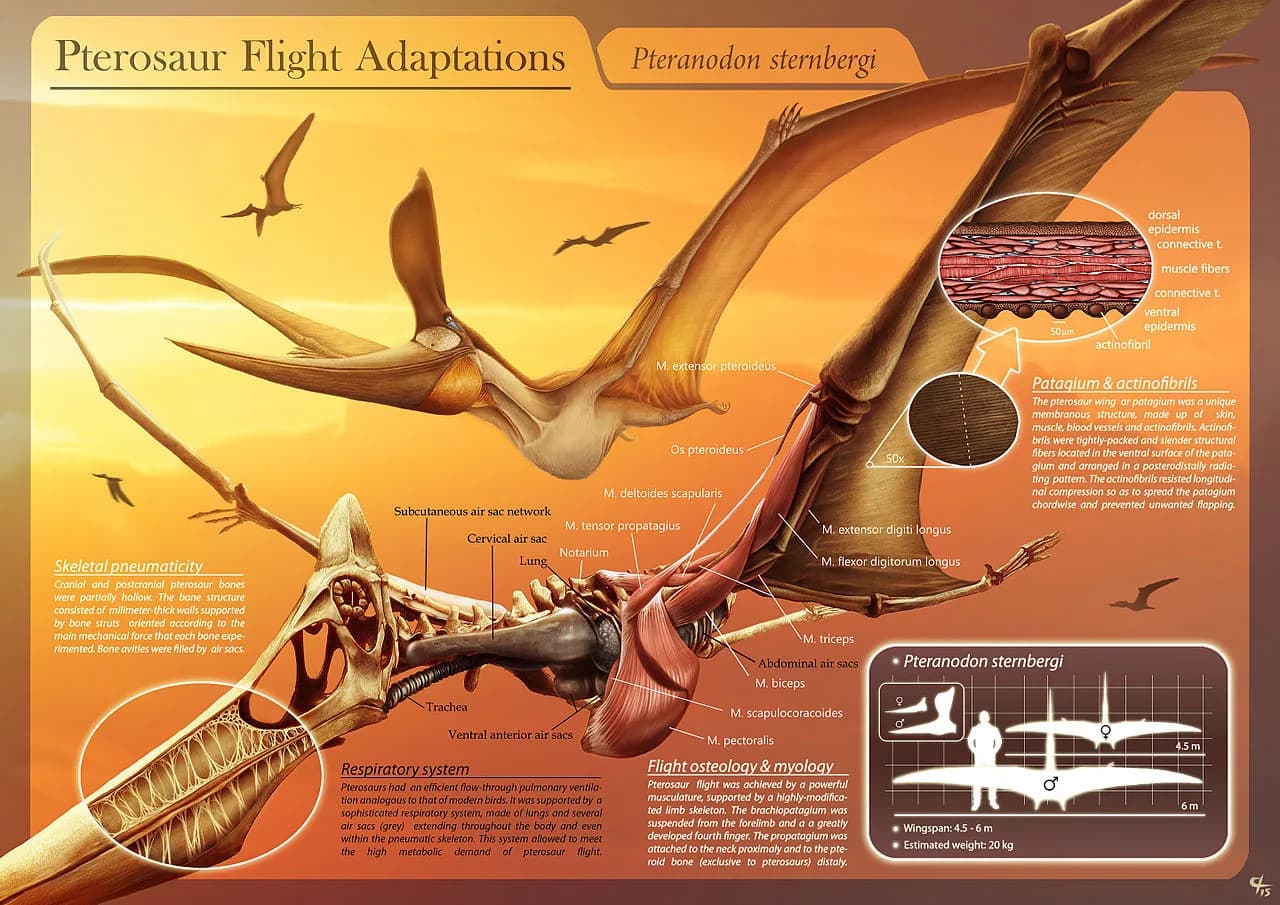
Tropeognathus was one of the largest pterosaurs of the Early Cretaceous, with an estimated wingspan between 6 and 8.2 meters depending on specimens and estimation methods. The most recent and conservative estimates place its wingspan around 6 to 7 meters, ranking it among the largest flying animals of its time. Its weight is estimated between 15 and 30 kg. The skull measured approximately 60 to 75 centimeters long, dominated by a long snout armed with conical teeth and terminated by semicircular bony crests at the tips of both jaws (upper and lower). These keel-shaped crests are the diagnostic feature of the genus. The body was compact and powerful, with massive shoulders providing the muscular anchorage necessary for wings of this span. Like all large pterosaurs, its skeleton was highly pneumatized, with hollow, air-filled bones minimizing weight while maximizing strength.
Tropeognathus was a specialized piscivore, perfectly adapted for catching fish in the open marine environment. Its long snout armed with conical, pointed teeth, spaced apart and tilted forward, formed an ideal trap for grasping fish at the water's surface. The keel-shaped crests on both jaws probably played a role in fishing by stabilizing the beak as it sliced through the water surface at high speed, reducing hydrodynamic resistance and preventing lateral deviation of the snout. This fishing technique is analogous to that of modern skimmers (Rynchops) that slice the water surface with their elongated lower mandible. Primary prey included fish from the shallow Cretaceous seas of the Araripe Basin, abundant in warm tropical waters. Tropeognathus's size allowed it to patrol vast marine expanses, potentially covering hundreds of kilometers in soaring flight over the ocean searching for fish schools.
Tropeognathus inhabited the coastal and pelagic marine environments of Early Cretaceous Brazil, in the Araripe Basin region. During the Albian, the South Atlantic was progressively opening between South America and Africa, creating warm, shallow seaways rich in marine life. The Araripe Basin lay at the edge of this nascent sea, with a warm tropical climate favoring high biological productivity. Tropeognathus was probably a pelagic pterosaur, spending most of its time in flight over the ocean, returning to land only to breed and nest. Its wingspan and wing morphology, long and narrow with a high aspect ratio, were perfectly adapted for dynamic soaring exploiting air currents above waves, like modern albatrosses. Nesting colonies were probably located on the coasts and islands of the proto-South Atlantic.
Tropeognathus anatomy was optimized for pelagic soaring and marine fishing. The elongated skull bore the diagnostic keel-shaped crests (carinae) at the anterior tips of both jaws, forming semicircular bony structures that projected beyond the beak tip. These crests were probably covered with keratin in life. The conical teeth were set in sockets, larger at the front and progressively decreasing toward the back of the snout. The postcranial skeleton showed typical adaptations of large soaring pterosaurs: a sternum with a developed keel for pectoral muscles, a robust humerus with a massive deltopectoral crest serving as flight muscle anchor, and elongated but hollow, pneumatized wing bones. The spine featured a notarium (fusion of dorsal vertebrae) reinforcing the torso against flight stresses. The feet were relatively small compared to the body, typical of an animal spending little time on the ground.
Tropeognathus behaved as a pelagic aerial predator, the Cretaceous equivalent of a giant albatross. Its long, narrow wings were designed for dynamic soaring, exploiting wind gradients above the marine surface to cover immense distances with minimal effort. This technique, called dynamic slope soaring, allows modern seabirds to fly for hours without flapping, and Tropeognathus likely used the same strategy. Fishing was conducted in low flight, with the pterosaur dipping its jaws into the water to seize fish near the surface, the keel crests stabilizing the beak in the water. Takeoffs and landings must have been critical maneuvers for an animal of this size, probably requiring sufficient headwind or launching from an elevation. Nesting occurred in coastal colonies, and adults probably made long-distance fishing trips to feed their young.
Tropeognathus was described in 1987 by Peter Wellnhofer from a partial skull discovered in the Santana Formation of the Araripe Basin, Brazil. The name means 'keel jaw' (Greek: tropos 'keel' + gnathos 'jaw'), referring to the characteristic crests on its jaws. The holotype specimen (BSP 1987 I 46) is a nearly complete skull housed at the Bayerische Staatssammlung für Paläontologie in Munich. A second important specimen (MN 6594-V), more complete with postcranial elements, was described by Kellner et al. and allowed better size estimation. The genus Tropeognathus has a complex taxonomic history, having sometimes been considered synonymous with Anhanguera or Ornithocheirus. Araripe Basin fossils are generally preserved three-dimensionally in limestone nodules, offering exceptional preservation quality for pterosaurs. Tropeognathus became popular through its depiction in the BBC documentary 'Walking with Dinosaurs' (1999).
| Period | Crétacé inférieur / Early Cretaceous |
| Era | Mésozoïque / Mesozoic |
| Age | ~110 Ma |
| Location | Amérique du Sud (Brésil, bassin d'Araripe) / South America (Brazil, Araripe Basin) |
| Length | Envergure / Wingspan: 8.2 m |
| Height | ~1.5 m |
| Weight | 50-75 kg |
| Diet | Piscivore |
| Discovery | 1987 |
No. Tropeognathus mesembrinus was a pterosaur, a flying archosaur reptile distinct from dinosaurs. Pterosaurs and dinosaurs share a common archosaur ancestor but form two separate groups. Tropeognathus, like all pterosaurs, is distinguished by its wing membrane supported by an elongated fourth finger — an anatomy radically different from birds or feathered dinosaurs.
Tropeognathus mesembrinus had semicircular bony crests at the tips of both jaws (upper and lower). These structures likely served to stabilize the beak during skimming flight — reducing hydrodynamic resistance when the snout sliced the water surface at high speed, a technique analogous to modern skimmers (Rynchops). They may also have played a display role.
Wingspan estimates for Tropeognathus mesembrinus vary across studies, from 6 to 8.2 meters depending on specimens and methods used. The most recent and conservative estimates place the wingspan between 6 and 7 meters, making Tropeognathus one of the largest pterosaurs of the Early Cretaceous. The holotype specimen (BSP 1987 I 46), described by Peter Wellnhofer in 1987, is housed in Munich.
Artistic reconstruction of Tropeognathus mesembrinus
Dmitry Bogdanov / Wikimedia Commons
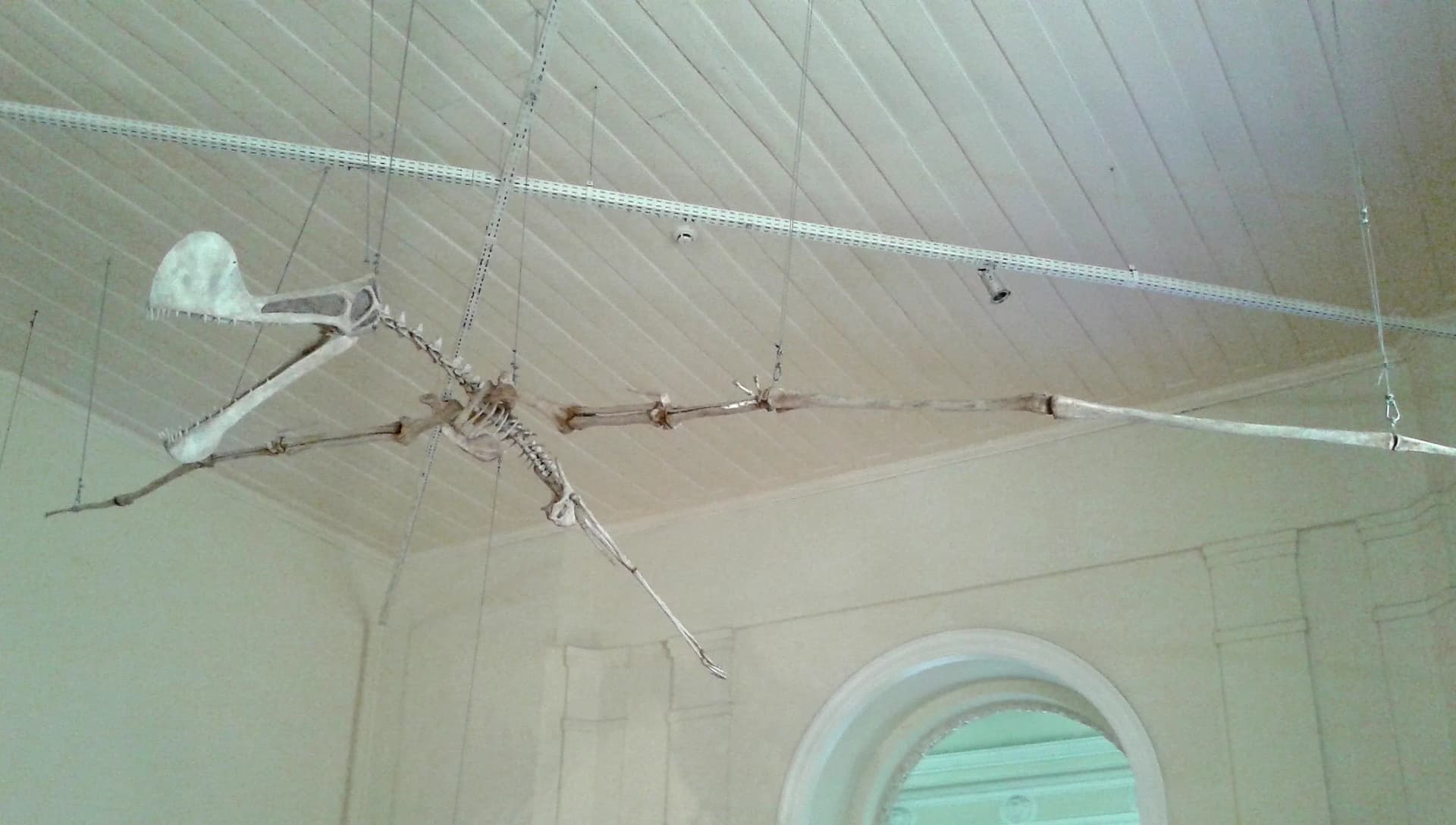
Mounted skeleton of Tropeognathus mesembrinus
Wikimedia Commons