Titanichthys
Titanichthys agassizi filtered plankton 350 million years before whales adopted the same strategy. This armoured fish, 5 to 7 metres and 500 kilograms to a tonne, shared its seas with Dunkleosteus, but its jaw, lacking cutting blades, served only to take in laden water. It lived 382 to 358 million years ago.
Titanichthys lived during the Late Devonian, approximately 382 to 358 million years ago (Frasnian-Famennian). This giant placoderm inhabited the warm, deep seas of the Paleotethys and Rheic Ocean, in what is now Morocco, the eastern United States, and Poland. The Late Devonian, nicknamed the 'Age of Fishes,' was dominated by armored placoderms that ruled the oceans. Titanichthys coexisted with the famous Dunkleosteus but occupied a radically different ecological niche.
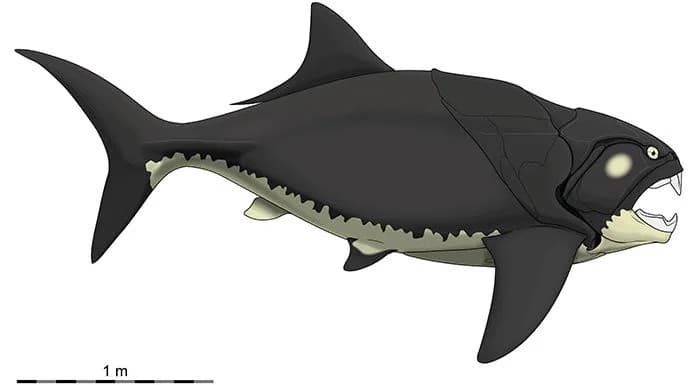
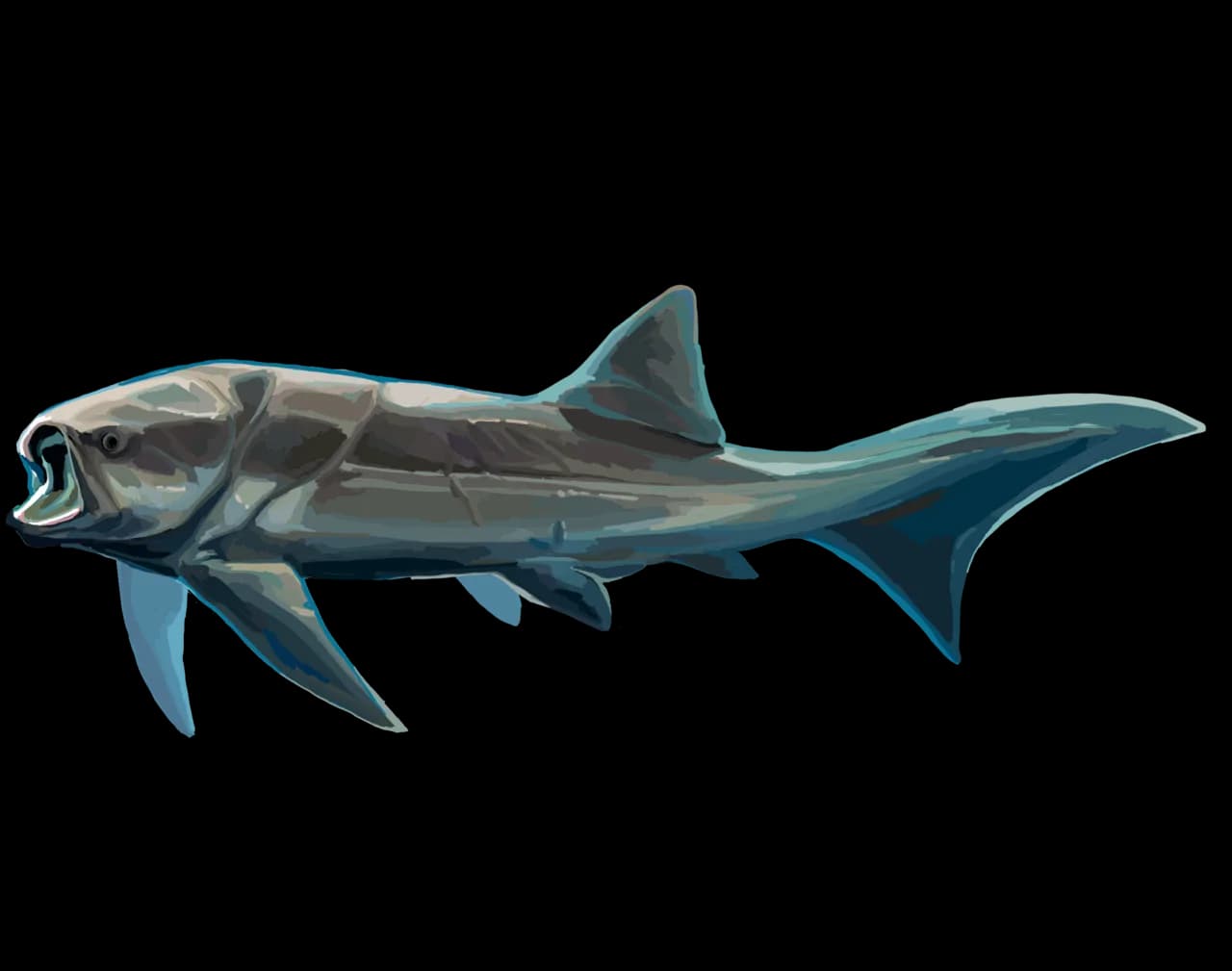
Titanichthys agassizi was one of the largest placoderms, reaching an estimated length of 5 to 7 meters. Its armored cephalic shield measured approximately 80 centimeters wide. Unlike Dunkleosteus whose buccal plates formed sharp blades, Titanichthys's plates were narrow, elongated, and lacked cutting edges, with no effective biting surface. Its mouth could open very widely, forming a gaping opening comparable to a whale shark's. Its weight is estimated between 500 kilograms and 1 tonne.
Titanichthys is interpreted as a giant filter feeder, the oldest known vertebrate to adopt this feeding strategy. Its blunt buccal plates and wide-gaping jaw indicate it did not bite prey but engulfed them by opening its massive mouth to suck in plankton-rich water and small organisms. This strategy is convergent with modern whale sharks, manta rays, and baleen whales. Recent biomechanical analyses (2020) confirmed that its maxillary plates could not withstand the bite forces needed to capture large prey.
Titanichthys inhabited the epicontinental seas and ocean basins of the Late Devonian. Its fossils have been found in marine formations of Morocco (Anti-Atlas), Ohio and Pennsylvania (USA), and Poland. These sites represent open sea to continental shelf environments, with well-oxygenated surface waters supporting abundant planktonic production. The diversity of fossil localities indicates a wide geographic distribution in tropical and subtropical seas.
Titanichthys's anatomy displays the typical arthrodire body plan (placoderms with cervical articulation) but with radical modifications related to its filter-feeding mode. Its cephalic shield articulated on the thoracic shield allowed a wide mouth opening. The gnathal plates (jaws) were unusually long, narrow, and smooth, contrasting sharply with Dunkleosteus's cutting blades. The orbits were small relative to skull size. The body, partially armored at the front, probably became more flexible toward the rear with a powerful tail for open-water swimming.
Titanichthys swam slowly but continuously in surface and mid-depth waters, filtering enormous volumes of water through its gaping mouth. Like modern whale sharks, it likely followed concentrations of plankton and small organisms, probably making seasonal migrations along productive ocean currents. Despite its imposing size, it was a peaceful giant with no predatory interest in large prey. Its coexistence with Dunkleosteus illustrates a classic ecological partition: two giants sharing the same ocean without direct competition.
Titanichthys was first described by Newberry in 1885 from Late Devonian fossils in Ohio, USA. The type species T. agassizi honors paleontologist Louis Agassiz. Additional material has been discovered in Morocco, in the rich Anti-Atlas deposits, and in Poland. Recent work by Coatham et al. (2020) in Royal Society Open Science used finite element biomechanical analyses to demonstrate that Titanichthys's jaws could not function as biting tools, definitively confirming the filter-feeding hypothesis.
| Period | Dévonien supérieur / Late Devonian |
| Era | Paléozoïque / Paleozoic |
| Age | 382-358 Ma |
| Location | Maroc, USA (Ohio), Pologne / Morocco, USA (Ohio), Poland |
| Length | 5-7 m |
| Height | ~1.5 m |
| Weight | 500-1000 kg |
| Diet | Filtreur (planctivore) |
| Discovery | 1885 |
No. Titanichthys agassizi was an arthrodire placoderm — an armored fish from the Late Devonian (382-358 Ma), over 120 million years before the first dinosaurs appeared. Placoderms are an extinct class of jawed fish, unrelated to reptiles. Titanichthys coexisted with Dunkleosteus in Devonian seas but occupied a radically different niche: plankton filter-feeder rather than predator.
Coatham et al. (2020) in Royal Society Open Science used finite element biomechanical analyses to demonstrate that Titanichthys agassizi's maxillary plates could not withstand the forces involved in biting large prey. Unlike Dunkleosteus's cutting blades, Titanichthys's plates were long, narrow, and smooth — lacking any effective cutting surface. Its mouth opened wide to suction plankton-rich water, like a modern whale shark.
Titanichthys agassizi reached 5 to 7 meters in length with an estimated weight between 500 kilograms and 1 tonne, with an armored cephalic shield approximately 80 centimeters wide. Its fossils were found in Morocco (Anti-Atlas), Ohio and Pennsylvania (USA), and Poland — demonstrating a wide distribution in the tropical and subtropical seas of the Late Devonian. It was first described by Newberry in 1885 from Ohio fossils.
Titanichthys agassizi life reconstruction
Wikimedia Commons