Bothriolepis
Bothriolepis canadensis is an armoured fish about thirty centimetres long that lived 380 to 360 million years ago. Described in 1880, it has been found on every continent, Antarctica included. With more than sixty species, its genus is the most diverse of all fossil fishes. It is thanks to it that the Miguasha site, in Gaspésie, is a UNESCO World Heritage listing.
Bothriolepis canadensis lived during the Late Devonian (Frasnian-Famennian), approximately 380 to 360 million years ago. This antiarch placoderm was one of the most abundant and widespread fish of the Devonian, found on every continent. Bothriolepis is the fossil fish genus with the greatest number of described species — over 60 valid species. This small armored fish was the 'rabbit' of the Devonian: omnipresent, abundant, and serving as basic prey for almost all larger predators. Its ecological success makes it one of the most widespread vertebrates of the Paleozoic.
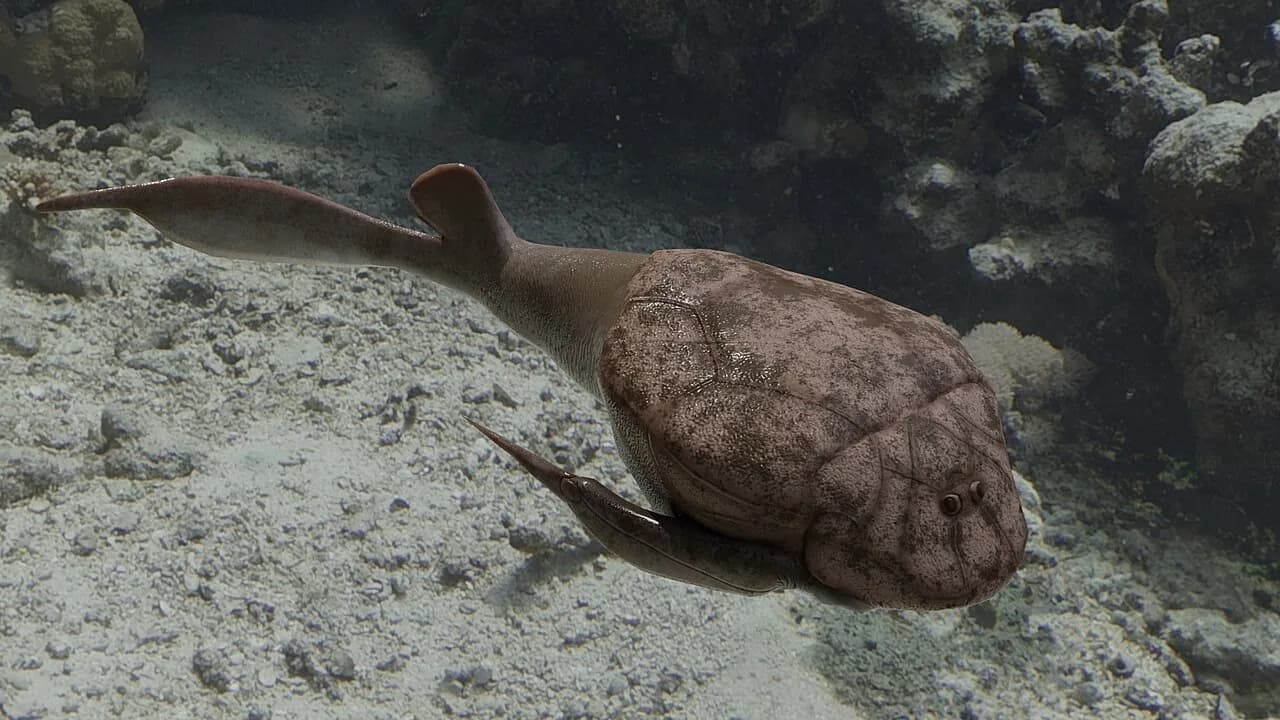
Bothriolepis canadensis measured approximately 30 centimeters in total length, though some species in the genus may have reached 1 meter. Its body was divided into two distinct parts: an entirely armored anterior thorax of bony plates (cephalothoracic shield) and a flexible posterior tail covered in scales. The pectoral fins were transformed into rigid, armored, articulated appendages resembling jointed arms — a characteristic unique to antiarchs. These bony 'arms' could bend at a median joint and measured about half the length of the thoracic shield.
Bothriolepis's diet is debated. The mouth, very small and downward-facing, possessed weak dental plates without true teeth. Most paleontologists consider it detritivorous or a grazer, feeding on decomposing organic matter, bacterial biofilms, and possibly algae on stream bottoms. However, fossilized stomach contents of a B. canadensis specimen reveal sediments rich in organic matter, confirming a feeding mode of ingesting nutritious mud. Its armored articulated arms could possibly have been used to stir up sediment and expose food.
Bothriolepis was primarily a freshwater fish that inhabited the rivers, lakes, and estuaries of the Late Devonian worldwide. The most famous site is Miguasha in Gaspésie (Québec, Canada), a national park and UNESCO World Heritage site where hundreds of B. canadensis specimens have been found in exceptional preservation conditions. Other important sites are in Australia, Europe, Asia, and Antarctica. This worldwide distribution makes it one of the most cosmopolitan Devonian vertebrates. Bothriolepis could possibly tolerate salinity variations.
Bothriolepis's anatomy is dominated by its bony armor. The cephalothoracic shield, composed of fused dermal plates, protected the head and anterior body. The eyes were closely set on top of the skull, small and upward-facing. The most remarkable feature is the pectoral fins transformed into armored articulated appendages — bony 'arms' unique among vertebrates. These arms possessed a median joint (like an elbow) and could bend. The tail was bare or covered in fine scales. The tiny ventral mouth bore gnathal plates (rudimentary 'jaws'). Some specimens show structures interpreted as primitive lungs.
Bothriolepis lived in large groups on the bottoms of Devonian rivers and lakes. Its armored articulated 'arms' probably served to anchor in currents, lift itself from the bottom, or dig in sediment to find food. The possible presence of primitive lungs suggests it could breathe air and temporarily survive out of water — an advantage in seasonal waterways that periodically dried up. Mass mortality deposits at Miguasha show hundreds of individuals dying together, testifying to gregarious behavior and catastrophic drying events.
Bothriolepis canadensis was described in 1880 by Whiteaves from fossils at the Miguasha site in Gaspésie, Québec. The name means 'pit scale' (Greek bothrios = pit, lepis = scale), referring to the ornamentation of its bony plates. Miguasha is today a national park and UNESCO World Heritage site (1999), famous for its exceptionally preserved Devonian fish fauna, including the elpistostegalian Elpistostege watsoni. With over 60 species described worldwide, Bothriolepis is the most diverse fossil fish genus. Thousands of specimens are known, making this small armored fish one of the best-documented Paleozoic vertebrates.
| Period | Dévonien supérieur / Late Devonian |
| Era | Paléozoïque / Paleozoic |
| Age | 380-360 Ma |
| Location | Mondial (Québec/Canada, Australie, Europe, Asie, Antarctique) / Worldwide (Québec/Canada, Australia, Europe, Asia, Antarctica) |
| Length | ~30 cm |
| Height | ~8 cm |
| Weight | ~0.5-1 kg (estimé / estimated) |
| Diet | Détritivore / Detritivore |
| Discovery | 1880 |
No, Bothriolepis canadensis was an antiarch placoderm — an armored fish of the Late Devonian (380-360 Ma), extinct about 290 million years before the first dinosaurs. Placoderms are a group of gnathostome (jawed) fish that are entirely extinct today, with no living descendants. With over 60 species described on every continent, it is the most diverse fossil fish genus known.
The pectoral fins of Bothriolepis canadensis were transformed into rigid, armored, articulated appendages with a median joint comparable to an elbow, unique among vertebrates. They likely served to anchor in river current, lift off the sediment bottom, or stir up mud to expose food. The tiny ventral mouth and weak dental plates confirm a detritivorous diet, ingesting nutritious mud.
The Miguasha site in Gaspésie (Québec), inscribed as a UNESCO World Heritage site in 1999, is the world's main deposit of Bothriolepis canadensis. Hundreds of specimens have been found there in exceptional preservation in Devonian sediments (around 375 Ma). It was from Miguasha fossils that Whiteaves described the species in 1880. The site's fauna also includes Elpistostege watsoni, a close relative of terrestrial tetrapods.
Bothriolepis canadensis life reconstruction
Wikimedia Commons