Thylacosmile
Thylacosmilus atrox is not a cat but a marsupial: its sabre canines arose independently of Smilodon's, a clear case of convergence. They also grew continuously throughout life, like a rodent's incisors, their roots reaching up above the eye sockets. A metre and a half long and 100 to 150 kilograms, it hunted in Argentina 9 to 3 million years ago.
Thylacosmilus atrox lived in South America during the Late Miocene and Pliocene, approximately 9 to 3 million years ago. This sparassodont saber-toothed marsupial is one of the most striking examples of convergent evolution in the history of life: although entirely unrelated to cats, it independently developed hypertrophied upper canines remarkably similar to those of Smilodon. Thylacosmilus evolved in the isolation of South America, a continent-island during most of the Cenozoic, where marsupials and notoungulates occupied ecological niches held by placentals on other continents. It disappeared in the early Pliocene, probably outcompeted by true placental carnivores arriving from North America during the Great American Biotic Interchange, though the exact timeline of its extinction remains debated among paleontologists.
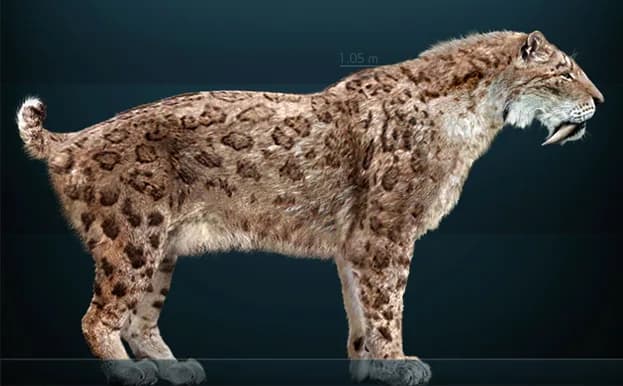
Thylacosmilus was a medium-sized predator, comparable to a modern jaguar. Estimates based on limb bones and skull suggest a weight of 80 to 120 kg and a body length of approximately 1.2 to 1.5 meters, with a relatively short tail. Its build was robust and stocky, with powerful forelimbs and massive shoulders, a body plan convergent with Smilodon despite the complete absence of relatedness. The skull measured about 23 cm long, dominated by spectacular upper canines that protruded 15 cm beyond the lower jaw. Sexual dimorphism remains poorly known due to the limited number of specimens, but modern predatory marsupials generally show moderate dimorphism. Its muscle mass was concentrated in the cervical region and shoulders, a convergent adaptation for driving canines into prey.
Thylacosmilus was a specialized carnivore, probably an ambush predator targeting medium-sized herbivores of the South American Miocene and Pliocene fauna. Its potential prey included notoungulates (endemic South American herbivores like Toxodon and its ancestors), litopterns (ungulates convergent with horses and llamas), and possibly small xenarthrans. Biomechanical analysis of its skull reveals that its bite was relatively weak, comparable to Smilodon in this regard, but the power of its cervical muscles more than compensated. The killing technique likely involved tackling prey followed by a targeted bite to the soft tissues of the neck, using neck muscles to drive the canines rather than jaw force. Its reduced molars indicate it did not chew bones, feeding primarily on tender meat and organs.
Thylacosmilus lived in the varied environments of Miocene and Pliocene South America, primarily in regions corresponding to present-day Argentina. Fossils come from geological formations associated with savannas, grasslands, and open woodlands of Patagonia and the pampas. During this period, South America was an isolated continent with a unique endemic fauna, often described as 'splendid isolation' by paleontologists. Thylacosmilus shared this ecosystem with other marsupial predators (borhyaenids), giant terror birds (phorusrhacids) that dominated the food chain, glyptodonts, giant ground sloths, and an extraordinary diversity of endemic ungulates. The climate was generally warmer and more humid than modern Argentina, with marked seasons favoring a mosaic of habitats.
Thylacosmilus anatomy is a masterpiece of convergent evolution with placental machairodonts, but with distinct anatomical solutions. Its upper canines, unlike Smilodon's which stopped growing at adulthood, were ever-growing (hypselodont), similar to rodent incisors, with roots extending in an arc above the orbits to the top of the skull. This perpetual growth compensated for constant wear and eliminated the risk of permanent canine fracture. The lower jaw possessed massive mentonian flanges forming a bony sheath protecting the canines when closed. The orbits were forward-facing, conferring excellent binocular vision for judging distances during attacks. The brain was relatively small compared to similarly-sized placental carnivores, a characteristic common to marsupials. Its spine was flexible, with an elongated lumbar region typical of predatory marsupials.
Thylacosmilus behavior can be inferred from its functional anatomy and by analogy with modern large predators, although predatory marsupials have gone extinct and no longer provide a direct living model. Its stocky morphology with relatively short limbs suggests an ambush predator rather than a pursuit runner, concealing itself in vegetation before pouncing on prey. The ever-growing canines indicate frequent and intense use of these weapons, whether for predation or possibly social interactions between conspecifics. The well-developed binocular vision confirms a predator that depended on visual precision to locate and attack prey. Like the extinct large Australian marsupial carnivores (thylacoleo), Thylacosmilus was probably a primarily solitary predator, defending a hunting territory against conspecifics. Its reproduction likely followed the marsupial pattern with young born at a very early stage of development.
Thylacosmilus was first described in 1934 by Argentine paleontologist Elmer Riggs from fossils discovered in Entre Ríos Province, Argentina. The name means 'pouch knife' (Greek: thylakos 'pouch, sac' + smilē 'knife'), a reference to both its marsupial nature and blade-like canines. The main fossils come from Late Miocene and Pliocene formations of Argentina, notably the Ituzaingó Formation and the Andalhuala Formation in Catamarca Province. The total number of known specimens remains relatively limited, with a handful of complete or partial skulls and fragmentary postcranial elements. Fossils attributed to Thylacosmilus or related forms have also been reported from Colombia and Venezuela, extending its known range to the northern part of the continent. In 2005, a detailed tomographic study of the skull revealed the remarkable internal structure of the ever-growing canines, confirming their functional but not structural convergence with those of machairodonts.
| Period | Miocène supérieur — Pliocène / Late Miocene — Pliocene |
| Era | Cénozoïque / Cenozoic |
| Age | 9 - 3 Ma |
| Location | Amérique du Sud (Argentine) / South America (Argentina) |
| Length | 1.5 m |
| Height | ~0.6 m |
| Weight | 100-150 kg |
| Diet | Carnivore |
| Discovery | 1926 |
Thylacosmilus atrox was a sparassodont marsupial, with no relation to cats. Its hypertrophied canines are an example of convergent evolution with Smilodon — two independent lineages that developed similar structures in response to the same selective pressures. Thylacosmilus lived in South America (Argentina) 9 to 3 million years ago, in the isolation of the insular continent, and was described by Elmer Riggs in 1934.
Thylacosmilus atrox's canines were hypselodont (ever-growing) — similar to rodent incisors — with roots extending in an arc above the eye sockets to the top of the skull. This perpetual growth compensated for constant wear from their intensive use in killing prey. In Smilodon by contrast, the canines stopped growing at adulthood. A 2005 tomographic study confirmed this unique internal structure.
Thylacosmilus atrox lived in savannas, grasslands, and open woodlands of present-day Argentina (Patagonia, pampas) during the Late Miocene and Pliocene. South America being an isolated continent at the time, it coexisted with giant terror birds (Phorusrhacids, up to 3 m tall) that dominated the food chain, other borhyaenid marsupial predators, glyptodonts, and a unique diversity of endemic ungulates such as notoungulates.
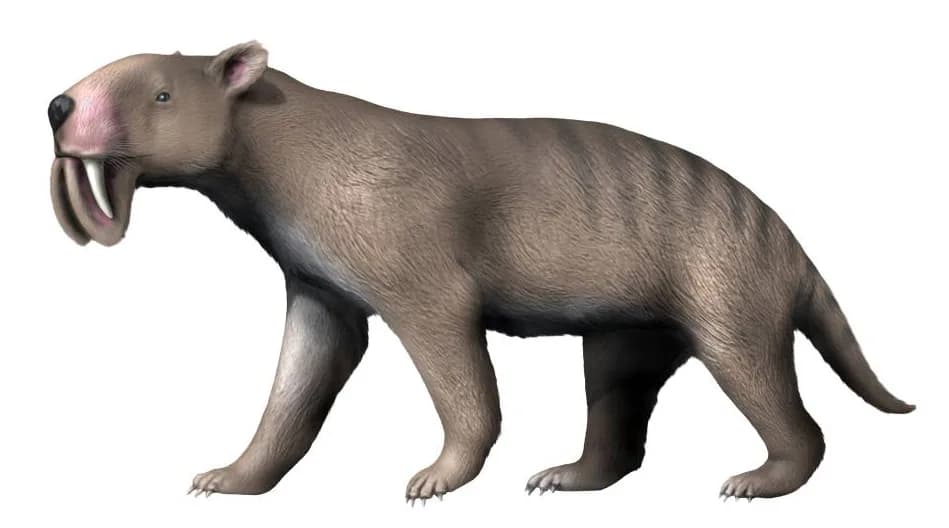
Thylacosmilus atrox, a saber-toothed marsupial
Nobu Tamura / Wikimedia Commons
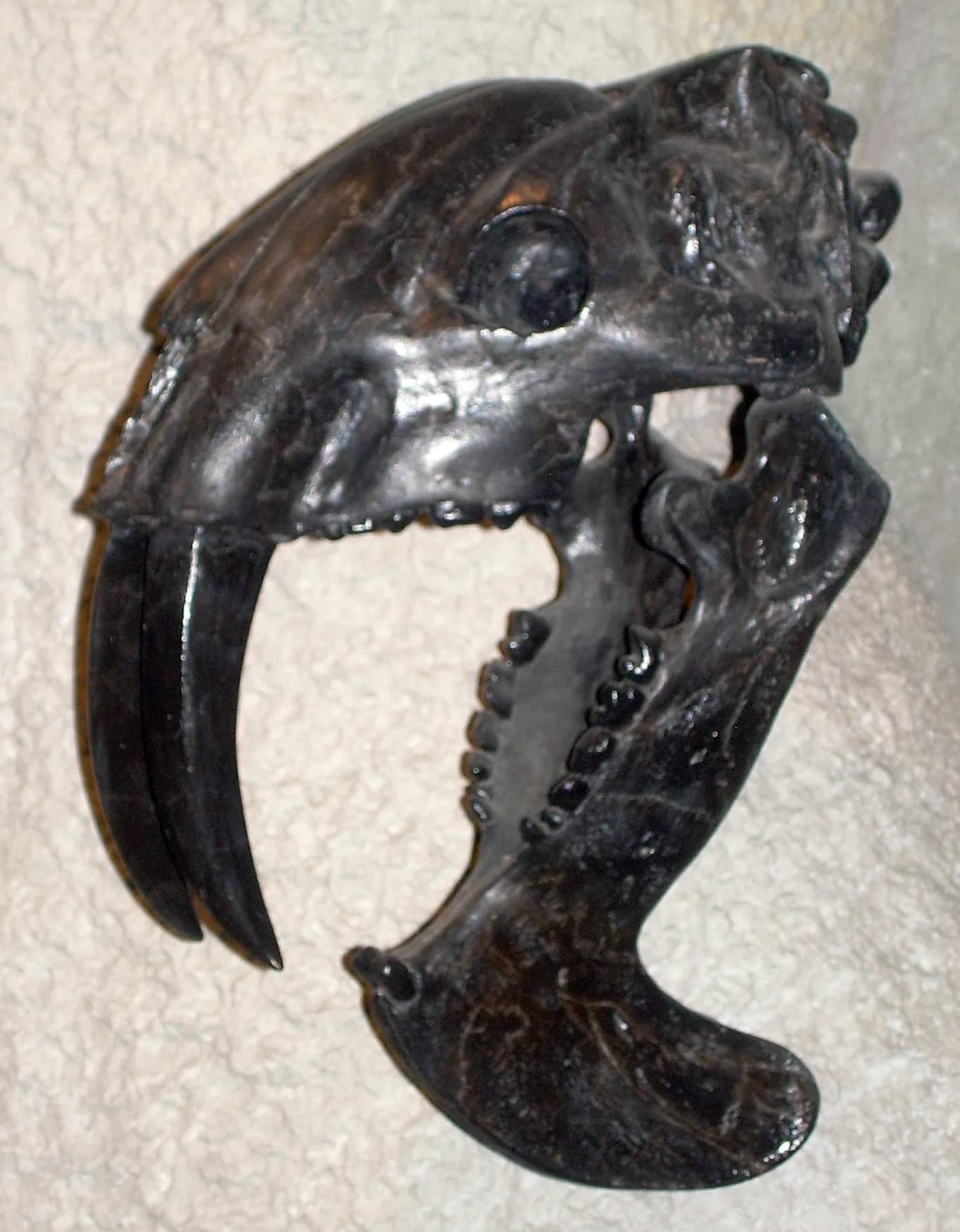
Thylacosmilus atrox, a South American predator convergent with cats
Wikimedia Commons