Rugops
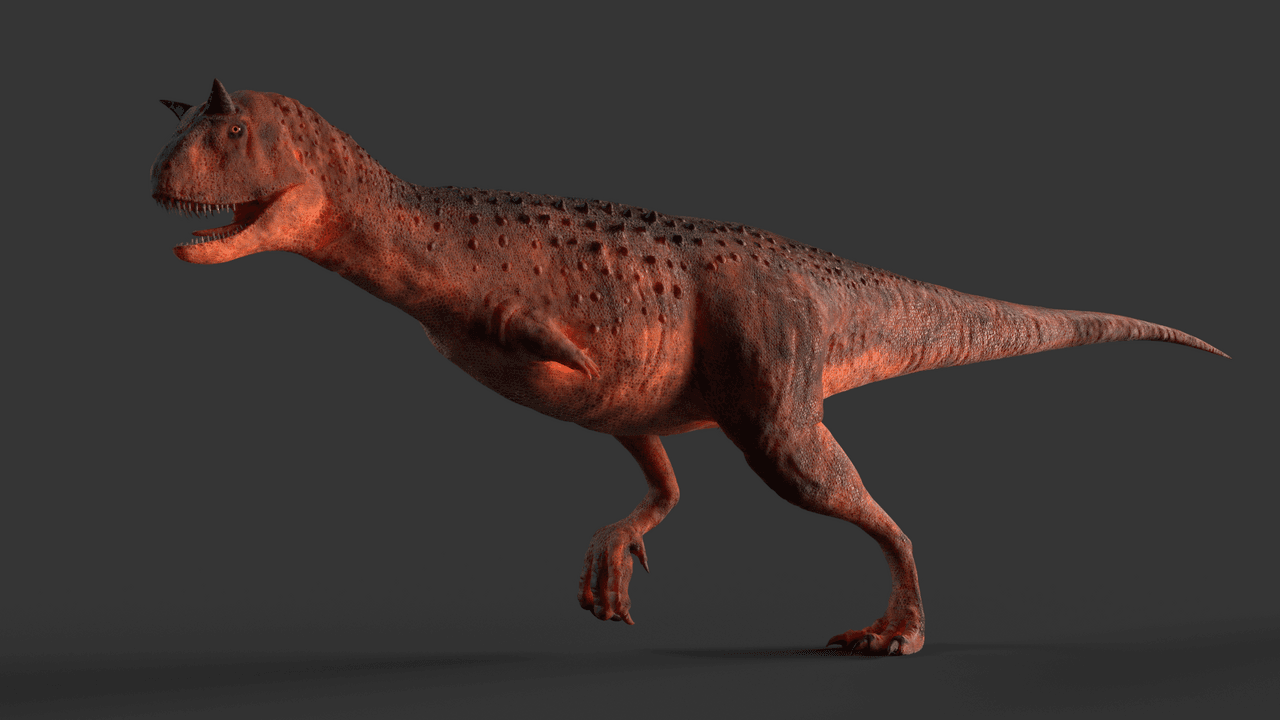
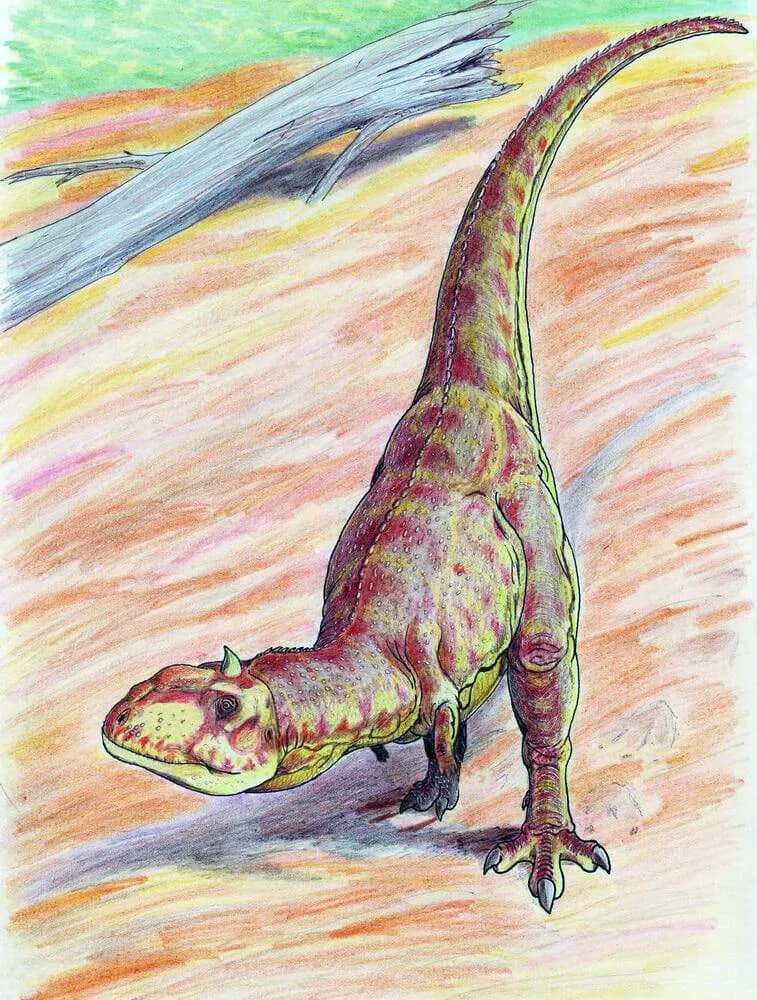
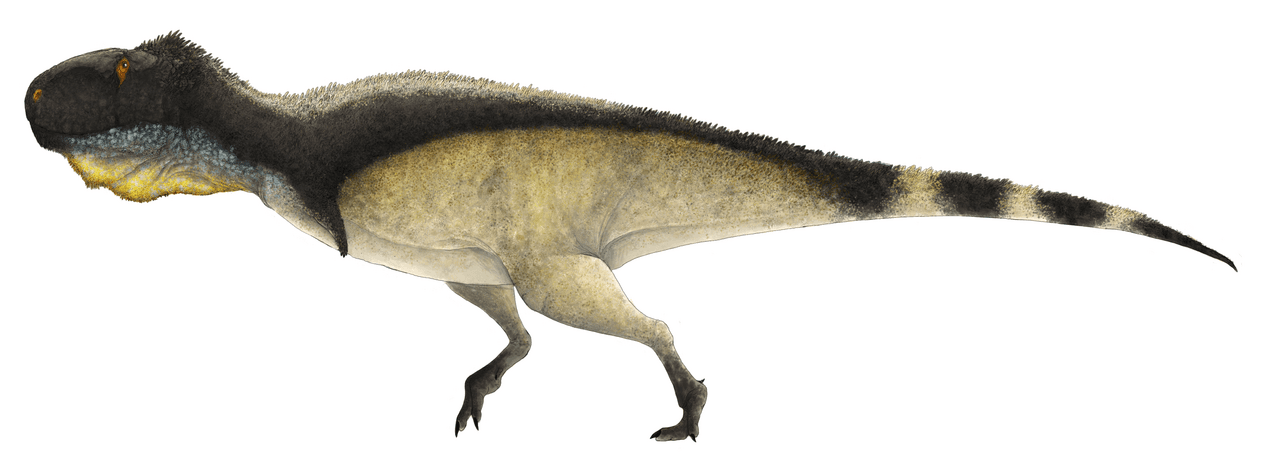
Rugops primus means « wrinkled face », after the pits and grooves scoring its skull: those marks suggest skin or keratin structures now lost. Six metres long and around 750 kilograms, described in 2000 at Gadoufaoua in Niger, it lived 95 million years ago. Jurassic World folded it into the fictional genome of Indominus rex.
Rugops primus lived during the Late Cretaceous period, approximately 95 million years ago, during the Cenomanian stage. This African abelisaurid inhabited the lands of present-day Niger, in the Saharan region, at a time when this territory was vastly different from the arid desert we know today. The Cenomanian represented a period of elevated global temperatures, with atmospheric CO2 levels far exceeding current levels. The continents continued their fragmentation, and Africa was still partially connected to other landmasses. Rugops shared its ecosystem with other remarkable dinosaurs, including Ouranosaurus and Nigersaurus, demonstrating a rich biodiversity in this tropical region of Gondwana.
Rugops primus was a medium-sized theropod, measuring approximately 6 meters in length from snout to tail tip. Although its dimensions were modest compared to the largest abelisaurids like Carnotaurus, Rugops remained an imposing predator within its Late Cretaceous African ecosystem. Its skull, relatively lightweight and adorned with numerous characteristic pits and grooves, measured approximately 35 centimeters in length. The overall body construction followed the typical abelisaurid body plan: a compact torso, robust hindlimbs adapted for bipedal locomotion, and reduced forelimbs. The estimated weight of Rugops probably ranged between 750 kilograms and one ton, placing it as an intermediate-sized carnivore in its environment.
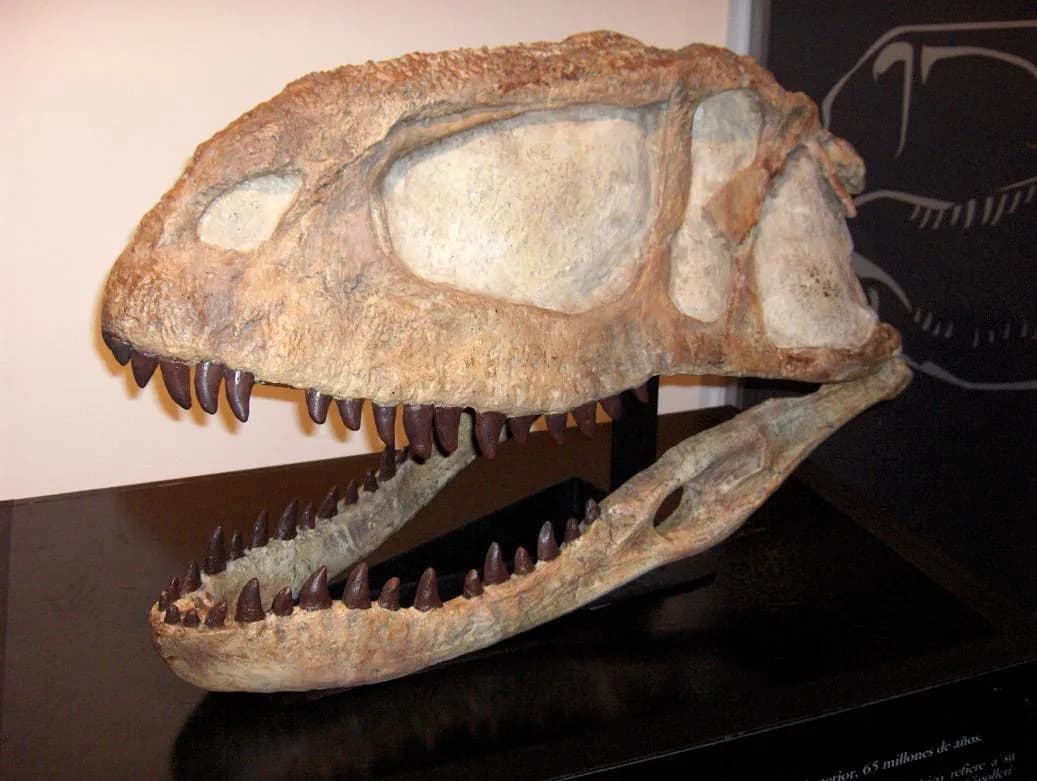
Rugops primus is widely considered by paleontologists to have been a scavenger rather than an active hunter, a hypothesis supported by several distinctive anatomical features. Its relatively weak jaw and non-robust teeth suggest it was not equipped to take down large living prey or crush thick bones. Unlike apex predators with powerful jaws and massive teeth, Rugops possessed dentition better suited for tearing flesh from already dead carcasses. The pits and grooves adorning its skull may have supported vascular structures or soft tissues related to olfactory detection, potentially allowing it to locate carcasses from a distance, a characteristic shared with modern scavengers such as vultures and certain species of storks.
Rugops primus lived in what is now the Gadoufaoua region of Niger, an area that during the Late Cretaceous was radically different from the modern Sahara Desert. Approximately 95 million years ago, this region was covered with lush forests, fertile floodplains, and traversed by vast river systems supporting dense and diverse vegetation. The climate was tropical and humid, creating ideal conditions for abundant and varied fauna. Rugops shared this verdant environment with Ouranosaurus, a sail-backed iguanodontian, Nigersaurus, a diplodocoid sauropod with a uniquely wide muzzle, and Suchomimus, a fish-eating spinosaurid. This coexistence of multiple predators and herbivores demonstrates a complex and productive ecosystem.
The cranial anatomy of Rugops primus is its most distinctive feature and the source of its name, which literally means 'wrinkle face.' The skull was covered with pits, grooves, and rough textures uncommon in theropods, suggesting the presence of elaborate integumentary structures during the animal's life. These structures may have included keratinized crests, colorful protuberances, or vascular tissues similar to those observed in certain modern birds and reptiles. The probable function of these cranial ornaments was visual display, serving in intraspecific recognition, sexual selection, or rival intimidation. The jaw of Rugops was relatively gracile and lacked the robustness necessary to exert strong bite pressure, confirming its probable scavenging role. The remainder of the postcranial skeleton, although less well preserved, followed the typical abelisaurid body plan with greatly reduced forelimbs.
The behavior of Rugops primus is inferred primarily from its anatomical characteristics and its relationship to other abelisaurids. The relative weakness of its jaw and dentition strongly suggests a primarily scavenging lifestyle, though it may have supplemented its diet through opportunistic predation on small prey or weakened animals. The elaborate cranial ornaments indicate complex social behaviors, probably including visual displays during the breeding season or to establish social hierarchy. Like other abelisaurids, Rugops possessed hindlimbs adapted for efficient bipedal locomotion, allowing it to range across vast territories in search of carcasses. Its sense of smell was potentially highly developed, enabling it to locate food sources over great distances, a crucial adaptation for a scavenger operating in a dense tropical environment.
Rugops primus was discovered in the year 2000 by renowned American paleontologist Paul Sereno and his team during an expedition to the Gadoufaoua region of Niger in West Africa. The holotype specimen consists of a remarkably well-preserved partial skull that allowed a detailed description of the animal's cranial anatomy. The species was officially named and described in 2004 by Sereno, assigning it the name Rugops primus, meaning 'first wrinkle face,' in reference to the unusual textures of its skull. This discovery was significant because it filled an important gap in our understanding of abelisaurid diversity in Africa during the Cretaceous. A notable cultural fact is that Rugops' fictional DNA was incorporated into the hybrid genome of the Indominus Rex in the 2015 film Jurassic World, propelling this relatively obscure dinosaur into worldwide popular culture. The original fossil is preserved and studied in research institutions, contributing to refining our understanding of Gondwanan theropod evolution.
| Period | Crétacé supérieur / Late Cretaceous |
| Era | Mésozoïque / Mesozoic |
| Age | 95 Ma |
| Location | Gadoufaoua, Niger / Gadoufaoua, Niger |
| Length | 6 m |
| Height | ~2 m |
| Weight | ~750 kg |
| Diet | Carnivore |
| Discovery | 2000 |
Rugops primus had a relatively gracile jaw and non-robust teeth for a 6-meter, roughly 750-kg theropod. This anatomy suggests an inability to bring down large living prey or crush thick bones, unlike apex predators like Carcharodontosaurus. The skull's pits and grooves may have supported olfactory tissues to detect carcasses from a distance.
The pits and grooves covering the skull of Rugops primus are the source of its name ('wrinkle face'). These textures, unusual for a theropod, suggest the presence of keratinized structures, colored crests, or subcutaneous blood vessels visible during life. Their likely role was intraspecific visual display — recognition, courtship, or rival intimidation.
Rugops primus was discovered in 2000 by paleontologist Paul Sereno and his team during an expedition to the Gadoufaoua region of Niger. The holotype is a well-preserved partial skull officially described in 2004. The fact that the present-day arid Sahara hosted a lush tropical forest 95 million years ago, populated by Ouranosaurus, Nigersaurus, and Suchomimus, illustrates the radical transformation of the region.
Rugops primus reconstruction
Wikimedia Commons
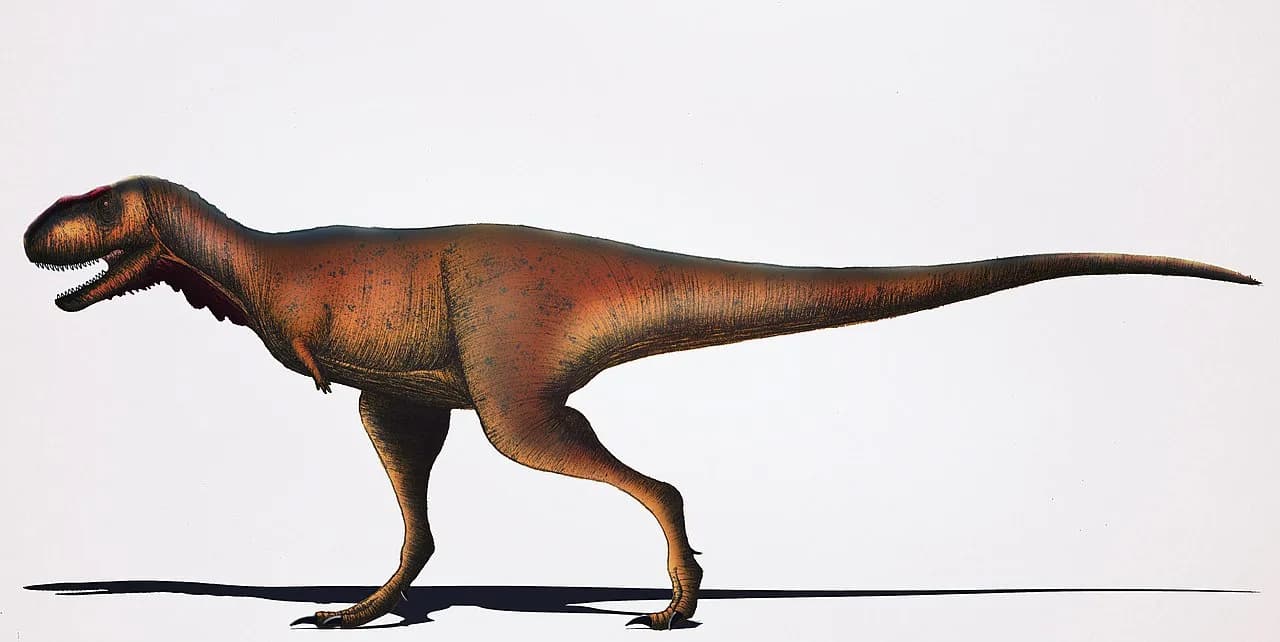
Rugops reconstruction
Wikimedia Commons