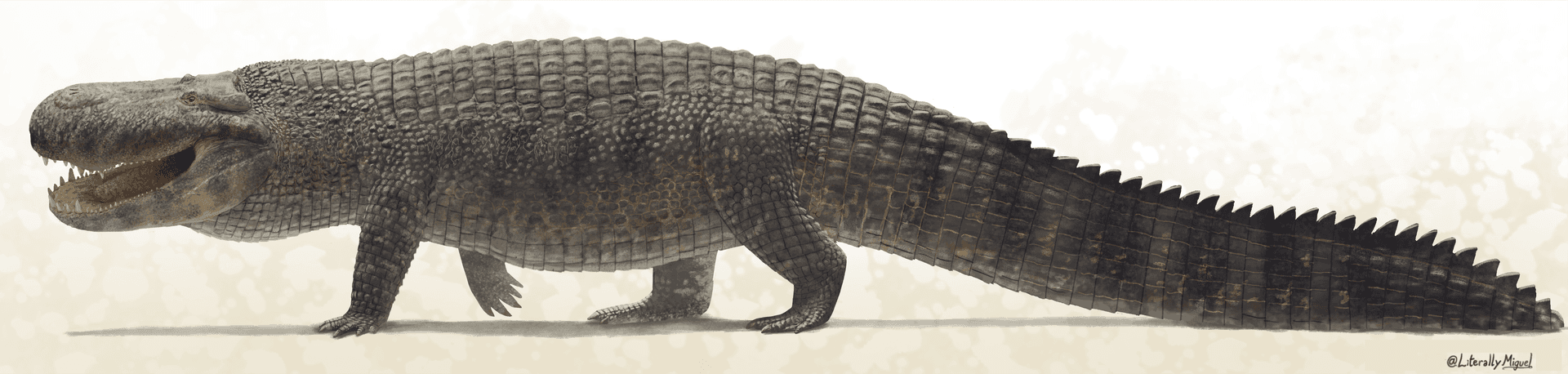
Purussaurus
Purussaurus brasiliensis was a giant South American crocodilian, described in 1892 and present 13 to 5 million years ago. At 10 to 12.5 metres and 5 to 8.4 tonnes, it carried a 1.4-metre skull — the largest crocodilian skull ever found. It lived in an Amazonian mega-lake larger than the Mediterranean Sea.
Purussaurus lived during the Middle to Late Miocene, approximately 13 to 5 million years ago, in the wetlands and giant river systems of what is now the Amazon basin. This colossal caiman belongs to the family Alligatoridae, subfamily Caimaninae — making it a direct relative of modern caimans, but incomparably larger. It dominated the freshwater ecosystems of the proto-Amazon, a vast lacustrine and swampy system called the Pebas system that covered much of western Amazonia. Its gradual extinction is linked to the drying of this mega-lake and the establishment of the modern Amazon river system.
Purussaurus brasiliensis is the largest caiman and one of the largest crocodilians of all time. Estimates based on complete skulls and allometric analyses place its length between 10 and 12.5 meters, with an estimated weight between 5 and 8.4 tonnes — rivaling the largest specimens of Deinosuchus and Sarcosuchus. Its skull alone measured approximately 1.4 meters long, the largest crocodilian skull ever discovered. Its bite force, estimated at approximately 69,000 Newtons, is the second most powerful calculated for a fossil crocodilian, after Deinosuchus. Its massive, rounded posterior teeth were capable of crushing the most resistant bones.
Purussaurus was the undisputed apex predator of South American Miocene freshwater ecosystems. Its diet included large fish, giant freshwater turtles, terrestrial mammals coming to drink at riverbanks, and potentially small freshwater cetaceans and sirenians (manatees). Its massive jaw and robust teeth allowed it to capture and crush very large prey. Biomechanical analyses suggest it could perform the fearsome 'death roll' characteristic of modern crocodilians, but at a much larger scale. Its position at the top of the food chain is confirmed by the absence of any terrestrial or aquatic predator of comparable size in its ecosystem.
Purussaurus inhabited the Pebas system, an immense network of lakes, swamps, and waterways that occupied much of northwestern South America during the Miocene. This environment, often described as a 'mega-lake' or 'mega-wetland,' extended over more than one million square kilometers — an area comparable to the Mediterranean Sea. Its fossils have been discovered in Brazil (Acre State), Peru, Colombia, and Venezuela. The warm, nutrient-rich waters of this system supported extraordinary biodiversity, including giant turtles, bull-sized rodents, and primitive freshwater dolphins.
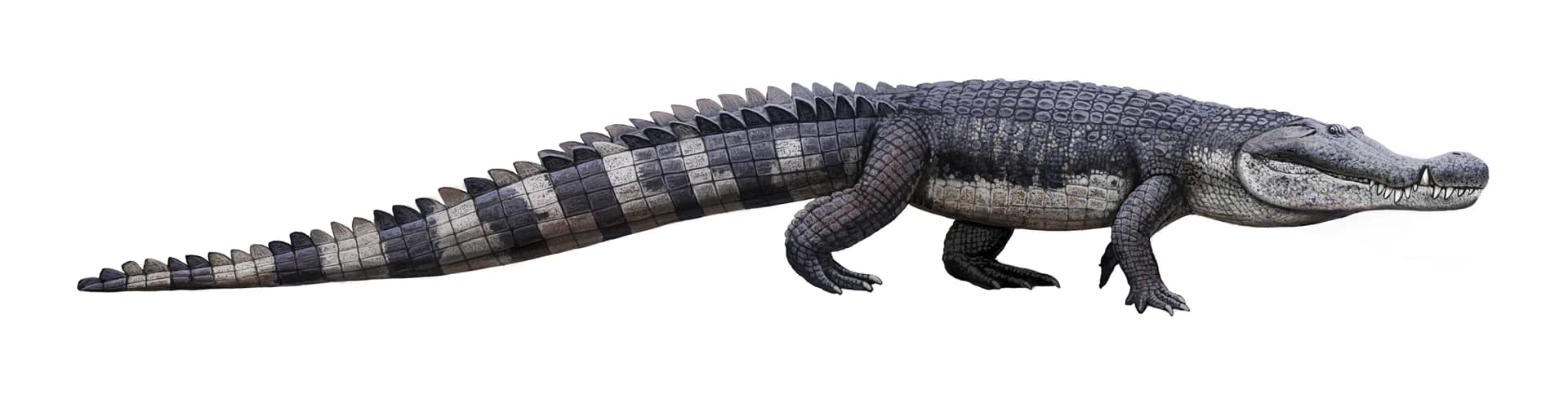
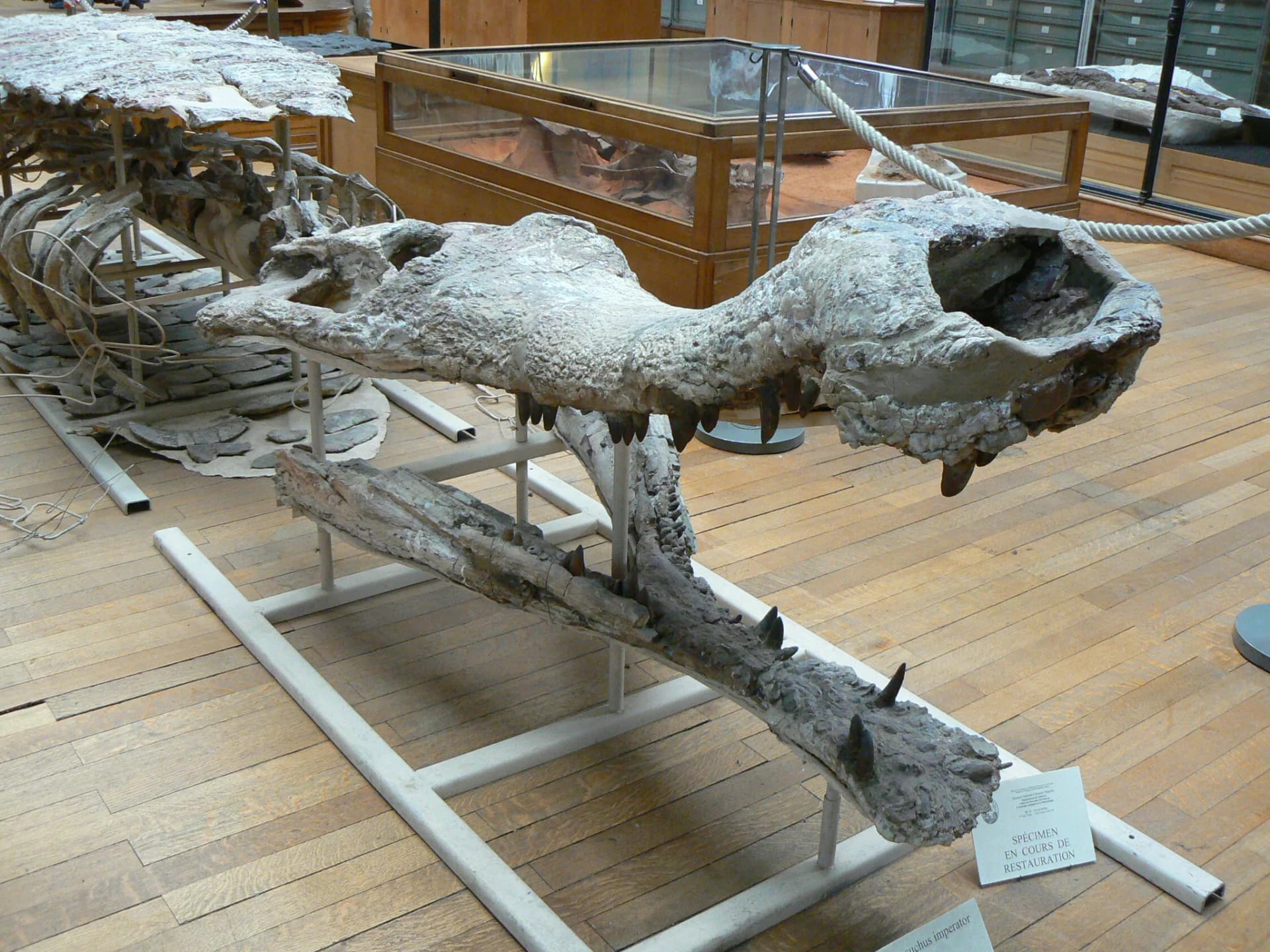
The skull of Purussaurus, measuring approximately 1.4 meters, is the largest crocodilian skull ever discovered. It features a broad, robust snout adapted for capturing large prey rather than catching fish. Its orbits, relatively small compared to skull size, were positioned dorsally for binocular vision above the water surface. Its massive conical teeth, particularly the rounded posterior teeth, were adapted for crushing bones and shells. Its body was covered with thick osteoderms forming dorsal armor. Its robust hindlimbs suggest it retained some terrestrial agility despite its colossal mass.
Purussaurus was probably a classic ambush predator, similar to modern crocodilians but operating at a much larger scale. Lurking in the murky waters of the Pebas system swamps and lakes, it waited for terrestrial mammals, giant turtles, or other prey to approach the water's edge before launching an explosive attack. Its colossal bite force allowed it to subdue almost any prey in its environment. Like large modern crocodilians, it probably used the 'death roll' to dismember prey too large to swallow whole. Its thermoregulation, based on basking on riverbanks, required vast sunlit areas — a factor that may have limited its distribution to the open environments of the Pebas system.
Purussaurus was first described by Brazilian naturalist João Barbosa Rodrigues in 1892, from fossils discovered along the Purus River in Acre State, Brazil — hence its name ('Purus lizard'). Three species are recognized: P. brasiliensis (type, the largest), P. neivensis (Colombia), and P. mirandai (Venezuela). The most impressive specimen is a nearly complete skull of P. brasiliensis measuring 1.4 meters long, discovered in Brazil. Recent studies using computed tomography have revealed internal skull details impossible to observe otherwise. The Solimões Formation in Brazil and the Urumaco Formation in Venezuela are the main fossil-bearing deposits.
| Period | Miocène moyen-supérieur / Middle-Late Miocene |
| Era | Cénozoïque / Cenozoic |
| Age | 13-5 Ma |
| Location | Brésil, Pérou, Colombie, Venezuela / Brazil, Peru, Colombia, Venezuela |
| Length | 10-12.5 m |
| Height | 1 m |
| Weight | 5-8.4 tonnes |
| Diet | Piscivore |
| Discovery | 1892 |
The bite force of Purussaurus brasiliensis is estimated at approximately 69,000 Newtons, the second most powerful calculated for a fossil crocodilian, after Deinosuchus. Its 1.4-meter skull — the largest crocodilian skull ever discovered — bore massive, rounded posterior teeth adapted for crushing bones and giant freshwater turtle shells.
Purussaurus brasiliensis inhabited the Pebas system, a network of lakes and swamps covering over one million square kilometers in northwestern South America (Brazil, Peru, Colombia, Venezuela) during the Miocene (13–5 Ma). This mega-lake, comparable in area to the Mediterranean Sea, hosted giant turtles, bull-sized rodents, and primitive freshwater dolphins.
Purussaurus brasiliensis was a caiman (family Alligatoridae, subfamily Caimaninae), a direct relative of modern caimans like the black caiman (Melanosuchus niger, ~4 m). But Purussaurus reached 10 to 12.5 meters weighing 5 to 8.4 tonnes — about 4 to 5 times longer than the largest modern black caiman. Brazilian naturalist João Barbosa Rodrigues described it in 1892 from fossils along the Purus River (Acre, Brazil).
Purussaurus brasiliensis life reconstruction
Wikipedia Commons
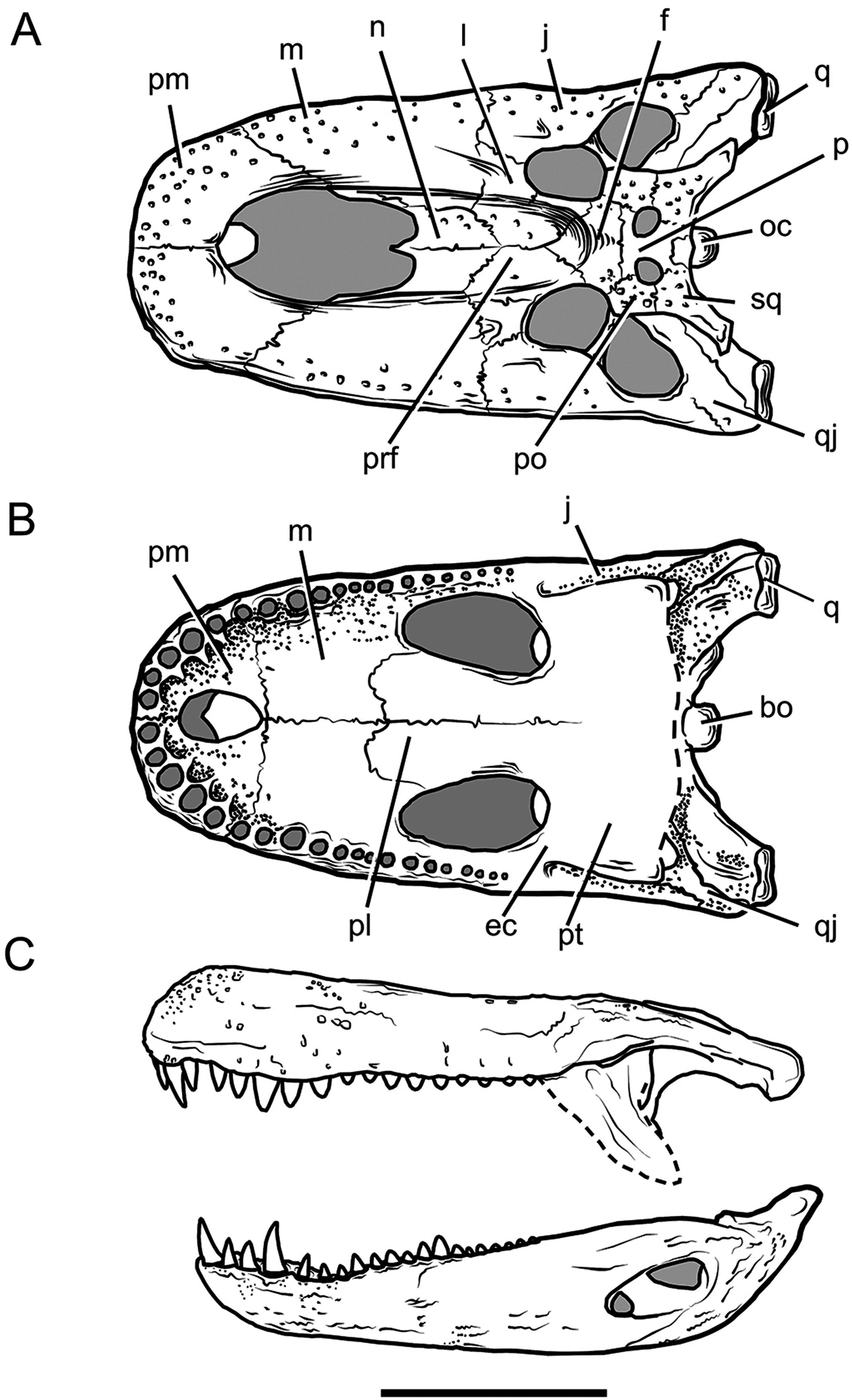
Purussaurus fossil skull
Wikipedia Commons