Machimosaurus
Machimosaurus hugii is among the oldest named crocodyliform genera: described in 1837, barely fifteen years after the first scientific description of a dinosaur. Five to 7 metres long and 1 to 3 tonnes, it frequented Europe and North Africa 157 to 130 million years ago. The species M. rex, found in Tunisia in 2016, revived interest in the genus.
Machimosaurus lived during the Late Jurassic and Early Cretaceous, approximately 157 to 130 million years ago (Kimmeridgian to Hauterivian). This giant marine crocodyliform belongs to the family Teleosauridae (or Machimosauridae in recent classifications), a group of thalattosuchians — marine crocodilians adapted to sea life that dominated the coastlines of the Jurassic and Early Cretaceous seas. It represents one of the largest members of this group, evolving in the warm, shallow seas of the Tethys that bathed present-day Europe, North Africa, and parts of the Middle East.
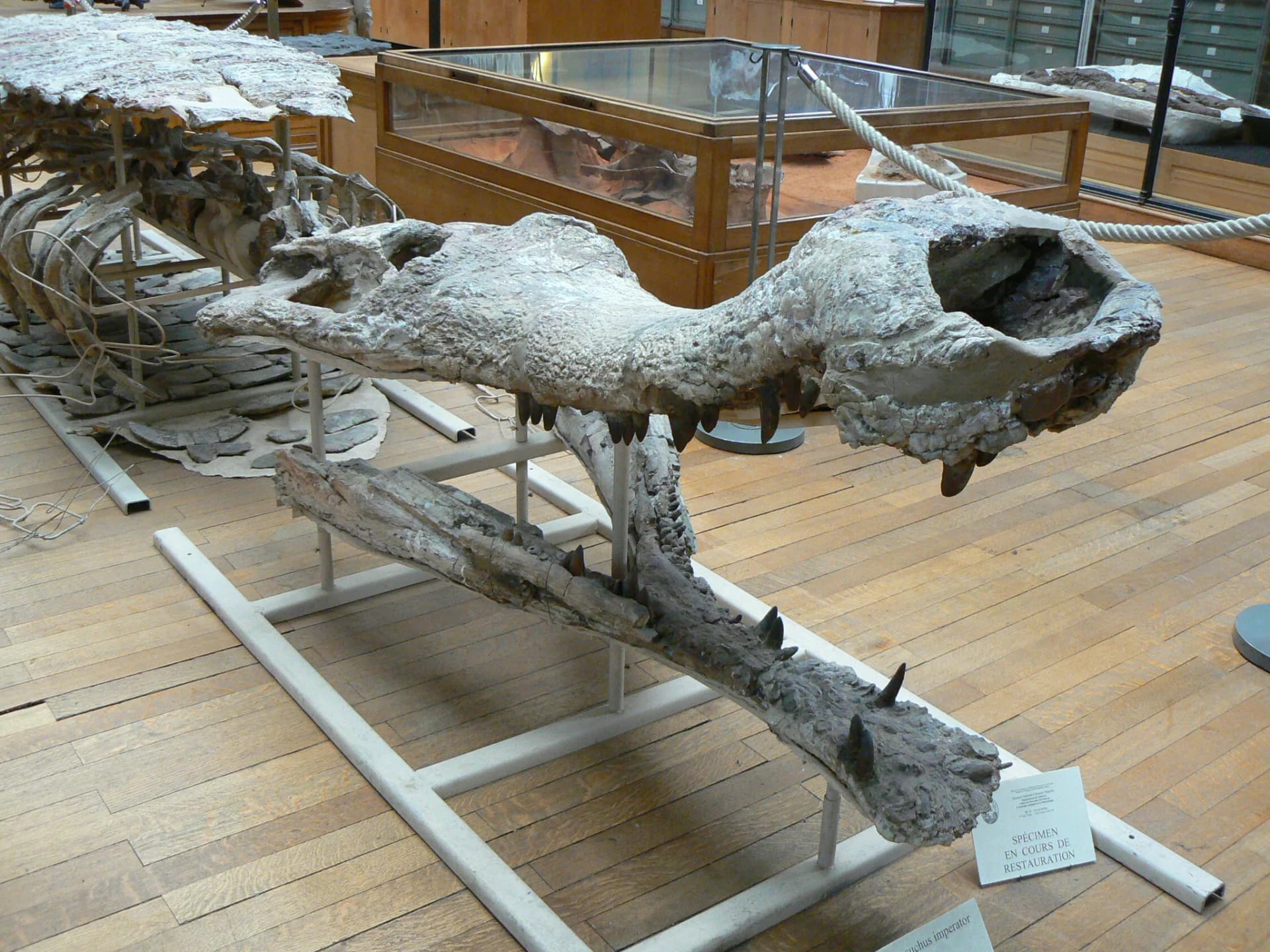
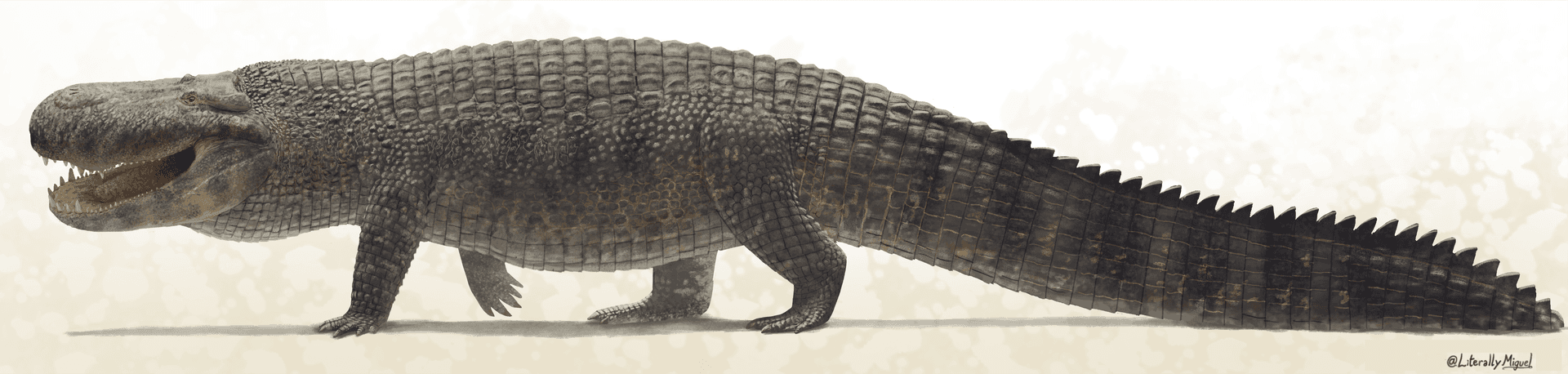
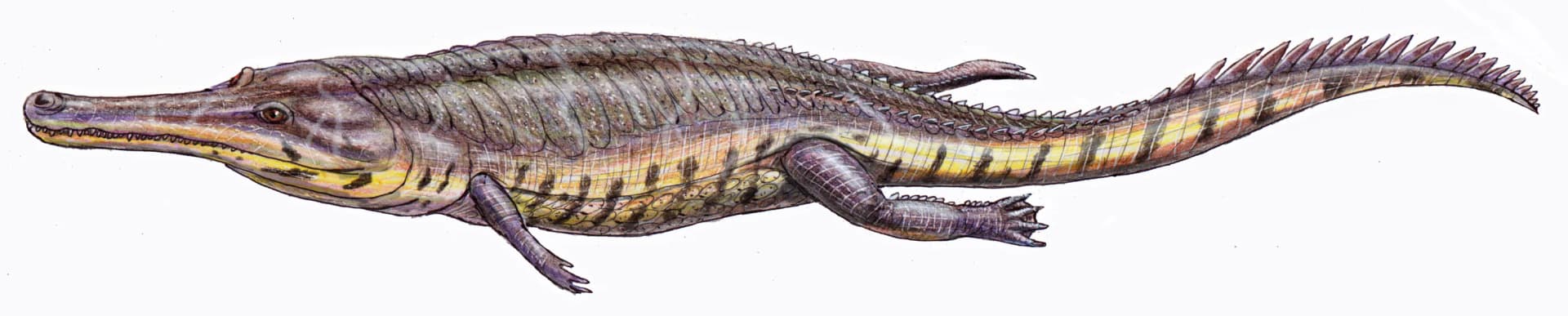
Machimosaurus is one of the largest thalattosuchians and one of the largest known marine crocodyliforms. The species M. rex, described in 2016 from Tunisian Early Cretaceous fossils, is estimated at approximately 6 to 7 meters in length — potentially the largest teleosaurid ever discovered. Other species (M. hugii, M. mosae) reached 5 to 6 meters. Its weight is estimated between 1 and 3 tonnes depending on species. Its robust, elongated skull measured approximately 60 to 80 centimeters, with a broad, flat snout adapted for capturing hard-shelled prey. Its rounded, massive posterior teeth clearly distinguish it from other teleosaurids with more pointed teeth.
Machimosaurus was a predator specialized in consuming hard-shelled prey — a dietary strategy called durophagy. Its massive, rounded posterior teeth with flattened crowns were perfectly adapted for crushing sea turtle shells, ammonite shells, and crustacean exoskeletons. This dietary specialization is confirmed by dental wear analyses showing characteristic micro-scratches from crushing. The anterior teeth, more pointed and conical, probably served to seize prey before the posterior teeth crushed them. It could also feed on fish and other opportunistic prey when turtles and crustaceans were scarce.
Machimosaurus inhabited the warm, shallow seas of the Tethys, a vast tropical ocean that separated Europe from Africa during the Jurassic and Cretaceous. Its fossils have been discovered in Portugal, Spain, France, England, Switzerland, Germany, Ethiopia, and Tunisia — a remarkably wide geographic distribution indicating a cosmopolitan species in the western Tethys. Depositional environments include coastal lagoons, shallow carbonate platforms, and epicontinental seas. The 2016 discovery of M. rex in Tunisia extended the geographic and temporal distribution of the genus to the Early Cretaceous of North Africa.
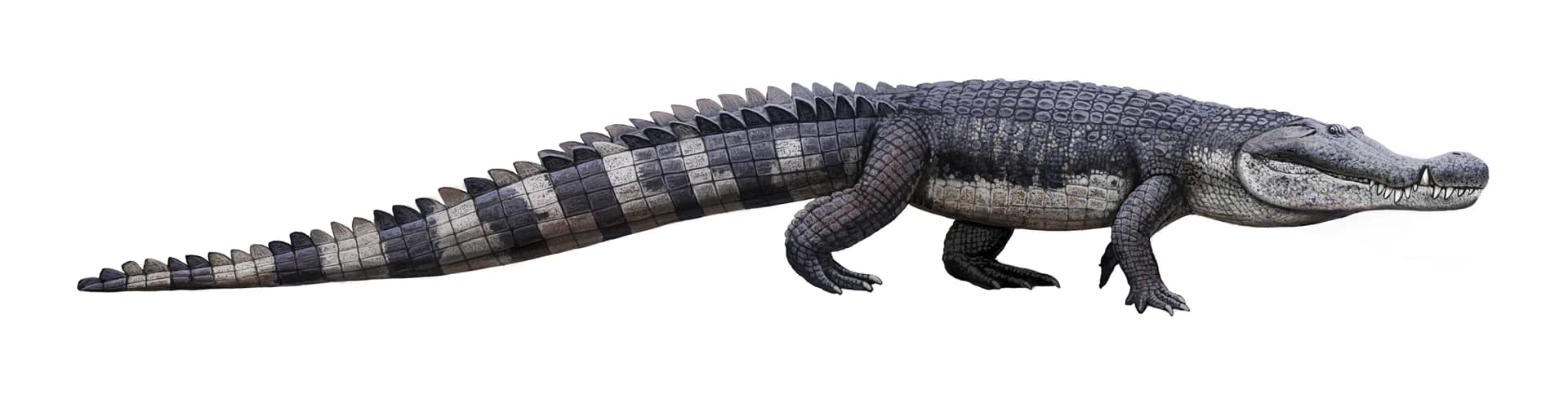
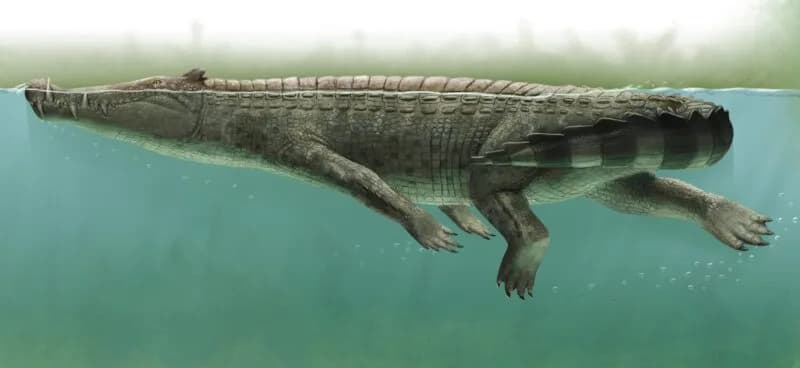
The anatomy of Machimosaurus reflects its dual adaptation to marine life and durophagy. Its skull is robust and broad, with a proportionally short snout compared to other piscivorous teleosaurids. Its most distinctive feature is its heterodont dentition: conical anterior teeth for grasping, and rounded, massive posterior teeth with flattened crowns for crushing. Its limbs, while retaining the basic crocodilian structure, were probably adapted for swimming with partially webbed feet. Its powerful, laterally compressed tail served as the main propulsor. Its dorsal osteoderms, thick and well-developed, formed a protective armor even in the marine environment.
Machimosaurus was probably a coastal predator that hunted in the shallow waters of Tethyan lagoons and carbonate platforms. Its durophagous specialization suggests it spent a significant portion of its time patrolling shallow seafloors searching for turtles, ammonites, and crustaceans whose hard shells it could crush with its powerful rounded posterior teeth. Unlike the fully pelagic metriorhynchids that were entirely adapted to open-ocean life, Machimosaurus probably retained the ability to move on land for resting, egg-laying, and thermoregulation — similar to modern marine crocodilians like the saltwater crocodile Crocodylus porosus. Its remarkably wide geographic distribution across the Tethys suggests considerable open-water swimming capabilities for colonizing new coastal regions.
Machimosaurus was first described by German paleontologist Christian Erich Hermann von Meyer in 1837, making it one of the oldest named fossil crocodyliform genera. The name means 'fighting lizard' (from Greek machimos 'fighting' + sauros 'lizard'). The type species, M. hugii, is known from the Kimmeridgian of Portugal and Switzerland. The 2016 description of M. rex by Fanti et al. from a remarkably complete Tunisian specimen made media headlines as 'the world's largest marine crocodyliform.' Four species are currently recognized: M. hugii, M. mosae, M. nowackianus, and M. rex. Late Jurassic deposits in Portugal are among the most productive.
| Period | Jurassique sup. – Crétacé inf. / Late Jurassic – Early Cretaceous |
| Era | Mésozoïque / Mesozoic |
| Age | 157-130 Ma |
| Location | Europe (Portugal, France, Angleterre), Afrique du Nord (Tunisie, Éthiopie) / Europe (Portugal, France, England), North Africa (Tunisia, Ethiopia) |
| Length | 5-7 m |
| Height | 0.8 m |
| Weight | 1-3 tonnes |
| Diet | Piscivore |
| Discovery | 1837 |
No. Machimosaurus hugii was a marine crocodyliform belonging to the family Teleosauridae (thalattosuchians) — an extinct group of marine reptiles related to modern crocodilians but distinct from dinosaurs. It lived from the Late Jurassic to the Early Cretaceous, 157 to 130 million years ago, in the warm Tethys seas.
Machimosaurus hugii practiced durophagy — specialization in hard-shelled prey. Its massive posterior teeth with flattened crowns, confirmed by dental wear analyses, were designed to crush sea turtle shells, ammonite shells, and crustacean exoskeletons. This specialization is unique among thalattosuchians, most of which had conical teeth for catching fish.
The largest species is Machimosaurus rex, estimated at 6 to 7 meters long — potentially the largest teleosaurid ever discovered. Described in 2016 by Fanti et al. from a remarkably complete specimen from Tunisia (Early Cretaceous), it extended the genus' geographic range to North Africa. The type species M. hugii is known from the Kimmeridgian of Portugal and Switzerland.
Machimosaurus life reconstruction
Dmitry Bogdanov, CC BY 3.0
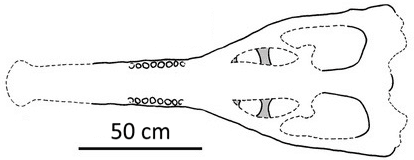
Palatal view of Machimosaurus rex skull
Wikipedia Commons