Prestosuchus
Prestosuchus chiniquensis was a rauisuchid from Brazil, described in 1938 and dated to 238 to 235 million years ago. At 5 to 7 metres and 300 to 400 kilograms, it was neither a dinosaur nor a true crocodile: a crocodilian relative that walked with its legs beneath its body. It dominated land ecosystems before dinosaurs rose.
Prestosuchus lived during the Middle Triassic, approximately 238 to 235 million years ago (Ladinian), in what is now southern Brazil. Discovered in 1938 by Friedrich von Huene in the Santa Maria Formation, Rio Grande do Sul, it was named in honor of Brazilian geologist Vicentino Prestes de Almeida. Prestosuchus is not a true crocodile but a rauisuchid, a group of pseudosuchians (crocodile-line archosaurs) that dominated terrestrial ecosystems before the rise of dinosaurs. These apex predators represented the supreme terror of the Middle Triassic landscape.
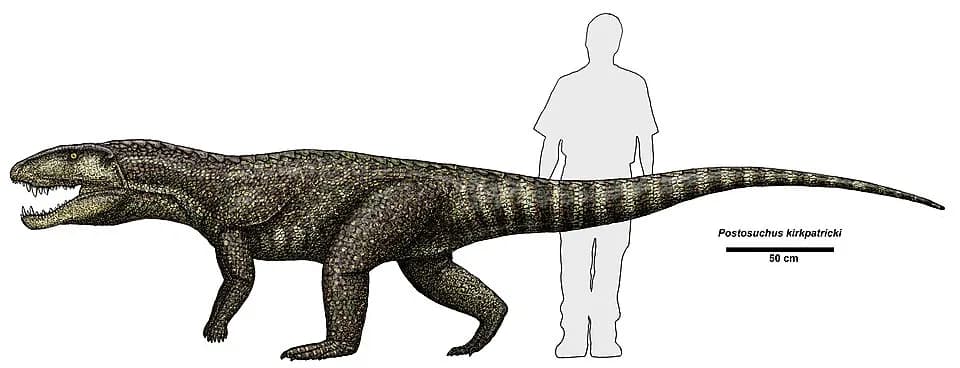
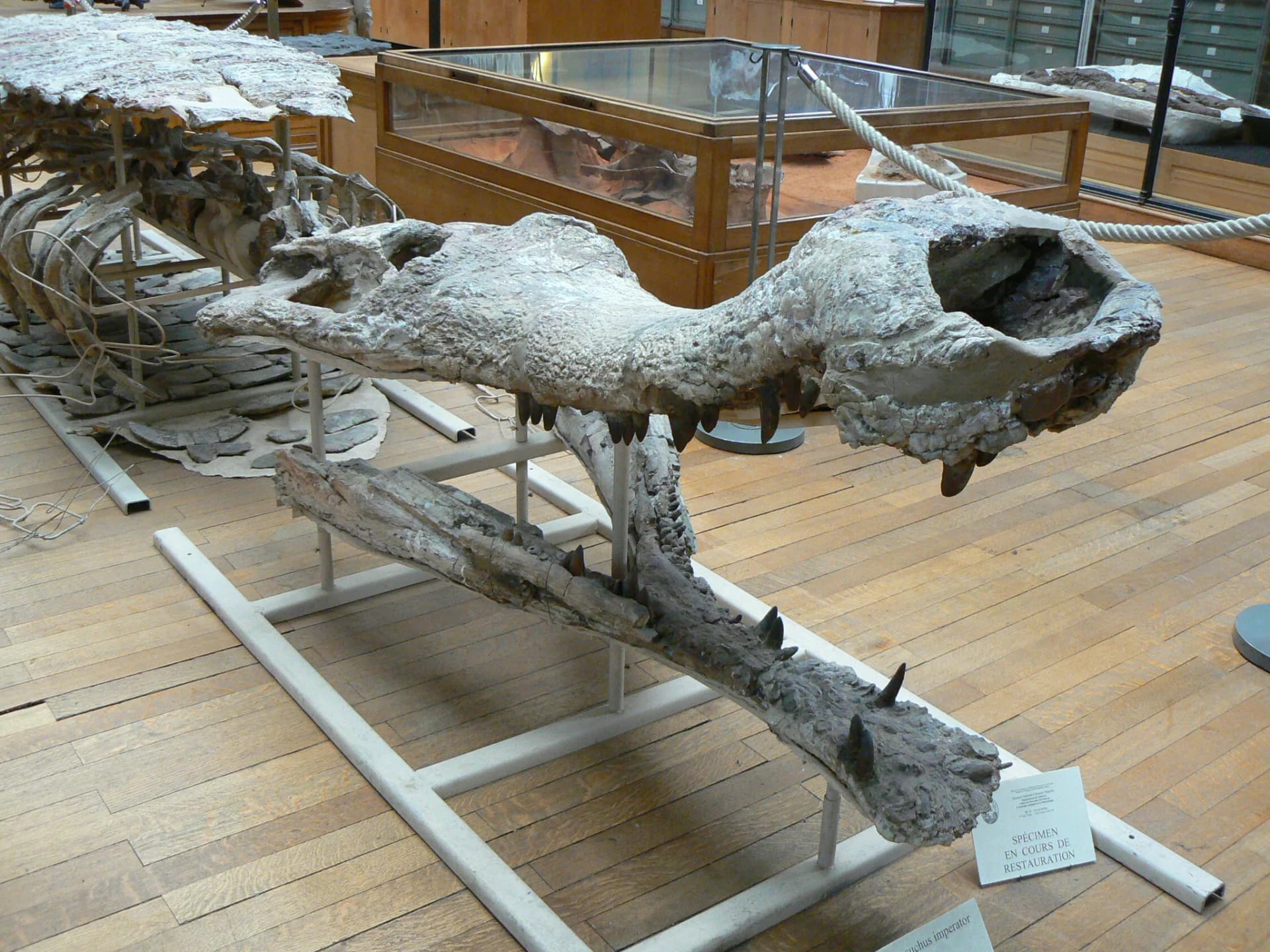
Prestosuchus chiniquensis measured between 5 and 7 meters in total length and reached a height of approximately 1.5 meters at the hips, with an estimated weight between 300 and 400 kilograms. Its size made it the largest terrestrial predator in its Triassic ecosystem, vastly outclassing the first dinosaurs that were still modest in size. Its massive, deep skull measured approximately 60 centimeters in length, armed with laterally compressed, sharp, backward-curving teeth perfectly adapted for tearing the flesh of its prey. Its jaws could exert considerable bite force.
A strict carnivore and undisputed apex predator of its time, Prestosuchus actively hunted the large herbivores of the Middle Triassic, including dicynodonts like Stahleckeria, rhynchosaurs, and the first herbivorous dinosaurs that were still of modest size. Its ziphodont teeth, laterally compressed and finely serrated, were perfect cutting tools for slicing through muscle tissue and tendons. Its hunting technique likely relied on ambush followed by an explosive attack, using its powerful jaws to inflict fatal wounds. It probably also scavenged carcasses when the opportunity arose.
Prestosuchus inhabited the alluvial plains and wooded areas of southern Gondwana, in what is now southern Brazil, specifically in the state of Rio Grande do Sul. The Santa Maria Formation, from which its fossils originate, represents a floodplain environment with seasonal rivers and vegetation composed of primitive conifers, ferns, and giant horsetails. The Middle Triassic climate was hot and semi-arid with marked wet seasons. This productive ecosystem harbored a remarkably diverse fauna including massive dicynodonts, agile cynodonts, and the very earliest small dinosaurs that would eventually inherit the Earth.
The anatomy of Prestosuchus reveals a highly specialized terrestrial predator, very different from modern crocodilians. Unlike today's crocodiles that sprawl along the ground, Prestosuchus walked in a semi-erect posture with limbs placed partially beneath the body, giving it more efficient locomotion and greater terrestrial speed. Its skull, tall and laterally compressed, differed radically from the flattened skull of modern crocodiles. The robust vertebral column supported a powerfully muscled body. The hind limbs, longer than the forelimbs, suggest a slightly bipedal posture during running.
As the apex predator of the Middle Triassic in Brazil, Prestosuchus reigned supreme over an ecosystem where dinosaurs were still only secondary players of modest size. Its semi-erect posture gave it a significant locomotor advantage over sprawling predators, allowing it to actively pursue prey over short distances. Rauisuchids like Prestosuchus dominated terrestrial ecosystems for millions of years before the Triassic-Jurassic extinction freed the ecological niches that would subsequently be filled by dinosaurs. It likely hunted as a solitary predator across vast territories.
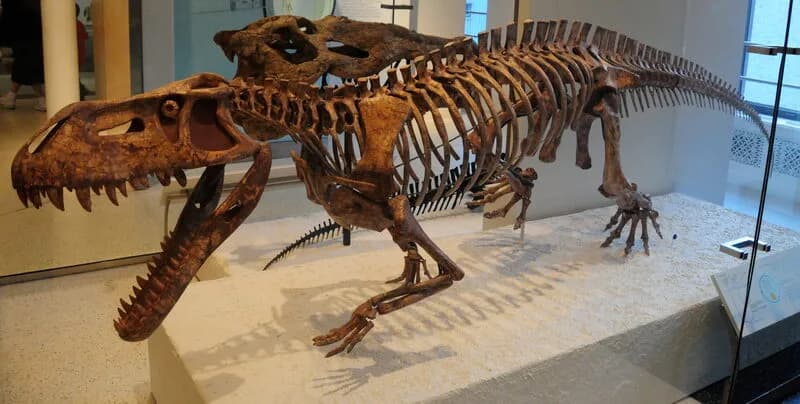
The holotype of Prestosuchus chiniquensis was described in 1938 by German paleontologist Friedrich von Huene from fossils discovered in the Santa Maria Formation, in the municipality of São Pedro do Sul, Rio Grande do Sul, Brazil. Since then, several additional specimens have been discovered in the same geological formation, including a remarkably complete skeleton (UFRGS-PV-0629-T) that enabled detailed reconstructions of its anatomy and biomechanics. Fossils are primarily housed at the Universidade Federal do Rio Grande do Sul. The most comprehensive description was published by Desojo and Rauhut in 2009.
| Period | Trias moyen / Middle Triassic |
| Era | Mésozoïque / Mesozoic |
| Age | 238-235 Ma |
| Location | Brésil (Rio Grande do Sul) / Brazil (Rio Grande do Sul) |
| Length | 5-7 m |
| Height | 1.5 m |
| Weight | 300-400 kg |
| Discovery | 1938 |
No. Prestosuchus chiniquensis was a rauisuchid, a pseudosuchian of the crocodilian lineage, not a dinosaur. It lived in the Middle Triassic (238–235 Ma) in Brazil and dominated terrestrial ecosystems before the rise of dinosaurs. Unlike modern sprawling crocodilians, it walked in a semi-erect posture with limbs partially beneath the body.
Prestosuchus chiniquensis measured between 5 and 7 meters long, standing about 1.5 meters at the hips, with an estimated weight of 300 to 400 kilograms. Its massive skull reached 60 centimeters, armed with recurved ziphodont teeth. It was the largest terrestrial predator of its Brazilian Triassic ecosystem.
The holotype of Prestosuchus chiniquensis was described in 1938 by Friedrich von Huene from the Santa Maria Formation in Rio Grande do Sul, Brazil. The remarkably complete skeleton UFRGS-PV-0629-T enabled detailed anatomical reconstructions. The most comprehensive description was published by Desojo and Rauhut in 2009. Fossils are housed at the Universidade Federal do Rio Grande do Sul.
Mounted skeleton of Prestosuchus chiniquensis
Wikimedia Commons, CC BY-SA
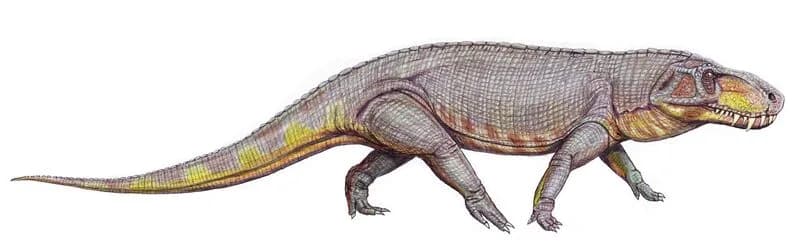
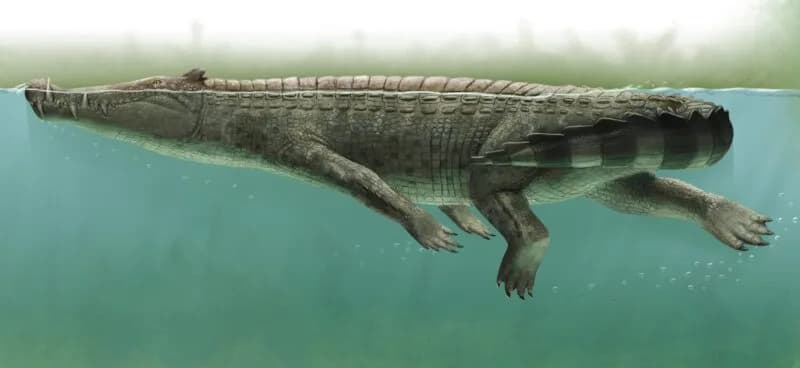
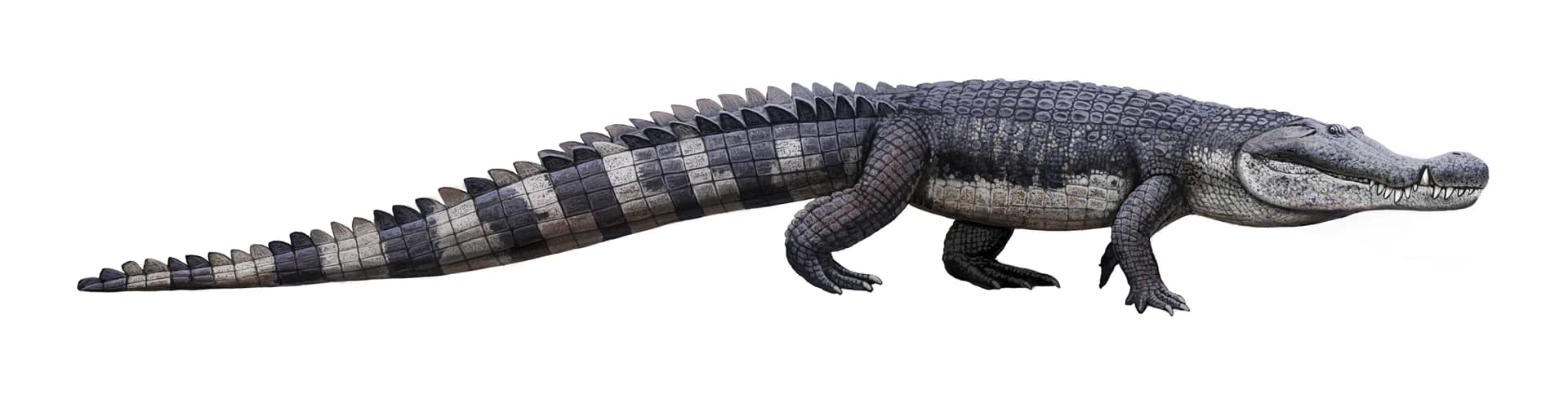
Reconstruction of Prestosuchus chiniquensis, Triassic predator
Wikimedia Commons, CC BY-SA