Platyhystrix
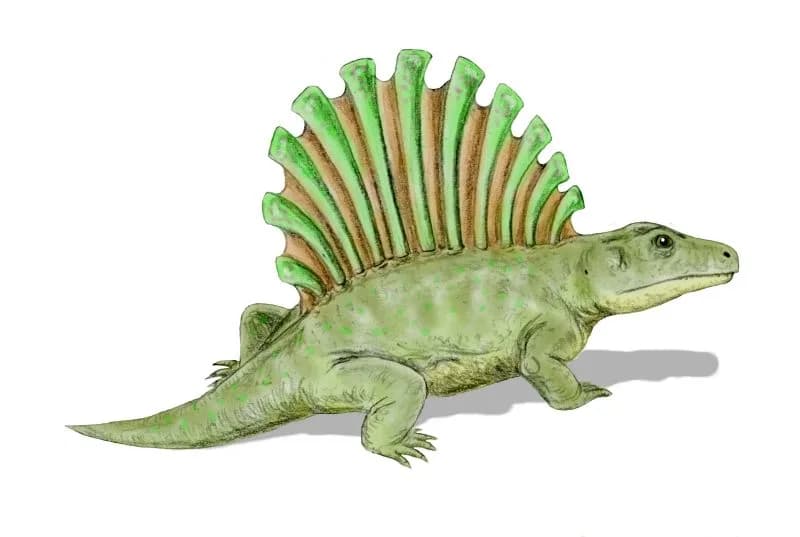
Platyhystrix rugosus carried a dorsal sail much like that of Dimetrodon, with which it shared Texas and New Mexico 295 to 280 million years ago. The two are nonetheless unrelated: one is a metre-long amphibian of 5 to 8 kilograms, the other a synapsid. The same solution appeared twice, independently.
Platyhystrix lived during the Early Permian, approximately 295 to 280 million years ago (Sakmarian-Artinskian). This temnospondyl amphibian inhabited the wetlands and swamps of what is now the southwestern United States, notably New Mexico and Texas. At that time, the supercontinent Pangaea was forming, and equatorial regions experienced a humid tropical climate with forests of giant ferns and lycophytes. Platyhystrix shared its environment with the famous sail-backed synapsids like Dimetrodon and Edaphosaurus.
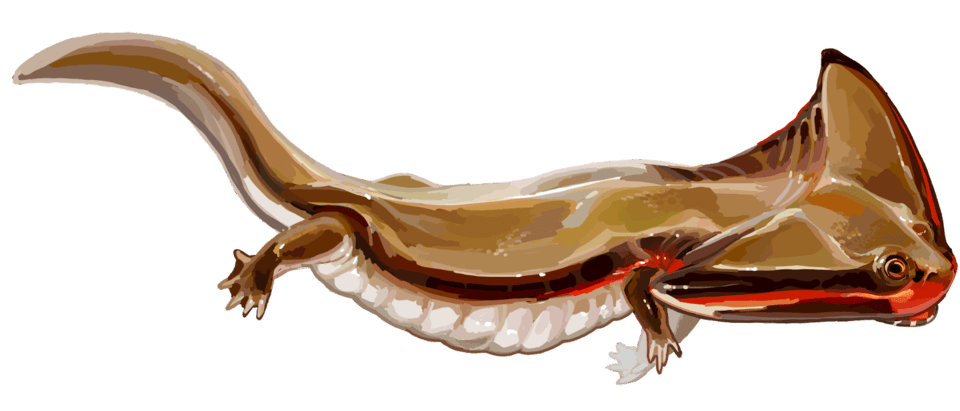
Platyhystrix rugosus measured approximately 1 meter in total length, making it a medium-sized amphibian for the Early Permian. Its most striking feature was its dorsal sail formed by elongated neural spines on the thoracic vertebrae, similar in appearance to Dimetrodon's but independently evolved. The sail reached about 15 centimeters in height. Its skull was broad and flattened, typical of dissorophid temnospondyls, with a visible otic notch.
Platyhystrix was a semi-aquatic carnivore that fed primarily on terrestrial insects, small amphibians, and freshwater fish. Its jaw bore conical teeth adapted for capturing slippery prey. Like many temnospondyls, it probably hunted both on land and in water, exploiting both environments depending on prey availability. In the Permian swamps, giant insects like 30 cm dragonflies and massive millipedes were prime prey.
Platyhystrix inhabited the swamps, floodplains, and humid lowland forests of the Early Permian equatorial lowlands. The geological formations of New Mexico (Cutler Formation) and Texas (Abo Formation) reveal an environment of alluvial plains with seasonal streams and permanent swampy areas. The lush vegetation included forests of tree ferns, calamites (giant horsetails), and lycophytes, creating dense cover suitable for amphibians.
Platyhystrix's anatomy combines the typical traits of dissorophid temnospondyls with a remarkable innovation: a dorsal sail. The neural spines of the thoracic vertebrae are considerably elongated and connected by a skin membrane, forming a structure similar to Dimetrodon's but evolved entirely independently — a spectacular case of convergent evolution. Its skull possessed a well-developed otic notch, probably covered by a tympanic membrane for aerial hearing. The cranial bone surfaces displayed the ornate sculptures typical of temnospondyls.
Platyhystrix probably led a semi-aquatic lifestyle, alternating between terrestrial areas for thermoregulation and shallow waters for hunting and reproduction. Its dorsal sail likely served for thermoregulation, allowing it to warm up rapidly in the morning by exposing its large vascular surface to the sun — a crucial advantage for an ectotherm in the cool Permian mornings. This function is the same as proposed for Dimetrodon, illustrating how very different animals found the same solution to the same problem.
Platyhystrix rugosus was described by Case in 1910, from fossils discovered in Early Permian formations of New Mexico. Additional material was found in the Abo Formation of New Mexico and equivalent beds in Texas. Specimens include vertebrae with their characteristic elongated neural spines, cranial elements, and limb bones. Work by Berman, Reisz, and Fracasso (1981) clarified the taxonomy and phylogenetic relationships of the animal within Dissorophidae.
| Period | Permien inférieur / Early Permian |
| Era | Paléozoïque / Paleozoic |
| Age | 295-280 Ma |
| Location | Nouveau-Mexique, Texas (USA) / New Mexico, Texas (USA) |
| Length | ~1 m |
| Height | ~20 cm (avec voile / with sail) |
| Weight | 5-8 kg |
| Diet | Carnivore |
| Discovery | 1910 |
Platyhystrix rugosus was neither a dinosaur nor a reptile. It was a temnospondyl, a prehistoric amphibian belonging to an extinct group. It lived 295 to 280 million years ago, more than 50 million years before dinosaurs appeared. Its dorsal sail resembles that of Dimetrodon (a synapsid), but the two animals share no close relationship — it is convergent evolution.
The dorsal sail of Platyhystrix rugosus, formed by 15 cm neural spines connected by a membrane, is a case of convergent evolution with Dimetrodon. The most likely function is thermoregulation: by exposing the vascularized surface to morning sunlight, this ectotherm warmed up faster than its sail-less contemporaries — a decisive advantage in the Permian swamps of Texas and New Mexico.
Platyhystrix rugosus measured approximately 1 meter in length and weighed 5 to 8 kg — a medium-sized amphibian for the Early Permian. It shared the swamps and floodplains of Texas and New Mexico with Dimetrodon (a 4 m synapsid predator), Edaphosaurus (a sail-backed herbivorous synapsid), and Eryops (a large 2 m amphibian), in an ecosystem of tree fern forests approximately 285 million years ago.
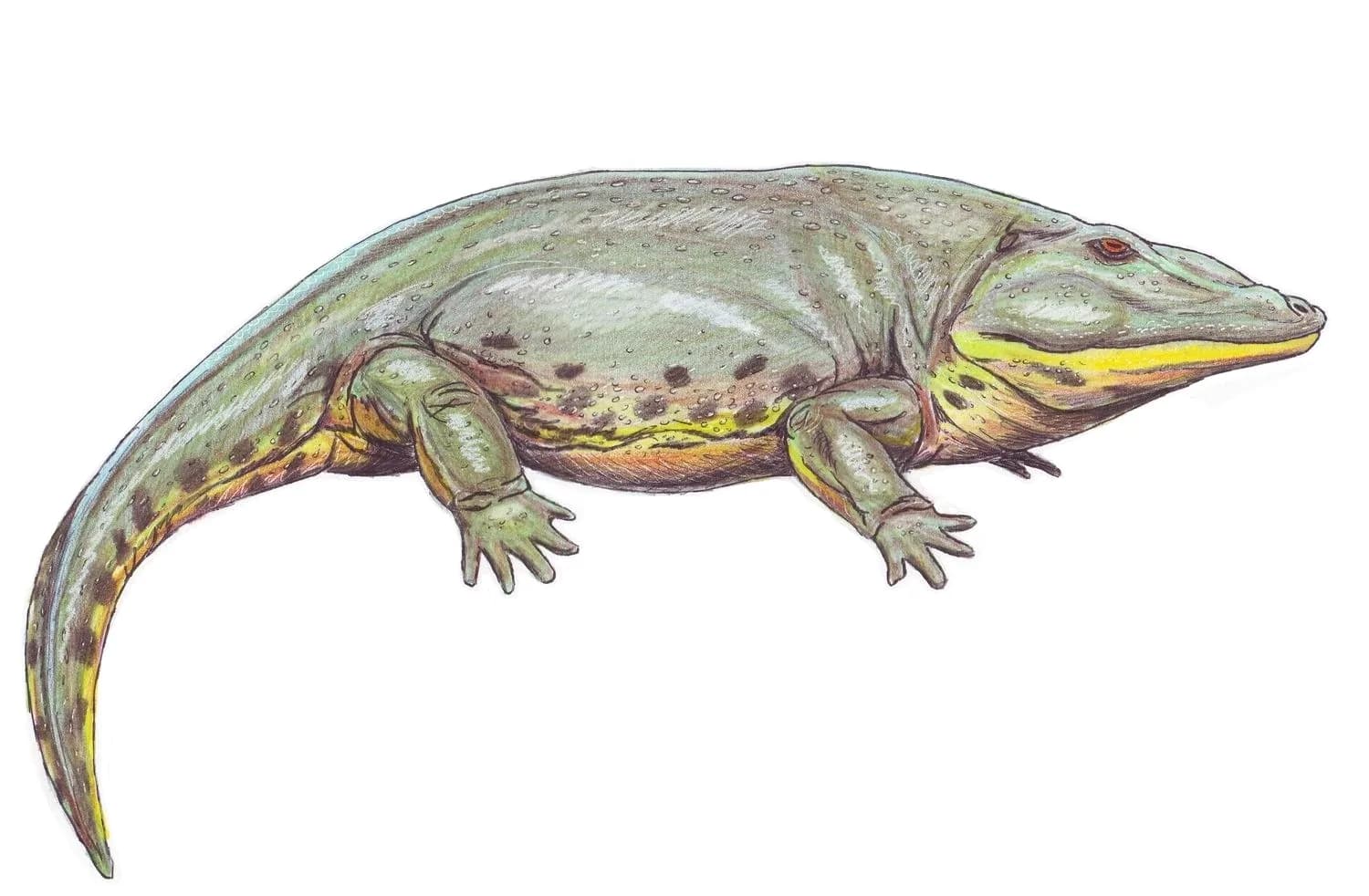
Platyhystrix rugosus life reconstruction
Wikimedia Commons