Paracérathérium
Paraceratherium transouralicum is the largest land mammal of all time: 7 to 8 metres and 15 to 20 tonnes, four times an adult African elephant. Its head cleared the roof of a two-storey building. This hornless rhinoceros ranged across Eurasia, from Pakistan to Turkey, between 34 and 23 million years ago.
Paraceratherium lived during the Oligocene, approximately 34 to 23 million years ago, across the vast plains and open forests of Eurasia. This giant hornless rhinoceros represents the largest land mammal ever to walk the Earth's surface, a record it has held for over 20 million years. The genus appeared in the early Oligocene in Central Asia, at a time when the global climate was cooling after the Eocene thermal optimum, driving the transformation of tropical forests into more open savannas and grasslands. Paraceratherium belongs to the family Hyracodontidae, a lineage of running rhinoceroses that diversified considerably during the Paleogene. Its disappearance in the early Miocene coincides with major ecological changes in Eurasia, notably India's collision with Asia which raised the Himalayas and profoundly altered monsoon patterns and habitat distribution.
Paraceratherium holds the undisputed title of the largest terrestrial mammal of all time. The most recent estimates attribute to it a total length of 7 to 8 meters, a shoulder height of 4.8 meters, and a total head height that could reach 7 to 8 meters, allowing it to browse treetops like a giant giraffe. Its weight is estimated between 15 and 20 tonnes, three to four times that of an adult male African elephant. Its skull alone measured approximately 1.3 meters long, carried at the end of a muscular neck over 2 meters long. Its forelimbs were longer than its hindlimbs, giving it a characteristic backward-sloping silhouette. To put its size in perspective, Paraceratherium could have looked over the roof of a two-story building.
Paraceratherium was an herbivorous folivore specialized in consuming tree and shrub foliage at height, exploiting an ecological niche inaccessible to other herbivores of its time. Its prehensile upper lip, comparable to that of the modern black rhinoceros but much more developed, allowed it to grasp and tear branches and leaves at great height. Its prominent forward-facing incisors served to strip twigs and bark tree trunks. Dental microwear analyses confirm a foliage diet rather than grasses, consistent with a canopy browser. Its daily food requirements were astronomical: extrapolating from modern elephants, an adult Paraceratherium needed to consume between 200 and 400 kilograms of vegetation per day, requiring vast territories of open forest.
Paraceratherium occupied a vast territory stretching from Eastern Europe to China, through Central Asia, Pakistan, Iran, and present-day Turkey. Its preferred habitat consisted of open forests and wooded savannas of subtropical to warm temperate type, offering an abundance of trees whose canopy it could reach. During the Oligocene, central Eurasia was characterized by a warmer climate than today, with sparse forests interspersed with grasslands, an ideal landscape for a mega-herbivore tree browser. The main fossil sites are found in Pakistan (Chitarwata Formation), Mongolia (Hsanda Gol Formation), Kazakhstan, and western China. The absence of Paraceratherium in Africa and the Americas is explained by the geographic barriers of the time: the Tethys Sea still separated Eurasia from Africa, and the North Atlantic was too wide to cross.
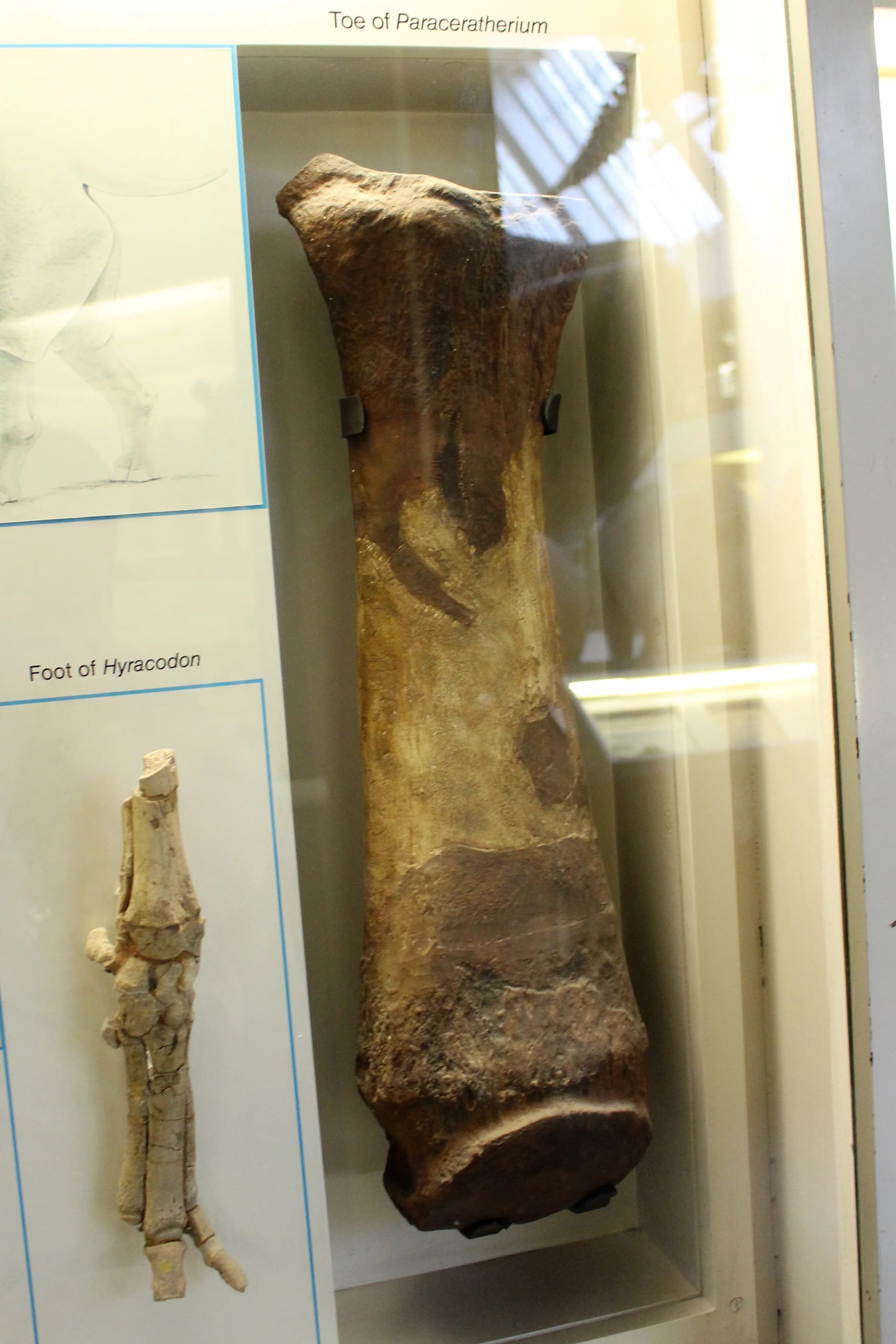
Paraceratherium's anatomy reflected the adaptations necessary to support a mass of 15 to 20 tonnes while reaching vegetation at height. Its skull, approximately 1.3 meters long, was remarkably light for its size thanks to vast frontal sinuses and pneumatized bones, a convergent adaptation with dinosaurian sauropods. Its muscular, elongated neck possessed massive cervical vertebrae with tall neural spines serving as anchors for powerful cervical muscles. Unlike modern rhinoceroses, Paraceratherium bore no horn on its nose, its defense relying solely on its colossal size. Its limbs were columnar, similar to those of an elephant, with thick straight bones designed to support enormous weight while standing. Its feet, broad with three functional toes, distributed ground pressure. Its skin was probably thick and hairless, like that of the modern rhinoceros.
Paraceratherium's behavior was probably similar to that of large modern rhinoceroses and elephants. Its gigantic size made it virtually invulnerable to adult predators of its time, including hyaenodonts and amphicyonids (bear-dogs), which likely only attacked juveniles. Due to its considerable dietary needs, Paraceratherium had to travel long distances daily, following seasonal routes between grazing areas, like modern African elephants. Males were probably solitary or semi-solitary, while females and young formed small family groups. The reproductive cycle must have been extremely slow, with a gestation estimated at over 2 years and a single calf per birth, making the species particularly vulnerable to rapid environmental changes. Its estimated lifespan likely exceeded 50 to 70 years.
The first Paraceratherium fossils were discovered in Balochistan (present-day Pakistan) in 1907 and described in 1911 by English paleontologist Clive Forster-Cooper under the name Paraceratherium bugtiense. The genus's taxonomic history is remarkably complex: the same animals were independently described under the names Indricotherium (Borissiak, 1915, Kazakhstan), Baluchitherium (Forster-Cooper, 1913, Pakistan), and Dzungariotherium (Chiu, 1973, China), before priority was given to Paraceratherium. The most complete specimen was discovered at Sain Shand, Mongolia, during Soviet-Mongolian expeditions in the 1960s, and included a nearly intact skull with much of the postcranial skeleton. Fossils have also been found in Turkey, Georgia, Romania, and northwestern China, demonstrating the genus's vast geographic distribution. In 2021, a comprehensive phylogenetic study reclassified Paraceratherium within the family Hyracodontidae rather than Rhinocerotoidea in the strict sense.
| Period | Oligocène / Oligocene |
| Era | Cénozoïque / Cenozoic |
| Age | 34 - 23 Ma |
| Location | Eurasie (Pakistan, Mongolie, Chine, Kazakhstan, Turquie) / Eurasia (Pakistan, Mongolia, China, Kazakhstan, Turkey) |
| Length | 7-8 m |
| Height | 4.8 m (au garrot / at shoulder), 7-8 m (tête / head height) |
| Weight | 15 000 - 20 000 kg |
| Diet | Herbivore |
| Discovery | 1907 |
Yes, according to available data. Paraceratherium transouralicum is estimated at 7–8 meters long, 4.8 meters at the shoulder, and 15,000–20,000 kg — 3 to 4 times the weight of an adult male African elephant. No other known terrestrial mammal exceeds these dimensions. Its head height could reach 7–8 meters, allowing it to browse treetops.
Fossils were independently discovered in Pakistan, Kazakhstan, and China between 1907 and 1973. Each team described a new genus: Paraceratherium bugtiense (Forster-Cooper, 1911), Baluchitherium (1913), Indricotherium (Borissiak, 1915), Dzungariotherium (Chiu, 1973). The nomenclatural priority rule ultimately established Paraceratherium as the valid name.
Paraceratherium was a folivore specialized in tree foliage at height. Its prehensile upper lip and prominent incisors allowed it to strip twigs. Extrapolating from modern elephants, an adult needed to consume 200 to 400 kg of vegetation per day — requiring vast territories of open Eurasian Oligocene forests.
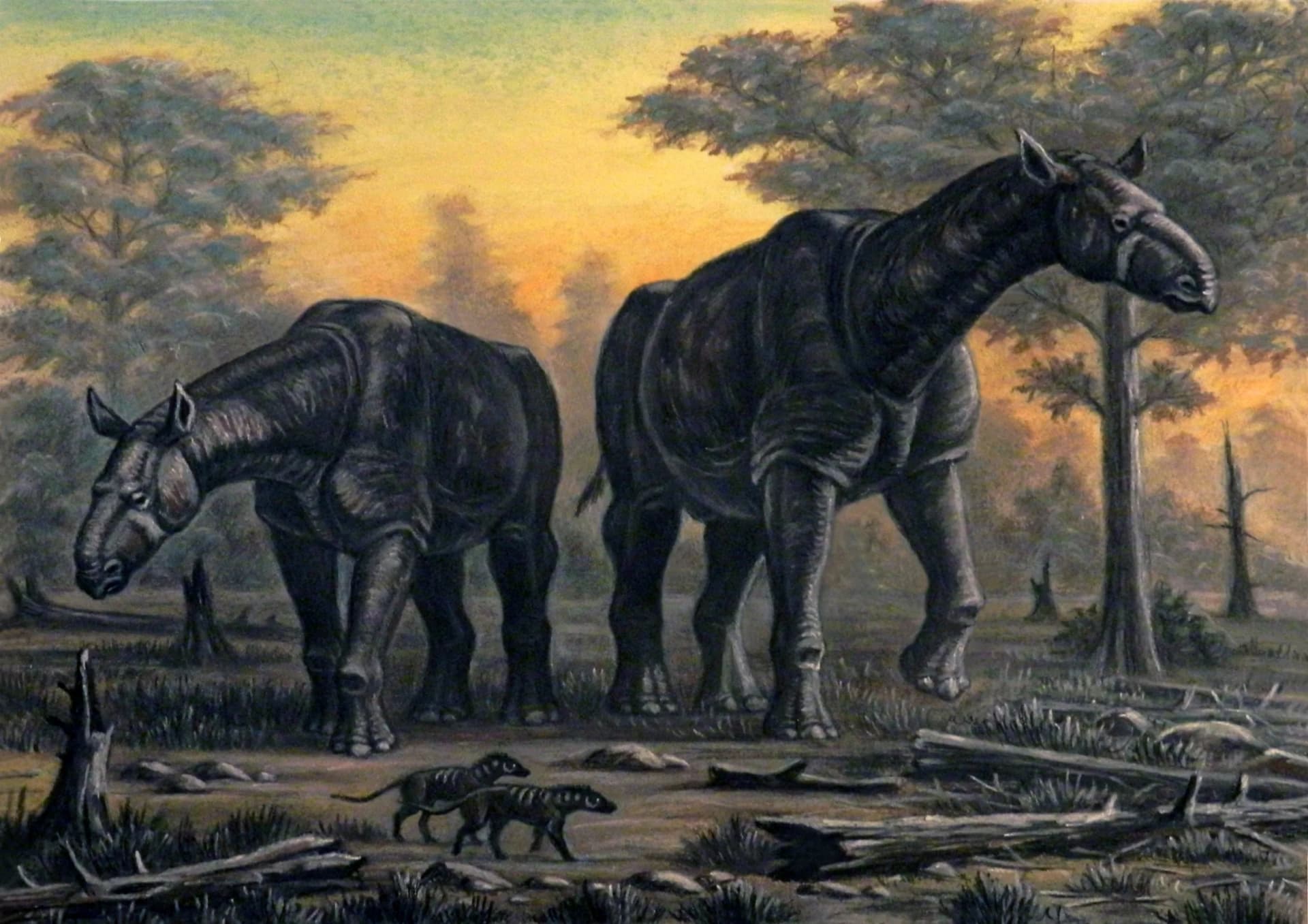
Reconstruction of Paraceratherium transouralicum, the largest land mammal of all time
ABelov2014, CC BY-SA 3.0
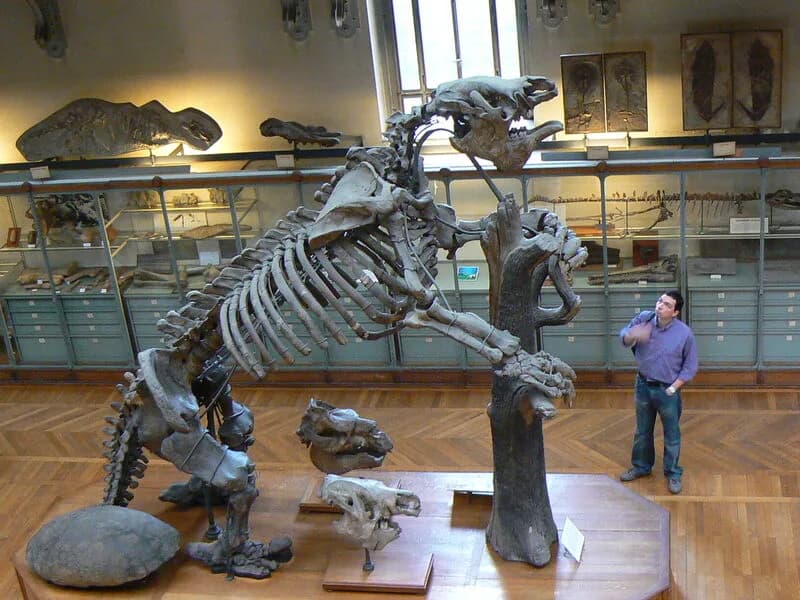
Mounted skeleton of Paraceratherium with a Hyracodon for size comparison
Emoke Denes, CC BY-SA 4.0