Orthocère
Orthoceras regulare was a straight-shelled cephalopod found worldwide around 450 million years ago. Its shell measured 10 to 30 centimetres and it weighed 0.5 to 2 kilograms. Described as early as 1732, it is one of the first fossils ever formally named; it swam backwards by jet propulsion, and its fossils are sold today as decorative objects.
Orthoceras lived during the Ordovician and Silurian periods, approximately 485 to 420 million years ago, in the seas that covered much of the planet. This period predates the appearance of dinosaurs by more than 250 million years and belongs to the Paleozoic Era. The Ordovician was a period of great marine biodiversity, often called the Great Ordovician Biodiversification Event, during which marine invertebrates diversified spectacularly. Orthocerids were among the most common predators of Paleozoic oceans, swimming in warm, shallow seas that covered continental shelves. The global climate was warmer than today, although the Ordovician ended with a massive glaciation event.
Orthoceras possessed a straight, conical shell generally measuring between 10 and 30 centimeters in length, although some related species could reach impressive lengths of over one meter. The shell diameter varied from 1 to 5 centimeters at its opening. The living animal, with tentacles deployed, could measure approximately 15 to 40 centimeters in total length. Compared to modern nautiluses whose shells are coiled, Orthoceras's straight shell is its most distinctive feature. Its size placed it among medium-sized predators of Ordovician oceans, below the large endocerids that could reach several meters in length.
Orthoceras was an active predator of Paleozoic seas, feeding on small marine invertebrates, trilobites, marine worms, and possibly small primitive fish. Its tentacles, probably numbering about ten like modern nautiluses, allowed it to capture agile prey in the water column. Its horny beak, similar to that of modern cephalopods, was capable of piercing trilobite carapaces and shredding prey flesh. Orthoceras probably hunted by ambush or active pursuit, using its jet propulsion to maneuver quickly. Its position in the food chain made it an important mesopredator of Ordovician marine ecosystems, controlling populations of small invertebrates.
Orthoceras inhabited the shallow, temperate seas that covered continental shelves during the Ordovician and Silurian. Its fossils are found worldwide, testifying to a cosmopolitan geographic distribution: Europe (Sweden, Morocco), North America, Asia, and North Africa. The waters in which it lived were clear and well-oxygenated, above calcareous or silty bottoms. It probably swam in the water column at moderate depths, between the surface and a few dozen meters deep. Ordovician reefs, built by sponges and bryozoans, offered habitats rich in prey. The sea floor teemed with trilobites, brachiopods, and crinoids that formed the base of the food chain.
Orthoceras anatomy is that of a nautiloid cephalopod with a straight shell (orthocone). The shell is divided into internal chambers (phragmocone) separated by partitions (septa) pierced by a central tube (siphuncle). The living animal occupied the last chamber (body chamber), the largest, from which its head and tentacles protruded. The siphuncle allowed buoyancy control by adjusting the amount of gas and liquid in the chambers, a system similar to that of the modern nautilus. Propulsion was achieved by expelling water through a muscular funnel (hyponome), enabling rapid backward swimming. The eyes were probably simple pinhole type, without a lens, like modern nautiluses. The tentacles lacked suckers but were probably adhesive.
Orthoceras behavior is inferred from its anatomy and comparison with modern nautiluses, its closest living relatives. It probably swam with its shell oriented horizontally or slightly tilted upward, tentacles directed forward to capture prey. Buoyancy regulation via the siphuncle allowed it to rise and descend in the water column, possibly performing daily vertical migrations to follow prey or avoid predators. At night, it probably rose toward the surface to hunt, as modern nautiluses do. Its reproductive mode probably involved laying eggs in shallow waters, with juveniles leading a planktonic life before becoming active swimmers. The straight shell, less hydrodynamic than the coiled nautilus shell, suggests a less maneuverable lifestyle.
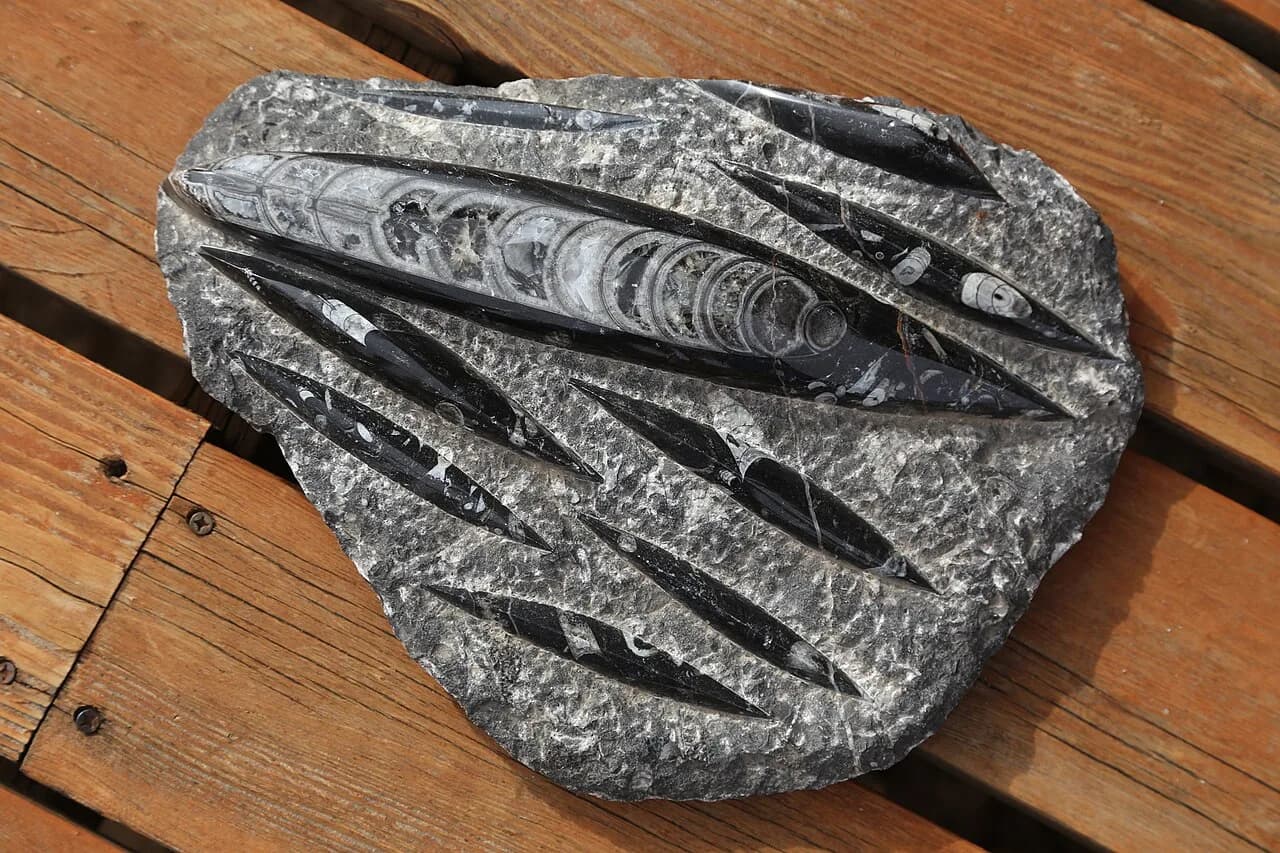
Orthoceras is one of the most abundant and recognizable fossils of the Paleozoic. The genus was first described by Auguste de Breynius in 1732, making it one of the earliest scientifically described cephalopod fossils. Its fossils are extraordinarily common in Ordovician and Silurian limestones worldwide, particularly in Scandinavia (Sweden, Estonia), Morocco, and North America. The famous polished black limestone slabs from Morocco, sold as decorative objects worldwide, often contain longitudinal sections of orthocerids showing internal chambers and the siphuncle. The term Orthoceras is often used informally to designate any straight-shelled nautiloid, although the genus in the strict sense is more restricted. The ease of fossilization of the calcareous shell and the abundance of these animals in Paleozoic seas explain the exceptional frequency of their fossils.
| Period | Ordovicien-Silurien / Ordovician-Silurian |
| Era | Paléozoïque / Paleozoic |
| Age | ~450 millions d'années / ~450 million years ago |
| Location | Mondial / Worldwide |
| Length | 10-30 cm (coquille) |
| Height | 3-5 cm (diamètre) |
| Weight | ~0.5-2 kg |
| Diet | Carnivore |
| Discovery | 1732 |
No. Orthoceras regulare was a nautiloid cephalopod, a marine invertebrate mollusk, that lived approximately 485 to 420 million years ago — more than 250 million years before dinosaurs appeared. It is much closer to modern nautiluses and octopuses than to any reptile or dinosaur.
Orthoceras regulated its buoyancy through the siphuncle, a tube running through all chambers of its conical shell. By adjusting the ratio of gas to liquid in each chamber via this tube, it could rise or descend in the water column, a mechanism identical to that of the living nautilus (Nautilus pompilius) still observed today.
Morocco's black limestones, formed on the floors of Ordovician and Silurian seas, contain an exceptional concentration of Orthoceras. Their calcareous shell fossilized easily, and their densely populated colonies left thousands of impressions. These polished slabs, sold worldwide, show the longitudinal section of the shell with chambers and siphuncle clearly visible.
Cluster of Orthoceras fossils in limestone
Wikimedia Commons
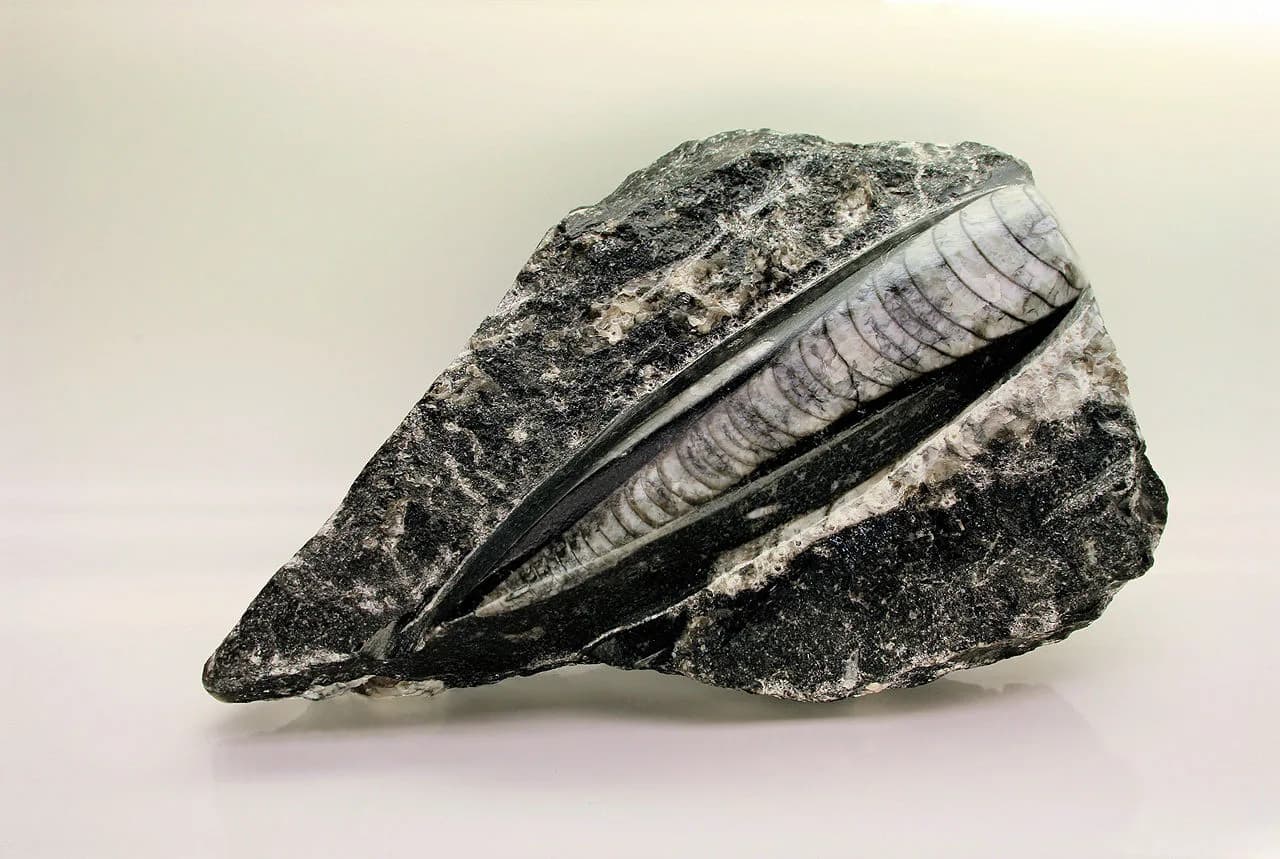
Silurian Orthoceras fossil — macro view
Wikimedia Commons