Nyctosaure
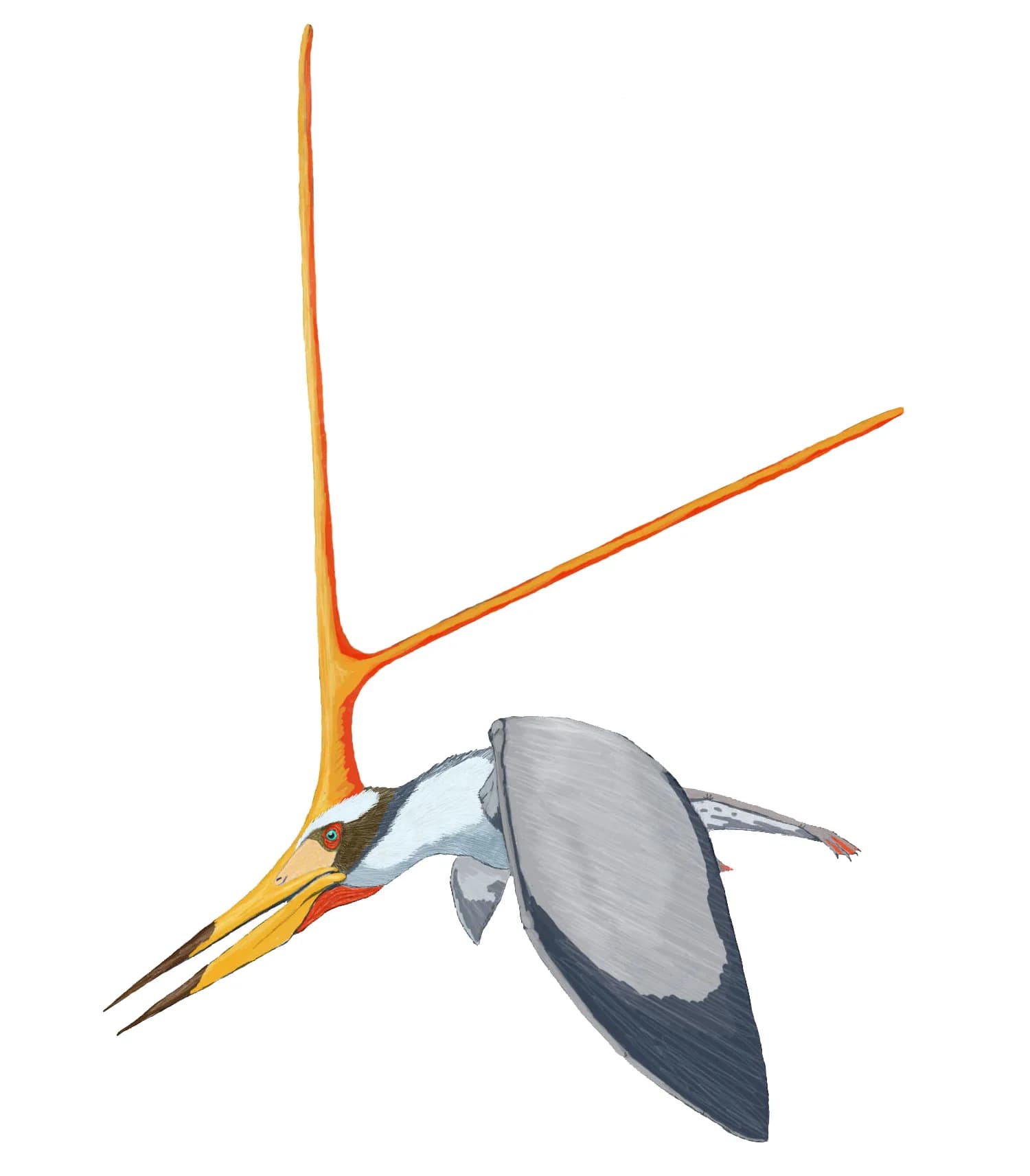
Nyctosaurus gracilis carried a crest shaped like a sailing mast, up to three times taller than its skull. It is also the only known pterosaur to have lost its grasping fingers: unable to perch or climb, it spent most of its time in the air. Its wingspan reached 2 to 3 metres for around 5 kilograms, 85 to 84 million years ago.
Nyctosaurus lived during the Late Cretaceous period, approximately 85 to 84 million years ago, in what is now the central United States. It inhabited the regions bordering the Western Interior Seaway, a vast shallow ocean that divided North America into two distinct continents during the Cretaceous. This warm, marine-life-rich body of water provided an ideal habitat for piscivorous pterosaurs such as Nyctosaurus. It coexisted with other large pterosaurs such as Pteranodon in this thriving marine ecosystem. Nyctosaurus was one of the last surviving pterosaurs in this region before the final extinction event that closed the Cretaceous period.
Nyctosaurus had a wingspan of approximately 2 to 3 meters, making it a medium-sized pterosaur compared to its larger contemporary Pteranodon. Its most remarkable feature was its extraordinary cranial crest shaped like a sailboat mast, composed of two bony branches forming a right angle. This impressive crest could reach a height equal to or greater than the length of the skull itself, making it one of the most distinctive cranial ornaments in the pterosaur fossil record. Unlike most pterodactyloids, Nyctosaurus had almost entirely lost its fingers on the forelimbs, retaining only the hypertrophied wing finger that supported the flight membrane, a unique adaptation among all known pterosaurs.
Nyctosaurus was a specialized piscivore, feeding primarily on fish and small marine organisms that it captured at the surface of the Western Interior Seaway. Its long, thin, toothless beak was perfectly adapted for grasping slippery fish while skimming over the water at speed. Its fishing technique was likely similar to that of modern skimmers, brushing the water surface with the lower mandible to catch unsuspecting prey. It could also feed on cephalopods and small crustaceans swimming near the surface. The absence of teeth suggests it swallowed its prey whole, relying on the beak shape alone to secure its catch before swallowing.
Nyctosaurus lived primarily above and around the Western Interior Seaway, the vast arm of sea that extended from the Gulf of Mexico to the Arctic Ocean during the Late Cretaceous. Its fossils have been discovered in geological formations in Kansas, indicating it frequented the warm, nutrient-rich waters of this interior sea. Since its fingers were extremely reduced, it likely spent most of its time in flight, landing only on coastal cliffs to rest and nest. This highly pelagic lifestyle, combined with its lightweight skeletal build, suggests Nyctosaurus was superbly adapted to sustained long-duration soaring flight over open marine waters.
Nyctosaurus' anatomy presents extreme adaptations for flight. Its most distinctive feature is its spectacular bifurcated antenna-shaped cranial crest, composed of two bony rods forming a right angle. The vertical branch could measure three times the length of the skull. Its wings were supported by a single hypertrophied wing finger, with the other three fingers having completely disappeared — a unique case among pterosaurs. This loss of grasping fingers suggests it did not perch in trees and spent the majority of its time in flight. Its pneumatized bones (hollow and air-filled) considerably reduced its weight, estimated at only 5 kilograms.
Nyctosaurus was most likely an oceanic flier, spending most of its life in flight above the Western Interior Seaway. Its lifestyle was comparable to modern albatrosses, soaring over long distances using updrafts above the ocean. Its spectacular crest likely played a role in courtship displays and individual recognition. Some paleontologists have hypothesized that a membrane of skin connected the two branches of the crest, forming an auxiliary sail. Unable to perch or climb due to the loss of its fingers, it had to take off from cliffs or slopes.
Nyctosaurus was first described in 1876 by Othniel Charles Marsh, the famous paleontologist of the 'Bone Wars.' The first fossils were discovered in the chalky deposits of Kansas, in the Niobrara Formation. The name means 'night lizard,' although the animal was probably not nocturnal — Marsh believed it could fly at night. The most spectacular discovery came in 2003, when Kenneth Stadtman described specimens bearing an extraordinary cranial crest shaped like a sailboat mast. This unexpected find reignited debates about the function of crests in pterosaurs.
| Period | Crétacé supérieur / Late Cretaceous (Coniacien–Santonien) |
| Era | Mésozoïque / Mesozoic |
| Age | 85–84 Ma |
| Location | Amérique du Nord / North America (Kansas, États-Unis / USA) |
| Length | Envergure / Wingspan: 2–3 m |
| Height | ~0.5 m (corps / body) |
| Weight | ~5 kg |
| Diet | Piscivore |
| Discovery | 1876 |
No, Nyctosaurus gracilis was not a dinosaur but a pterosaur — a flying reptile from the Late Cretaceous, 85 to 84 million years ago. Pterosaurs form a group distinct from dinosaurs within archosaurs. Nyctosaurus weighed about 5 kilograms with a wingspan of 2 to 3 meters. Described in 1876 by O.C. Marsh in the Niobrara Formation (Kansas), it was contemporaneous with Pteranodon in the Western Interior Seaway.
Nyctosaurus gracilis's crest — composed of two bony rods forming a right angle, potentially reaching three times the skull length — probably served for courtship displays and intraspecific recognition. Some paleontologists have suggested that a skin membrane stretched between the branches, forming an accessory sail. Described in 2003 by Stadtman, this extraordinary crest ranks among the most spectacular in the pterosaur fossil record.
Nyctosaurus gracilis had reduced its forelimbs to a single hypertrophied wing finger supporting the flight membrane — the other three fingers had completely disappeared. This extreme reduction, unique among all known pterosaurs, means it could neither perch nor climb. To take off, it used coastal cliffs or slopes. Its lifestyle was comparable to modern albatrosses: soaring over long distances above the North American interior seaway.
Artistic reconstruction of Nyctosaurus with its distinctive crest
Dmitry Bogdanov, CC BY-SA, via Wikimedia Commons
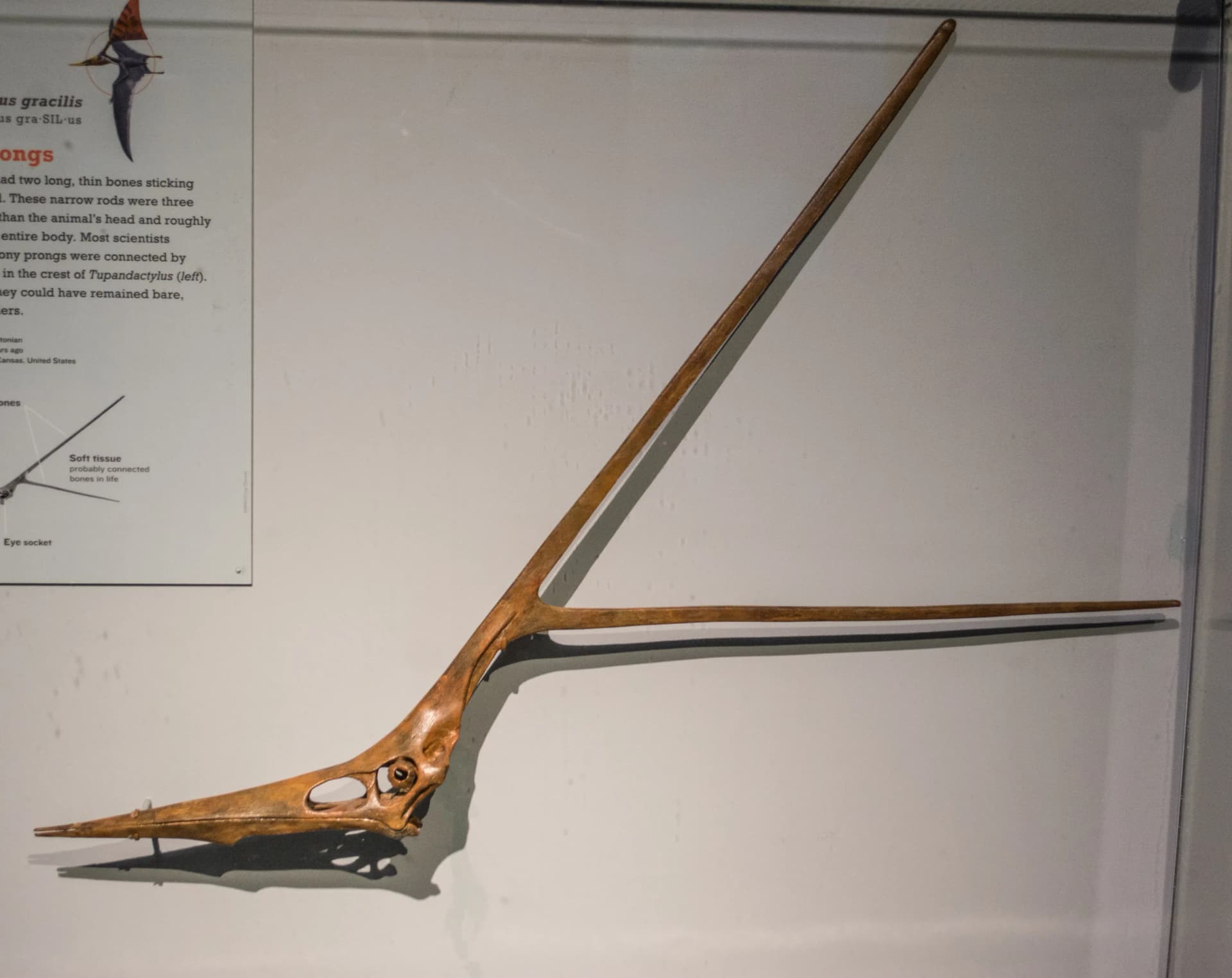
Fossil skull of Nyctosaurus gracilis
Wikimedia Commons, CC BY-SA