Najash
Najash rionegrina is a snake that still had genuine functional hind legs, articulated to the pelvis. That anatomy directly supports the idea that snakes descend from land lizards. About 1.5 metres long and 2 to 3 kilograms, described in 2006 in Argentine Patagonia, it lived some 95 million years ago. Its name takes up Nahash, the serpent of the Hebrew Bible.
Najash rionegrina lived during the Late Cretaceous (Cenomanian-Turonian), approximately 95 million years ago. This extraordinary primitive snake is one of the most important fossils for understanding snake evolution, as it still possessed functional hind limbs with an articulated sacrum. Discovered in Argentine Patagonia, it challenges the hypothesis of a marine origin for snakes and instead supports a terrestrial origin. Najash lived in a continental arid to semi-arid environment, very different from the marine settings where other primitive snakes like Pachyrhachis have been found.
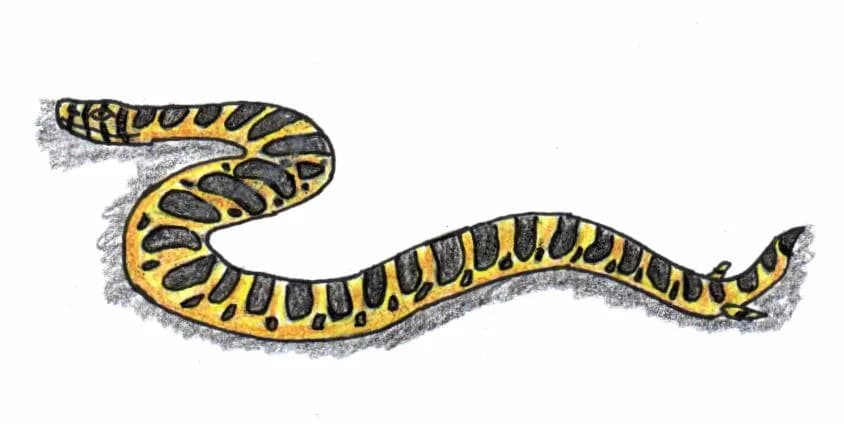
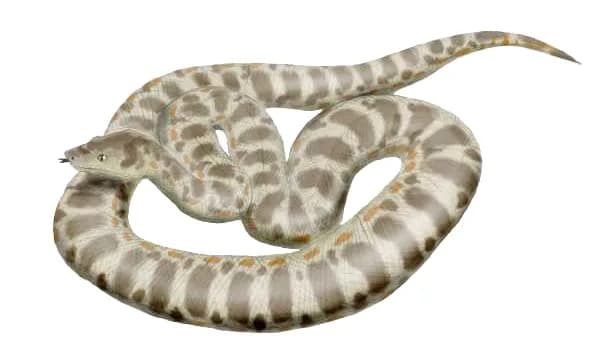
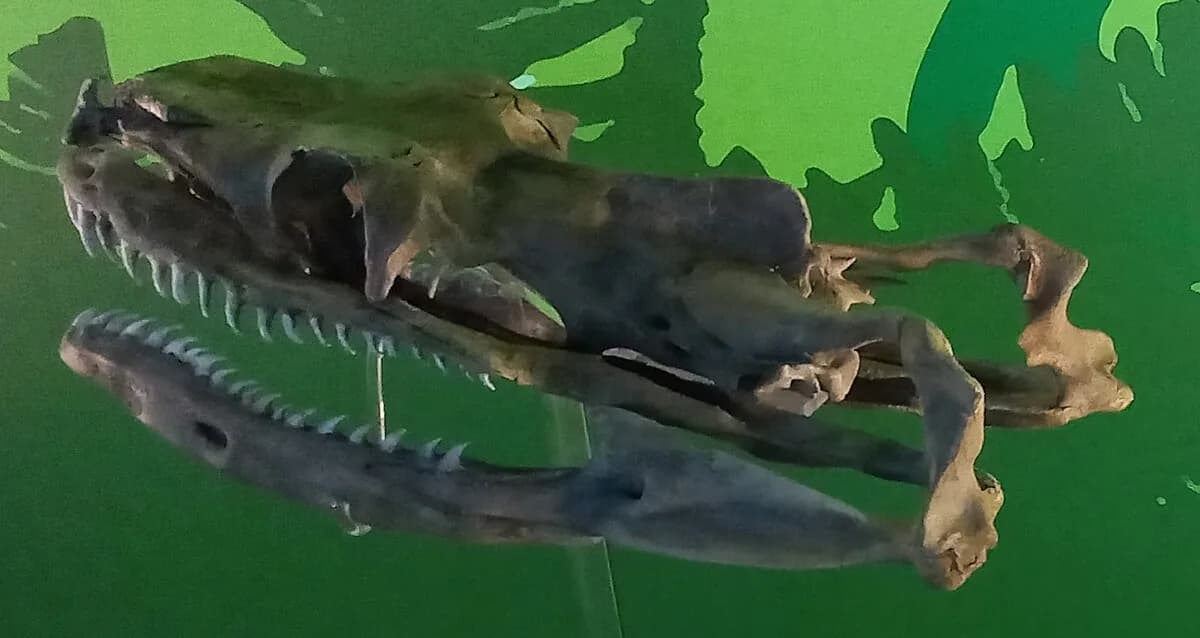
Najash rionegrina measured approximately 1.5 meters in total length, making it a modestly sized snake compared to giants like Titanoboa. Its body was elongated and cylindrical, typical of burrowing or semi-burrowing snakes. Its hind limbs, though reduced, were still functional and articulated to the pelvis through a true sacrum — a feature absent in all modern snakes. The skull, remarkably well preserved, reveals an intermediate morphology between lizards and modern snakes, with already advanced cranial mobility.
Najash was a carnivore that likely hunted small terrestrial vertebrates, lizards, insects, and small primitive mammals in its continental Patagonian environment. Its pointed, recurved dentition, typical of snakes, indicates a diet of prey swallowed whole. Unlike the giant constricting snakes that would evolve later, Najash was too small to tackle large prey. Its hunting strategy likely relied on ambush from burrows or beneath plant debris, taking advantage of its elongated body to squeeze through narrow spaces.
Najash inhabited the arid to semi-arid continental environments of the Late Cretaceous in Patagonia, in what is now the province of Río Negro in Argentina. The landscape consisted of sand dunes, alluvial plains, and areas of sparse vegetation. The aeolian and fluvial sediments of the Candeleros Formation indicate a warm climate with pronounced dry seasons. Najash shared this ecosystem with theropod dinosaurs, crocodilians, and other reptiles, occupying an ecological niche as a small terrestrial burrowing predator.
Najash's anatomy is revolutionary for snake paleontology. It possessed functional hind limbs with a femur, tibia, and probably toes, articulated to a pelvis equipped with a true sacrum — the vertebral connection to the pelvis that all modern snakes have lost. Its skull, described in detail in 2019, shows an intermediate condition: the jugal and postorbital bones are still present but modified, and cranial mobility (kinesis) is already partially developed. This mosaic of primitive and derived characters makes it a crucial 'missing link' in snake evolution.
Najash likely adopted a semi-fossorial lifestyle, spending part of its time in burrows or beneath layers of sand and debris. Its hind limbs, though reduced, could still serve to anchor the body in the substrate during underground locomotion or to facilitate mating, like the vestigial spurs of modern boas and pythons. Primary locomotion was through lateral undulation of the elongated body. Its activity was probably crepuscular or nocturnal to avoid the intense heat of the Cretaceous Patagonian desert.
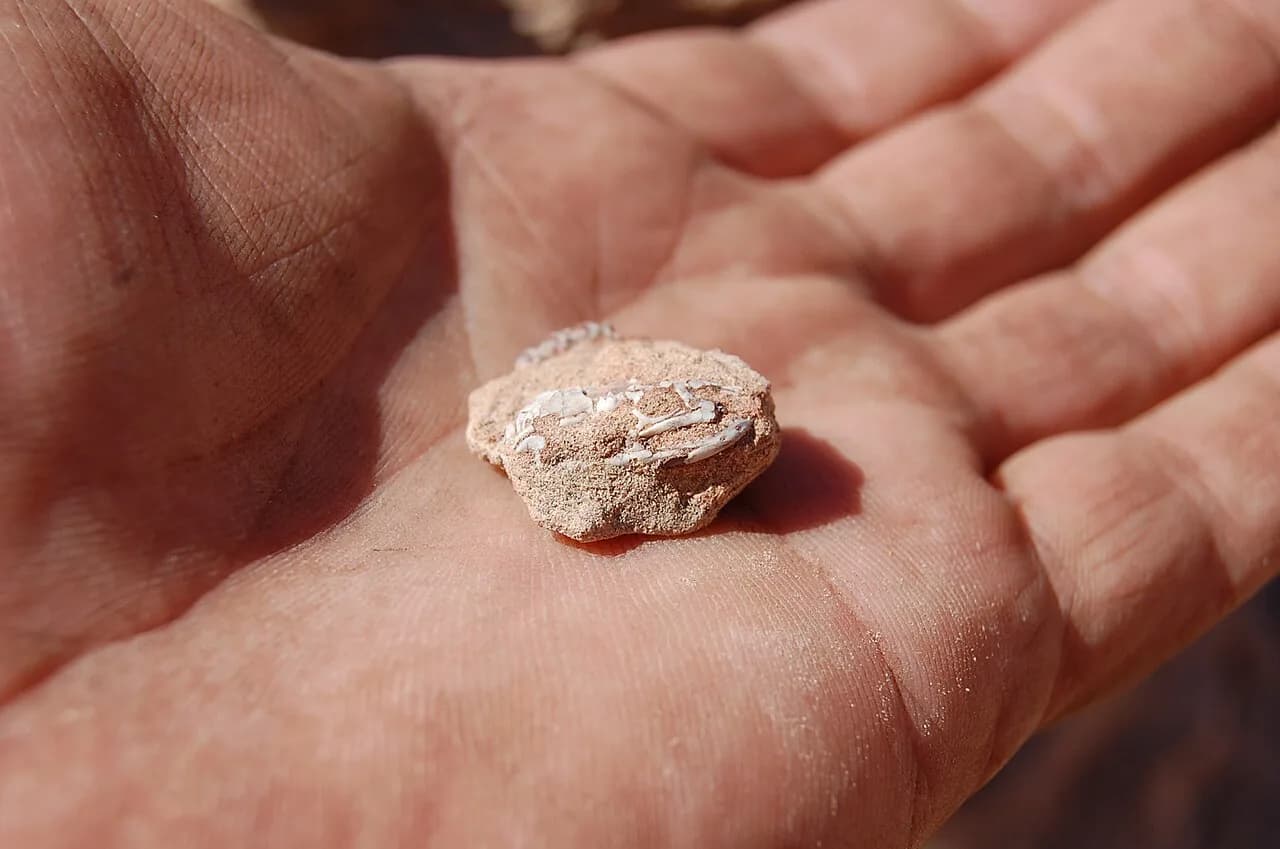
Najash rionegrina was described in 2006 by Apesteguía and Zaher from fossils discovered in the Candeleros Formation (Cenomanian) of Río Negro Province in Argentine Patagonia. The name Najash derives from 'Nahash,' the Hebrew word for serpent (in reference to the serpent of Genesis), and rionegrina refers to the province of origin. In 2019, a landmark study by Garberoglio et al. described an exceptionally preserved three-dimensional skull, revealing for the first time the complete cranial anatomy of a primitive legged snake. This discovery revolutionized the understanding of snake cranial evolution.
| Period | Crétacé supérieur / Late Cretaceous |
| Era | Mésozoïque / Mesozoic |
| Age | ~95 Ma |
| Location | Argentine (Patagonie, Río Negro) / Argentina (Patagonia, Río Negro) |
| Length | ~1.5 m |
| Height | N/A |
| Weight | ~2-3 kg (estimé / estimated) |
| Diet | Carnivore |
| Discovery | 2006 |
Yes, Najash rionegrina possessed functional hind limbs — femur, tibia, and probably toes — articulated to a pelvis with a true sacrum, a vertebral connection absent in all modern snakes. Described in 2006 by Apesteguía and Zaher from the Candeleros Formation (Río Negro, Argentina), it lived 95 million years ago. An exceptional three-dimensional skull described in 2019 confirmed its status as a crucial missing link.
Najash rionegrina lived in the arid to semi-arid continental environments of Patagonia (Candeleros Formation, Cenomanian), far from any marine setting. Other primitive snakes like Pachyrhachis came from marine sediments, supporting an aquatic origin. The discovery of Najash in a desert terrestrial context reinvigorated the debate in favor of a terrestrial burrowing origin for snakes — a century-old debate.
The name Najash derives from 'Nahash,' the Hebrew word for serpent in the Bible (the tempting serpent of Genesis), alluding to the idea that the biblical serpent may also have had legs. The species name rionegrina refers to Río Negro Province in Argentine Patagonia, where the fossils were found in the Candeleros Formation. Described in 2006 by Apesteguía and Zaher.
Najash rionegrina fossil skull
Wikimedia Commons CC BY 4.0