Moschops
Moschops capensis had the top of its skull thickened by ten centimetres of solid bone: it fought head to head, like rams, but with the mass of a 400-to-700-kilogram animal. About 2.7 metres long, described in 1911 in the South African Karoo, it lived 265 to 260 million years ago. Its name means « calf face ».
Moschops capensis lived during the Middle Permian (Capitanian), approximately 265 to 260 million years ago. This massive herbivorous dinocephalian belonged to the Tapinocephalidae, a family of therapsids (advanced synapsids) that dominated Middle Permian terrestrial ecosystems in Gondwana. Dinocephalians ('terrible heads') were among the first large terrestrial herbivores in history, occupying ecological niches that dinosaurs would not colonize for another 30 million years. Moschops disappeared during the Capitanian extinction, a mass event preceding the great Permian extinction.
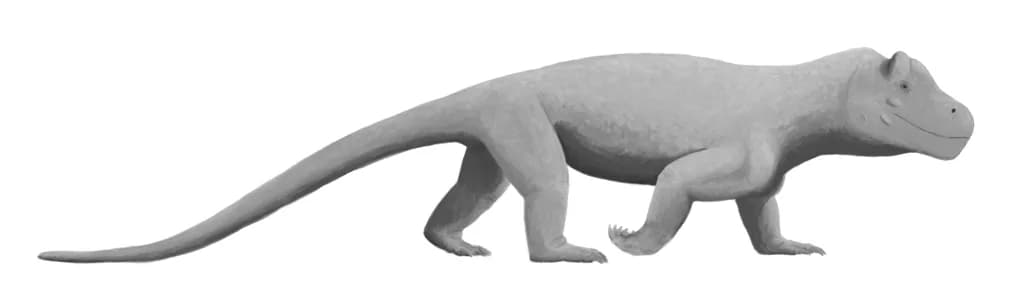
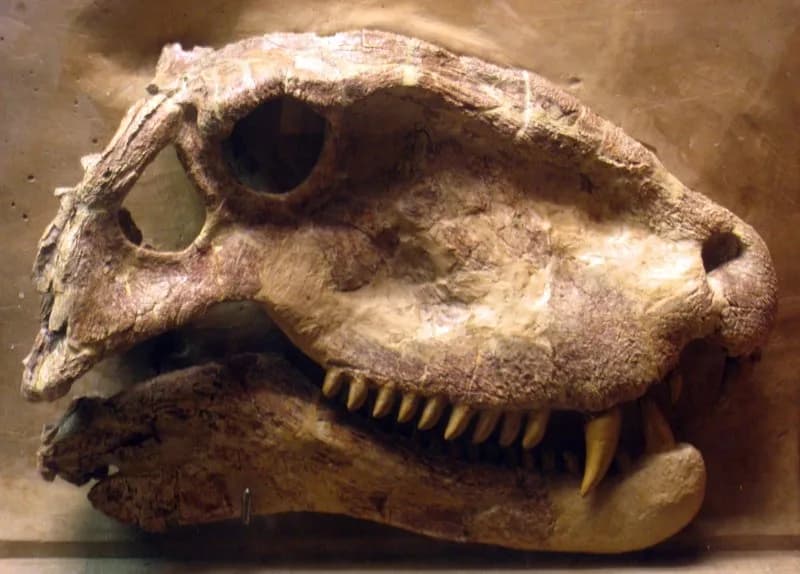
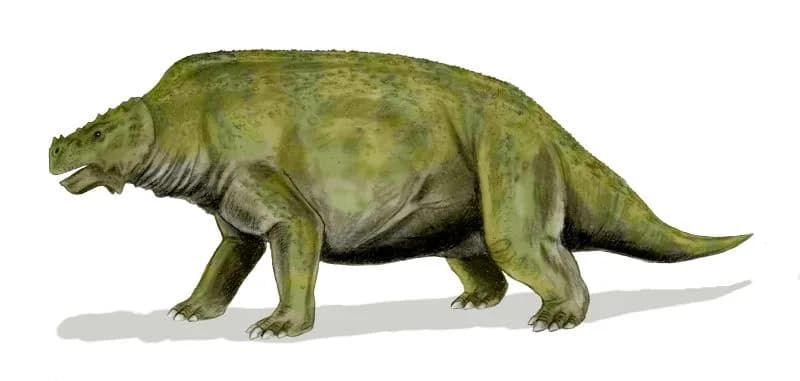
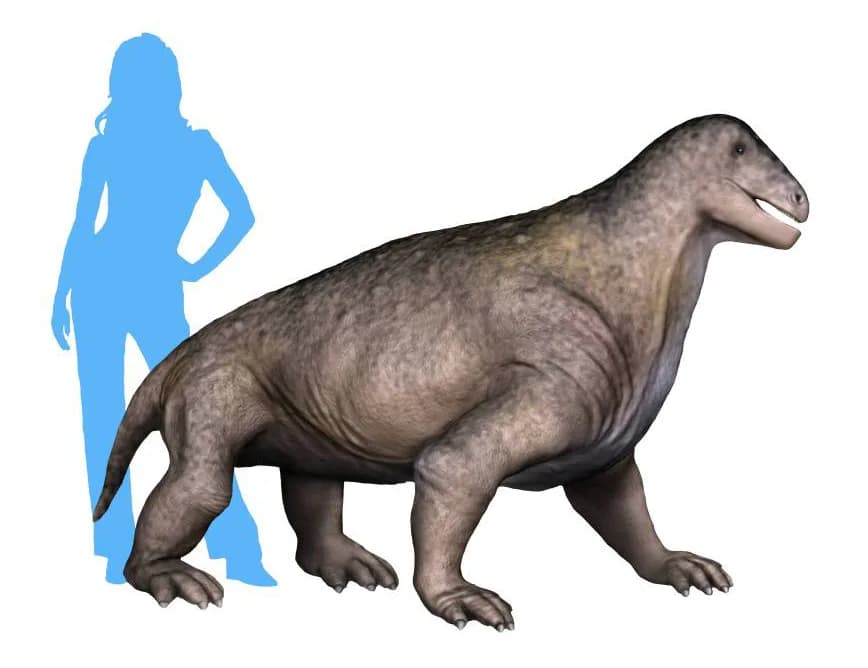
Moschops capensis measured approximately 2.7 meters in total length and about 1.5 meters tall at the shoulder. Its weight is estimated between 400 and 700 kilograms, making it one of the largest terrestrial animals of its time. Its body was massive and stocky, barrel-shaped, with a back strongly sloped forward — the forelimbs being significantly shorter than the hindlimbs. The skull was thick and massive, with a remarkably thickened cranial roof reaching up to 10 centimeters of solid bone at the top, adapted for head-butting contests between males.
Moschops was a strict herbivore that fed on the low vegetation of the Permian: ferns, horsetails, lycophytes, and primitive gymnosperms. Its teeth were short, blunt, and peg-shaped, ideal for tearing and grinding vegetation. The jaw, relatively weak, did not allow chewing very tough plants, suggesting a preference for tender parts. Its barrel-shaped body likely housed a very long intestine necessary for fermentation and digestion of plant fibers, like modern herbivores. It must have consumed large quantities of vegetation daily.
Moschops inhabited the plains and valleys of the Middle Permian in what is now the Karoo region of South Africa. The Karoo Basin was then a vast semi-arid depression at the southern margin of Gondwana, with marked wet and dry seasons. Vegetation was dominated by Glossopteris (seed ferns) and lycophytes. Moschops shared this ecosystem with other dinocephalians, predatory gorgonopsians, and pareiasaurs. The Tapinocephalus Assemblage Zone deposits in the Karoo have yielded numerous complete specimens.
Moschops's anatomy is characteristic of tapinocephalid dinocephalians. The most remarkable trait is extreme cranial pachyostosis: the skull roof is thickened up to 10 centimeters of compact bone, forming a solid bony dome. This adaptation served for intraspecific combat: males butted heads, like modern rams and musk oxen. The posture was semi-erect with forelimbs shorter than hindlimbs, creating a distinctive sloped profile. Cervical vertebrae were robust and reinforced to absorb the shock of cranial combat. The barrel-shaped body reflected a voluminous digestive tract.
Moschops was probably a gregarious animal living in herds on the Karoo plains. Males engaged in violent head-butting contests for control of harems and territory, driving their thickened skulls into each other with considerable force — behavior similar to bighorn sheep or musk oxen. The extreme skull thickness and reinforced cervical vertebrae are direct anatomical evidence of this behavior. Females and young probably formed protected groups. Despite its large size, Moschops was vulnerable to carnivorous dinocephalian predators like Anteosaurus.
Moschops capensis was described in 1911 by paleontologist Robert Broom from fossils discovered in the Karoo, South Africa. The name means 'calf face' (Greek moschos = calf, ops = face), referring to the bovine appearance of the head. Numerous complete or sub-complete skeletons have been recovered from the Tapinocephalus Assemblage Zone, dating to the Capitanian. The South African Museum in Cape Town holds excellent mounted specimens. Moschops was popularized in the 1980s by a British animated television series of the same name, which depicted it as a friendly, clumsy herbivore — an image fairly faithful to paleontological reality.
| Period | Permien moyen / Middle Permian (Capitanien) |
| Era | Paléozoïque / Paleozoic |
| Age | 265-260 Ma |
| Location | Afrique du Sud (Karoo) / South Africa (Karoo) |
| Length | ~2.7 m |
| Height | ~1.5 m |
| Weight | 400-700 kg |
| Diet | Herbivore |
| Discovery | 1911 |
No, Moschops capensis was not a dinosaur but a dinocephalian, a member of the Tapinocephalidae — a family of therapsids (advanced synapsids) belonging to our own evolutionary lineage. It lived 265 to 260 million years ago, 30 million years before the first dinosaurs appeared. Therapsids are actually closer to modern mammals than to reptiles. Described in 1911 by Robert Broom from Karoo fossils, South Africa.
Moschops capensis's cranial roof reached up to 10 centimeters of compact bone — an adaptation for head-butting combat between males. Like modern bighorn sheep or musk oxen, individuals drove their thickened skulls together to control harems and territory. Robust cervical vertebrae confirmed this behavior through shock absorption. Moschops capensis measured about 2.7 meters long with an estimated weight of 400 to 700 kilograms.
Moschops capensis inhabited the semi-arid plains and valleys of the Karoo, South Africa (Gondwana basin), 265 to 260 million years ago. Vegetation was dominated by Glossopteris (seed ferns) and lycophytes. It shared this ecosystem with other dinocephalians, pareiasaurs, and carnivorous gorgonopsians — including the formidable Anteosaurus, a predatory dinocephalian capable of attacking a 500-kilogram animal.
Moschops capensis life reconstruction
Wikimedia Commons