Antéosaurus
Anteosaurus magnificus was a carnivorous therapsid from South Africa's Karoo, described in 1923 and dated to 265 to 260 million years ago. At 5 to 6 metres and 500 to 600 kilograms, it was the largest land predator of its era — 200 million years before the dinosaurs. A 2021 inner-ear scan showed it was far more agile than assumed.
Anteosaurus magnificus lived during the Middle Permian (Capitanian), approximately 265 to 260 million years ago. This carnivorous dinocephalian was the largest terrestrial predator of its time, dominating the Karoo ecosystems in South Africa. Anteosaurids formed a family of predatory dinocephalians that hunted massive herbivores like Moschops and pareiasaurs. Anteosaurus was the apex super-predator of the Middle Permian, a role comparable to T. rex in the Cretaceous — but 200 million years earlier. It disappeared during the Capitanian extinction.
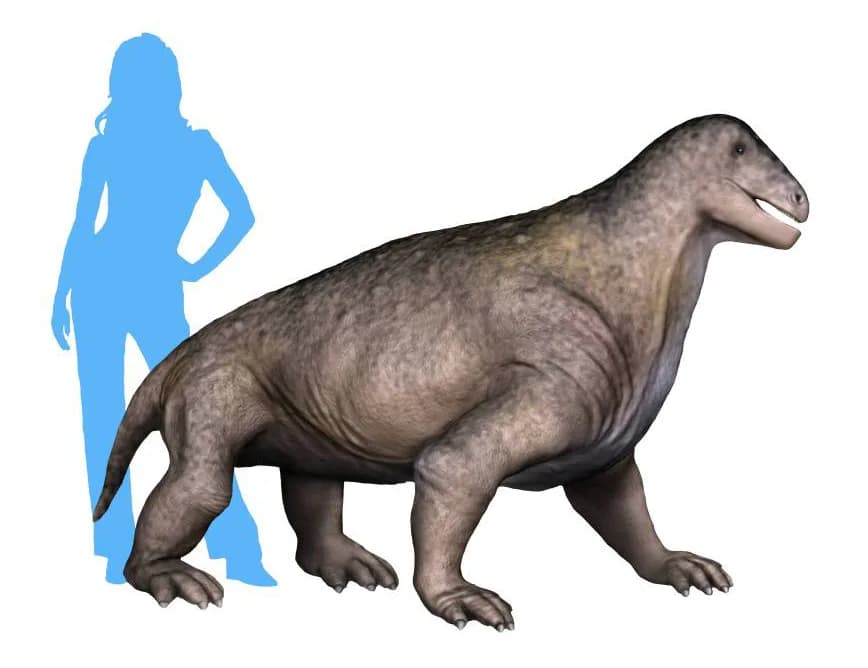
Anteosaurus magnificus was a colossal predator measuring between 5 and 6 meters in total length, making it the largest terrestrial predator of the Middle Permian. Its skull alone measured about 80 centimeters long, massive and armed with imposing teeth. Estimated weight exceeded 500 to 600 kilograms. Its body was robust and powerful, with particularly developed forelimbs for seizing prey. The forehead bore a bony thickening (frontal pachyostosis) less pronounced than in Moschops but present, suggesting head-butting contests also existed among predators.
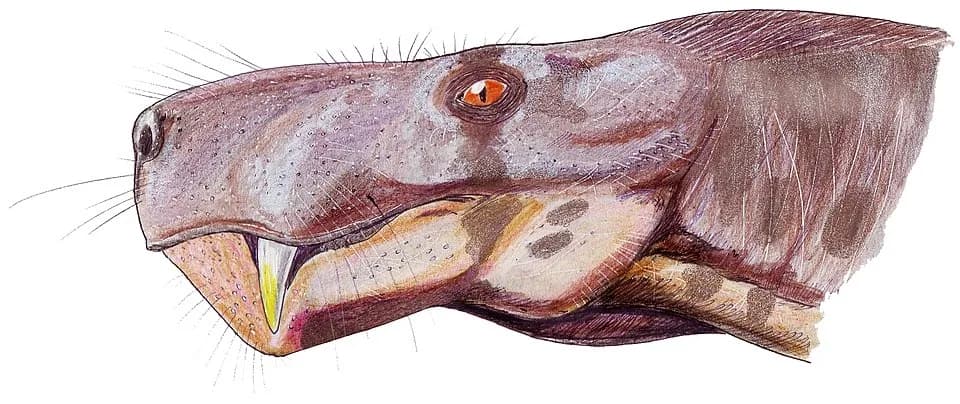
Anteosaurus was the apex super-predator of its ecosystem. Its massive teeth, including large interlocking incisors and prominent canines, were designed to pierce the thick skin and defenses of large herbivores like Moschops and pareiasaurs. Its powerful jaw exerted considerable bite force. Unlike ambush predators, a 2021 study of Anteosaurus's inner ear anatomy revealed it possessed a superior sense of balance and agility than previously thought, suggesting an active hunter capable of rapid pursuits rather than a slow scavenger.
Anteosaurus inhabited the plains and valleys of the Karoo Basin in South Africa during the Middle Permian. The landscape was semi-arid with seasonal waterways, alluvial plains, and Glossopteris vegetation. It shared this ecosystem with its main prey — the herbivorous dinocephalians Moschops and Tapinocaninus — as well as smaller predators. Fossils come from the Tapinocephalus Assemblage Zone in the Beaufort Series of the Karoo. This sedimentary basin is one of the most important in the world for Permian fossils.
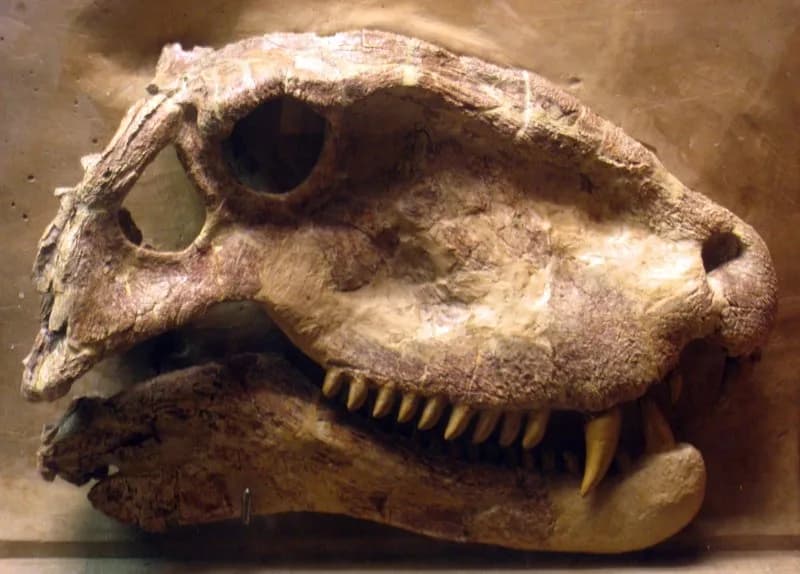
Anteosaurus possessed a massive, elongated skull with impressive heterodont dentition: large interlocking anterior incisors, prominent canines, and smaller postcanine teeth. The forehead bore bony pachyostosis (thickening), less developed than in herbivores but sufficient for intraspecific combat. A 2021 study by Benoit et al. scanned Anteosaurus's inner ear and revealed remarkably developed semicircular canals — indicating agility, balance, and coordination superior to those expected for an animal of this size. Limbs were robust, especially the forelimbs, probably used for seizing and restraining prey.
The 2021 study of Anteosaurus's inner ear overturned our image of this animal. Far from the slow, lumbering predator we imagined, Anteosaurus possessed a sophisticated vestibular system comparable to modern agile predators. It was probably capable of rapid sprints and coordinated movements during hunting. Intraspecific combat between males, evidenced by frontal pachyostosis, must have been impressive: two 500 kg predators smashing heads together. The relative scarcity of fossils compared to herbivores confirms its status as a super-predator with large individual territories.
Anteosaurus magnificus was described in 1923 by South African paleontologist Sidney Haughton from Karoo fossils. The name means 'Antaeus lizard' (Antaeus, the giant of Greek mythology, son of Gaia) — 'magnificus' emphasizes the impressive size. Several skulls and partial skeletons have been discovered in the Tapinocephalus Assemblage Zone. The revolutionary 2021 study by Benoit, Kruger et al. using tomography to scan the inner ear was published in Acta Palaeontologica Polonica, radically changing our understanding of locomotion and hunting in predatory dinocephalians.
| Period | Permien moyen / Middle Permian (Capitanien) |
| Era | Paléozoïque / Paleozoic |
| Age | 265-260 Ma |
| Location | Afrique du Sud (Karoo) / South Africa (Karoo) |
| Length | 5-6 m |
| Height | ~1.5 m |
| Weight | 500-600 kg |
| Diet | Carnivore |
| Discovery | 1923 |
No, Anteosaurus magnificus was a dinocephalian, a synapsid of the Middle Permian (265-260 Ma), thus predating the dinosaurs that appeared in the Triassic around 230 Ma. Synapsids are the lineage leading to mammals, not to reptiles or birds. Anteosaurus was actually more closely related to modern mammals than to dinosaurs.
Anteosaurus magnificus measured between 5 and 6 meters in total length with an estimated weight of 500 to 600 kg. Its skull alone reached about 80 cm long. It was the largest terrestrial predator of the Middle Permian, hunting prey such as Moschops, a 500 kg herbivore, on the semi-arid plains of the Karoo Basin in South Africa.
The study by Benoit et al. (2021, Acta Palaeontologica Polonica) used tomography to scan the inner ear of Anteosaurus magnificus. The semicircular canals reveal a vestibular system comparable to modern active predators: far more agility and coordination than expected for a 500 kg animal. This confirms an active hunter capable of rapid sprints, not a slow scavenger.
Anteosaurus magnificus life reconstruction
Wikimedia Commons