Minmi
Minmi paravertebra is the first ankylosaur found in Australia, described in 1980 in Queensland. Two to 3 metres long and 200 to 300 kilograms, it lived around 115 million years ago. One specimen preserves its stomach contents, allowing its last meal to be reconstructed. Its « paravertebrae », bony plates running along the back, occur in no other dinosaur.
Minmi lived during the Early Cretaceous period, approximately 119 to 113 million years ago, during the Aptian stage, in what is now Queensland, Australia. This period corresponds to a time when Australia was still part of the Gondwana supercontinent, though it was beginning to separate from Antarctica. The Early Cretaceous in Australia was characterized by a cool temperate climate, with eastern regions located at more southerly latitudes than today. Minmi is one of the few known armored dinosaurs from Gondwana and the first ankylosaur described from Australia, demonstrating the presence of this family on the southern continent.
Minmi was a small ankylosaur, measuring approximately 2 to 3 meters in length and weighing an estimated 200 to 300 kilograms. Its back height reached approximately 1 meter. Compared to large North American ankylosaurs like Ankylosaurus (8 meters), Minmi was modestly sized, but its small size did not diminish the effectiveness of its defensive armor. Its compact and wide body, low to the ground, gave it a very low center of gravity, making it difficult for a predator to overturn. Its small size could be an adaptation to the particular environmental conditions of Cretaceous Australia, or simply reflect its basal position in the ankylosaur evolutionary tree.
Minmi was an herbivore feeding on low vegetation. The exceptional analysis of its fossilized gut contents — an extremely rare discovery — revealed the presence of finely chewed leaf fragments, seeds, fruits, and fern sporangia. This direct evidence of feeding is one of the most complete for any ankylosaur dinosaur. The small pieces of plant matter (fragments of 0.3 to 5 mm) indicate that Minmi chewed its food more carefully than its simple dentition would suggest, probably through more complex jaw movements than previously thought in ankylosaurs. It probably selected its food with its narrow horny beak, targeting the most nutritious parts of low-growing plants.
Minmi inhabited the coastal environments and alluvial plains of eastern Queensland during the Early Cretaceous. The Bungil and Allaru formations, where its fossils were found, represent shallow marine and coastal plain environments. Early Cretaceous Australia was located much further south than today, at subpolar latitudes, meaning winters with long periods of darkness. The climate was nevertheless temperate thanks to the global greenhouse effect of the Cretaceous. Vegetation included conifers (araucarias, podocarpus), ferns, and early angiosperms. The ecosystem included other Australian dinosaurs such as the ornithopod Muttaburrasaurus and the large theropod Australovenator.
Minmi anatomy presents unique characteristics among ankylosaurs. Its most distinctive trait is the presence of paravertebrae — elongated flat bones located along the spinal column, a structure unique among all known dinosaurs. These paravertebrae were probably ossified tendons or ligaments that reinforced the animal's back. Its body armor was composed of small osteoderms (bony plates in the skin) arranged in regular rows across the back, flanks, and even the ventral surface, offering almost complete protection. Unlike Ankylosaurus, Minmi lacked a tail club, distinguishing it from derived ankylosaurids and placing it among the most basal ankylosaurs. Its skull was relatively simple, without the complex ornamentation of more advanced ankylosaurs.
Minmi behavior was probably that of a slow, solitary herbivore, methodically moving through plains in search of nutritious vegetation. Its extensive body armor suggests it faced significant predation pressure despite its small size. When threatened, it probably crouched to the ground, presenting its impenetrable dorsal armor to the predator, a passive but effective strategy similar to modern armadillos. The absence of a tail club means it could not actively defend itself like more derived ankylosaurids. The presence of fossilized gut contents suggests regular feeding on a variety of plant matter, indicating opportunistic browsing behavior rather than specialization on a particular plant type.
Minmi was described in 1980 by paleontologist Ralph Molnar from fossils discovered near Minmi Crossing in Queensland, Australia, hence its name. The holotype is a partial skeleton including vertebrae, ribs, osteoderms, and the famous diagnostic paravertebrae. A second, even more complete specimen was discovered at Marathon Station in Queensland in 1990, including skull elements, nearly the entire postcranial skeleton, and extraordinarily, fossilized gut contents. This second specimen has sometimes been assigned to a different genus, Kunbarrasaurus, by some researchers, adding taxonomic complexity to the group. The exceptional preservation of armor and gut contents makes Minmi one of the best-documented ankylosaurs from Gondwana and a treasure of Australian paleontology. Casts of its fossils are displayed in several Australian museums.
| Period | Crétacé inférieur / Early Cretaceous |
| Era | Mésozoïque / Mesozoic |
| Age | ~115 millions d'années / ~115 million years ago |
| Location | Queensland, Australie / Queensland, Australia |
| Length | 2-3 m |
| Height | ~1 m |
| Weight | ~200-300 kg |
| Diet | Herbivore |
| Discovery | 1980 |
Minmi paravertebra measured between 2 and 3 meters in length with an estimated weight of 200 to 300 kilograms — roughly the size of a pony. It is one of the smallest known ankylosaurs, far more modest than the North American Ankylosaurus which exceeded 8 meters. Its small size may reflect an adaptation to the specific environmental conditions of Cretaceous Australia.
Minmi paravertebra's paravertebrae are elongated flat bones positioned along the spinal column, an anatomical structure absent in any other known dinosaur. These elements, probably ossified tendons or ligaments, reinforced the animal's back. This distinctive feature gave the species its name: paravertebra. Described in 1980 by Ralph Molnar, the holotype was discovered near Minmi Crossing, Queensland.
A second Minmi paravertebra specimen discovered at Marathon Station (Queensland) in 1990 preserved fossilized gut contents — an extreme rarity in paleontology. Analysis revealed finely chewed leaf fragments, seeds, fruits, and fern sporangia (0.3 to 5 mm). This direct evidence shows that Minmi carefully selected the most nutritious parts of low plants, chewing more thoroughly than its simple dentition would suggest.
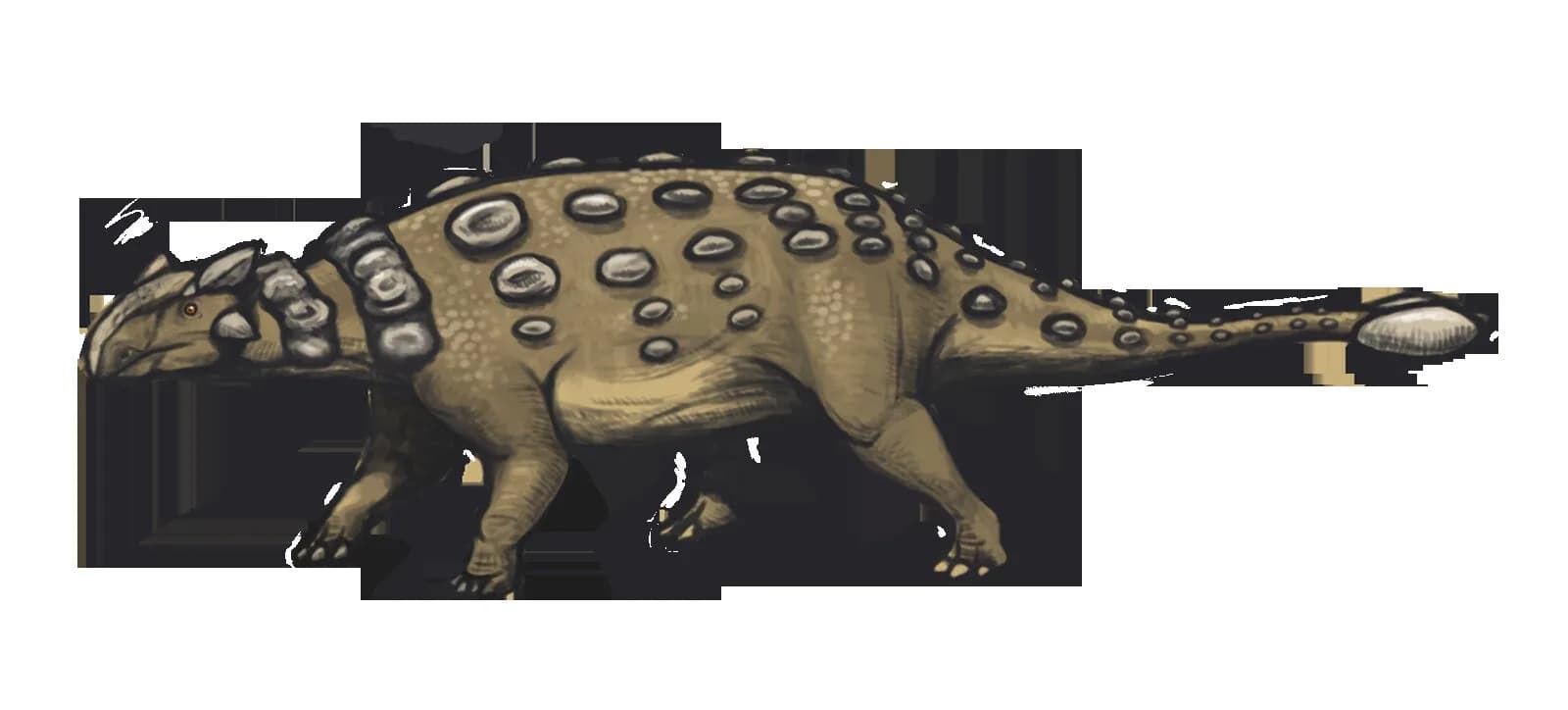
Reconstruction of Minmi paravertebra
Wikimedia Commons
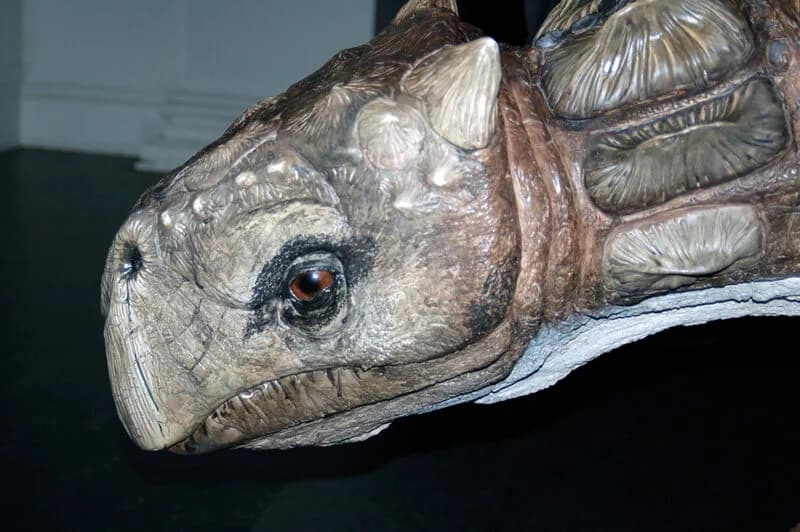
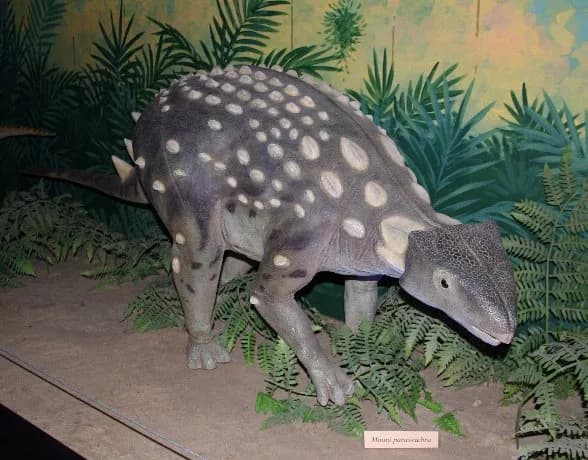
Minmi model at an Australian museum
Wikimedia Commons