Méiolania
Meiolania platyceps was a land turtle 2.5 metres long including the tail, weighing 500 to 800 kilograms. Its head carried horns that stopped it from withdrawing into its shell, and its tail was armoured with bony rings, like an ankylosaur's. Described in 1886, it held on until 2,000 years ago on Pacific islands, long after Australia.
Meiolania lived from the Miocene to the Late Pleistocene, with species surviving until approximately 2,000 years ago in New Caledonia and Vanuatu. The main species, M. platyceps, lived during the Pleistocene in Australia, approximately 50,000 to 20,000 years ago. It is one of the last giant terrestrial turtles to have gone extinct, probably due to human hunting. Meiolania is a remarkable example of Quaternary megafauna, those giant animals that coexisted with early humans and whose extinction often coincides with human arrival. Its close relatives are known from the Cretaceous of South America and Antarctica, testifying to the ancient Gondwanan connection.
Meiolania was an impressive giant turtle, measuring approximately 2.5 meters in total length (including the tail) and weighing an estimated 500 to 800 kilograms. Its shell alone measured approximately 1.5 meters in length and up to 1 meter in width. Its head, adorned with large horns, measured approximately 50 centimeters in width, which is disproportionately large for a turtle. It was significantly larger than current Galápagos giant tortoises (approximately 1.5 m and 250 kg). Only the Rodrigues giant tortoises (Cylindraspis) and certain prehistoric South American turtles rivaled its size. Its massive, columnar legs supported its enormous weight on land.
Meiolania was a terrestrial herbivore feeding on ground-level vegetation: ferns, grasses, fallen fruits, and low vegetation of the open forests and grasslands of Pleistocene Australia. Its broad, powerful horny beak was adapted for cutting and grinding a variety of plant matter. Like modern land tortoises, it was probably a slow and methodical grazer, spending most of its time feeding to maintain its significant body mass. Its ectothermic (cold-blooded) metabolism meant it needed less food than a similarly sized mammal, but it still had to consume large quantities of vegetation daily. It probably played an important role in seed dispersal of Australian plants.
Meiolania inhabited open forests, grasslands, and coastal areas of Australia and Southwest Pacific islands. In Australia, its fossils are primarily known from Lord Howe Island and New South Wales. Related species are known from New Caledonia (M. mackayi) and Vanuatu (Meiolania damelipi), where they survived until approximately 2,000 BCE. Lord Howe Island's habitat offered an insular environment with subtropical forests, mild climate, and an absence of large terrestrial predators. Pleistocene Australian climate oscillated between drier glacial periods and wetter interglacials, and Meiolania had to adapt to these environmental fluctuations. Its extinction on the Australian mainland coincides with the arrival of Aboriginal people approximately 50,000 years ago.
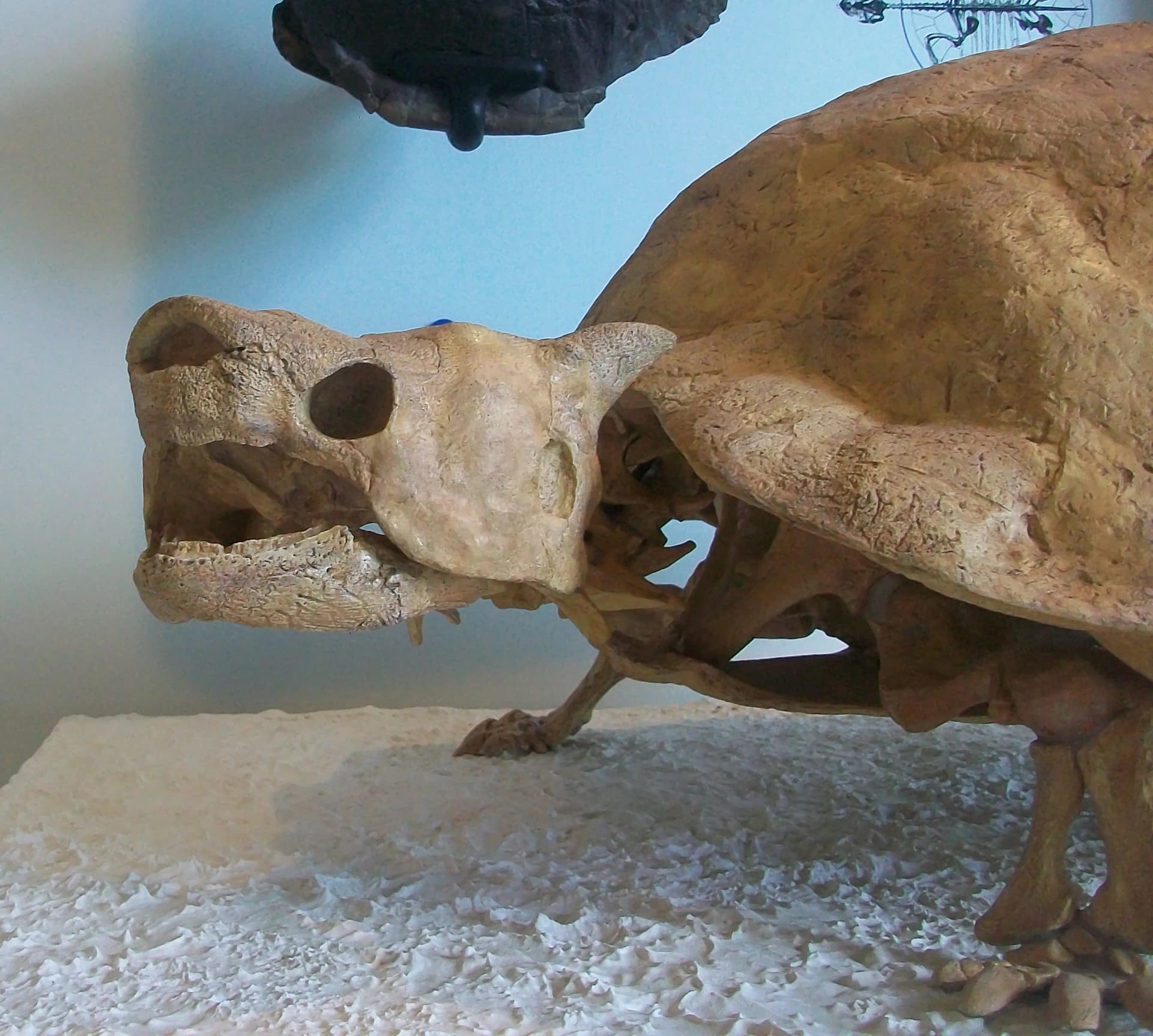
Meiolania anatomy is unique among turtles. Its most spectacular feature is its massive head adorned with two pairs of large bony horns: a pair of pointed lateral horns protruding from each side of the head, and a pair of frontal bosses. These horns made the head so wide that it was impossible to retract it under the shell, unlike most turtles. Its tail was armored and equipped with a ring of bony spines, forming a defensive club similar to ankylosaurs — a remarkable example of convergent evolution. The shell was high and domed, typical of terrestrial turtles. Legs were robust and columnar, with broad feet adapted for terrestrial walking. Meiolania classification was long debated, but it is now placed among the Meiolaniidae, a family of basal turtles unrelated to modern cryptodires or pleurodires.
Meiolania behavior was probably similar to that of modern large land tortoises: a slow herbivore, solitary or living in loose small groups, methodically roaming its territory in search of food. Cranial horns probably served for ritual combat between males for access to females, with individuals pushing each other with their horned heads, similar to ram fights. The armored, spiny tail was a defensive weapon against predators, capable of being swung with force. Like modern giant tortoises, Meiolania probably spent long hours basking in the sun to maintain body temperature. Its longevity was probably exceptional, possibly exceeding 100 years. Reproduction involved laying eggs in nests dug into the ground. The extinction of Melanesian island populations 2,000 years ago is directly linked to the arrival of the Lapita people, the first Polynesian navigators.
Meiolania was first described in 1886 by Richard Owen (who had previously described the first dinosaurs) from fossils discovered at Lord Howe Island, a small volcanic island between Australia and New Zealand. The name means 'small wanderer,' a name chosen by Owen who initially thought it was a lizard (megalania/meiolania). The holotype includes a nearly complete skull showing the characteristic horns. Additional fossils, including shells and postcranial skeletons, have been found in mainland Australia (Queensland, New South Wales), New Caledonia, and Vanuatu. The 2010 discovery of Meiolania damelipi fossils in Vanuatu in archaeological layers dated to 2,000 BCE demonstrated that the first humans in Melanesia hunted and probably exterminated this species. Bones bearing cooking marks have been found in human hearths, direct evidence of hunting.
| Period | Miocène-Pléistocène / Miocene-Pleistocene |
| Era | Cénozoïque / Cenozoic |
| Age | ~50 000 - 2 000 ans / ~50,000 - 2,000 years ago |
| Location | Australie, Nouvelle-Calédonie, Vanuatu / Australia, New Caledonia, Vanuatu |
| Length | ~2.5 m (avec queue) |
| Height | ~0.8 m |
| Weight | ~500-800 kg |
| Diet | Herbivore |
| Discovery | 1886 |
No. Meiolania platyceps was a giant terrestrial turtle (family Meiolaniidae), not a dinosaur. It is a reptile distinct from the archosaurs to which dinosaurs belong. This giant tortoise lived in Pleistocene Australia (50,000–20,000 years ago) and related species survived in New Caledonia and Vanuatu until approximately 2,000 BCE, coexisting with the first humans of Melanesia.
Meiolania platyceps had two anatomically unique features among turtles: a massive head adorned with two pairs of large bony horns, so wide (approximately 50 cm) that retraction into the shell was impossible, and an armored tail ending in a ring of bony spines forming a defensive club. This tail evokes that of ankylosaur dinosaurs — a rare example of convergent evolution between distantly related reptiles.
The 2010 discovery of Meiolania damelipi fossils in Vanuatu in archaeological layers dated to ~2,000 BCE provided direct evidence: bones bearing cooking marks were found in Lapita hearths, the first Polynesian navigators. The arrival of these populations on Melanesian islands caused the rapid extinction of this giant turtle, which had no natural predators and was unable to flee or effectively defend itself against human hunters.
Reconstruction of Meiolania platyceps
Wikimedia Commons
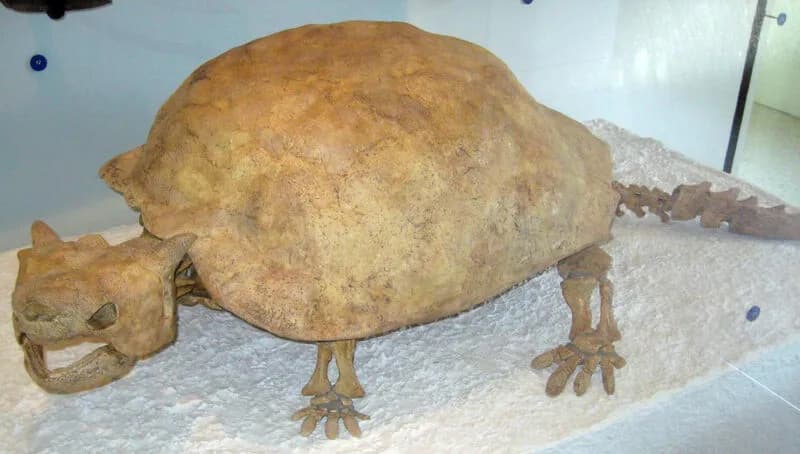
Horned skull of Meiolania platyceps
Wikimedia Commons