Cerf géant
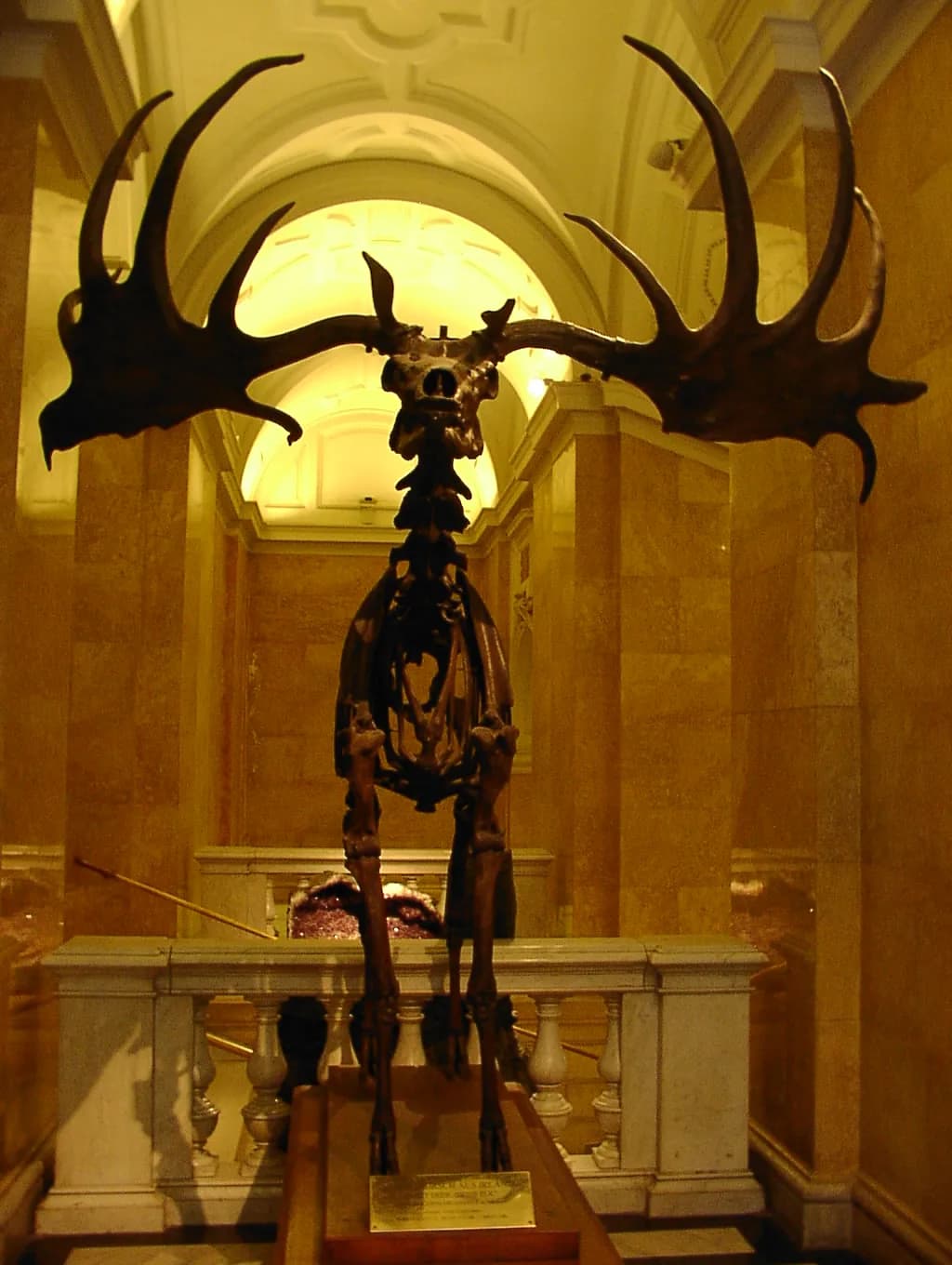
Megaloceros giganteus carried the largest antlers of any deer: 3.65 metres across and 40 kilograms, regrown every year. Standing 2.5 metres and weighing 500 to 700 kilograms, it lived from Ireland to Siberia between 400,000 and 7,700 years ago. Its nickname « Irish elk » is doubly misleading: it was no elk, and it was not confined to Ireland.
Megaloceros giganteus, commonly known as the giant deer or Irish elk, lived during the Middle and Late Pleistocene, approximately 400,000 to 7,700 years ago. This colossal cervid appeared in Eurasia and reached its peak during interglacial periods, when vast grasslands and steppes provided the ideal habitat for a herbivore of this size. Its range extended from Ireland to eastern Siberia, across continental Europe and Central Asia. The last surviving populations persisted in western Siberia and possibly the Caucasus until around 7,700 years ago. Its disappearance coincides with post-glacial climate changes that transformed open steppes into dense forests, an unsuitable habitat for an animal bearing antlers spanning over 3.5 meters. Human hunting pressure likely contributed to the extinction of the last isolated populations.
Megaloceros giganteus was the largest cervid that ever existed. Males stood approximately 2.1 meters at the shoulder, comparable to a modern moose but with a more massive build, and weighed between 540 and 700 kg. Females were considerably smaller, weighing about 350 to 450 kg, a pronounced sexual dimorphism typical of large-antlered cervids. But it was its antlers that remain its most spectacular feature: male antlers reached a span of 3.65 meters from tip to tip and weighed up to 40 kg. These antlers were shed and regrown annually, imposing a colossal metabolic cost in calcium and phosphorus during the spring growth period. The limb bones were exceptionally thick and robust to support the combined weight of body and antlers.
Megaloceros was a mixed feeder combining browsing and grazing depending on season and available habitats. Isotopic analysis of its bones and tooth enamel reveals a diet primarily composed of grasses, sedges, and herbaceous plants from open steppes and grasslands, supplemented with leaves, buds, and shoots from low shrubs during colder periods. The annual growth of its massive antlers required considerable mineral intake, particularly calcium and phosphorus, which the animal obtained by selecting nutrient-rich plants and possibly licking mineral outcrops. Dental microwear studies show patterns consistent with a browser of varied vegetation, neither exclusively a grazer nor exclusively a browser. This dietary flexibility allowed it to adapt to seasonal changes in Eurasian vegetation.
Megaloceros occupied the vast steppe-grasslands, parklands (mosaics of grasslands and scattered groves), and open areas of temperate and subarctic Eurasia. Its preferred habitat was the mammoth steppe, a vanished ecosystem characterized by rich, nutritious herbaceous vegetation maintained by the megafauna itself. The colossal size of its antlers made dense forests impractical, limiting the animal to open or semi-open terrain. In Ireland, where the finest specimens were discovered in peat bogs, the animal frequented calcium-rich grassland plains during interglacials. The most important fossil sites are found in Ireland (Pleistocene lakes and bogs), Germany, southern Russia, and the Caucasus. The post-glacial transformation of steppes into closed forests is considered the primary factor in its extinction.
Megaloceros anatomy was dominated by adaptations necessary to support and use its gigantic antlers. The skull was elongated and reinforced, with exceptionally wide pedicles (antler bases) and thickened frontal bones to distribute weight and absorb combat shocks between males. The cervical vertebrae were massive, with prominent spinous processes serving as anchors for powerful neck musculature. The characteristic hump at the withers, visible in cave art depictions, corresponded to elongated spinous processes of the anterior thoracic vertebrae, providing the muscular attachment necessary to hold the head and its antlers. The forelimbs were slightly longer than the hindlimbs, giving the animal a silhouette slightly tilted toward the rear. The hooves were broad and adapted to the varied terrain of the Eurasian steppes.
Megaloceros behavior can be reconstructed by analogy with modern large cervids and through numerous Paleolithic cave art representations. Males used their spectacular antlers primarily as visual signals of dominance during the autumn rut, with antler size directly indicating genetic quality and physical condition. Ritualized combat between rival males, though potentially dangerous, likely followed engagement rules similar to modern red deer: frontal antler clashing, pushing and twisting to assess the opponent's strength. Cave paintings at Lascaux, Chauvet, and other European caves depict Megaloceros in small mixed herds, suggesting a gregarious lifestyle with groups of females and young accompanied by dominant males during the breeding season. Outside the rut, males likely formed separate bachelor groups.
The first Megaloceros fossils were described in the 17th century in Ireland, where remarkably preserved skeletons were regularly discovered in peat bogs and lake sediments. Naturalist Thomas Molyneux published the first scientific description in 1697, initially believing it was a giant moose — hence the persistent nickname 'Irish elk' despite the animal being neither an elk nor exclusively Irish. The generic name Megaloceros ('great horns') was established by Brookes in 1828. The finest collections come from the Irish peat bogs of Ballybetagh near Dublin, where over 100 complete skeletons have been extracted. Exceptional specimens have also been found on the Isle of Man, in Germany (Rhine Valley), northern Italy, Crimea, and as far as western Siberia. Radiocarbon dating of the last Siberian specimens indicates survival until approximately 7,700 years ago, well after the disappearance of European populations.
| Period | Pléistocène / Pleistocene |
| Era | Cénozoïque / Cenozoic |
| Age | 400 000 - 7 700 ans |
| Location | Eurasie (Irlande à Sibérie) / Eurasia (Ireland to Siberia) |
| Length | 2.5 m |
| Height | 2.1 m (au garrot / at shoulder) |
| Weight | 500-700 kg |
| Diet | Herbivore |
| Discovery | 1799 |
The antlers of male Megaloceros giganteus reached a span of 3.65 meters from tip to tip and weighed up to 40 kilograms. These antlers were shed and regrown annually, imposing a colossal metabolic cost in calcium and phosphorus. The limb bones were exceptionally thick to support this combined weight alongside a body standing 2.1 meters at the shoulder and weighing 540 to 700 kilograms.
No — Megaloceros giganteus was neither an elk nor exclusively Irish. Its range extended from Ireland to eastern Siberia, across continental Europe and Central Asia. While Ireland yielded the finest skeletons (Ballybetagh peat bogs, over 100 complete individuals), specimens have been found as far as western Siberia, where the last individuals survived until approximately 7,700 BCE.
The post-glacial transformation of open steppes into dense forests is the primary factor in the extinction of Megaloceros giganteus. The colossal span of its antlers (3.65 m) made forest navigation impractical, limiting the animal to open terrain. Human hunting pressure likely accelerated the disappearance of the last isolated populations in western Siberia and the Caucasus.
Megaloceros giganteus, the giant deer with majestic antlers
Wikimedia Commons
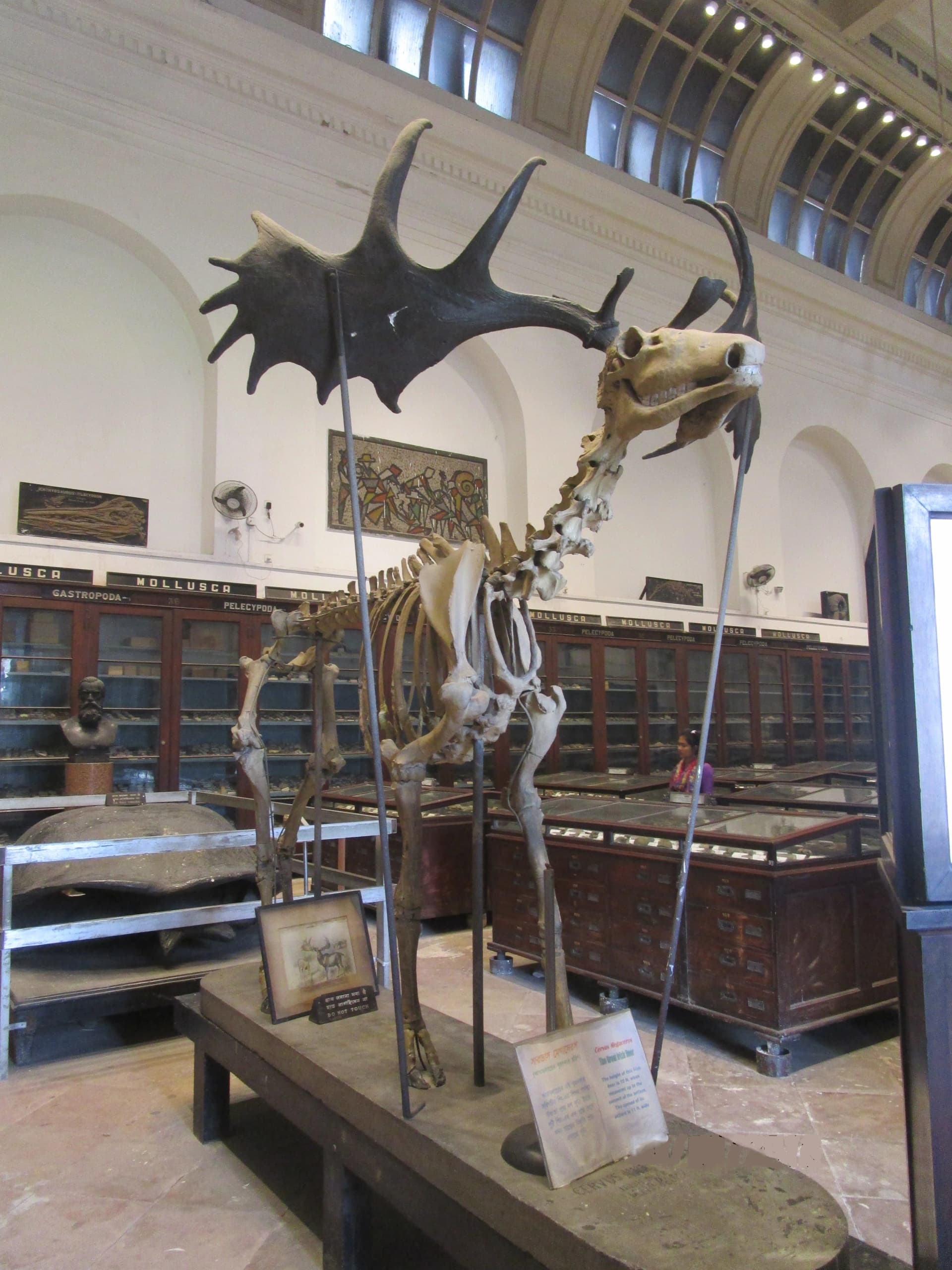
Megaloceros giganteus, the largest deer of all time
Wikimedia Commons