Mégacérops
Megacerops coloradensis stood 5 metres and weighed 3 to 4 tonnes, ranging South Dakota, Nebraska and Colorado 38 to 34 million years ago. The Lakota called it « thunder beast »: its bones surfaced from cliff faces after storms. Despite its rhinoceros look, this brontothere is closer to horses than to living rhinos.
Megacerops lived during the Late Eocene, approximately 38 to 34 million years ago, a pivotal period in Earth's climate history. The Late Eocene world was still a warm greenhouse environment, but global temperatures were beginning to decline progressively, heralding the transition toward the cooler conditions of the Oligocene. The tropical and subtropical forests that had dominated North America during the Middle Eocene were slowly giving way to more open landscapes, mixing sparse woodlands with nascent grasslands. It was in this context of climatic transition that Megacerops reached its evolutionary peak, becoming one of the largest land mammals of its time in North America, before disappearing during the Grande Coupure at the Eocene-Oligocene boundary, which saw the extinction of numerous archaic mammal lineages across the continent and fundamentally reshaped terrestrial ecosystems.
Megacerops coloradensis was a truly colossal animal for its time, rivaling and often exceeding the largest modern rhinoceroses in size and overall body mass. It measured approximately 5 meters in total length from snout to tail and reached an impressive shoulder height of 2.5 meters, making it one of the largest land mammals of the North American Eocene. Its estimated weight ranged between 3 and 4 tonnes, comparable to an adult male hippopotamus or a large modern white rhinoceros. Its massive, stocky silhouette, with a barrel-shaped body supported by four thick columnar limbs, gave it an imposing appearance that dominated the landscapes of plains and open woodlands where it roamed and fed. Males were noticeably larger than females, a marked sexual dimorphism that suggests competitive behaviors among males for access to receptive females during the breeding season, similar to patterns seen in many large modern herbivores.
Megacerops was a strict herbivore specialized in consuming soft vegetation and low browse, a feeding mode described by paleontologists as selective browsing rather than grazing on tough grasses. Contrary to what its imposing size might suggest, its teeth were surprisingly small and relatively simple for an animal of this stature, adapted to grinding tender leaves, soft fruits, and plant shoots rather than masticating abrasive silica-rich grasses that would require more robust dental equipment. Analysis of dental morphology reveals brachydont molars with thin enamel, characteristic of a diet composed of soft plant material requiring little abrasion during chewing and processing. Its large size allowed it to access branches and foliage at heights unreachable by most other herbivores in its ecosystem, thus reducing direct food competition with smaller species sharing its woodland and open plain habitat throughout the Late Eocene.
Megacerops inhabited the open plains and sparse woodlands of western North America during the Late Eocene, in regions corresponding today to South Dakota, Nebraska, and Colorado. The landscape of that era differed considerably from today's terrain: a subtropical to warm temperate climate supported lush vegetation composed of open deciduous forests, wooded savannas, and grasslands scattered with trees and shrubs that provided ample food resources. The large river systems that crossed these plains created corridors of dense riparian vegetation along which Megacerops probably moved to feed and drink throughout the changing seasons. The White River geological formations in South Dakota and Nebraska, famous for their exceptional fossil richness, bear witness to this vanished environment and have yielded hundreds of Megacerops specimens in remarkable states of preservation that allow detailed study of this magnificent brontothere's biology and ecology.
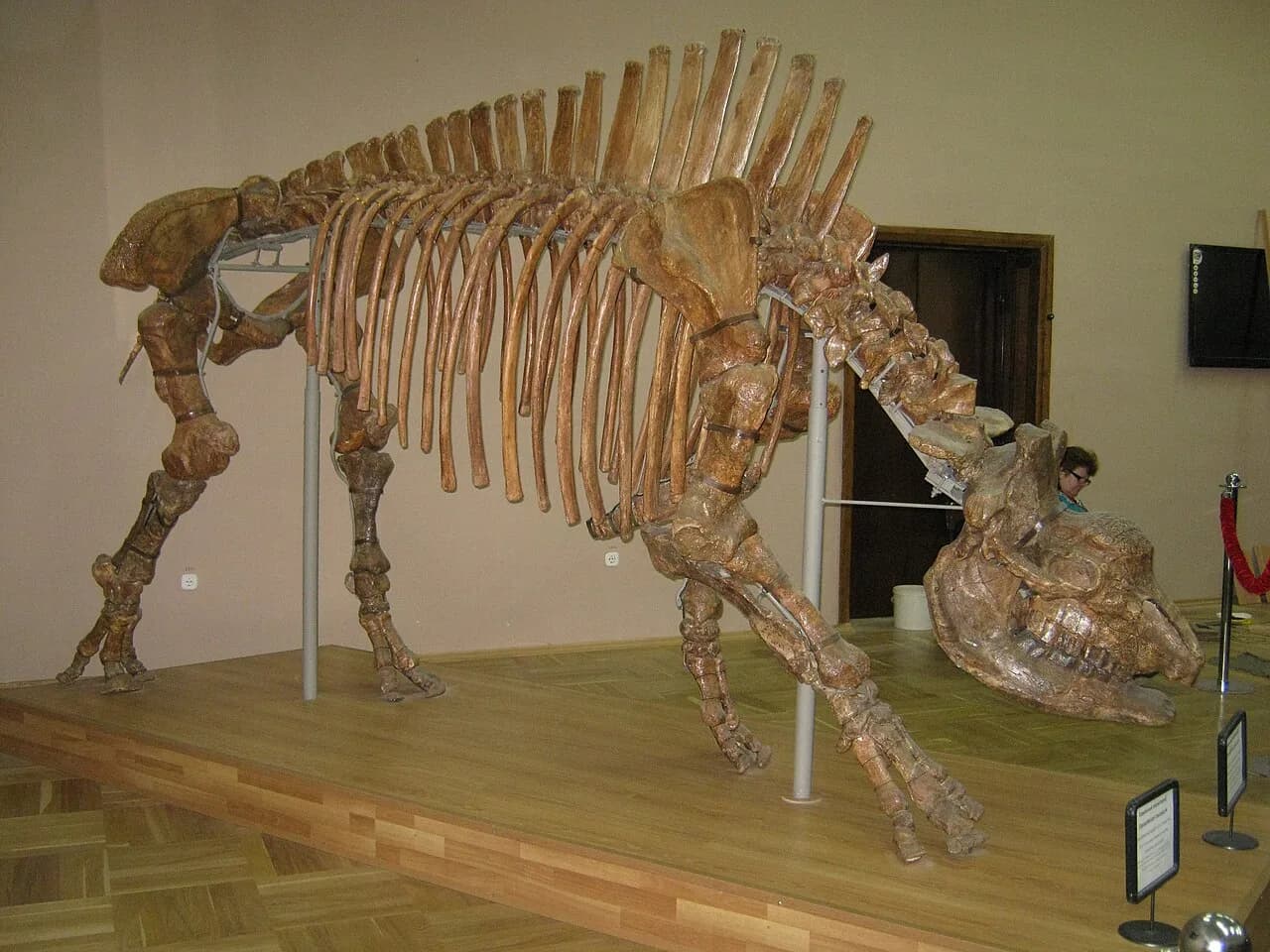
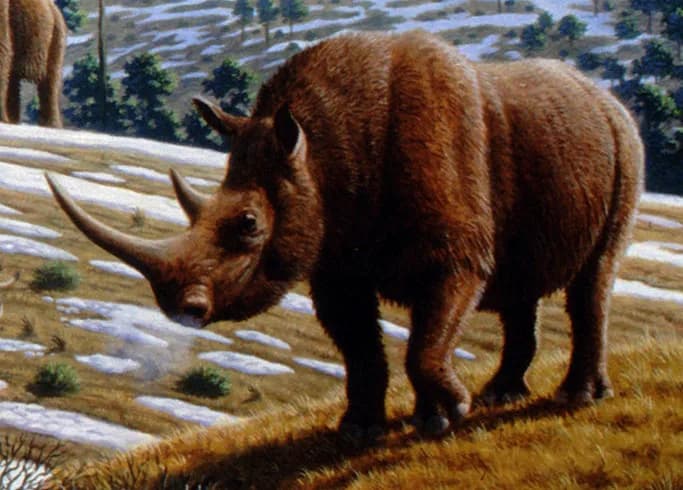
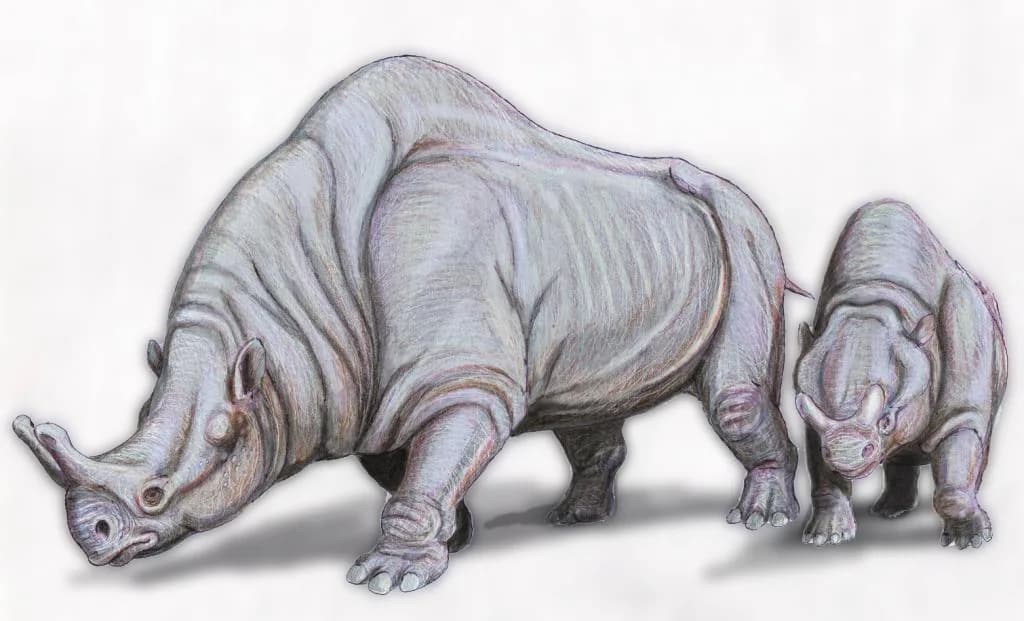
Megacerops' anatomy was dominated by its most distinctive feature: a Y-shaped nasal horn situated at the tip of its snout, a unique bony structure in the animal kingdom that immediately distinguished brontotheres from all other large mammals of their era. This forked horn, covered with thick skin or keratin during the animal's life, was markedly more developed in males than in females, suggesting an important role in sexual selection and intraspecific combat for dominance and mating rights. Despite a superficial resemblance to rhinoceroses, Megacerops was absolutely not related to them — it belonged to the family Brontotheriidae, a group of perissodactyls more closely related to modern horses and tapirs than to rhinoceroses, a surprising evolutionary connection. Its massive barrel-shaped body rested on four thick columnar limbs ending in three-toed feet, a morphology typical of primitive perissodactyls adapted to supporting considerable weight across varied terrain in the Late Eocene landscapes.
Megacerops likely lived in herds, a social lifestyle suggested by the frequent discovery of multiple fossilized individuals together in the same geological layers of the White River formations across South Dakota and Nebraska. Males, equipped with Y-shaped nasal horns significantly larger than those of females, probably used these structures for ritualized combat during the breeding season, pushing head-to-head in a manner similar to modern bison or deer to establish dominance and access to harems of females. This combat behavior is consistent with the pronounced sexual dimorphism observed across numerous fossil specimens collected over more than a century of paleontological research. As a slow, massive browser, Megacerops probably moved methodically through plains and open woodlands, devoting most of its days to feeding in order to maintain its considerable body mass of 3 to 4 tonnes, requiring a substantial daily caloric intake of tender vegetation, soft leaves, and plant shoots.
The name Megacerops means 'great horned face' (from Greek megas 'great' + keras 'horn' + ops 'face'), but indigenous Lakota peoples knew these fossils long before Western paleontologists, calling them 'thunder beasts,' believing the enormous bones emerging from cliffs after thunderstorms belonged to mythical creatures galloping through the storm clouds above the plains. This legend gave rise to the scientific family name Brontotheriidae (from Greek brontē 'thunder' + thērion 'beast'), forever linking these animals to the dramatic weather of the American Great Plains. Hundreds of specimens have been discovered in the White River formations of South Dakota and Nebraska, some in extraordinary states of preservation including nearly complete skeletons with remarkable anatomical detail. Among the most remarkable discoveries are assemblages of multiple individuals killed simultaneously by volcanic ashfall, preserved in tuff beds that froze entire herds in their final postures, offering a striking snapshot of life and death at the twilight of the Eocene epoch.
| Period | Éocène supérieur / Late Eocene |
| Era | Cénozoïque / Cenozoic |
| Age | 38-34 Ma |
| Location | Dakota du Sud, Nebraska, Colorado / South Dakota, Nebraska, Colorado |
| Length | 5 m |
| Height | 2.5 m (au garrot / at shoulder) |
| Weight | 3-4 tonnes |
| Diet | Herbivore |
No. Despite a similar silhouette, Megacerops coloradensis belonged to the Brontotheriidae, a group of perissodactyls more closely related to horses and tapirs than to rhinoceroses. This is a classic case of convergent evolution: two distinct lineages independently developed a massive body and nasal horn. The two families diverged approximately 55 million years ago in the Eocene.
Megacerops coloradensis measured approximately 5 meters in length and 2.5 meters at the shoulder, weighing an estimated 3 to 4 tonnes. It lived during the Late Eocene, approximately 38 to 34 million years ago, in the plains of South Dakota, Nebraska, and Colorado. It was one of the largest North American land mammals of its time.
The Lakota indigenous people regularly discovered the enormous bones of Megacerops coloradensis eroding from the Badlands cliffs after thunderstorms. They associated these bones with mythical creatures galloping through storm clouds. This legend gave the scientific family its name, Brontotheriidae (Greek brontē 'thunder' + thērion 'beast'), still used by paleontologists today.
Megacerops coloradensis restoration
Wikimedia Commons
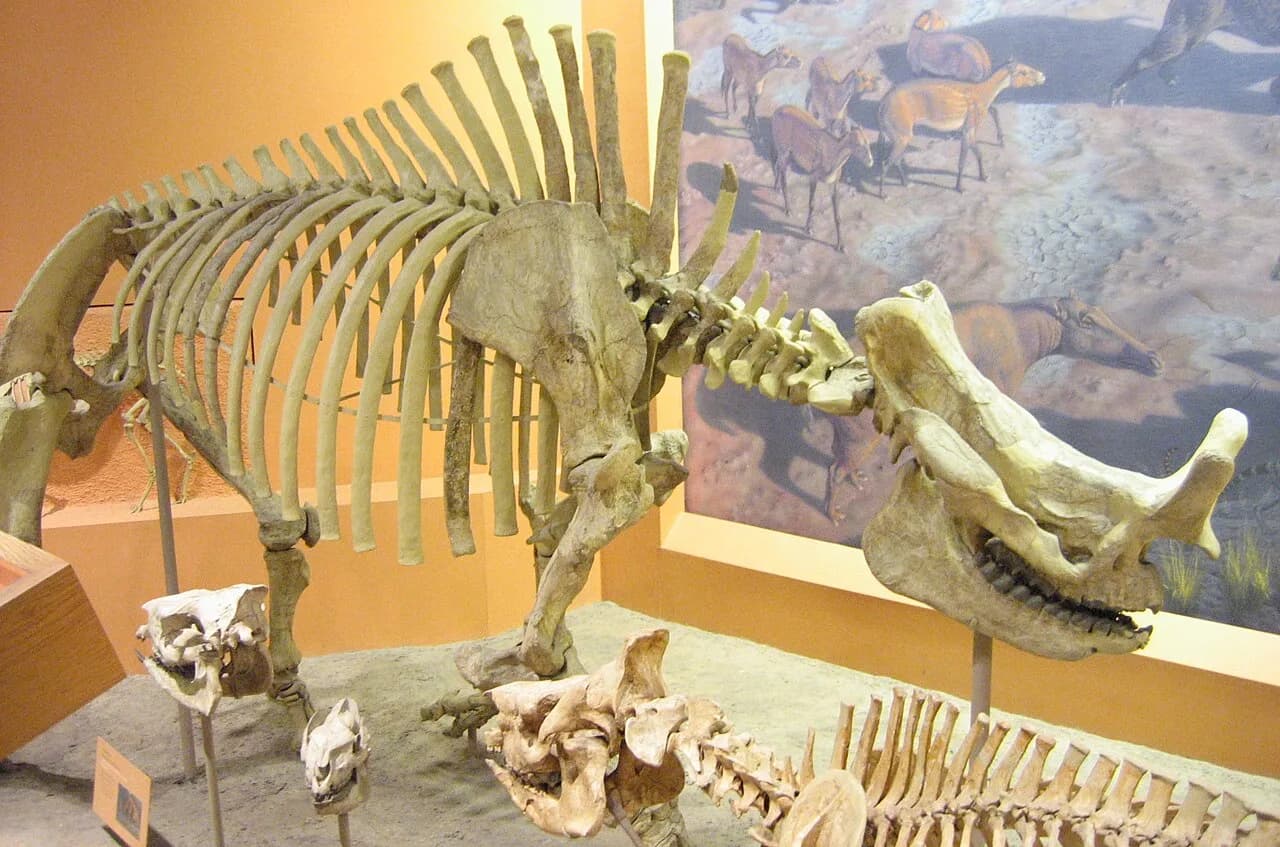
Brontotherium hatcheri skeleton
Wikimedia Commons