Mastodonsaure
Mastodonsaurus giganteus carried a skull 1.25 metres long, larger than that of many predatory dinosaurs. Two teeth from its lower jaw passed straight through the palate and emerged above the snout, through openings made for them. This amphibian, 6 metres long and around 500 kilograms, lived 242 to 227 million years ago in Europe.
Mastodonsaurus giganteus lived during the Middle to Late Triassic (Ladinian-Carnian), approximately 242 to 227 million years ago. This giant temnospondyl was the largest amphibian of its time and one of the largest that ever existed. It dominated European freshwater ecosystems at a crucial period in the history of life — just after the great Permian-Triassic extinction that had wiped out 96% of marine species. Temnospondyls like Mastodonsaurus were survivors of a very ancient amphibian lineage that had thrived since the Carboniferous.
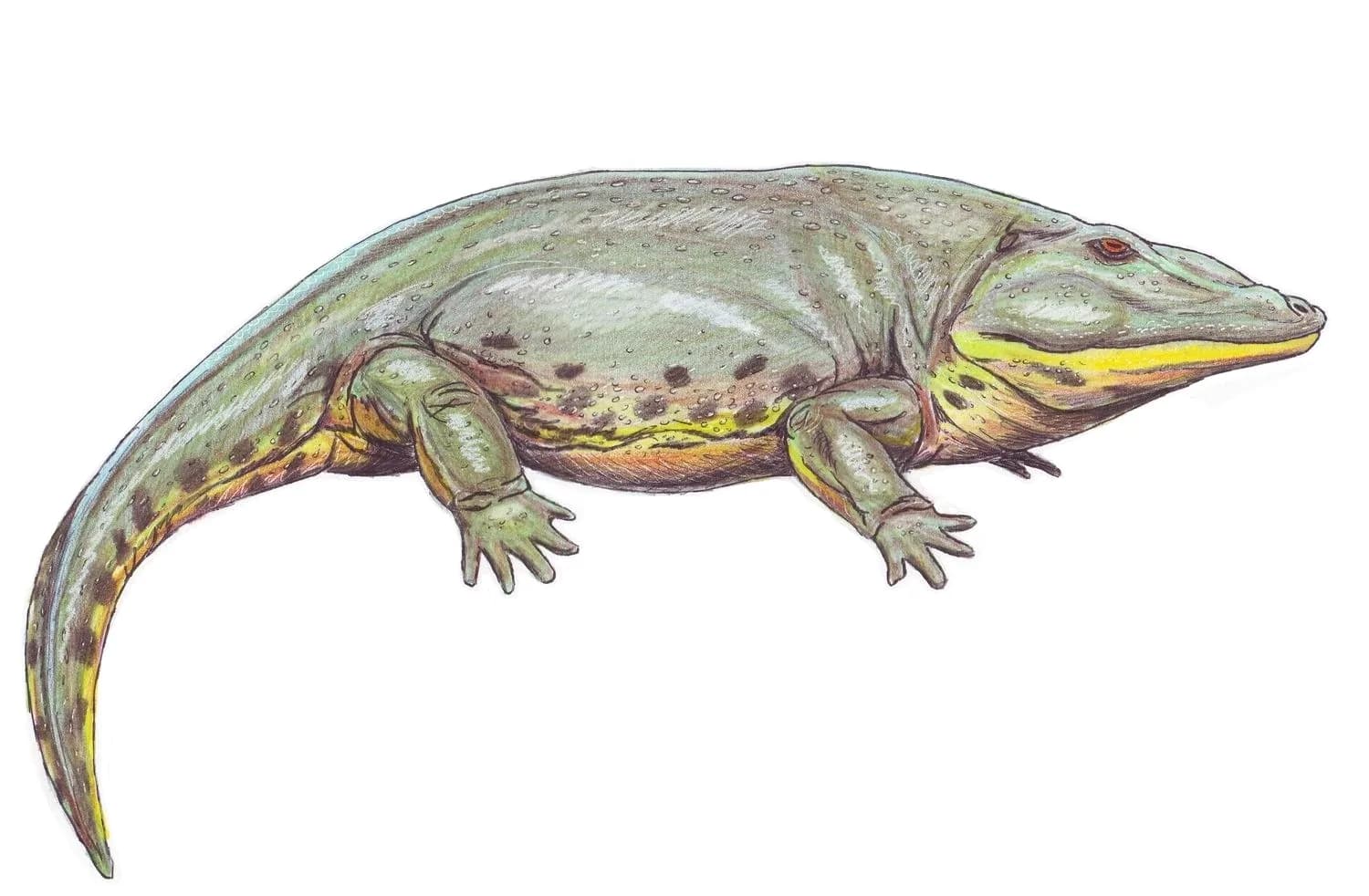
Mastodonsaurus giganteus reached approximately 6 meters in total length, making it one of the largest amphibians of all time. Its skull alone measured up to 1.25 meters long — larger than those of many predatory dinosaurs. Estimated weight exceeded 500 kilograms. Its massive, flattened, parabolic head constituted about one-fifth of total body length. The body was stocky and powerful, carried on short but robust limbs. Its gaping mouth, armed with conical teeth, could open to over 60 centimeters wide.
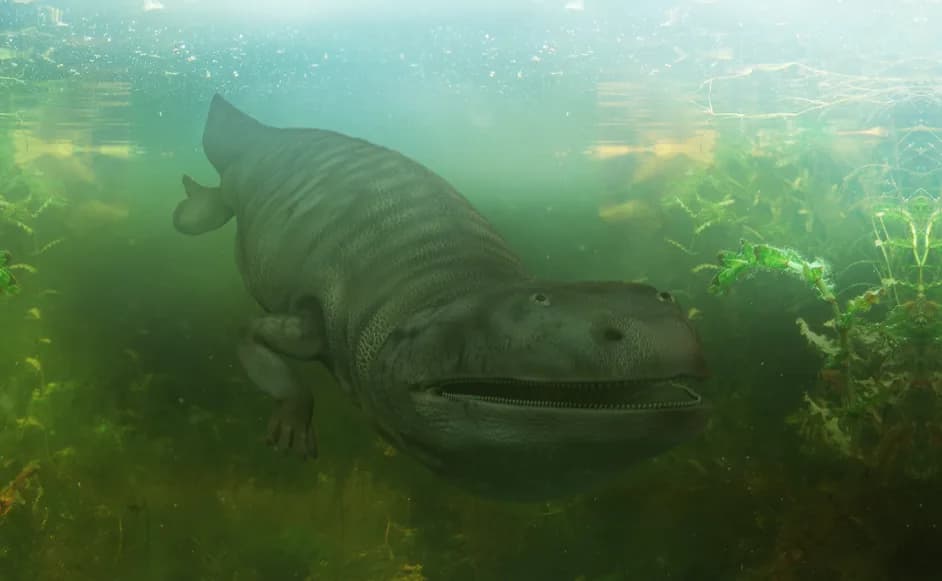
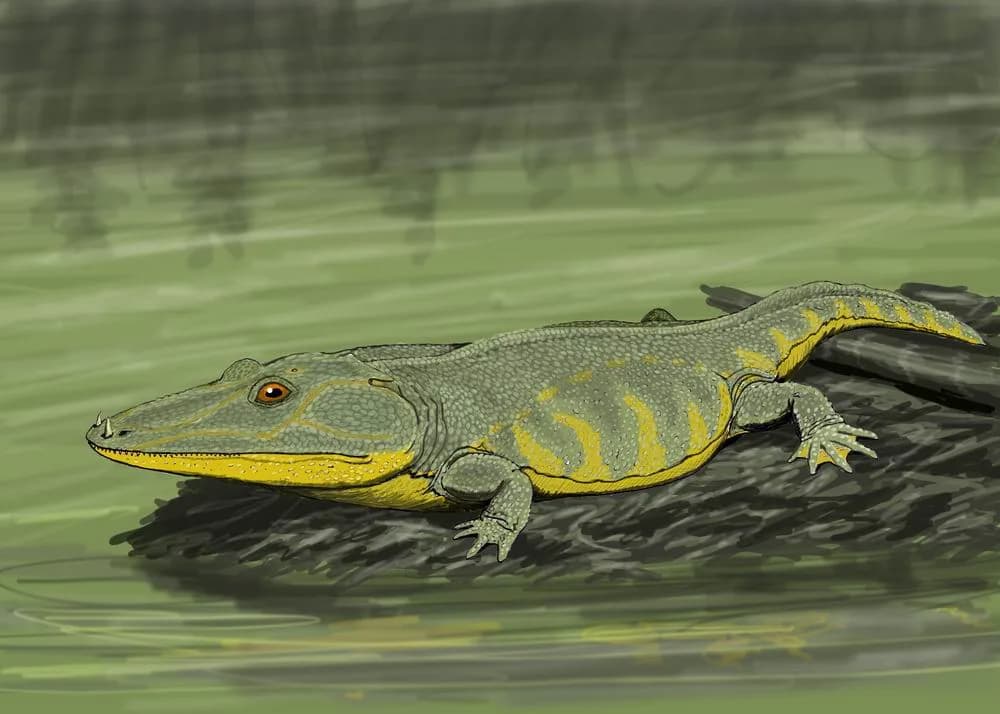
Mastodonsaurus was an aquatic super-predator that fed on fish, smaller amphibians, and possibly young archosaurs that ventured too close to the water. Its hunting technique relied on ambush: lurking at the bottom of lakes and rivers, it suddenly opened its massive jaws to create a suction effect pulling in prey. Two large fang teeth on the mandibular symphysis pierced through openings in the palate, protruding above the snout when the mouth was closed. These reversed fangs prevented slippery prey from escaping.
Mastodonsaurus inhabited the lakes, rivers, and wetlands of central Europe during the Middle Triassic. Fossils come primarily from the Keuper of Germany (Baden-Württemberg, Bavaria), but also from Poland, France, and England. The environment consisted of vast alluvial plains traversed by seasonal waterways, with a warm, semi-humid climate. The freshwater lakes and basins where Mastodonsaurus lived were bordered by conifer and fern forests. It shared these habitats with ganoid fish, smaller temnospondyls, and the first terrestrial archosaurs.
Mastodonsaurus's skull is one of the most impressive structures of all amphibians. Broad, flat, and parabolic, it was composed of dermal bones sculpted with pits and sensory grooves (lateral lines), indicating an aquatic lifestyle. The two large mandibular fang teeth pierced the palate through specialized palatal fenestrae — a unique adaptation. The upper jaw bore rows of conical teeth and vomerine palatal teeth. The body was massive with a laterally compressed tail for aquatic propulsion. Limbs were short and poorly adapted for terrestrial locomotion. The skin probably bore osteoderms (bony plates) on the belly.
Mastodonsaurus was a primarily aquatic ambush predator that spent most of its time submerged in lakes and waterways. Its hunting mode resembled that of modern crocodiles: motionless at the bottom or at the surface, it waited for prey to come within range before suddenly opening its jaws to suck in water and prey. Lateral line sensory grooves on its skull allowed it to detect vibrations in water, like fish. On land, its movements were slow and laborious. It could possibly estivate in mud during seasonal droughts, like some modern amphibians.
Mastodonsaurus was first described in 1828 by Georg Friedrich Jaeger from an isolated tooth found in the Keuper of Stuttgart, Germany. The name means 'nipple-tooth lizard' (Greek mastos = nipple, odous = tooth, sauros = lizard), referring to the conical shape of its teeth. Since then, hundreds of specimens have been discovered in Triassic deposits across Europe. Exceptional complete skulls are displayed at the Staatliches Museum für Naturkunde in Stuttgart. The wealth of fossil material makes it one of the best-known temnospondyls, enabling detailed reconstructions of its anatomy, growth, and ecology.
| Period | Trias moyen-supérieur / Middle-Late Triassic |
| Era | Mésozoïque / Mesozoic |
| Age | 242-227 Ma |
| Location | Europe (Allemagne, Pologne, France, Angleterre) / Europe (Germany, Poland, France, England) |
| Length | ~6 m |
| Height | ~60 cm |
| Weight | ~500 kg (estimé / estimated) |
| Diet | Piscivore |
| Discovery | 1828 |
No, Mastodonsaurus giganteus was not a dinosaur. It was a temnospondyl, a giant amphibian belonging to an entirely distinct group ancestral to modern amphibians. It lived during the Middle to Late Triassic (242–227 Ma), well before the height of dinosaur diversity. At roughly 6 meters in length, it remains one of the largest amphibians that ever existed on Earth.
Mastodonsaurus giganteus had two large fang teeth on the mandibular symphysis (lower jaw) that pierced through bony windows in the palate and protruded above the snout when the mouth was closed. These reversed fangs formed a retention mechanism: a slippery prey item (fish, small amphibian) seized in the jaws could no longer escape forward.
Mastodonsaurus giganteus was first described in 1828 by Georg Friedrich Jaeger from an isolated tooth found in the Keuper (Triassic) of Stuttgart, Germany. Since then, hundreds of specimens have been unearthed in Triassic deposits across Germany (Baden-Württemberg, Bavaria), Poland, France, and England. Complete skulls are on display at the Staatliches Museum für Naturkunde in Stuttgart.
Mastodonsaurus giganteus life reconstruction
Wikimedia Commons