Mammouth de Colomb
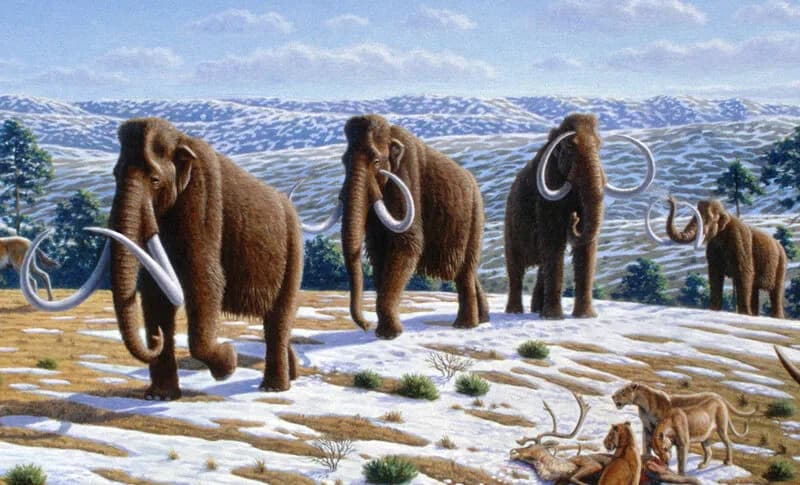
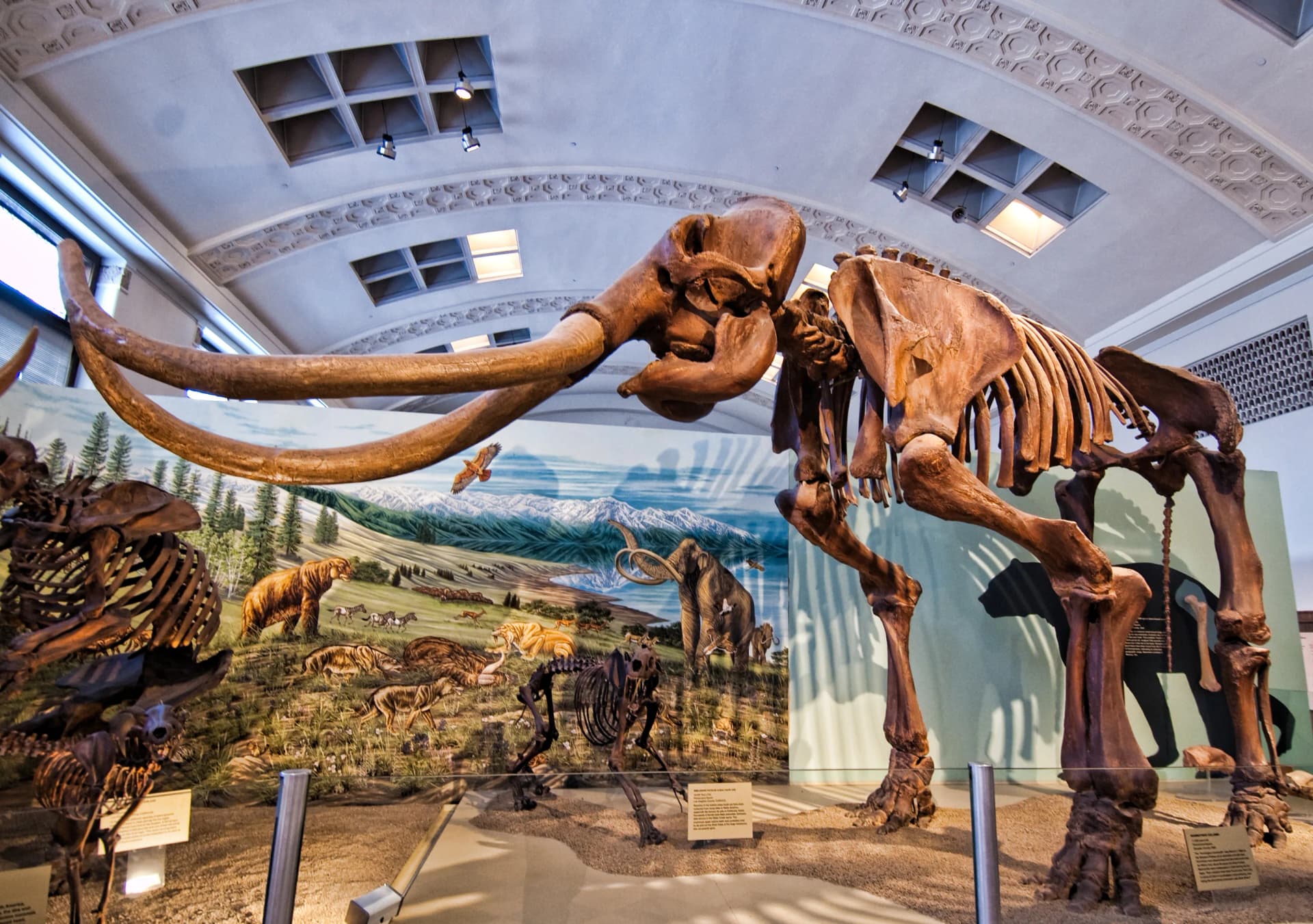
Mammuthus columbi clearly outgrew its woolly cousin: 4.5 metres at the shoulder and 8 to 10 tonnes, with tusks reaching 4.9 metres. It occupied North America, from Canada to Mexico, between 1.5 million and 11,000 years ago. At the Waco site in Texas, an entire herd of twenty-four was fossilised at once by a flood, 68,000 years ago.
Mammuthus columbi, the Columbian mammoth, lived in North America during the Pleistocene, approximately 1.5 million to 11,000 years ago. Larger than its cousin the woolly mammoth, this proboscidean colonized the temperate and southern regions of the continent, from the Great Plains to central Mexico and Costa Rica. It descended from Mammuthus meridionalis, a Eurasian mammoth that crossed Beringia in the early Pleistocene. Unlike the woolly mammoth adapted to Arctic cold, the Columbian mammoth thrived in temperate grasslands, savannas, and semi-arid zones of North America. It coexisted with the first Paleoamericans of the Clovis culture, whose characteristic spear points have been found associated with mammoth bones at several sites. Its disappearance around 11,000 years ago likely resulted from the combination of post-glacial warming and human hunting.
The Columbian mammoth ranked among the largest proboscideans that ever lived. Males reached a shoulder height of 3.7 to 4 meters, significantly taller than the woolly mammoth (approximately 3 meters), and weighed between 8 and 10 tonnes, rivaling Palaeoloxodon namadicus for the title of largest terrestrial elephant. Females were smaller, measuring about 2.8 to 3.2 meters at the shoulder and weighing 4 to 6 tonnes. Its curved tusks could reach 4.9 meters in length, the longest known among mammoths. The largest tusk ever discovered, from the Post site in Texas, measured 4.9 meters along the outer curve. Its massive body was likely covered with sparse hair, far less dense than the woolly mammoth's coat, adapted to the milder temperatures of its southern habitat.
The Columbian mammoth was a generalist herbivore adapted to North American grasslands. Analysis of gut contents from preserved specimens and isotopic study of tooth enamel reveal a diet dominated by prairie grasses, supplemented with herbaceous plants, tree and shrub leaves, and occasionally bark. Its lamellar molars, composed of numerous parallel enamel ridges, were perfectly adapted for grinding abrasive silica-rich vegetation. Like modern elephants, it underwent horizontal tooth replacement: six sets of molars succeeded each other throughout its life, each new tooth pushing the worn predecessor forward. An adult probably consumed between 150 and 300 kg of vegetation per day. Coprolite analyses from caves in the American Southwest show the presence of grasses, juniper, sage, and even cactus in its diet.
The Columbian mammoth occupied a wide range of temperate to semi-arid habitats across North America, from the Great Plains of southern Canada to central Mexico and Honduras. Unlike the woolly mammoth confined to Arctic steppes, the Columbian mammoth preferred temperate grasslands, savannas, river valleys, and open woodlands. Major fossil sites like Waco in Texas (where an entire herd was buried by a flash flood), Hot Springs in South Dakota (a natural warm-sediment trap), and the La Brea tar pits in California attest to the diversity of its habitats. In the American Southwest, it frequented riparian zones and desert oases, as evidenced by the Murray Springs and Lehner sites in Arizona. Its seasonal migration routes likely followed river valleys and grassland corridors.
The Columbian mammoth's anatomy exhibited the typical characteristics of advanced mammoths with adaptations to temperate climates. Its skull was tall and dome-shaped, with a prominent cranial crest serving as an anchor for the powerful neck muscles needed to maneuver its massive head and long tusks. The tusks, made of ivory (modified dentine), were strongly spirally curved and could individually weigh over 90 kg. They served as multipurpose tools for digging up roots, stripping bark, breaking ice at water sources in winter, and as weapons during fights between males. Its trunk, a boneless muscular organ composed of more than 100,000 muscle fascicles, was the most versatile tool in its anatomy, capable of uprooting trees as well as plucking a single blade of grass. Its broad, cushioned feet efficiently distributed its considerable weight, leaving characteristic footprints found fossilized at several sites.
The Columbian mammoth likely had a social structure comparable to modern elephants, organized around matriarchal groups led by the oldest and most experienced female. The Waco site in Texas, where at least 24 individuals (primarily females and juveniles) were buried together by a catastrophic flood, provides direct evidence of gregarious herd behavior. Adult males probably lived alone or in small bachelor groups, joining female herds only during the breeding season. Tusks were used in ritualized combat between rival males, as evidenced by specimens showing characteristic fractures and wear from clashing. Seasonal migration routes, documented through serial isotopic variations in tooth enamel, indicate movements of several hundred kilometers between summer and winter pastures.
The Columbian mammoth was named in 1857 by paleontologist Hugh Falconer in honor of Christopher Columbus, symbolizing its connection to the New World. Fossils are extraordinarily abundant across North America, with thousands of specimens discovered from Canada to Mexico. The most spectacular site is the Waco Mammoth National Monument in Texas, where an entire herd of at least 24 mammoths was fossilized in situ by a flash flood approximately 68,000 years ago. Hot Springs in South Dakota preserves over 60 individuals that fell into a natural trap. Channel Islands National Park in California holds remains of the Channel Islands pygmy mammoth (M. exilis), an insular descendant of the Columbian mammoth that shrank through insular dwarfism to only 1.8 meters at the shoulder. In 2021, a genomic study revealed that the Columbian mammoth regularly hybridized with the woolly mammoth in contact zones at the northern edge of its range.
| Period | Pléistocène / Pleistocene |
| Era | Cénozoïque / Cenozoic |
| Age | 1,5 Ma - 11 000 ans |
| Location | Amérique du Nord (Canada au Mexique) / North America (Canada to Mexico) |
| Length | 4.5 m |
| Height | 4 m (au garrot / at shoulder) |
| Weight | 8-10 tonnes |
| Diet | Herbivore |
| Discovery | 1857 |
Mammuthus columbi was larger than Mammuthus primigenius: males reached 3.7 to 4 meters at the shoulder weighing 8 to 10 tonnes, versus about 3 meters and 4 to 6 tonnes for the woolly mammoth. It lived in temperate North American grasslands (Canada to Mexico), not Arctic steppes. Its coat was much thinner, adapted to milder temperatures. A 2021 genomic study proved the two species hybridized in their contact zones.
Waco Mammoth National Monument in Texas is the most remarkable: at least 24 Mammuthus columbi individuals (mainly females and juveniles) were fossilized in situ about 68,000 years ago after a flash flood. This entire herd preserved together constitutes direct evidence of matriarchal gregarious behavior. Hot Springs in South Dakota preserves over 60 individuals trapped in naturally warm sediments.
Yes. Mammuthus columbi coexisted with Paleoamericans of the Clovis culture, approximately 13,000 to 11,000 years ago. Clovis-type spear points have been found directly associated with mammoth bones at several North American sites (Arizona, Texas, New Mexico). Its disappearance around 11,000 BCE likely resulted from a combination of human hunting and postglacial climate warming.
Mammuthus columbi, the mammoth of the Americas
Wikimedia Commons
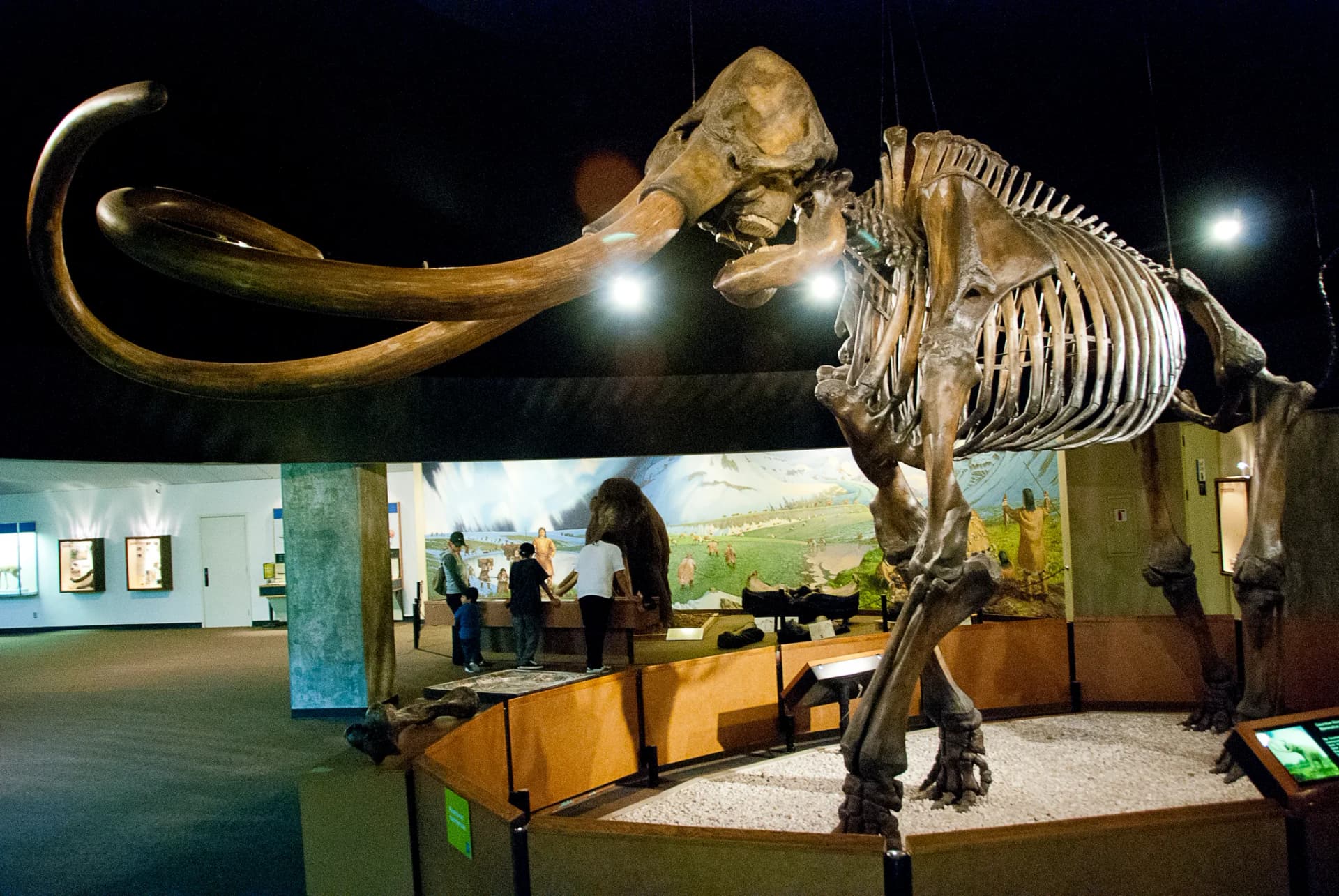
Mammuthus columbi, a giant of the North American plains
Wikimedia Commons