Homotherium
Homotherium serum was a sabre-toothed cat described in 1890, present across Europe, Asia, Africa and North America from 5 million years ago until 12,000 years before the present. Around 2 metres and 150 to 250 kilograms, it is less famous than Smilodon, yet it lasted far longer and across four continents rather than two.
Homotherium lived from the late Pliocene to the end of the Pleistocene, spanning a period from approximately 5 million years ago to just 12,000 years before the present era. This machairodont felid was one of the most enduring saber-toothed predators in history, surviving nearly to the very end of the last ice age. Unlike its famous cousin Smilodon, which was confined to the Americas, Homotherium colonized four distinct continents, demonstrating remarkable ecological adaptability across vastly different environments and climates. Its extinction coincided with the widespread disappearance of Pleistocene megafauna, likely caused by a combination of rapid climate changes and increasing pressure from expanding human populations. In Europe, the last known fossils date to around 28,000 years ago, but in North America the species H. serum appears to have persisted even longer, possibly until 12,000 years before present.
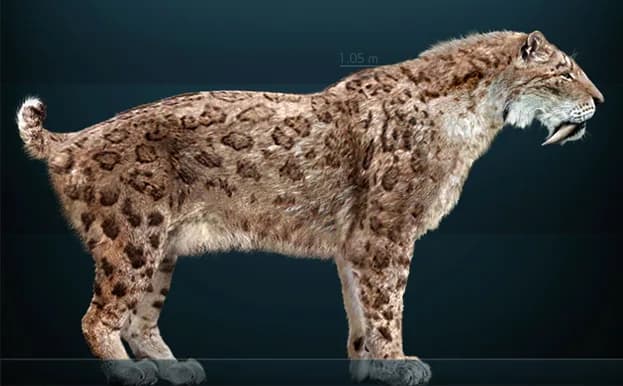
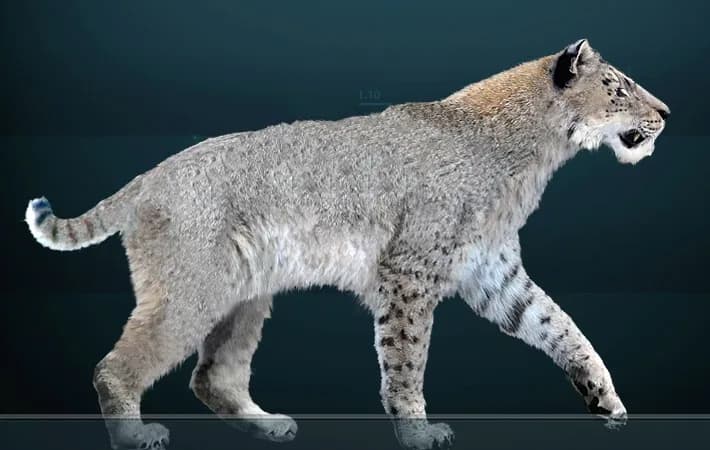
Homotherium was a large felid, comparable to the modern lion in overall body dimensions and general proportions. Adults stood approximately 1.1 meters at the shoulder, slightly taller than a modern lion at the withers. Estimated body weight ranged between 150 and 250 kilograms, with males being significantly heavier than females, as is typical among large predatory cats. Unlike most saber-toothed cats that had a stocky and massive build, Homotherium possessed a relatively lean body with long and powerful forelimbs and proportionally shorter hindlimbs, giving it a profile reminiscent of a modern spotted hyena. This athletic morphology suggests an animal built for endurance rather than explosive sprinting, capable of pursuing its prey over long distances across the vast open plains that constituted its primary hunting grounds throughout its extensive geographic range.
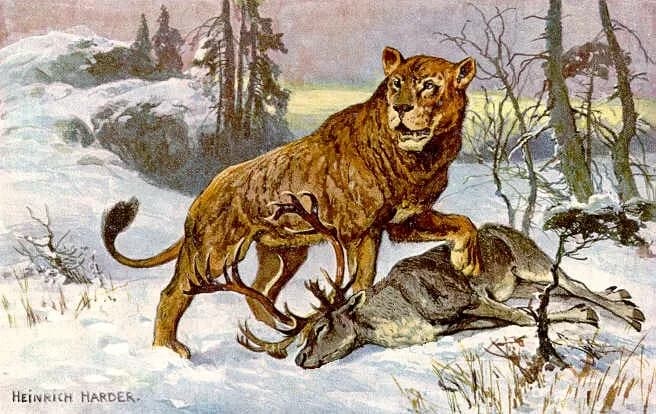
Homotherium was a hypercarnivore specialized in hunting the very largest herbivores of the Pleistocene epoch, particularly juvenile mammoths, wild horses, and plains bison. The most compelling evidence comes from Friesenhahn Cave in Texas, where the remains of over thirty individual Homotherium were discovered alongside the bones of at least twenty juvenile Columbian mammoths, indicating regular and targeted predation on proboscideans. Isotopic analysis of its bones confirms a diet dominated by large grazing herbivores of the open grasslands. Its scimitar-shaped canines, shorter and more robust than the dagger-like fangs of Smilodon, were perfectly adapted for inflicting deep slashing and lacerating wounds on the soft tissues of massive prey animals. Its specialized post-canine dentition allowed it to efficiently shear through meat and tough tendons.
Homotherium primarily occupied the open grasslands, steppes, and savannas that covered much of the Northern Hemisphere during the Pleistocene epoch. Its geographic range was extraordinarily vast, spanning four continents: Europe, Asia, Africa, and North America. In Europe, its fossils have been found from Spain to Great Britain and Eastern Europe. In Asia, it inhabited the steppes from China to the Indian subcontinent. In Africa, it was present in the eastern and southern savannas during the Pliocene and early Pleistocene. In North America, the species H. serum dominated the Great Plains from Texas all the way to Alaska. This global distribution testifies to exceptional adaptability to different climates and ecosystems, although the animal clearly preferred open environments where its long legs and keen diurnal vision gave it a distinct predatory advantage over ambush-dependent competitors.
The anatomy of Homotherium was distinctly different from that of other saber-toothed cats through several unique characteristics that set it apart. Its upper canines, while long and laterally flattened, were scimitar-shaped — curved and serrated along their posterior edge — rather than straight and smooth like the dagger-like fangs of Smilodon. This dental morphology facilitated slashing and lacerating bites rather than deep stabbing thrusts into prey. Its forelimbs were remarkably long and powerful, while its hindlimbs were comparatively shorter, creating a backward-sloping dorsal profile similar to that of a modern hyena. Its tail was short and robust. Its brain was relatively large compared to its body size, with particularly well-developed visual lobes, suggesting excellent visual acuity adapted for diurnal hunting in bright conditions. Its claws were semi-retractile, representing a compromise between ground traction for sustained pursuit and grasping capability for subduing prey.
Homotherium was very likely a pack hunter, a rare and remarkable characteristic among the great cats of any era. The most convincing evidence comes from Friesenhahn Cave in Texas, where more than thirty individuals of all ages were discovered together, accompanied by the remains of at least twenty juvenile Columbian mammoths. This accumulation strongly suggests that these predators hunted in coordinated groups, capable of isolating and bringing down juvenile prey far larger than any individual cat could manage alone. Unlike Smilodon, which was probably a crepuscular ambush hunter, the visual adaptations of Homotherium indicate a diurnal predator that actively pursued its prey across open terrain during daylight hours. Its complex social behavior, similar to that of modern lions, would have included cooperative hunting strategies, prey sharing among group members, and collective protection of the young.
The genus Homotherium was first described in 1890 by paleontologist Edouard Fabrini, based on fossils discovered in Italy. Since then, specimens have been found on four continents, confirming the cosmopolitan distribution of this remarkable predator across the ancient world. The most famous site is Friesenhahn Cave near San Antonio, Texas, excavated in the 1930s and 1940s, which contained the remains of more than thirty individual Homotherium serum associated with the bones of juvenile mammoths. In 2000, a spectacularly well-preserved skull was dredged from the bottom of the North Sea, proving that the species had inhabited Doggerland, the land bridge that once connected Britain to the European continent. In 2017, ancient DNA extracted from this North Sea specimen revealed that the European and North American populations were genetically distinct but closely related. The oldest African fossils date back approximately 5 million years, suggesting an African origin for the entire genus.
| Period | Pliocène-Pléistocène / Pliocene-Pleistocene |
| Era | Cénozoïque / Cenozoic |
| Age | 5 Ma - 12 000 ans |
| Location | Europe, Asie, Afrique, Amérique du Nord / Europe, Asia, Africa, North America |
| Length | ~2 m |
| Height | 1.1 m (au garrot / at shoulder) |
| Weight | 150-250 kg |
| Diet | Carnivore |
| Discovery | 1890 |
Homotherium serum's canines were scimitar-shaped — shorter, curved, and serrated along their posterior edge — designed for slashing and lacerating bites. Smilodon fatalis's fangs were longer, straighter, and smooth, adapted for deep stabbing thrusts into soft tissues. This morphological difference reflects distinct hunting strategies: Homotherium was an active daytime hunter, Smilodon likely a crepuscular ambush predator.
The most compelling evidence is Friesenhahn Cave in Texas, where the remains of over 30 individual Homotherium serum were found alongside bones of at least 20 juvenile Columbian mammoths. This accumulation strongly suggests coordinated cooperative hunting specifically targeting juveniles. Homotherium's morphology — long forelimbs, developed visual lobes — confirms a diurnal open-terrain predator adapted to social pursuit hunting.
Homotherium colonized four distinct continents — Europe, Asia, Africa, and North America — an unmatched geographic distribution among machairodontines. The genus described in 1890 by Edouard Fabrini from Italian fossils went extinct progressively: in Europe around 28,000 years before present, and in North America (H. serum) possibly until 12,000 BP. In 2017, ancient DNA from a skull dredged from the North Sea showed that the European and North American populations were genetically distinct.
Homotherium serum skeleton
Wikimedia Commons
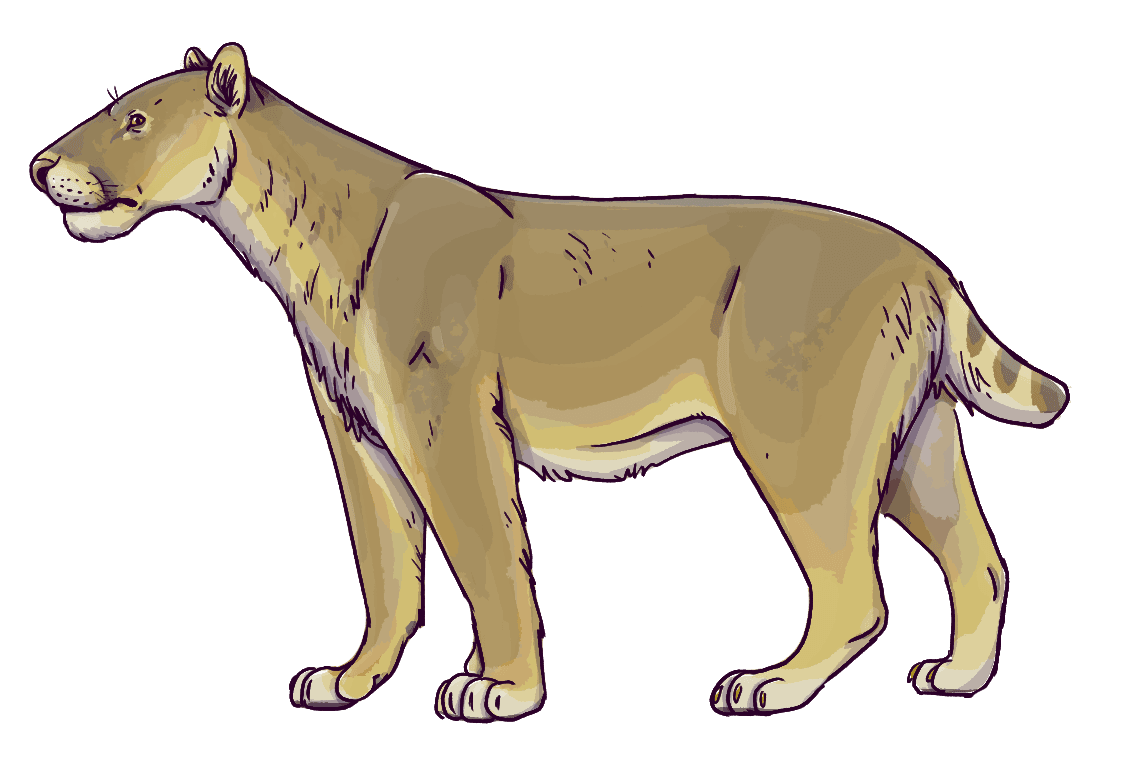
Homotherium life reconstruction
Wikimedia Commons