Hénodus
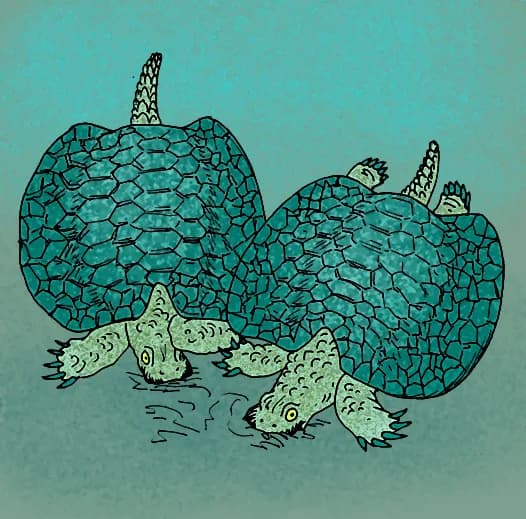
Henodus chelyops looks like a turtle without being one: it is a placodont, an extinct line of marine reptiles, and its squared shell is the product of convergence. About a metre long and 30 to 50 kilograms, described in 1936 in Germany, it lived some 228 million years ago. It carried just two functional teeth and filter-fed in fresh water.
Henodus lived during the Late Triassic period, approximately 228 million years ago, during the Carnian stage, in what is now southern Germany. This period corresponds to the early Mesozoic Era, well before the heyday of dinosaurs. The Triassic was a transitional period after the great Permian extinction, during which reptiles were rapidly diversifying to fill vacant ecological niches. Placodonts, the group to which Henodus belongs, were specialized marine reptiles that had developed turtle-like armor through convergent evolution. Henodus is remarkable because it lived in freshwater or brackish environments, unlike most placodonts which were marine.
Henodus measured approximately 1 meter in length, making it a medium-sized placodont. Its body was broad and flattened, measuring approximately 60 centimeters in width, giving it a shape remarkably similar to that of a sea turtle. Its bony shell constituted most of its body structure. Weight is estimated between 30 and 50 kilograms. Its flattened, wide silhouette was ideally adapted for life in shallow waters, where it could move slowly along the bottom searching for food. Despite its striking resemblance to turtles, Henodus is not related to them — it is a classic example of convergent evolution.
Henodus possessed unique dentition among reptiles: only two flat teeth on the palate and lower jaw, surrounded by a broadened horny beak. This morphology suggests a highly specialized diet, probably based on crustaceans, bivalves, and brachiopods from sandy and muddy bottoms. The broad, flat beak functioned as a crushing system for breaking hard shells, similar to how modern rays crush shellfish with their dental plates. It may also have filtered mud to extract small organisms, a filter-feeding technique. Its powerful jaws but reduced teeth indicate a diet that did not require seizing active prey.
Unlike most placodonts that lived in shallow seas, Henodus inhabited freshwater or brackish lagoons of the Late Triassic in Germany. Its fossils come from lacustrine sediments of the Gipskeuper formation in Baden-Württemberg, an environment of lakes and coastal lagoons. This freshwater preference is exceptional among placodonts and testifies to a unique ecological adaptation. The Triassic climate in central Europe was warm and semi-arid, with pronounced wet and dry seasons. The lagoons it inhabited were shallow and calm, with muddy bottoms rich in invertebrates. The coastal environment included conifer forests and terrestrial fauna that included the first dinosaurs and other archosaurs.
Henodus anatomy is dominated by its spectacular bony shell covering both back and belly, forming a box-like structure similar to turtles. The dorsal carapace is composed of hexagonal bony plates arranged in a mosaic pattern, while the ventral plastron is also well developed. The skull is very broad and flattened, with a widened horny beak and only two functional teeth. Limbs are short and robust, adapted for walking on the aquatic bottom rather than rapid swimming. The tail is short. Limb bones show adaptations to aquatic life without being fully modified into flippers. The shell system developed independently from that of turtles, representing one of the most spectacular examples of convergent evolution in the animal kingdom.
Henodus probably led a peaceful benthic life in shallow lagoons, spending its time exploring the bottom in search of food. Its short limbs and heavy shell suggest a slow animal, moving by walking on the bottom rather than actively swimming. It probably rested on the muddy bottom, partially buried in sediment. Its massive shell offered effective protection against predators in its environment, notably semi-aquatic reptiles and early crocodylomorphs. Henodus probably surfaced regularly to breathe, like modern sea turtles. Its freshwater rather than marine lifestyle suggests a specific adaptation that reduced competition with marine placodonts. The rarity of its fossils suggests limited populations.
Henodus was described in 1936 by Friedrich von Huene, a prolific German paleontologist, from fossils discovered in Keuper sediments (Gipskeuper) near Tübingen in Baden-Württemberg, Germany. The name Henodus means 'single tooth,' referring to its extremely reduced dentition. The holotype is a remarkably complete skeleton including the dorsal and ventral shell, skull, and most of the postcranial skeleton. Only a few Henodus specimens have been found, all in the same geological region of southern Germany, suggesting a very limited geographic distribution. Fossilization conditions in fine lacustrine sediments allowed exceptional preservation of anatomical details. Henodus is displayed at the Staatliches Museum für Naturkunde in Stuttgart and remains one of the most complete and striking placodonts known.
| Period | Trias supérieur / Late Triassic |
| Era | Mésozoïque / Mesozoic |
| Age | ~228 millions d'années / ~228 million years ago |
| Location | Allemagne / Germany |
| Length | ~1 m |
| Height | ~20 cm |
| Weight | ~30-50 kg |
| Diet | Filtreur |
| Discovery | 1936 |
Henodus chelyops is not related to turtles: it is a placodont (Placodontia), a group of Triassic marine reptiles that are completely extinct. Its bony shell and flattened silhouette result from independent convergent evolution. Placodonts belong to the Sauropterygia, a clade distinct from chelonians. Henodus lived approximately 228 million years ago (Carnian) in Germany, described in 1936 by Friedrich von Huene from Gipskeuper fossils near Tübingen.
Henodus chelyops had only two functional teeth, surrounded by a broadened horny beak. This reduced dentition was adapted to a diet of crustaceans, bivalves, and brachiopods from muddy bottoms, which its flat beak crushed similarly to how modern rays crush shellfish. It may also have filtered mud to extract small organisms. Its powerful jaws compensated for the near-absence of teeth when processing hard-shelled prey.
Most placodonts were marine animals, but Henodus chelyops inhabited freshwater or brackish lagoons of Late Triassic Germany, in the Gipskeuper formation (Baden-Württemberg). This freshwater adaptation is unique among placodonts and reflects a distinct ecological niche — probably to reduce competition with marine placodonts. The geographic isolation of continental lagoons also explains the very limited distribution of its fossils.
Reconstruction of Henodus chelyops
Wikimedia Commons
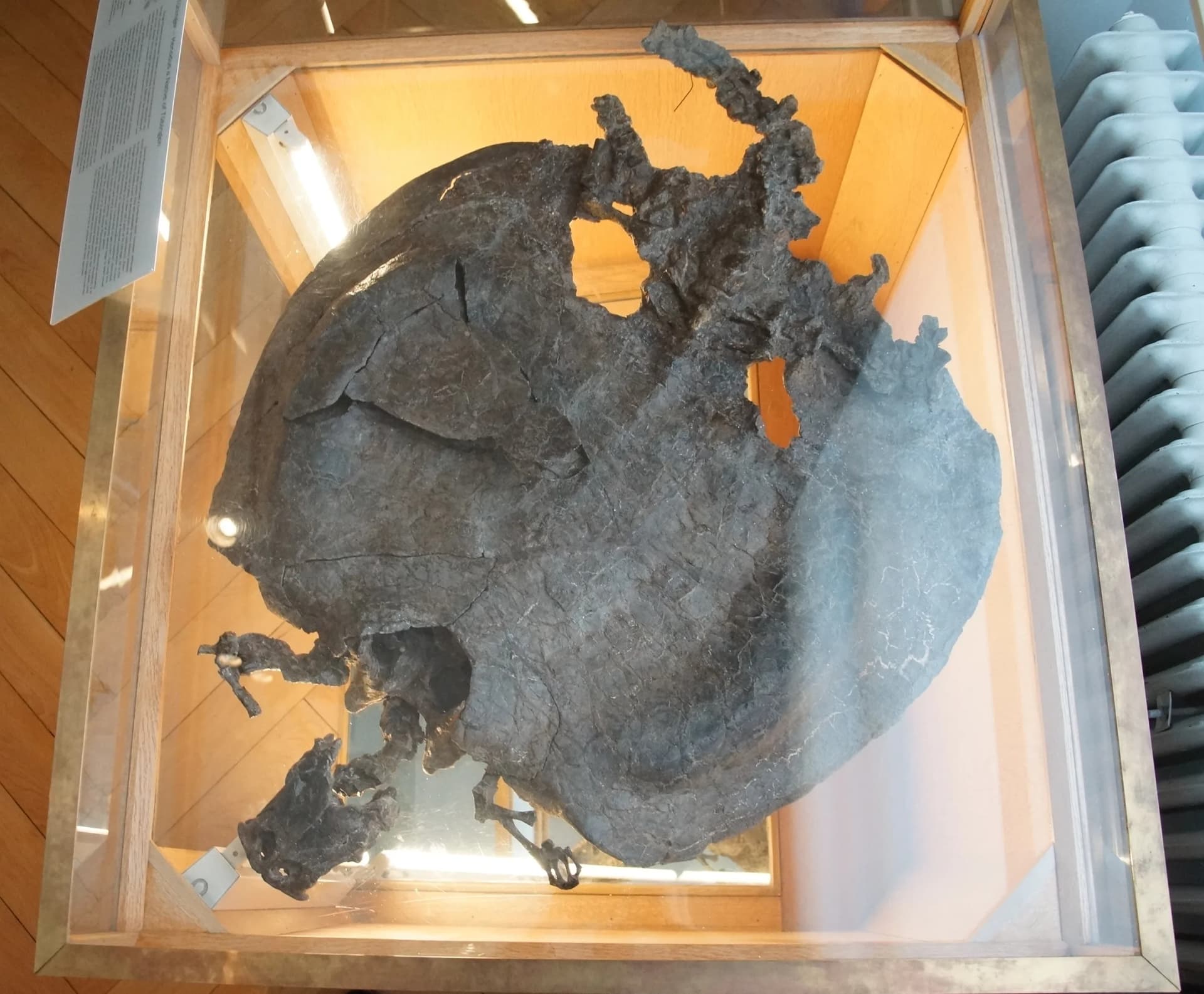
Henodus fossil with its shell
Wikimedia Commons