Doedicurus
Doedicurus clavicaudatus is a glyptodont 4 metres long and 1.5 to 2 tonnes, described in 1874 and present in Argentina, Brazil and Uruguay between 2 million and 11,000 years ago. Its shell fused more than a thousand osteoderms together. Its tail ended in a spiked club of 40 to 65 kilograms, able to crack a rival's carapace.
Doedicurus clavicaudatus lived in South America during the Pleistocene, approximately 2 million to 11,000 years ago. This giant glyptodont, the largest of its family, represents the evolutionary culmination of the armored xenarthran lineage that thrived in the isolation of the South American continent. Doedicurus appeared in the early Pleistocene and coexisted with the first humans to arrive in South America approximately 15,000 years ago. Archaeological evidence suggests that Paleoindian peoples used empty glyptodont carapaces as temporary shelters. Doedicurus disappeared during the South American megafaunal extinction at the end of the Pleistocene, a likely victim of post-glacial climate changes combined with human hunting pressure. Its closest living relatives are modern armadillos, though the resemblance is distant.
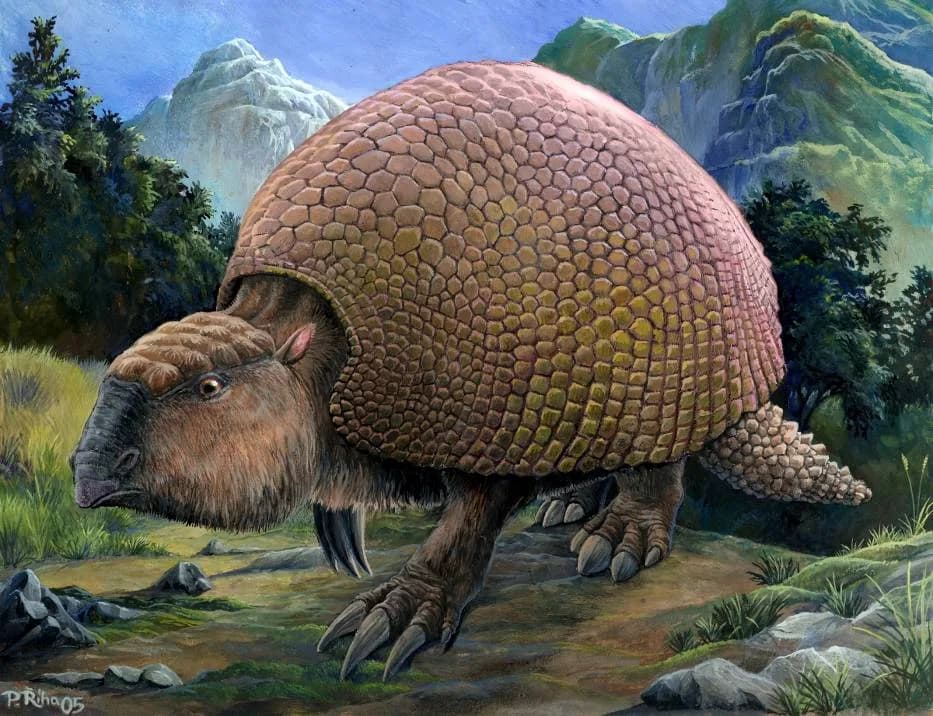
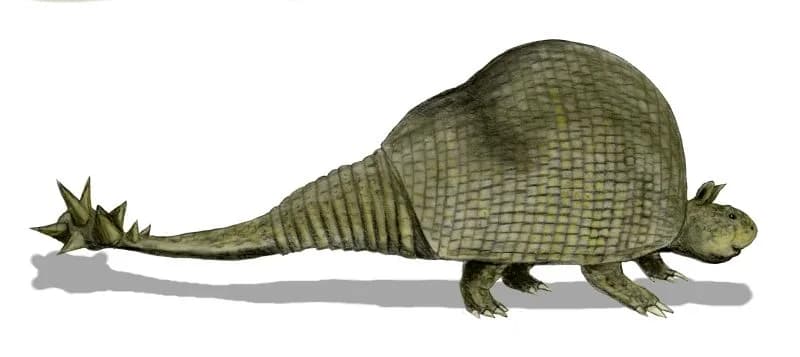
Doedicurus was the largest of the glyptodonts and one of the largest xenarthrans that ever existed. It stood approximately 1.5 meters at the shoulder and reached nearly 4 meters in total length, including its tail. Its estimated weight ranged between 1,300 and 2,000 kg, comparable to a small car. Its bony carapace, composed of over a thousand osteoderms fused into a rigid structure, measured about 1.5 meters long by itself and added considerably to its mass. The tail, its primary weapon, measured about 1 meter long and ended in a bony club studded with spikes, probably weighing between 40 and 65 kg. The combined carapace-tail complex represented a significant proportion of the animal's total weight, requiring an exceptionally robust skeleton and musculature to support this natural armor.
Doedicurus was a strict herbivore adapted to the grasslands and pampas of South America. Its jaw, lacking anterior teeth (incisors and canines), possessed ever-growing columnar molars perfectly adapted for grinding tough grasses and low vegetation. The shape of its low, wide skull with powerful masticatory muscles indicates an animal specialized in ground-level grazing. Isotopic analysis of dental enamel from Argentine specimens reveals a diet dominated by C4 grasses (tropical and subtropical grasses), confirming a specialized grazer lifestyle. Like modern armadillos, Doedicurus had a relatively low metabolic rate for an animal of its size, allowing it to survive on modest-quality food. Its low body position and downward-oriented mouth facilitated efficient grazing of short grasslands.
Doedicurus primarily occupied the pampas, temperate grasslands, and savannas of South America, with a particular concentration in southern Brazil, Uruguay, and Argentina. Its preferred habitat corresponded to the vast open grassland plains that dominated the South American landscape during the glacial and interglacial periods of the Pleistocene. The animal's massive morphology and rigid carapace made it unsuited to dense forest environments, limiting it to open terrain and transition zones. The richest fossil sites are found in the Luján Formation and Buenos Aires Formation in Argentina, as well as in southern Brazil. During glacial periods, when sea levels dropped and grasslands expanded, Doedicurus's range expanded considerably across the South American lowlands.
Doedicurus anatomy was entirely organized around its defensive carapace and offensive tail club. The dorsal carapace, formed by over 1,000 fused polygonal osteoderms, constituted a continuous bony shield protecting the back, flanks, and upper limbs. Unlike modern armadillos that can roll into a ball, Doedicurus's carapace was rigid and fixed, forcing the animal to protect itself by crouching to the ground and tucking its head beneath the anterior edge of the shield. A separate cephalic helmet, composed of smaller osteoderms, protected the skull. The tail consisted of mobile bony rings terminating in a spherical or ovoid club covered with bony bumps and spikes. The caudal vertebrae were fused in the club region, transforming the tail tip into a rigid projectile capable of delivering devastating blows. The pelvis was massive and fused with the spine to support the carapace's weight.
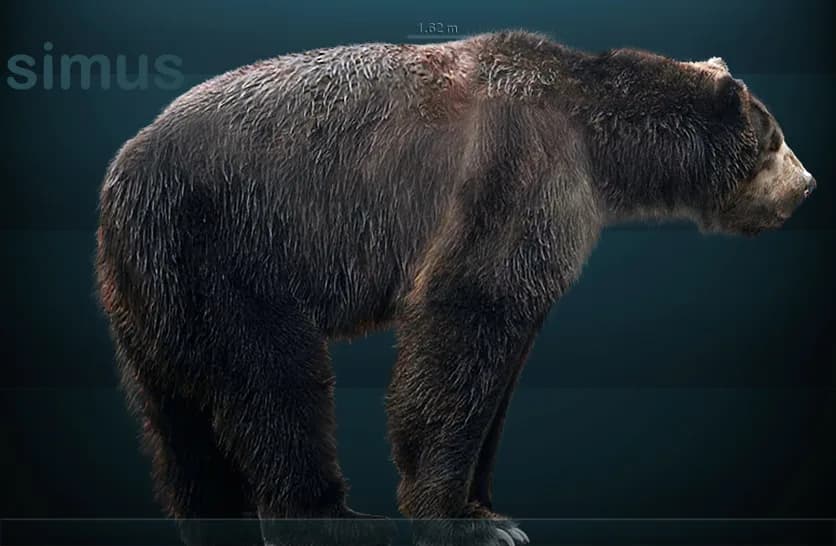
Doedicurus behavior can be reconstructed by analogy with modern giant armadillos and through functional analysis of its unique anatomy. The tail club likely served two primary functions: defense against predators (Smilodon, short-faced bear Arctodus) and intraspecific combat between males for access to females. Biomechanical simulations show that the caudal club, propelled by powerful tail muscles, could generate enough force to fracture a rival's carapace, confirmed by fossil specimens showing fractured and healed carapaces. This behavior is analogous to ankylosaurs, armored dinosaurs that also used a tail club for defense and combat. Doedicurus was probably a solitary animal or lived in small family groups, moving slowly through grasslands while grazing. Its low metabolism and substantial body mass suggest a calm, relatively inactive animal that rested frequently.
Doedicurus was first described in 1874 by English naturalist Edwin Burmeister from fossils discovered in Argentina. The name means 'pestle tail' (Greek: doedix 'pestle, mortar' + oura 'tail'), a reference to its characteristic tail club. Doedicurus fossils are relatively common in Pleistocene deposits of the Argentine pampas, making it one of the best-documented glyptodonts. Nearly complete skeletons, including intact carapaces and tail clubs, have been discovered in the Luján and Buenos Aires Formations. The Museo de La Plata in Argentina houses several spectacular specimens, including carapaces measuring over 1.5 meters long. Fossils have also been found in Brazil, Uruguay, and Paraguay. Remarkably, some carapaces found in archaeological contexts show traces of human use, with Paleoindian peoples apparently using them as shelters, water reservoirs, or funerary structures.
| Period | Pléistocène / Pleistocene |
| Era | Cénozoïque / Cenozoic |
| Age | 2 Ma - 11 000 ans |
| Location | Amérique du Sud (Argentine, Brésil, Uruguay) / South America (Argentina, Brazil, Uruguay) |
| Length | 4 m |
| Height | ~1.5 m |
| Weight | 1.5-2 tonnes |
| Diet | Herbivore |
| Discovery | 1874 |
Doedicurus clavicaudatus reached about 4 meters in total length, stood 1.5 meters at the shoulder, and weighed an estimated 1,300 to 2,000 kg — comparable to a small car. Its bony carapace of over 1,000 fused osteoderms measured 1.5 meters long alone, and the terminal tail club weighed between 40 and 65 kg.
The tail club of Doedicurus clavicaudatus served two main functions: defense against predators such as Smilodon and the short-faced bear Arctodus, and intraspecific combat between rival males. Biomechanical simulations show it generated enough force to fracture a rival's carapace, confirmed by fossil specimens with fractured and subsequently healed armor.
The closest living relatives of Doedicurus clavicaudatus are modern armadillos (order Xenarthra), though the resemblance is distant: living armadillos weigh at most 50 kg, roughly 40 times less than this giant glyptodont. Both groups share a bony dermal carapace, but armadillos can roll into a ball whereas the carapace of Doedicurus was completely rigid.
Doedicurus clavicaudatus, a club-tailed glyptodont
Nobu Tamura / Wikimedia Commons
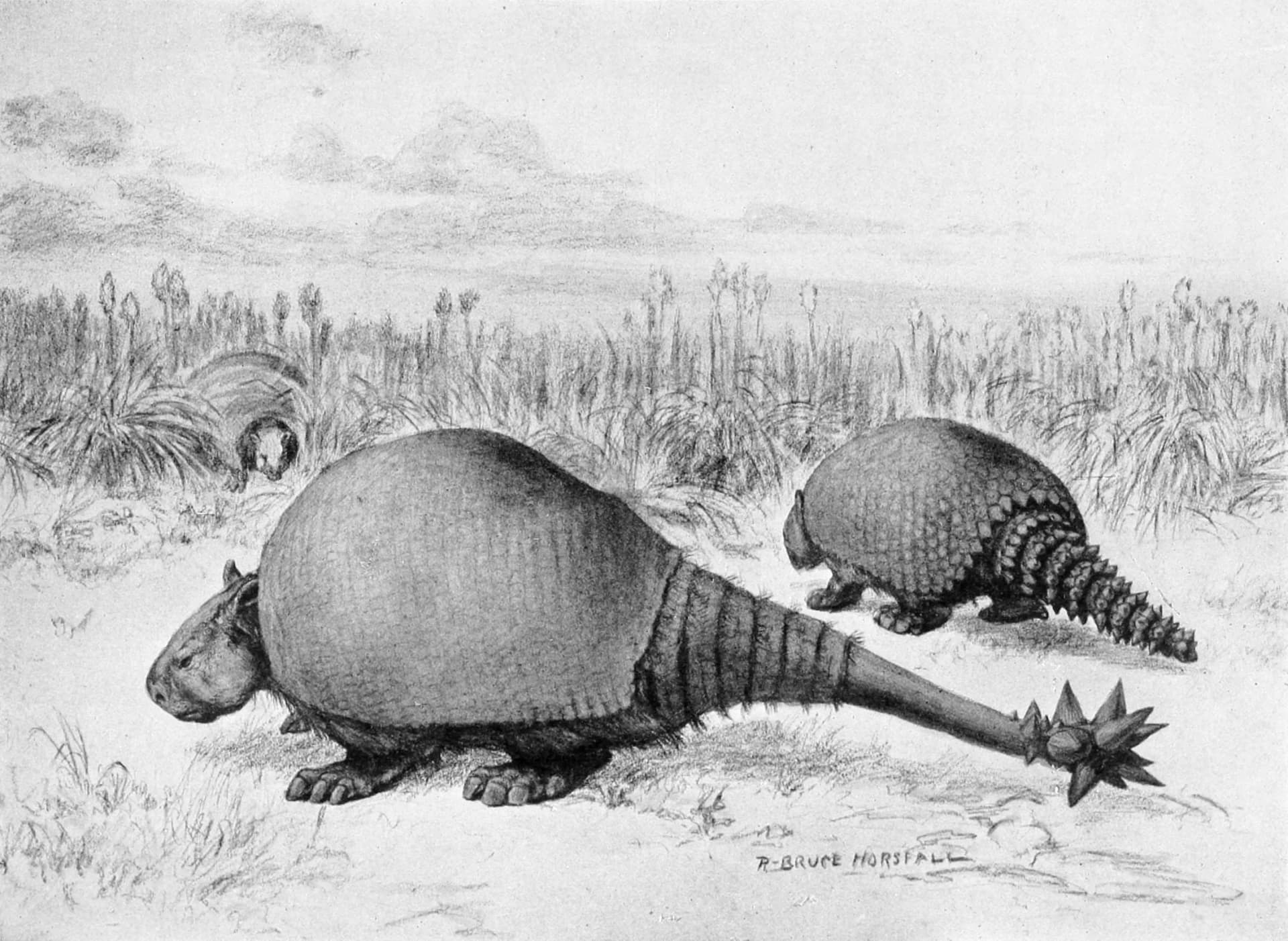
Doedicurus clavicaudatus, a natural armored tank of the Pleistocene
Wikimedia Commons