Gerrothorax
Gerrothorax pulcherrimus opened its mouth the wrong way round: instead of dropping the jaw, it lifted the roof of its skull like a lid. About a metre long and 5 to 10 kilograms, described in 1934 and dated to 220 to 201 million years ago, it lay flattened on the beds of lakes in Germany, Sweden and Greenland, ambushing prey and keeping its gills for life.
Gerrothorax lived during the Late Triassic, approximately 220 to 201 million years ago (Norian-Rhaetian). This temnospondyl amphibian inhabited the lakes and rivers of Central Europe at a time when the first dinosaurs were beginning to dominate terrestrial ecosystems. The Late Triassic had a hot, semi-arid climate in interior regions, but the lacustrine areas where Gerrothorax lived provided stable aquatic habitats. It was among the last surviving temnospondyls, a group of giant amphibians that had dominated aquatic ecosystems since the Carboniferous.
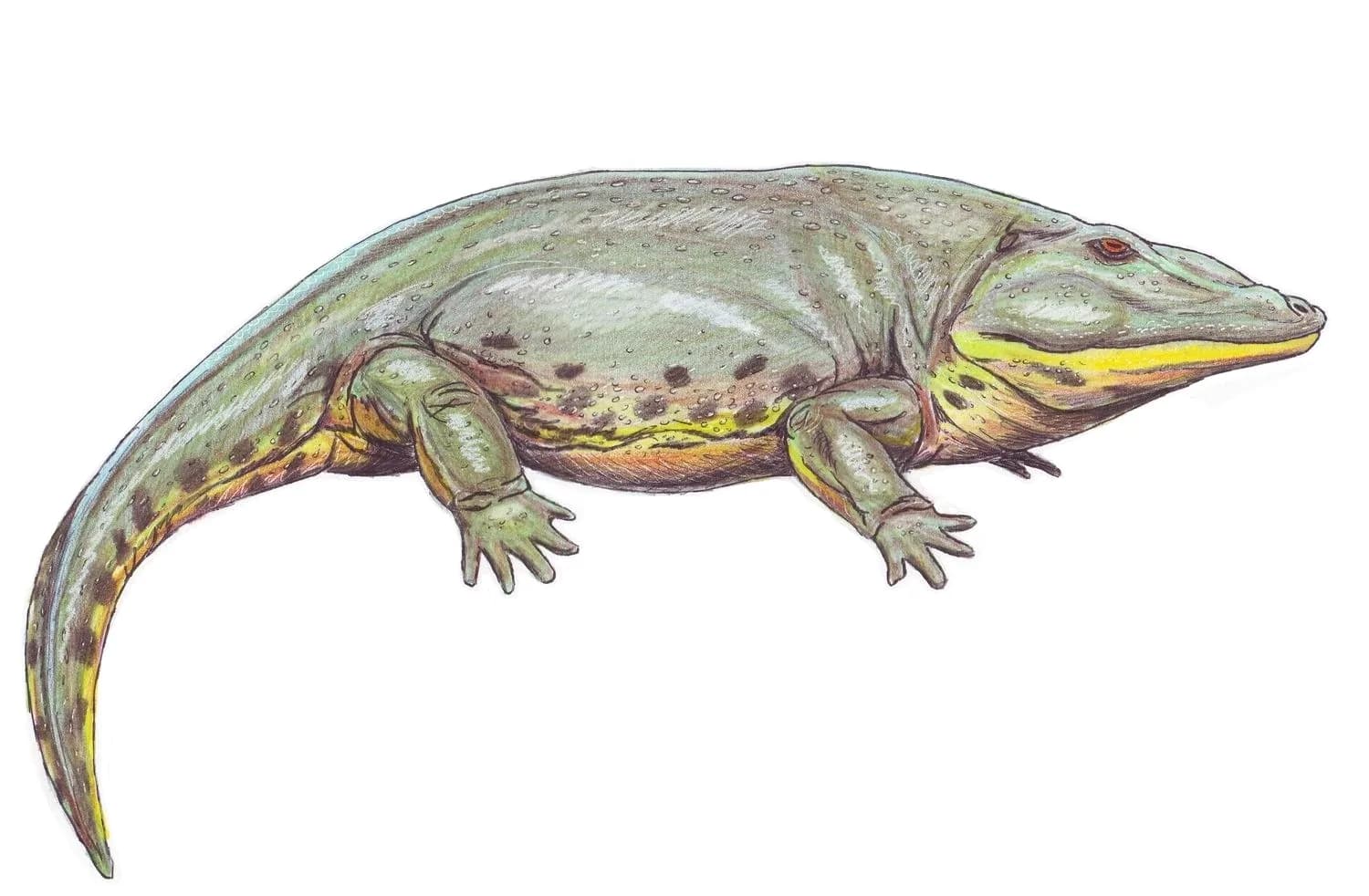
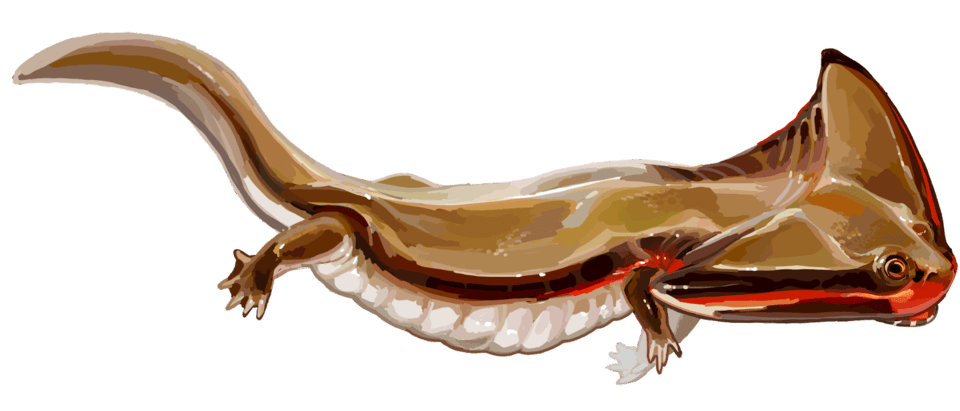
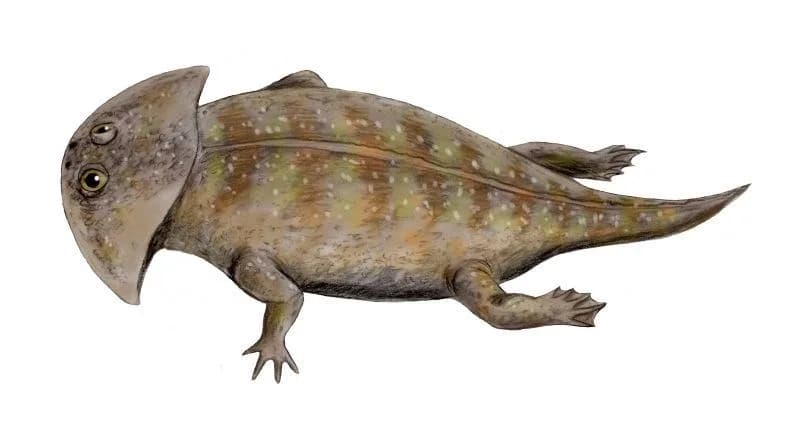
Gerrothorax pulcherrimus measured approximately 1 meter in total length. Its body was extraordinarily flattened dorso-ventrally, resembling a living pancake more than a conventional amphibian. Its wide, flat, shovel-like head comprised nearly one-third of the total body length. This extremely flattened morphology is unique even among temnospondyls, a group already known for flat body forms. It probably weighed between 5 and 10 kilograms, distributed over a maximized body surface area.
Gerrothorax was an aquatic ambush predator that fed on fish and small amphibians. Its capture technique was unique among vertebrates: instead of lowering the lower jaw to open the mouth like virtually all other animals, Gerrothorax raised the upper part of its skull like a trash can lid. This 'reverse hinge' jaw allowed it to snap up prey by suction, creating a sudden water intake. It remained motionless on the bottom, camouflaged in mud, waiting for a fish to pass above its gaping maw.
Gerrothorax inhabited freshwater lakes and slow rivers in what is now Germany (Baden-Württemberg), Sweden (Scania), and Greenland. The Late Triassic European lacustrine environments offered calm waters with muddy bottoms, perfect for a benthic ambush predator. Aquatic vegetation consisted of ferns and horsetails lining the shores. The most important fossil sites come from the Löwenstein Formation in Germany and the Rhaetian deposits of Scania.
Gerrothorax's anatomy is among the most bizarre of all vertebrates. Its skull, forming a flattened triangle, possessed a unique cranial articulation allowing the skull roof to pivot upward by 50 degrees. This 'top-opening' mechanism has no equivalent in other vertebrates. Its dorsal surface was covered with ornate bone sculptures serving as camouflage and protection. Remarkably, Gerrothorax retained functional external gills in adulthood, confirmed by the presence of branchial grooves on the ceratobranchial bones. Its eyes were positioned on top of the head, oriented upward to spot prey swimming above.
Gerrothorax was a purely aquatic predator that spent its entire life submerged in lakes and rivers. Its hunting strategy consisted of remaining perfectly motionless on the muddy bottom, its flat, sculpted body making it nearly indistinguishable from the substrate. When prey passed above, it abruptly opened its upper jaw, creating a powerful suction effect that drew in the helpless fish. This suction capture mechanism was remarkably efficient and required no pursuit. Its external gills allowed it to remain indefinitely underwater without surfacing to breathe.
Gerrothorax pulcherrimus was first described by Nilsson in 1934, from Rhaetian fossils in Scania, Sweden. Exceptional additional material was discovered in the Löwenstein Formation in Germany, including complete specimens showing the characteristic flattened morphology. Work by Hellrung (2003) and Jenkins et al. (2008) revolutionized understanding of its unique jaw mechanism through biomechanical analyses and CT scanning. The discovery of external gills in adults by Witzmann (2009) confirmed its permanent neotenic lifestyle.
| Period | Trias supérieur / Late Triassic |
| Era | Mésozoïque / Mesozoic |
| Age | 220-201 Ma |
| Location | Allemagne, Suède, Groenland / Germany, Sweden, Greenland |
| Length | ~1 m |
| Height | ~5 cm (aplati / flattened) |
| Weight | 5-10 kg |
| Diet | Piscivore (embuscade) |
| Discovery | 1934 |
Gerrothorax pulcherrimus was a temnospondyl amphibian, not a dinosaur. It belonged to the family Plagiosauridae and lived during the Late Triassic (220-201 Ma) in freshwater lakes in Germany, Sweden, and Greenland. Temnospondyls are a group of giant amphibians that dominated aquatic ecosystems since the Carboniferous. Gerrothorax retained its external gills in adulthood — a unique permanent neoteny.
Gerrothorax pulcherrimus possessed a jaw mechanism with no equivalent among vertebrates: instead of lowering the lower jaw like all other animals, it raised the upper part of its skull like a lid, pivoting up to 50 degrees. This top-opening action created a powerful suction effect that drew in fish. Lying motionless on the muddy bottom, its flat body made it practically invisible.
Gerrothorax pulcherrimus measured about 1 meter long but only about 5 centimeters thick, with an estimated weight of 5 to 10 kilograms. This dorso-ventrally flattened morphology, unique even among temnospondyls, was an adaptation to a benthic ambush lifestyle on the muddy floors of Late Triassic lakes. Its triangular head represented nearly one-third of the total body length.
Gerrothorax pulcherrimus life reconstruction
Wikimedia Commons