Estésia
Estesia mongoliensis is one of the oldest known venomous lizards: about 60 centimetres and 1 to 2 kilograms, described in 1992 in the Gobi Desert. Its teeth carry grooves that channelled venom, as in the living Gila monster. It lived 80 to 75 million years ago, in the same desert as Velociraptor.
Estesia lived during the Late Cretaceous, approximately 80 to 75 million years ago (Campanian). This venomous lizard inhabited the semi-arid plains and sand dunes of the Gobi Desert in what is now Mongolia. At that time, Central Asia experienced a hot, dry climate with marked seasons, forming a desert environment punctuated by oases and seasonal streams. Estesia shared its habitat with a spectacular fauna including Velociraptor, Protoceratops, and Oviraptor, making the Djadokhta Formation one of the richest Cretaceous fossil sites.
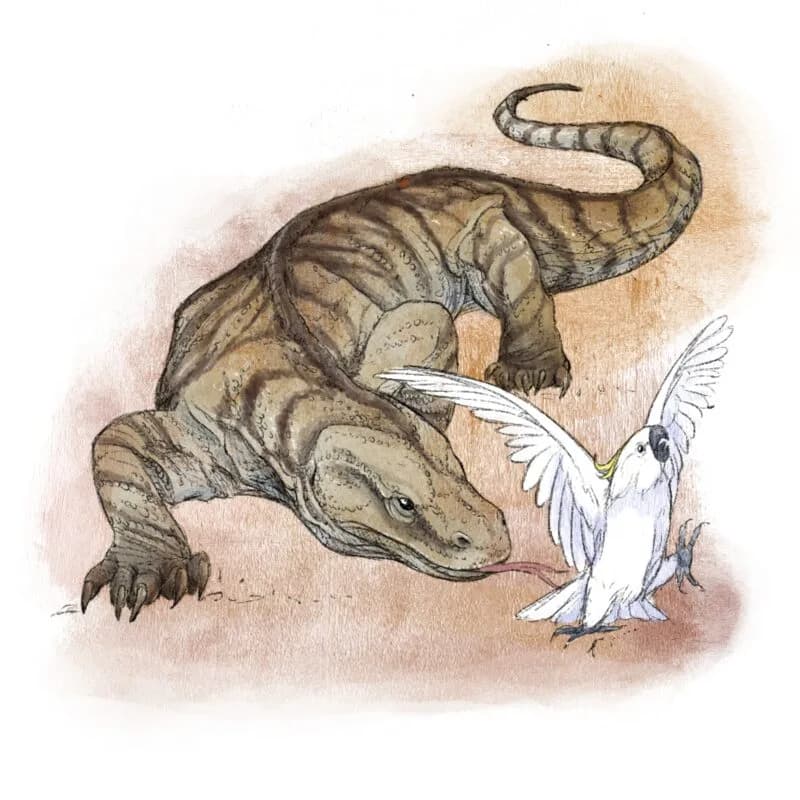
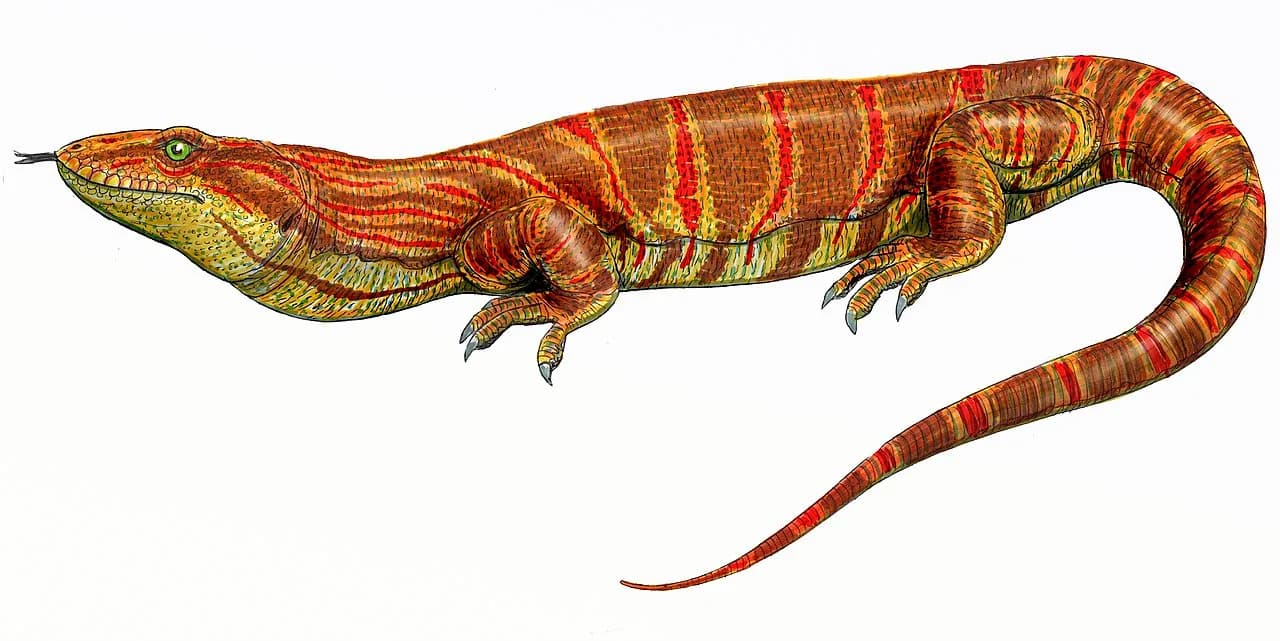
Estesia mongoliensis was a medium to large lizard for its time, measuring approximately 60 centimeters in total length, about half of which was tail. Its robust skull measured about 8 centimeters long, with a powerful jaw bearing specialized teeth. Its build was comparable to a modern Nile monitor, with a relatively stocky body and well-developed limbs for terrestrial locomotion. It probably weighed between 1 and 2 kilograms, making it one of the largest lizards in its ecosystem.
An active predator, Estesia probably hunted small terrestrial vertebrates: lizards, small Mesozoic mammals, juvenile dinosaurs, and eggs. Its teeth bore longitudinal grooves characteristic of venomous lizards, allowing venom to flow into bite wounds. Like the modern Gila monster (Heloderma), its venom was probably not instantly lethal but caused intense pain and progressive weakening of prey. It likely supplemented its diet with insects and opportunistic scavenging during harsh dry seasons.
Estesia inhabited the semi-arid environments of the Djadokhta Formation in southern Mongolia. The landscape was dominated by aeolian dune fields interspersed with moist interdunes and small oases fed by groundwater. Vegetation was sparse, consisting of low shrubs and drought-adapted plants. Daytime temperatures were high with cool nights, a climate regime favorable to diurnal ectotherms. Fossils come primarily from the Khulsan locality in the Gobi.
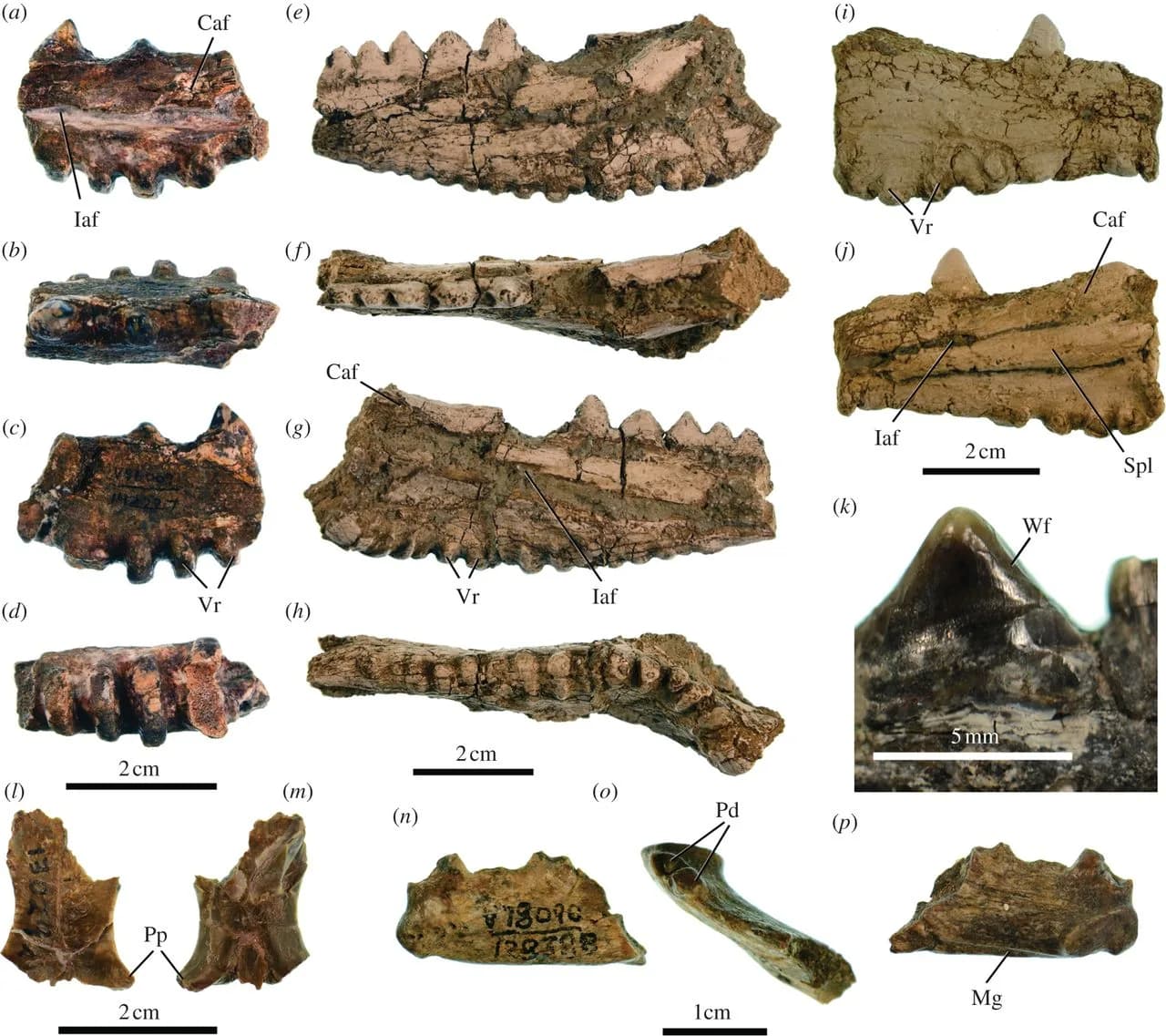
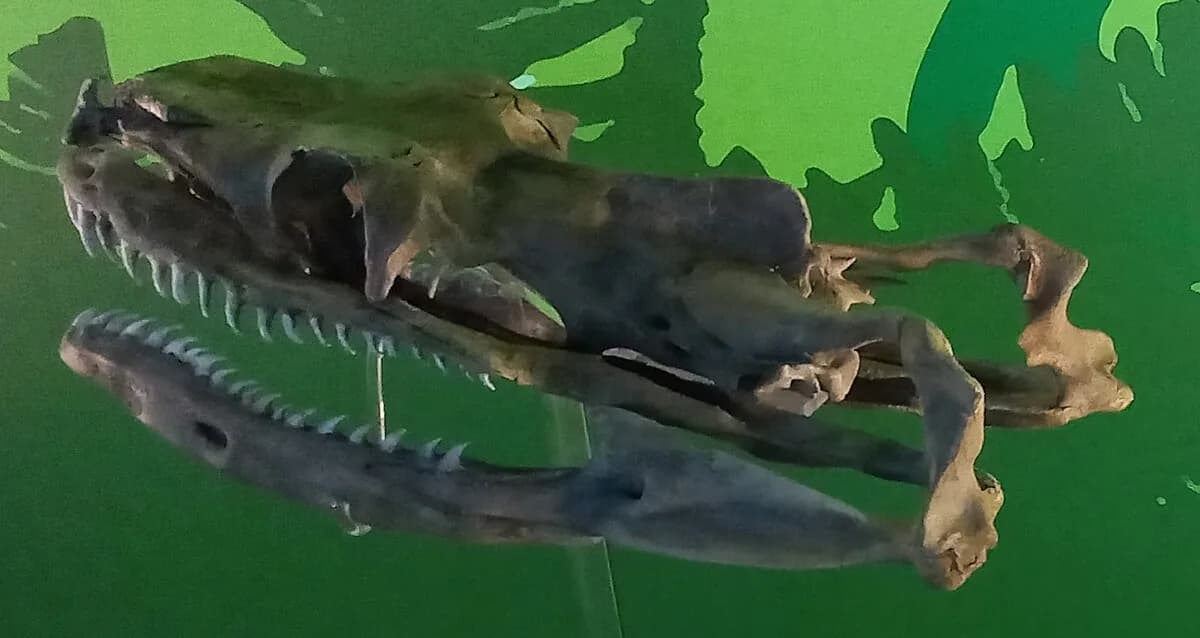
Estesia's cranial anatomy is particularly remarkable for the presence of venom grooves on its teeth, a feature shared with modern helodermatids (Gila monsters and beaded lizards). These longitudinal grooves run along the labial face of the maxillary and dentary teeth, serving to conduct venom produced by modified mandibular glands. The skull was robust with powerful temporal musculature, enabling a strong and sustained bite. The body displayed the typical varanoid plan with four well-developed limbs, sharp claws, and a long tail serving as a counterbalance.
Estesia was probably an active diurnal predator, using its venom to subdue prey relatively large compared to its body size. Like the modern Gila monster, it bit its prey and maintained the bite for several seconds to allow venom to seep through the dental grooves. Its hunting mode likely combined active searching and ambush from burrows or under rocks. It probably also raided dinosaur nests to steal eggs, taking advantage of absent parents. During cold seasons, it likely retreated into burrows for dormancy.
Estesia mongoliensis was described in 1992 by paleontologists Mark Norell, Malcolm McKenna, and Michael Novacek from the American Museum of Natural History (AMNH), based on cranial material collected during Mongolian-American paleontological expeditions in the Gobi Desert. The holotype includes a well-preserved partial skull clearly showing the dental venom grooves. The fossils come from the Barun Goyot Formation at Khulsan. This discovery was crucial for understanding venom evolution in squamates, demonstrating that venomous capability was far more ancient and widespread than previously thought.
| Period | Crétacé supérieur / Late Cretaceous |
| Era | Mésozoïque / Mesozoic |
| Age | 80-75 Ma |
| Location | Mongolie (Gobi) / Mongolia (Gobi) |
| Length | ~60 cm |
| Height | ~8 cm |
| Weight | 1-2 kg |
| Diet | Carnivore (venimeux) |
| Discovery | 1992 |
Estesia mongoliensis measured about 60 centimeters long, weighing an estimated 1 to 2 kilograms. This Late Cretaceous varanid lived approximately 80 to 75 million years ago in the Gobi Desert of Mongolia. It was described in 1992 from fossils found in the Djadochta Formation.
Estesia mongoliensis displays grooves and channels in its teeth and lower jaw that resemble those of venomous modern varanids. These structures suggest this ancient Cretaceous lizard may have produced toxic secretions to immobilize prey. This finding contributed to debates about the ancient origin of venom in squamates.
Estesia mongoliensis was an active carnivore in the Late Cretaceous Gobi Desert, likely hunting small lizards, mammals, and invertebrates. Its pointed, slightly recurved teeth coupled with purported venom channels made it an effective predator despite its small size. Its membership in primitive varanids places it in a group that today includes the Komodo dragon.
Estesia mongoliensis life reconstruction
Wikimedia Commons