Barbaturex
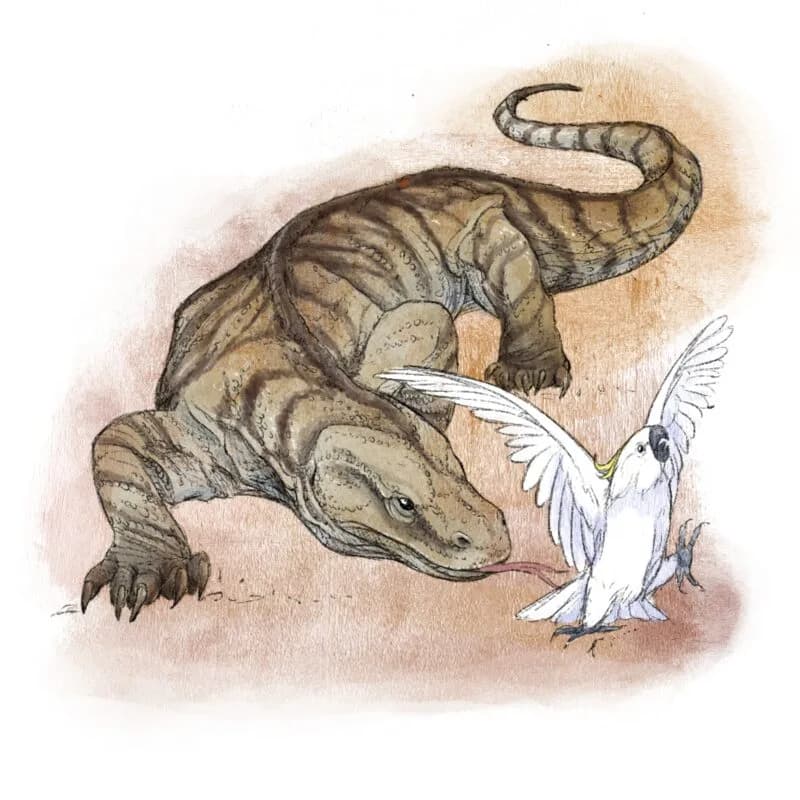
Barbaturex morrisoni is a herbivorous lizard about 1.8 metres long and 27 kilograms, described in 2013 from fossils in the Pondaung Formation of Myanmar. It lived some 40 million years ago, at a time already dominated by mammals. Its species name honours Jim Morrison, the Doors singer nicknamed « The Lizard King ».
Barbaturex morrisoni lived during the Middle Eocene, approximately 40 million years ago, during the Eocene climatic optimum — a period when global temperatures were among the highest of the Cenozoic. This giant herbivorous lizard is remarkable because it demonstrated that ectothermic reptiles could dominate large herbivore niches even in the presence of mammals. Discovered in Myanmar (formerly Burma), it lived in a dense, warm tropical forest of Southeast Asia, at a time when herbivorous mammals were beginning to diversify but had not yet monopolized these ecological niches.
Barbaturex morrisoni measured approximately 1.8 meters in total length, making it one of the largest known herbivorous lizards from the age of mammals. Its weight is estimated at about 27 kilograms. For comparison, the largest living herbivorous lizards — the Galápagos land iguanas — barely exceed 13 kg. Barbaturex was therefore about twice as heavy as any herbivorous lizard alive today. Its massive head bore a prominent bony crest on the lower jaw, similar to the 'beard' of modern bearded dragons but considerably larger.
Barbaturex was a strictly herbivorous lizard — a rarity among large reptiles. Its dentition was adapted for grinding tough vegetation: broad, flat, multi-cusped teeth, similar to those of modern iguanas but more robust. It likely fed on leaves, fruits, and young shoots in the low canopy and understory vegetation of the Eocene tropical forest. Its large size allowed it to access vegetation beyond the reach of smaller lizards, reducing interspecific competition and giving it access to abundant food resources.
Barbaturex inhabited the warm, humid tropical forests of the Middle Eocene in Myanmar. At that time, Southeast Asia was covered in dense rainforests, with average annual temperatures exceeding 30 degrees Celsius and abundant rainfall year-round. The extreme heat conditions of the Eocene climatic optimum favored large ectothermic reptiles, allowing them to maintain an active metabolism. The Pondaung Formation, where the fossils were found, has also yielded primitive primates and mammals, testifying to a diverse tropical ecosystem.
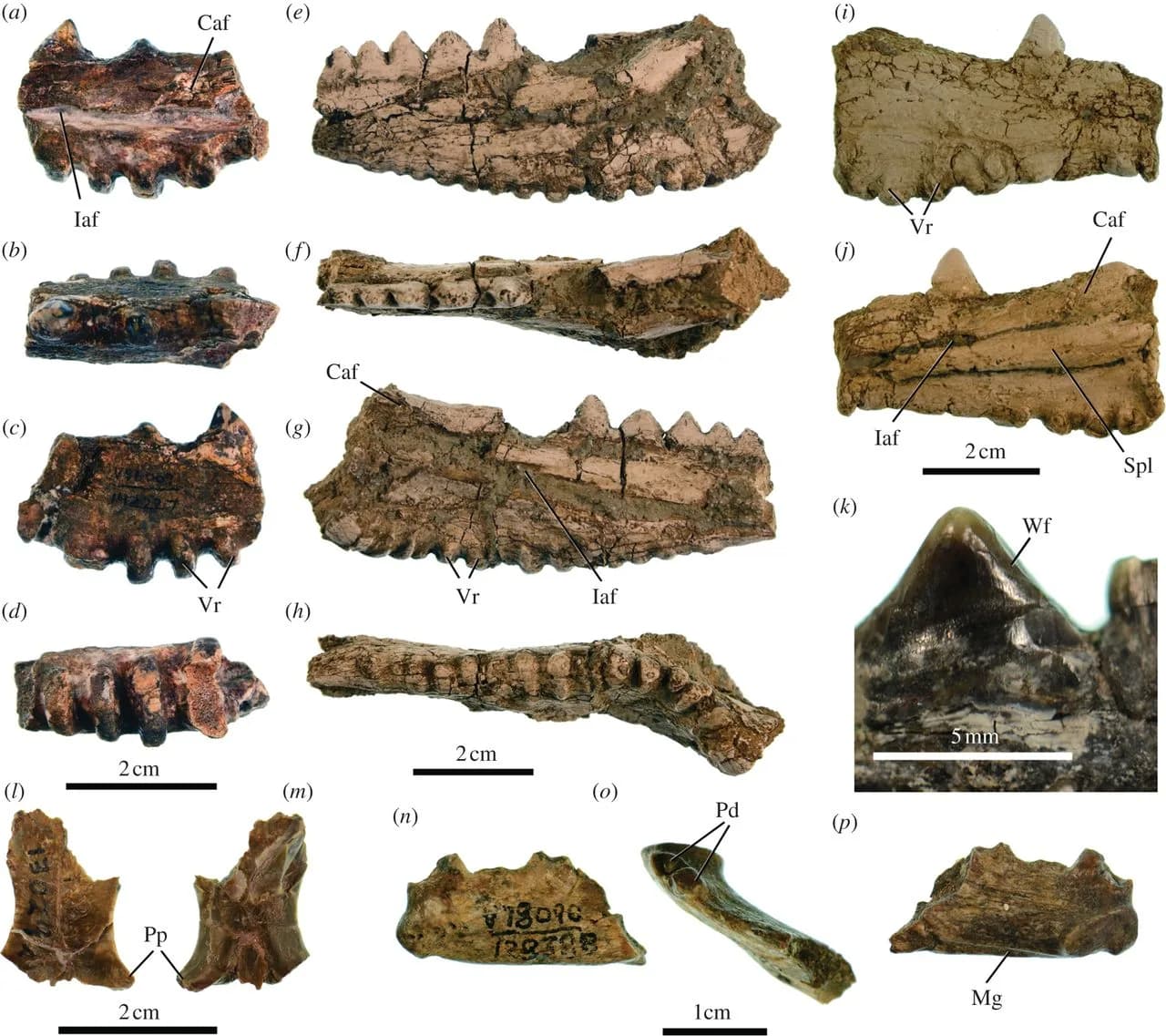
Barbaturex's anatomy is known primarily from cranial and mandibular elements. Its most distinctive feature is a prominent bony crest on the dentary (lower jawbone), forming a rigid 'beard' that earned it its name. This structure likely played a role in sexual signaling or intraspecific recognition, similar to the dewlaps of modern bearded dragons (Pogona). Its teeth were pleurodont (fused to the inner side of the jaw), broad and multicuspid, perfectly adapted for grinding vegetation. The skull morphology places it close to Iguanidae and Agamidae.
Barbaturex was probably a diurnal and arboreal or semi-arboreal lizard that spent its days feeding in the trees and shrubs of the tropical forest. Its mandibular bony crest likely served during courtship displays and territorial confrontations between males, as in modern iguanas and bearded dragons. Sexual dimorphism was probable, with males sporting a more developed crest. Like large modern iguanas, it probably thermoregulated by alternating between sunny canopy areas and understory shade. Its ectothermic metabolism was advantaged by the constantly warm Eocene climate.
Barbaturex morrisoni was described in 2013 by Head, Gunnell et al. from fossils discovered in the Pondaung Formation (Middle Eocene) in Myanmar. The genus name Barbaturex means 'bearded king' (Latin barba = beard, rex = king), referring to the prominent mandibular crest. The species name morrisoni honors Jim Morrison, lead singer of The Doors — nicknamed 'The Lizard King' — a humorous nod typical of modern paleontology. The discovery was published in the Proceedings of the Royal Society B and attracted considerable media attention thanks to this evocative name. The fossils include well-preserved cranial and mandibular fragments.
| Period | Éocène moyen / Middle Eocene |
| Era | Cénozoïque / Cenozoic |
| Age | ~40 Ma |
| Location | Myanmar (Formation de Pondaung) / Myanmar (Pondaung Formation) |
| Length | ~1.8 m |
| Height | ~30 cm |
| Weight | ~27 kg |
| Diet | Herbivore |
| Discovery | 2013 |
Barbaturex morrisoni measured approximately 1.8 meters in total length and weighed about 27 kilograms. It is one of the largest known herbivorous lizards from the age of mammals — approximately twice as heavy as the largest modern Galápagos land iguanas (~13 kg). Its existence in Myanmar (Pondaung Formation) ~40 Ma ago proves that ectothermic reptiles could still dominate large herbivore niches even in the presence of mammals.
The species name morrisoni of Barbaturex morrisoni honors Jim Morrison of The Doors, nicknamed 'The Lizard King.' This is a typical humorous nod in modern paleontology — the generic name Barbaturex means 'bearded king' (Latin barba = beard, rex = king) in reference to the prominent bony crest on this lizard's lower jaw. The discovery was published by Head, Gunnell et al. in 2013 in the Proceedings of the Royal Society B.
During the Eocene climatic optimum (~40 Ma), global temperatures were among the highest of the Cenozoic, exceeding 30°C in Southeast Asia. These conditions favored large ectothermic reptiles: an active metabolism without costly thermoregulation was possible thanks to constant heat. Barbaturex morrisoni could only exist during this warm period — the progressive Cenozoic cooling would subsequently favor endothermic mammals.
Barbaturex morrisoni fossil jaws
Wikimedia Commons CC BY 3.0