Épidexiptéryx
Epidexipteryx hui carries the oldest known pennaceous feathers on a dinosaur: four long ornamental tail feathers, useless for flight. Its body is just 25 centimetres, 44.5 with the feathers, for around 164 grams. Described in 2008 in Inner Mongolia, it lived some 160 million years ago. Its greatly elongated fingers recall those of the aye-aye.
Epidexipteryx lived during the Late Jurassic period, approximately 160 to 168 million years ago, in what is now northeastern China. This dating makes it one of the earliest known dinosaurs possessing display feathers, predating even Archaeopteryx by approximately 8 million years. The Late Jurassic in China was a period of intense diversification of maniraptoran dinosaurs, with the appearance of numerous feathered forms that demonstrate the evolutionary link between dinosaurs and birds. The Daohugou biota, where Epidexipteryx was discovered, is one of the world's richest deposits of feathered fossils, rivaling the famous Early Cretaceous Jehol biota.
Epidexipteryx was a tiny dinosaur, measuring approximately 25 centimeters in body length (excluding tail feathers) and weighing an estimated 164 grams, barely heavier than a pigeon. Including its four long ornamental tail feathers, its total length could reach 44.5 centimeters. It is one of the smallest known non-avian dinosaurs. Its tiny size approaches that of the smallest modern birds. Despite its smallness, Epidexipteryx displayed complex morphology with distinct proportions: a relatively broad skull compared to the body, very long fingers, and extraordinarily developed ornamental feathers relative to its body size.
Epidexipteryx possessed unique dentition among dinosaurs: its front teeth, particularly elongated and procumbent (forward-leaning), formed a sort of comb or pincer. This unusual dental morphology suggests specialized feeding, probably insectivorous. Its extremely long fingers, reminiscent of the aye-aye (a Madagascar primate), could have been used to extract insect larvae from rotting wood or tree bark, convergently with the modern aye-aye. It probably also hunted flying insects and small invertebrates. This dietary specialization illustrates the remarkable ecological diversity of small feathered dinosaurs in Jurassic China.
Epidexipteryx inhabited the humid, temperate forests of the Late Jurassic in northeastern China, in a lacustrine and volcanic environment. The Daohugou biota, where it was discovered, preserved a rich forest ecosystem around lakes formed by volcanic activity. The canopy was dominated by ginkgoes, conifers, and tree ferns, providing ideal habitat for a small arboreal dinosaur. Lakes and rivers housed giant salamanders, primitive fish, and diverse insects. The forest teemed with insects that likely formed the basis of Epidexipteryx's diet. The exceptional preservation conditions in lacustrine volcanic ash allowed detailed fossilization of feathers and soft tissues.
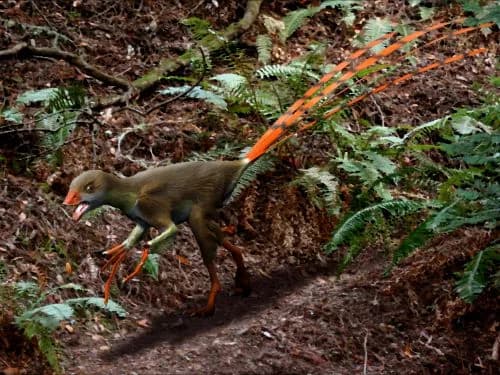
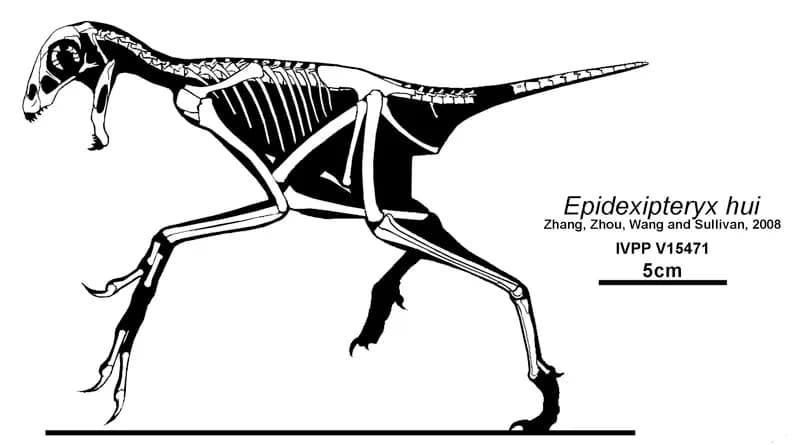
Epidexipteryx anatomy is remarkable for several unique characteristics. Its skull is short and broad with procumbent front teeth forming a comb-like structure. The third finger of the hand is extraordinarily elongated, the longest of all fingers, an inverse proportion to most theropods. The body was covered in simple, filamentous proto-feathers resembling down, but WITHOUT the asymmetric wing feathers that enable flight. In contrast, four long pennaceous ornamental feathers were attached to the tail, forming a spectacular fan. These display feathers, the oldest known pennaceous feathers in a non-avian dinosaur, had no aerodynamic function and served exclusively for display. The absence of flight feathers on the arms suggests Epidexipteryx could neither fly nor even glide.
Epidexipteryx's most remarkable behavior was undoubtedly related to its ornamental tail feathers. These four long feathers, which greatly exceeded the body's length, were almost certainly used for courtship display and sexual selection, analogous to modern peacock feathers. This implies complex social behavior with elaborate mating rituals. As a small, probably arboreal dinosaur, it spent a significant portion of its time in trees, climbing with its claws and long fingers to search for insects. Its small size made it vulnerable to predators, and the display feathers could also play a role in intraspecific recognition or communication between conspecifics in the dense forest environment.
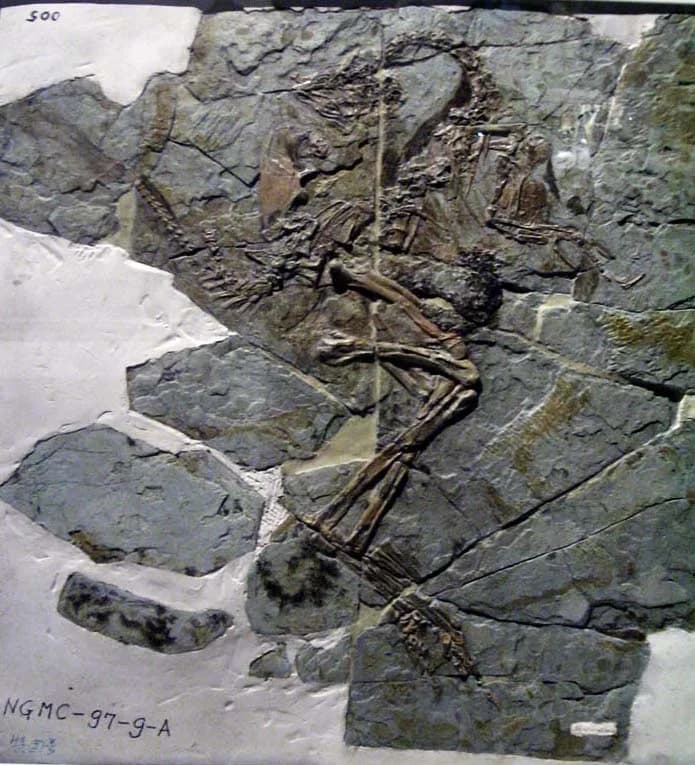
Epidexipteryx was described in 2008 by Zhang Fucheng, Zhou Zhonghe, and colleagues from the Institute of Vertebrate Paleontology and Paleoanthropology (IVPP) in Beijing. The holotype (IVPP V 15471) is a nearly complete skeleton with exceptionally preserved feather impressions, discovered in Daohugou biota sediments in the Tiaojishan Formation, Inner Mongolia, China. Preservation is remarkable: body proto-feathers, four long pennaceous tail feathers, and even some soft tissues are visible on the rock slab. Exact dating has been debated, with estimates ranging from 152 to 168 million years, but the most recent studies favor a date around 160 million years. Epidexipteryx is particularly important because it demonstrates that ornamental feathers evolved before flight feathers in dinosaurs.
| Period | Jurassique supérieur / Late Jurassic |
| Era | Mésozoïque / Mesozoic |
| Age | ~160 millions d'années / ~160 million years ago |
| Location | Mongolie-Intérieure, Chine / Inner Mongolia, China |
| Length | 25 cm (corps) / 44.5 cm (avec plumes) |
| Height | ~15 cm |
| Weight | ~164 g |
| Diet | Insectivore |
| Discovery | 2008 |
Epidexipteryx hui measured about 25 centimeters in body length and weighed only 164 grams — barely heavier than a starling. Including its four long ornamental tail feathers, total length reached 44.5 centimeters. This Jurassic scansoriopterygid lived approximately 160 million years ago in Inner Mongolia, China.
The four long ribbon-like tail feathers of Epidexipteryx hui were not adapted for flight — they lacked functional barbs and barbules. Instead, they served for display or intraspecific recognition, representing the oldest known case of ornamental feathers with no aerodynamic function in non-avian dinosaurs.
Epidexipteryx hui was insectivorous. Its exceptionally elongated, procumbent front teeth formed a kind of clamp or comb, adapted for extracting insects from tree bark — similar to the modern aye-aye of Madagascar. This convergent feeding mode suggests an arboreal animal specialized in finding arthropods hidden in wood.
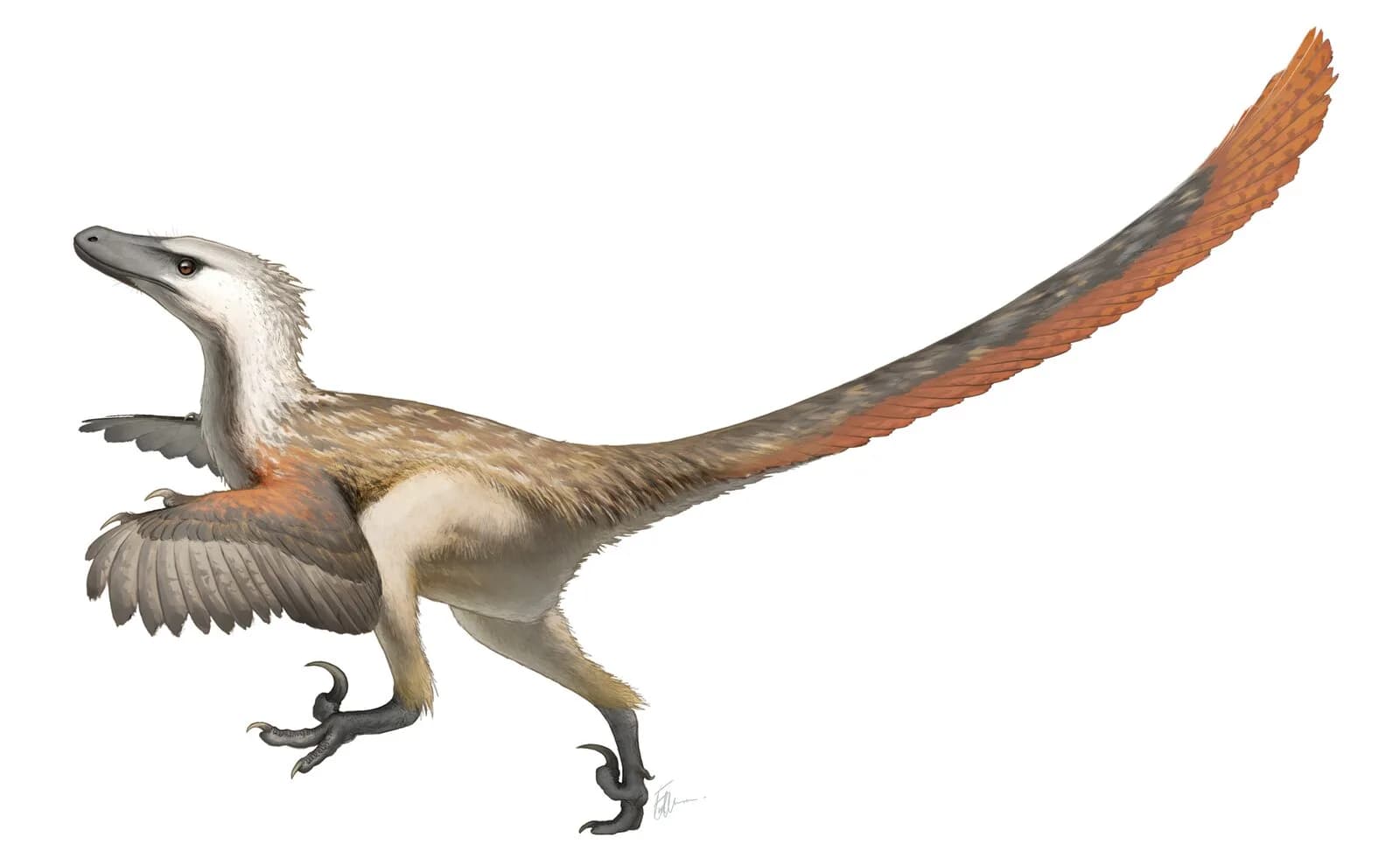
Reconstruction of Epidexipteryx hui with its display feathers
Wikimedia Commons
Epidexipteryx fossil showing feather impressions
Wikimedia Commons