Einiosaure
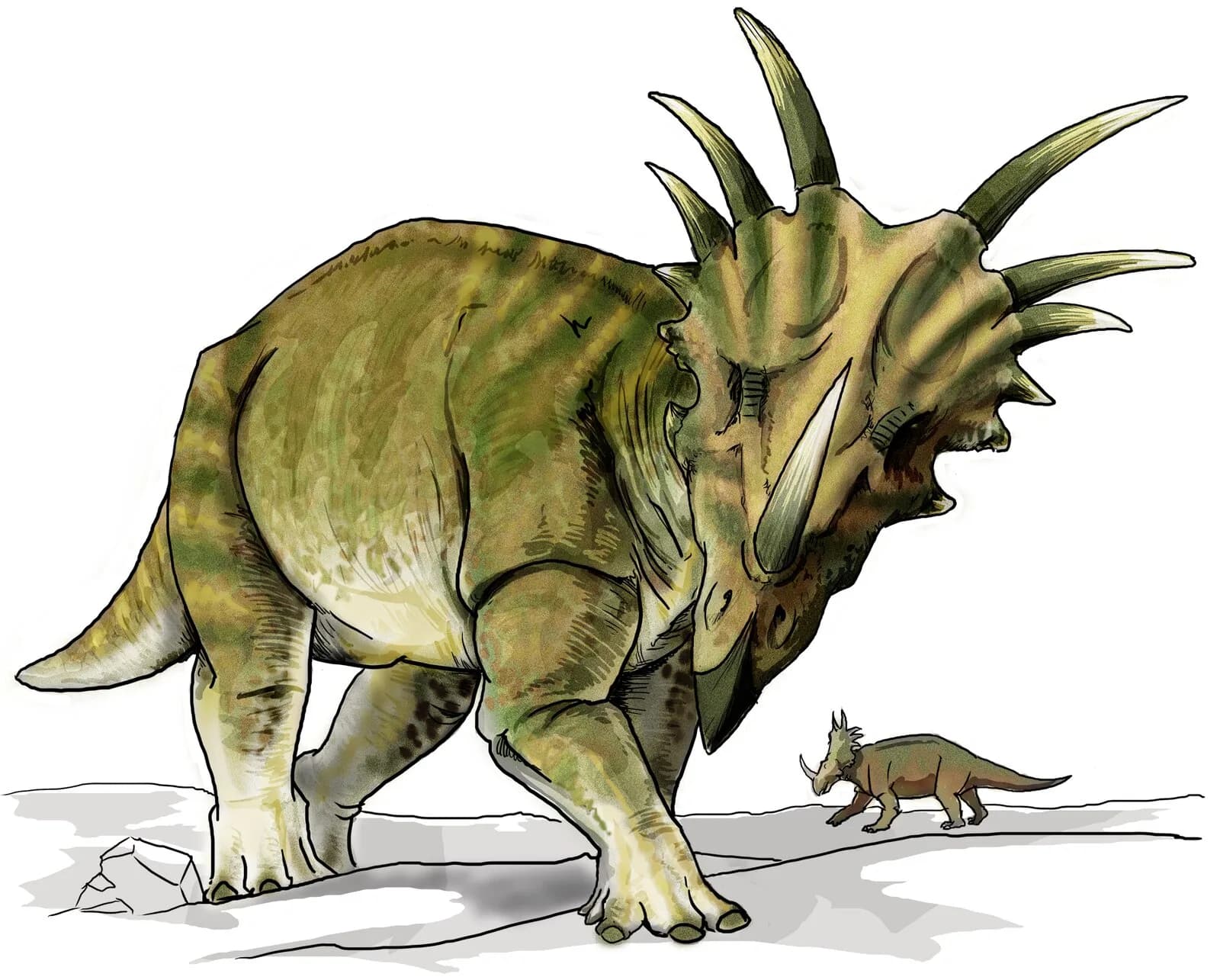
Einiosaurus procurvicornis carries a nasal horn curving forward, often likened to a can opener: no other horned dinosaur has anything like it. At 4.5 to 6 metres and 1 to 2 tonnes, described in 1995 in Montana, it lived around 74.5 million years ago. Its name comes from « eini », the Blackfoot word for bison, echoing its large herds.
Einiosaurus lived in the Late Cretaceous, approximately 74.5 million years ago, during the Campanian stage. This period corresponds to an era of great diversity among centrosaurine ceratopsians in western North America. Einiosaurus belongs to the subfamily Centrosaurinae and represents an important link in the evolutionary lineage leading from Styracosaurus to Achelousaurus and then to Pachyrhinosaurus. It lived in the coastal plains of present-day Montana, a region that hosted a rich and diverse dinosaur community during the late Campanian. The warm, humid subtropical climate of the time favored abundant vegetation capable of supporting large herbivore populations. Einiosaurus is remarkable for its unique forward-hooking nasal horn, without equivalent among other ceratopsids.
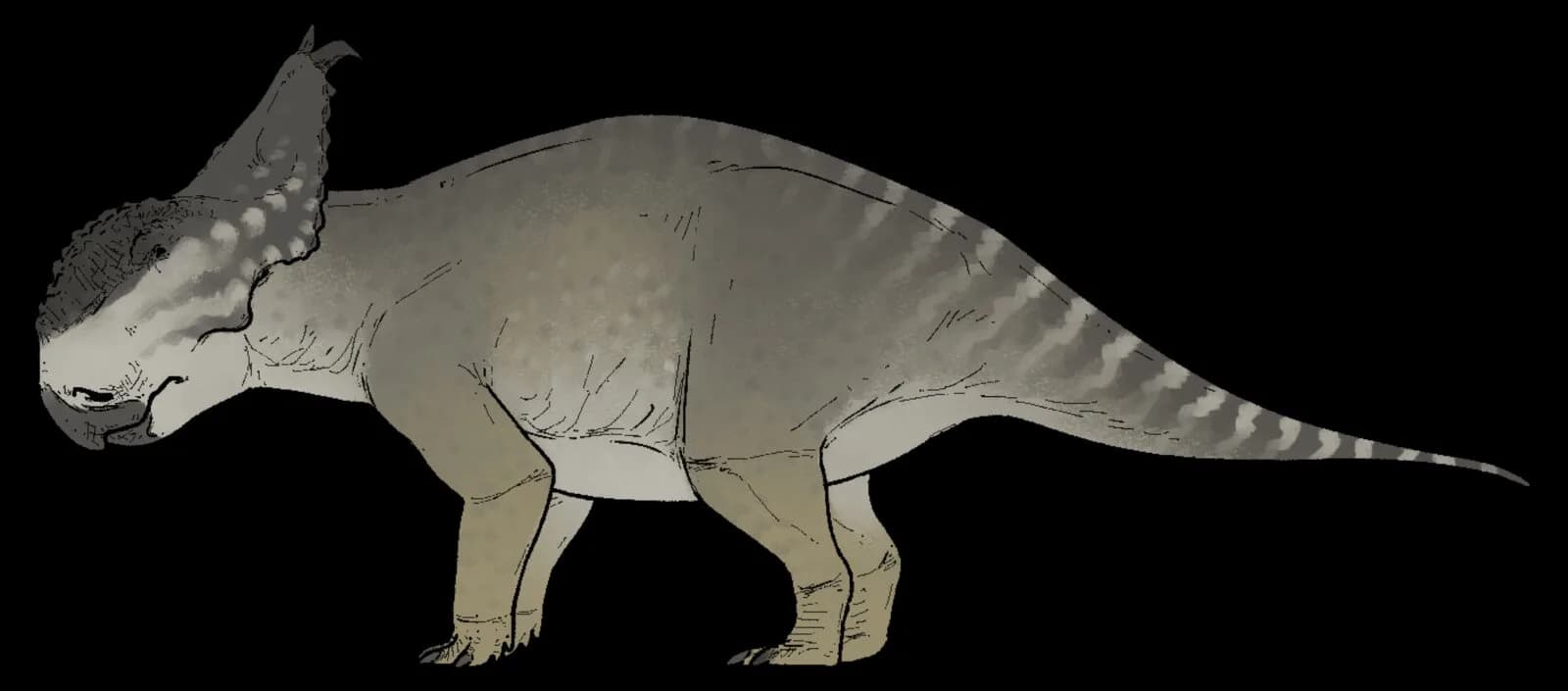
Einiosaurus measured approximately 4.5 to 6 meters in length, with a height of about 1.8 meters at the hips and an estimated weight between 1 and 2 tonnes. Its size was modest compared to giants like Triceratops, placing it in the medium-sized ceratopsid category. Its skull, about 1 meter long including the frill, was dominated by a single spectacular nasal horn that curved sharply forward and downward, resembling a giant can opener. The brow horns were reduced to mere bumps. The parietal frill, relatively short, bore a pair of long straight spines pointing backward from its upper edge. This combination of a recurved nasal horn and straight frill spines gives Einiosaurus an immediately recognizable cranial profile.
A strict herbivore, Einiosaurus fed on the low, fibrous vegetation of the Late Cretaceous plains. Its horny beak at the front of the jaws could efficiently section the stems and fronds of ferns, cycads, and early angiosperms. The complex dental batteries, composed of hundreds of teeth organized in vertical columns and continuously replaced, ensured efficient shearing of the toughest plant fibers. The jaw functioned through a vertical shearing motion rather than the rotary chewing motion of mammals. The naturally low position of its head indicates it primarily grazed at ground level. Its ecological niche was probably similar to that of a modern browsing rhinoceros, feeding on low shrubs and herbaceous vegetation.
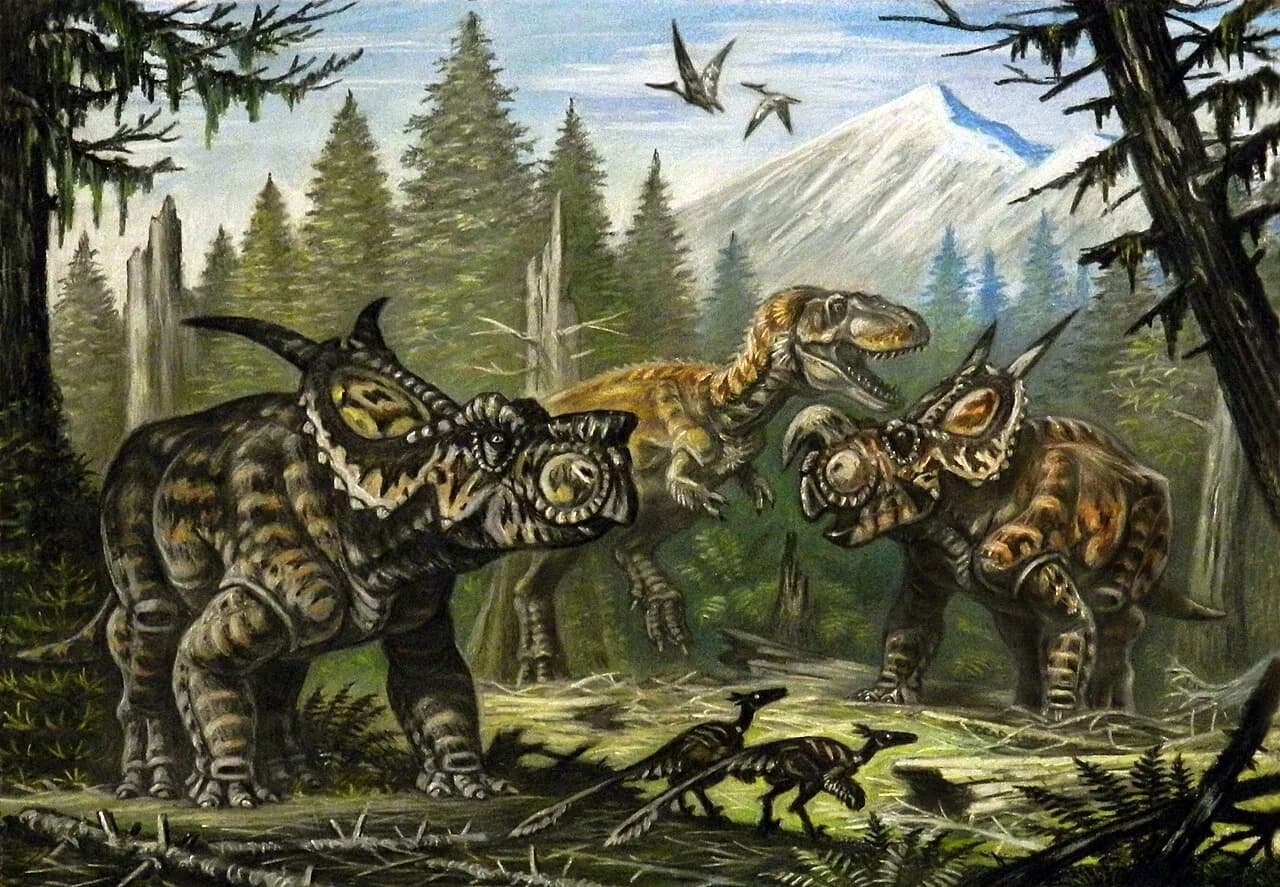
Einiosaurus inhabited the coastal plains and lowlands of present-day western Montana, a region bordering the Western Interior Seaway. The Campanian environment in this area was characterized by a humid subtropical climate with marked seasons, winding rivers surrounded by swamps, and forests of conifers and ferns. The Two Medicine Formation, where all specimens were discovered, represents a rich and productive coastal plain ecosystem. Einiosaurus coexisted with other ceratopsids like Achelousaurus and with hadrosaurs, ankylosaurs, and predatory theropods like Daspletosaurus. Environmental conditions favored large herbivore concentrations, as evidenced by the massive bone beds discovered in this formation.
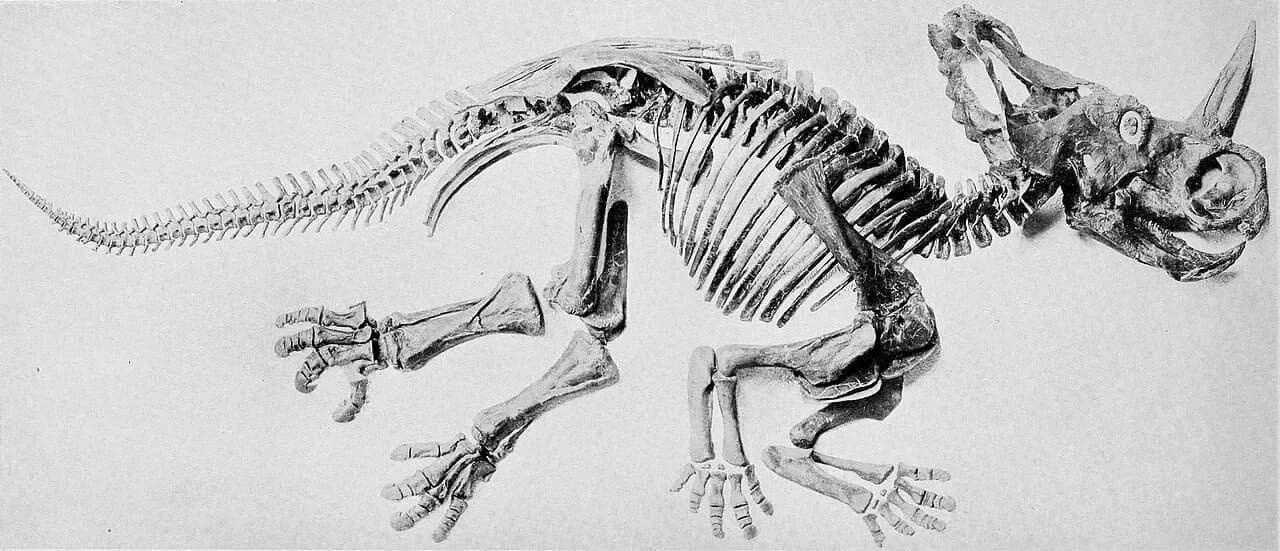
The cranial anatomy of Einiosaurus is its most remarkable feature. The nasal horn, unique among ceratopsids, curves strongly forward and downward, forming a pronounced hook whose exact function remains debated. The brow horns are almost entirely absent, reduced to small bumps above the orbits. The parietal frill is relatively short and fenestrated, bearing a pair of long, straight spines that rise from the dorsal edge and point backward. The body was robust and quadrupedal, typical of medium-sized ceratopsids, with massive limbs adapted for terrestrial locomotion. The postcranial skeleton is less distinctive than the skull and closely resembles that of other centrosaurines. The cervical musculature must have been powerful to support and manipulate such an ornate skull.
Einiosaurus was most likely a gregarious animal, as demonstrated by the massive bone beds discovered in the Two Medicine Formation containing dozens of individuals of all ages. These accumulations suggest that Einiosaurus lived in large herds that moved together across the coastal plains. Mass drowning during crossings of flooded rivers is the most likely hypothesis to explain these accumulations, a phenomenon similar to that observed in Centrosaurus. The recurved nasal horn probably served during ritualized combat between males, where two opponents interlocked their horns in pushing contests rather than direct charges. The frill spines functioned as visual signals for species recognition and sexual selection.
Einiosaurus procurvicornis was discovered and described in 1995 by Scott Sampson, from fossils found in the Two Medicine Formation in Glacier County, Montana. The genus name comes from the Blackfoot word 'eini' meaning 'buffalo,' in reference to its presumed bison-like herding behavior. The specific epithet 'procurvicornis' means 'with forward-curving horn.' The holotype (MOR 456) is a nearly complete skull housed at the Museum of the Rockies in Bozeman, Montana. Two main bone beds have yielded dozens of specimens, including juveniles, sub-adults, and adults, providing an exceptional view of ontogenetic growth and individual variation within the species. This abundance of material has made Einiosaurus one of the best-known centrosaurines in the fossil record.
| Period | Crétacé supérieur / Late Cretaceous |
| Era | Mésozoïque / Mesozoic |
| Age | ~74.5 Ma |
| Location | Amérique du Nord (Montana) / North America (Montana) |
| Length | 4.5-6 m |
| Height | ~1.8 m |
| Weight | 1-2 tonnes |
| Diet | Herbivore |
| Discovery | 1995 |
Einiosaurus procurvicornis measured between 4.5 and 6 meters long, weighing an estimated 1 to 2 tonnes. At roughly 1.8 meters at the hip, it ranks as a medium-sized ceratopsid — noticeably smaller than Triceratops but comparable in size to a modern white rhinoceros.
Einiosaurus procurvicornis was a strict herbivore that grazed on ferns, cycads, and early flowering plants across the coastal plains of present-day Montana, roughly 74.5 million years ago (Campanian). Its dental battery of hundreds of continuously replaced teeth allowed it to shear the toughest plant fibers.
The nasal horn of Einiosaurus procurvicornis, unique among ceratopsids, curves sharply forward and downward. Paleontologists propose it was used during ritualized combat between males — rivals interlocked horns in pushing contests — and served as a visual recognition signal for species identification.
Einiosaurus procurvicornis life reconstruction
Wikimedia Commons
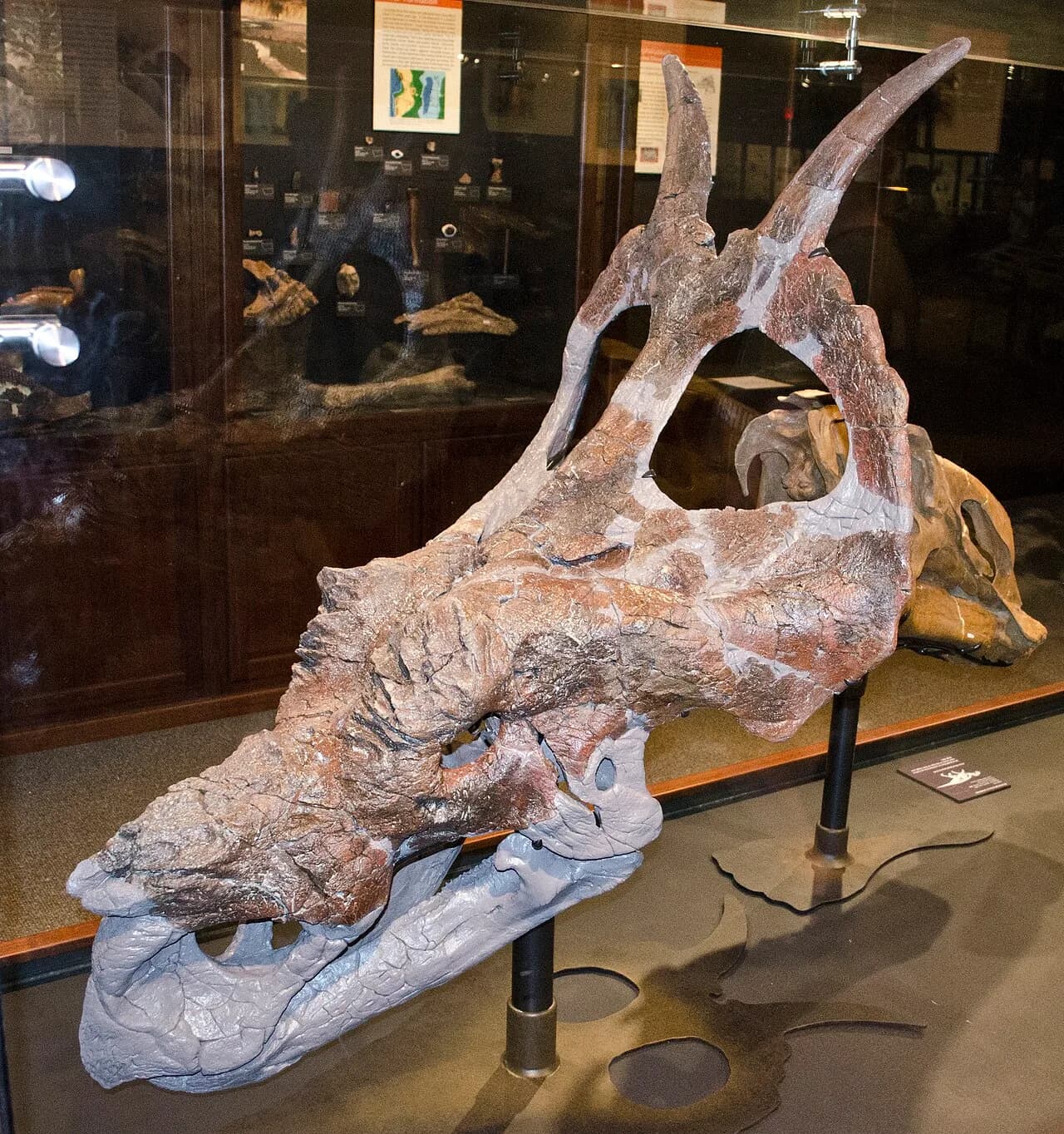
Einiosaurus skull showing the recurved nasal horn
Wikimedia Commons