Ours à face courte
Arctodus simus, the short-faced bear, ruled North America from Alaska to Mexico between 1.8 million and 11,000 years ago. Described in 1854, it weighed 600 to 1,100 kilograms and stood 3.7 metres tall on its hind legs, higher than a basketball hoop. Its elongated limbs let it run at 50 to 70 kilometres per hour despite its bulk.
Arctodus simus lived during the Pleistocene, approximately 1.8 million to 11,000 years ago, in North America. This giant bear, commonly called the giant short-faced bear, was the continent's largest terrestrial carnivore during most of the Pleistocene, dominating an ecosystem rich in megafauna. Arctodus belongs to the subfamily Tremarctinae, whose only living representative is the spectacled bear of South America (Tremarctos ornatus). The genus Arctodus includes two species: A. pristinus (smaller, southeastern United States) and A. simus (larger, distributed across all of North America). Arctodus's appearance coincides with the diversification of large North American herbivores in the early Pleistocene, and its extinction around 11,000 BCE falls within the megafaunal extinction wave that swept the Americas at the end of the last glaciation, possibly accelerated by competition with brown bears (Ursus arctos) newly arrived from Eurasia.
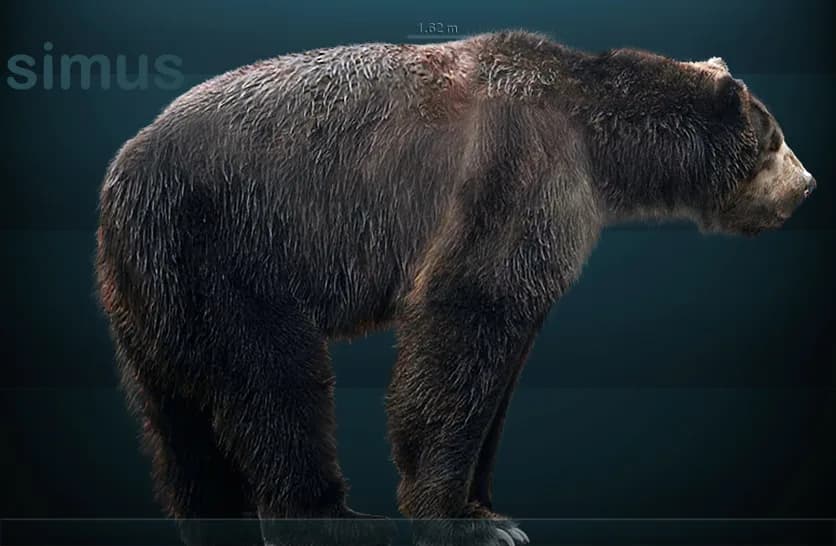
Arctodus simus was the largest bear that ever existed and one of the largest terrestrial carnivores of all time. Standing on its hind legs, it reached a dizzying height of 3.4 to 3.7 meters, exceeding any modern grizzly or polar bear. On all fours, its shoulder height was approximately 1.5 to 1.8 meters, about 30% taller than a male grizzly. Weight estimates range between 600 and 1,100 kilograms for the largest males, with an average of about 700 to 800 kg. Its most distinctive trait was its unusually short and wide snout (brachycephalic), which earned it its common name, contrasting sharply with the elongated muzzle of brown and black bears. Its legs were exceptionally long relative to its body, with forelimbs reaching the height of an adult man, giving it a particularly tall and gangly gait.
The diet of Arctodus simus is the subject of intense scientific debate. Two main hypotheses compete: that of a specialized hypercarnivore and that of an opportunistic omnivore. Isotopic analysis of bone collagen indicates a diet rich in animal protein, placing Arctodus at the top of the Pleistocene food chain. Its short snout and powerful jaw muscles gave it considerable bite force, theoretically capable of crushing the bones of bison and horses. However, its dentition does not show typical hypercarnivore adaptations (no sharp carnassials like felids), which has led some researchers to propose that Arctodus was primarily a kleptoparasite: a giant scavenger that stole kills from Smilodon and wolves thanks to its intimidating size. The most recent hypothesis suggests an omnivore with strong carnivorous tendencies, comparable to the modern polar bear but even more meat-oriented.
Arctodus simus occupied a vast territory covering most of North America, from Alaska to central Mexico. Its geographic distribution was remarkably extensive, encompassing varied habitats: open prairies of the Great Plains, sparse forests of the northwest, semi-arid zones of the southwest, and steppe tundra of eastern Beringia. The most abundant fossils come from California (Rancho La Brea), Texas, Florida, and Indiana, but specimens have been found in nearly every US state and southern Canadian province. Its long legs suggest an adaptation for long-distance travel in open terrain, consistent with a nomadic omnivore lifestyle ranging vast territories in search of carcasses or prey. The short-faced bear likely avoided dense forests, where its great height and long legs would have been handicaps.
Arctodus simus's anatomy reflected a bear highly specialized for rapid locomotion and physical dominance. Its brachycephalic skull (short and wide) was unique among ursids, with a shortened snout that increased bite force by reducing the mandibular lever arm. Its forward-facing orbits gave it superior binocular vision compared to modern bears, an advantage for a predator. Its canines, though large, were not as oversized as Smilodon's; its power resided more in the mass of its jaw and overall muscular strength. The most remarkable anatomical feature was its exceptionally long and straight limbs, with a limb-length-to-body-size ratio exceeding that of any modern bear. This 'cursorial' morphology is unique among ursids and suggests sustained running capability estimated at 50 to 70 km/h over short distances. Its feet were more digitigrade than those of modern bears, further increasing its potential speed.
Arctodus simus's behavior is reconstructed from its fossil distribution, morphology, and comparisons with modern ursids. Its large size and running adaptations suggest a solitary predator-scavenger ranging immense territories, possibly comparable to the modern polar bear's lifestyle on sea ice. The kleptoparasitism hypothesis proposes that Arctodus located kills made by other predators (Smilodon, wolves, American lions) through its developed sense of smell, then drove them from their meal through physical intimidation, its colossal size generally sufficient to scare away even the largest cats. Males were likely strongly territorial, as evidenced by pronounced sexual dimorphism (males being up to 50% heavier than females). The relative rarity of its fossils compared to other Pleistocene carnivores suggests low population density, typical of an apex super-predator requiring individual territories of several hundred square kilometers.
The genus Arctodus was described in 1854 by American paleontologist Joseph Leidy from fossils discovered in Pleistocene deposits in the United States. The name means 'bear tooth' (Greek: arktos 'bear' + odous 'tooth'). The most famous site is Rancho La Brea in Los Angeles, which has yielded over 30 individuals trapped in natural asphalt, providing detailed information about the species' morphology, size, and pathologies. A remarkable specimen discovered in Indiana in 1967 (the 'Fulton County bear') constitutes one of the most complete skeletons, enabling precise reconstructions of size and proportions. Arctodus fossils have also been found in caves in the Yukon and Alaska, preserved in permafrost, sometimes with remnants of fur and soft tissue. Radiocarbon dating of the last known specimens places Arctodus's extinction around 11,000 years ago, coinciding with the massive arrival of the first humans in North America via Beringia and the expansion of the brown bear (Ursus arctos) onto the continent.
| Period | Pléistocène / Pleistocene |
| Era | Cénozoïque / Cenozoic |
| Age | 1.8 Ma - 11 000 ans |
| Location | Amérique du Nord (Alaska au Mexique) / North America (Alaska to Mexico) |
| Length | 2.5-3 m |
| Height | 1.5-1.8 m (au garrot / at shoulder), 3.4-3.7 m (debout / standing) |
| Weight | 600 - 1 100 kg |
| Diet | Omnivore |
| Discovery | 1854 |
Arctodus simus was the largest bear that ever lived: standing on its hind legs, it reached 3.4 to 3.7 meters — exceeding any modern grizzly or polar bear. On all fours, its shoulder height was 1.5 to 1.8 meters, about 30% taller than a male grizzly. The largest males weighed between 700 and 1,100 kilograms, with proportionally long limbs unique among ursids.
The popular hypothesis suggests Arctodus simus stole kills from Smilodon and wolves by intimidating them with its size. Isotopic analysis of bone collagen confirms a diet rich in animal protein. However, the absence of sharp carnassial teeth typical of hypercarnivores has led some researchers to propose instead an omnivore with strong carnivorous tendencies, comparable to the polar bear but even more meat-oriented.
Arctodus simus went extinct around 11,000 years ago, during the megafaunal extinction wave that swept the Americas at the end of the last ice age. Radiocarbon dating of the last known specimens coincides with the massive arrival of the first humans via Beringia and the expansion of the brown bear (Ursus arctos) from Eurasia. Over 30 individuals have been recovered from the natural asphalt seeps at Rancho La Brea, Los Angeles.
Reconstruction of Arctodus simus, the largest bear that ever existed
Sergio De La Rosa, CC BY-SA 3.0
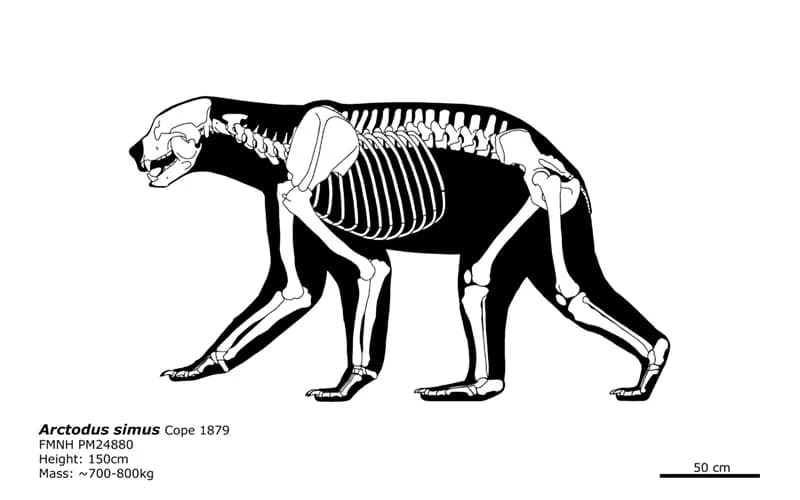
Skeletal reconstruction of Arctodus simus showing its unique proportions with long legs
bLAZZE92, CC BY 3.0