Crocodile à liens
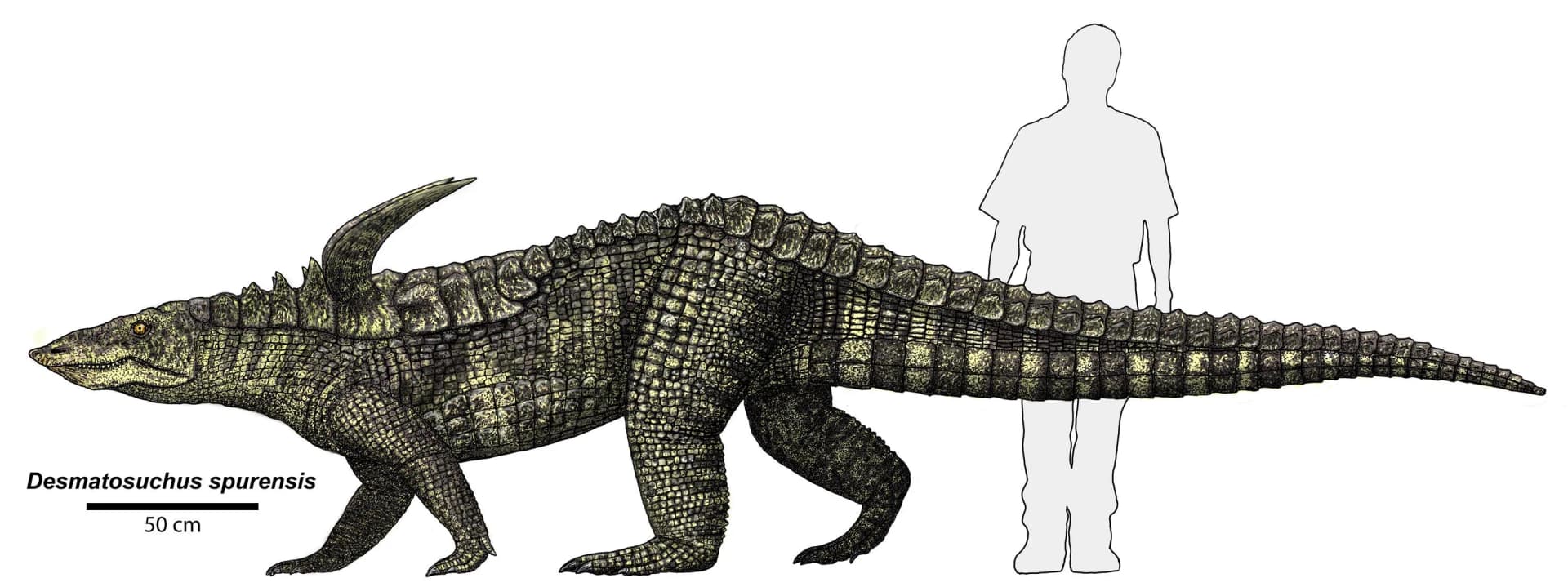
Desmatosuchus spurensis is a herbivorous aetosaur 4 to 5 metres long and 200 to 300 kilograms, described in 1920 from Texas. It lived 228 to 210 million years ago. Related to crocodiles rather than dinosaurs, it carried full osteoderm armour along with two shoulder spikes reaching 45 centimetres, angled outward.
Desmatosuchus lived during the Late Triassic (Norian), approximately 228 to 210 million years ago, in what is now the southwestern United States. This animal belongs to the aetosaurs, a group of armored archosaurs related to modern crocodilians but very different in their lifestyle. The Late Triassic was a pivotal period in Earth's history: the first dinosaurs were only just beginning to appear, and it was non-dinosaurian archosaurs like Desmatosuchus that still dominated many terrestrial ecosystems. Its name means 'link crocodile' in Greek, referring to the way its osteoderms (bony plates) articulate together like links in a chain.
Desmatosuchus was a sizeable animal for the Late Triassic, reaching 4 to 5 meters in total length from snout to tail tip. Its weight is estimated between 200 and 300 kilograms, comparable to a large wild boar or a small bison. Its body was relatively low-slung, with considerable width accentuated by its bony armor. The most striking element of its build was the pair of massive spines projecting from its shoulders, each reaching up to 45 centimeters in length. These lateral horns gave the animal an immediately recognizable and intimidating silhouette, widening its apparent size well beyond its actual body.
Unlike its crocodilian relatives who are formidable predators, Desmatosuchus was a peaceful herbivore — an evolutionary irony showing that armored appearance does not always correlate with a carnivorous diet. Its dentition consisted of small leaf-shaped teeth, perfectly adapted for grinding plant matter rather than capturing prey. Its upturned, rounded snout equipped with a sort of shovel was ideal for rooting in the soil and digging up roots, tubers, and rhizomes. It probably also fed on low ferns, horsetails, and young conifer shoots that constituted the dominant vegetation of the Late Triassic in North America.
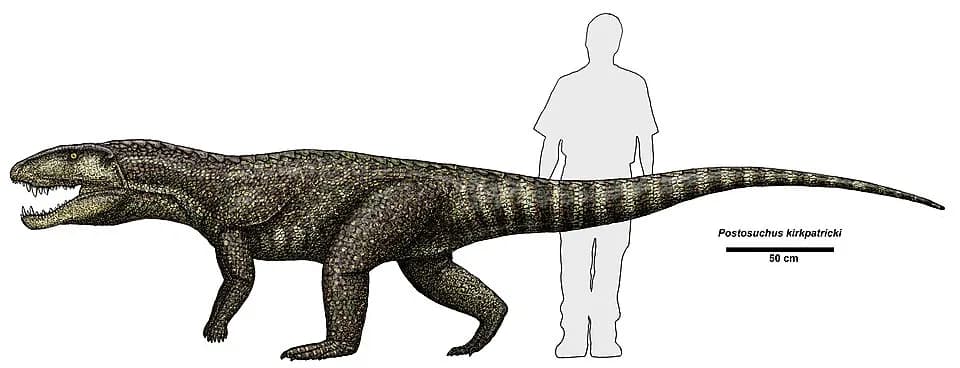
Desmatosuchus inhabited the semi-arid alluvial plains of southwestern North America during the Late Triassic. Fossils come primarily from the Dockum Group in Texas and New Mexico, as well as the Chinle Formation in Arizona. These regions were then located near the equator on the supercontinent Pangaea, with a tropical to subtropical climate marked by well-contrasted wet and dry seasons. The landscape consisted of seasonal rivers bordered by primitive conifer forests, with more open areas of ferns and horsetails. Desmatosuchus shared its environment with phytosaurs, rauisuchians like Postosuchus, and the very first dinosaurs such as Coelophysis.
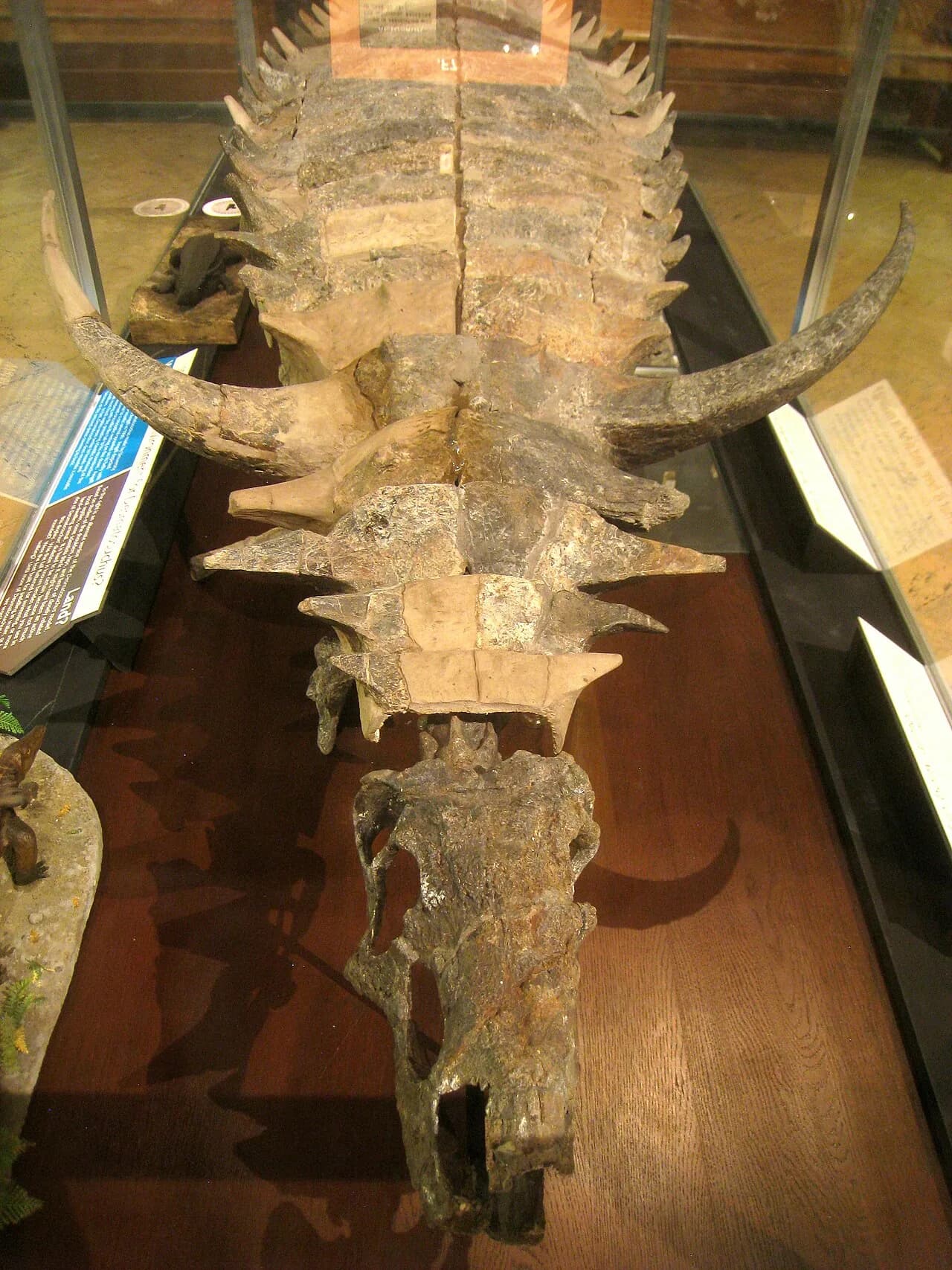
Desmatosuchus's anatomy is remarkable for its elaborate defensive armor, one of the most impressive in the prehistoric animal world. The entire back and flanks were covered in rows of osteoderms — rectangular bony plates interlocking with one another — forming a true articulated carapace comparable to that of a giant armadillo. Two massive spines projected from the shoulders, composed of solid bone covered in keratin, likely serving as defense against predators and possibly as intraspecific visual signals. Its skull was short and wide, with an upturned snout equipped with a hardened nasal plate, perfectly adapted for rooting in soil. Its tail was also protected by lateral osteoderms forming a double defensive row.
Desmatosuchus was most likely a gregarious and peaceful animal, spending most of its time rooting in the soil for plant food with its upturned, horny snout. Its survival strategy relied entirely on passive defense: when faced with a predator like the fearsome Postosuchus, Desmatosuchus could crouch down and present its impenetrable dorsal armor and threatening shoulder spines. This behavior recalls that of modern armadillos and pangolins. Aetosaurs probably lived in small family groups, as suggested by the discovery of several individuals fossilized together in certain deposits. Their pace of life was likely slow and steady, typical of large armored herbivores.
Desmatosuchus was first described in 1920 by American paleontologist Ermine Cowles Case, from fossils discovered in Crosby County, Texas. The type species, D. spurensis, takes its name from the town of Spur, Texas, near the original discovery site. Since then, additional fossils have been unearthed at several localities in the Dockum Group in Texas and New Mexico, as well as in the Chinle Formation in Arizona. A second species, D. smalli, was described in 2002. Specimens include partial skeletons with their armor in place, allowing precise reconstruction of osteoderm arrangement. Desmatosuchus is now the best-known aetosaur in North America and an emblematic representative of the pre-dinosaurian Triassic fauna.
| Period | Trias supérieur / Late Triassic (Norien) |
| Era | Mésozoïque / Mesozoic |
| Age | 228-210 Ma |
| Location | Amérique du Nord (Texas) / North America (Texas) |
| Length | 4-5 m |
| Height | 0.6 m |
| Weight | 200-300 kg |
| Diet | Herbivore |
| Discovery | 1920 |
No. Unlike predatory modern crocodilians, Desmatosuchus spurensis was an herbivore. Its small, leaf-shaped teeth and upturned snout were adapted for browsing and rooting in soil to unearth roots and tubers. This armored Late Triassic archosaur shared its Texan habitat with predators such as the rauisuchian Postosuchus, against which its armor served as its only defense.
The shoulder spines of Desmatosuchus spurensis, reaching up to 45 centimeters in length, were composed of solid bone covered in keratin. Their primary role was likely defensive — making the animal difficult to attack from the side or above. They may also have served as visual signals between individuals of the same species, similar to certain modern armored herbivores.
Desmatosuchus spurensis lived 228 to 210 million years ago, during the Late Triassic (Norian), in what is now Texas. It was described in 1920 by American paleontologist Ermine Cowles Case from fossils in Crosby County. Its name comes from the town of Spur, Texas. A second species, D. smalli, was described in 2002.
Skeleton of Desmatosuchus spurensis showing the osteoderm armor and shoulder spines
Wikipedia Commons
Museum reconstruction of Desmatosuchus in a Triassic diorama
Wikipedia Commons