Cotylorhynchus
Cotylorhynchus romeri is a herbivorous pelycosaur about 6 metres long and 500 to 2,000 kilograms, described in 1937 from Oklahoma and Texas. It lived 279 to 260 million years ago. Its head does not exceed 15 centimetres, the most extreme head-to-body mismatch in the entire fossil record. Slow and bulky, it was on the menu for Dimetrodon.
Cotylorhynchus romeri lived during the Early to Middle Permian (Cisuralian-Guadalupian), approximately 279 to 260 million years ago. This giant caseид was the largest terrestrial herbivore of the Early Permian in North America, a true vegetarian 'tank' of the Paleozoic era. Caseidae formed a family of herbivorous primitive synapsids (pelycosaurs) that rank among the first large terrestrial herbivores in history. Cotylorhynchus was contemporary with Dimetrodon and occupied a diametrically opposite ecological niche: prey rather than predator.
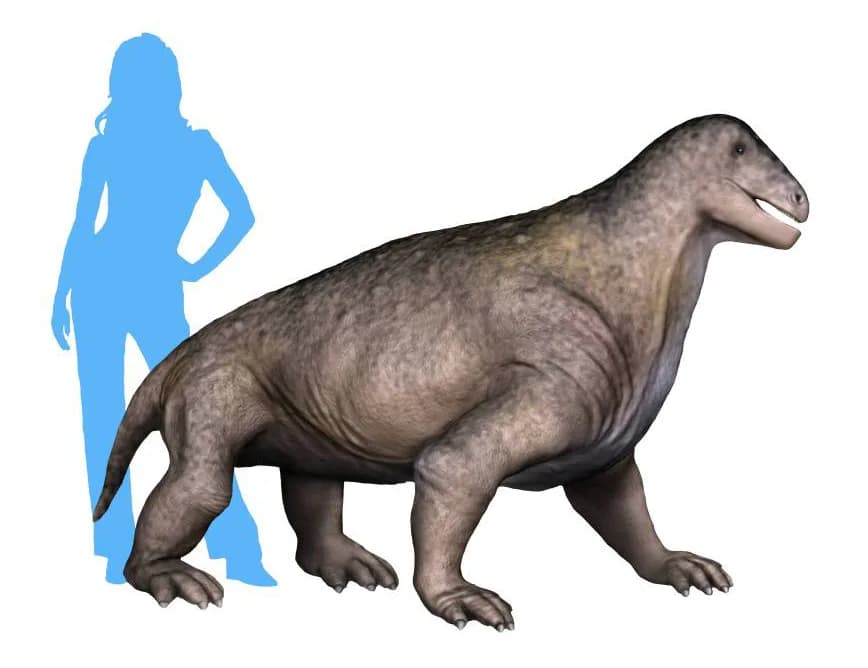
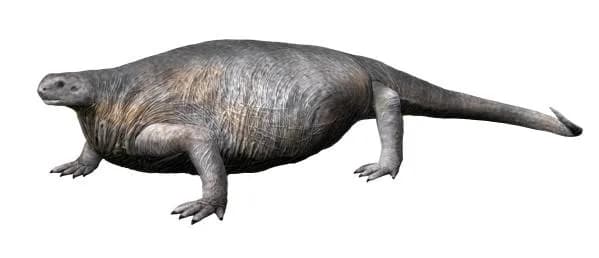
Cotylorhynchus romeri reached approximately 6 meters in total length, making it one of the largest terrestrial animals of the Permian and the largest known caseid. Its weight is estimated between 500 and 2,000 kilograms depending on sources — a considerable mass for a primitive synapsid. Its body was extraordinarily wide and barrel-shaped, with a distended abdomen housing a voluminous digestive system necessary for plant fermentation. Its head was paradoxically tiny relative to the body — a skull of only 15 centimeters on a 6-meter body, giving almost comical proportions.
Cotylorhynchus was a strict herbivore whose spatulate, blunt dentition was adapted for shearing and grinding vegetation. The spoon-shaped teeth could efficiently strip fern fronds and horsetail stems. Its giant barrel body testified to a massive digestive tract, necessary because Permian plants were nutrient-poor and difficult to digest. Like modern hindgut fermenters (horses, elephants), it must have spent most of its waking hours feeding to maintain its enormous body mass.
Cotylorhynchus inhabited the semi-arid Permian alluvial plains in what is now Oklahoma and Texas. The Hennessey and Flowerpot geological formations in central Oklahoma have yielded the main fossils. The environment consisted of low plains crossed by seasonal waterways, with vegetation of ferns, horsetails, and primitive conifers. The climate was warm and seasonal with dry periods. Cotylorhynchus shared its habitat with Dimetrodon (its main potential predator), other synapsids, and amphibians.
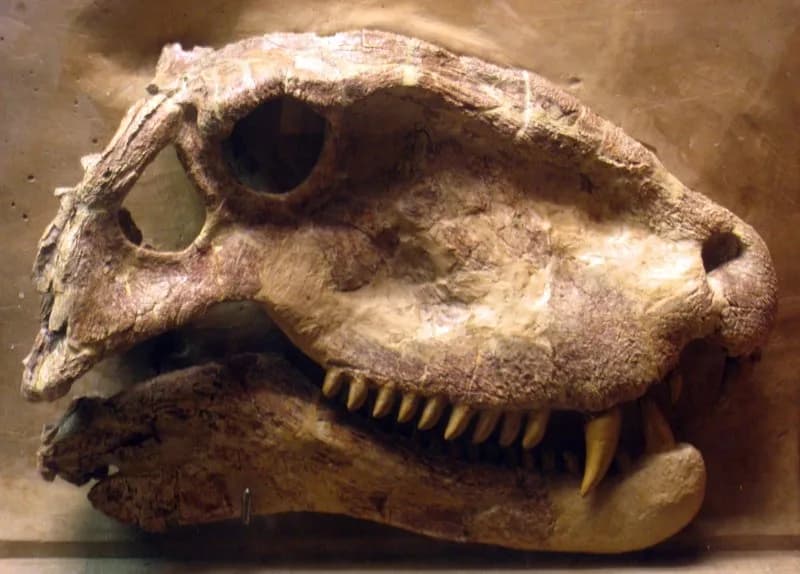
Cotylorhynchus's most striking anatomical feature is the absurd contrast between its tiny head and enormous body. The 15-centimeter skull possessed very large external nares (possibly for thermoregulation or a developed olfactory organ) and spatulate teeth. The barrel body, the widest of all primitive synapsids, housed a voluminous digestive apparatus. Limbs were short and sprawling in a 'beam' posture, adapted to support considerable weight but limiting speed and agility. Claws were broad and blunt, possibly used for digging burrows or uprooting roots.
Cotylorhynchus was a slow, placid herbivore that probably spent most of its time feeding. Its movement speed was limited by short limbs and sprawling posture, making it vulnerable to predators like Dimetrodon. Its main defense was its massive size — a 6-meter adult potentially exceeding one tonne was a difficult prey even for a large Dimetrodon. The broad claws may have served to dig burrows for protection from heat or predators. Juveniles may have been semi-fossorial, using burrows as refuges.
Cotylorhynchus romeri was described in 1937 by Stovall from fossils discovered in Permian formations of Oklahoma. The name means 'cup snout' (Greek kotyle = cup, rhynchos = snout), referring to the concave shape of certain cranial bones. The species name honors paleontologist Alfred Romer, a pioneer in the study of primitive vertebrates. Three species are recognized: C. romeri (the largest), C. bransoni, and C. hancocki. The Oklahoma Museum of Natural History holds important specimens. The discovery of relatively complete skeletons allowed reconstruction of the grotesque but notable proportions of this animal — a tiny head on a gigantic body.
| Period | Permien inférieur-moyen / Early-Middle Permian |
| Era | Paléozoïque / Paleozoic |
| Age | 279-260 Ma |
| Location | États-Unis (Oklahoma, Texas) / USA (Oklahoma, Texas) |
| Length | ~6 m |
| Height | ~1.5 m |
| Weight | 500-2000 kg |
| Diet | Herbivore |
| Discovery | 1937 |
No, Cotylorhynchus romeri was a caseid, a primitive synapsid of the Early to Middle Permian (279-260 Ma), roughly 30 million years before the first dinosaurs appeared in the Triassic. Synapsids are the lineage leading to mammals, not to reptiles or dinosaurs. Cotylorhynchus was phylogenetically actually closer to modern mammals than to any dinosaur.
Cotylorhynchus romeri had a skull of about 15 cm on a 6-meter body — the most extreme proportions among primitive synapsids. This contrast reflects two opposing constraints: a small head with spatulate teeth sufficient to shear Permian ferns and horsetails, and a giant barrel abdomen housing a voluminous digestive tract essential for fermenting these nutrient-poor plants.
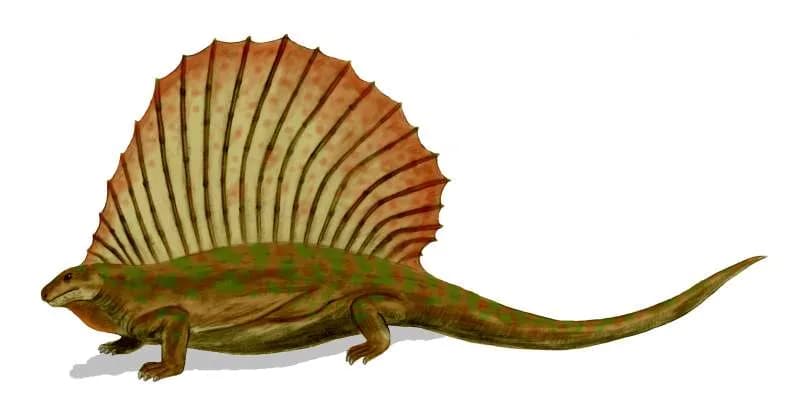
Yes, Cotylorhynchus romeri and Dimetrodon shared the same Permian formations of Oklahoma and Texas (Hennessey and Flowerpot formations), roughly 279 to 260 million years ago. They occupied opposite niches: Dimetrodon was the apex predator and Cotylorhynchus the giant herbivore of 500 to 2,000 kg. The massive size of an adult Cotylorhynchus was probably its main defense against Dimetrodon attacks.
Cotylorhynchus romeri life reconstruction
Wikimedia Commons