Austroraptor
Austroraptor cabazai is the largest known dromaeosaur from the southern hemisphere: 5 to 6 metres and 200 to 370 kilograms, unearthed in Argentine Patagonia and described in 2008. It lived around 70 million years ago and fished, as shown by its elongated, cone-toothed skull, a striking convergence with the spinosaurs. Its arms were proportionally shorter than those of Tyrannosaurus rex.
Austroraptor lived in the Late Cretaceous, approximately 70 million years ago, during the Maastrichtian stage, just before the Cretaceous-Paleogene mass extinction event. This period corresponds to the final millions of years of the age of dinosaurs in South America. Austroraptor is a dromaeosaurid of the subfamily Unenlagiinae, an exclusively Gondwanan group that includes genera such as Buitreraptor and Unenlagia. This South American lineage of raptors evolved separately from their Laurasian cousins (Velociraptor, Deinonychus) for tens of millions of years, developing unique anatomical characteristics. Austroraptor is the largest known dromaeosaurid from the Southern Hemisphere and one of the last representatives of its family before the mass extinction.
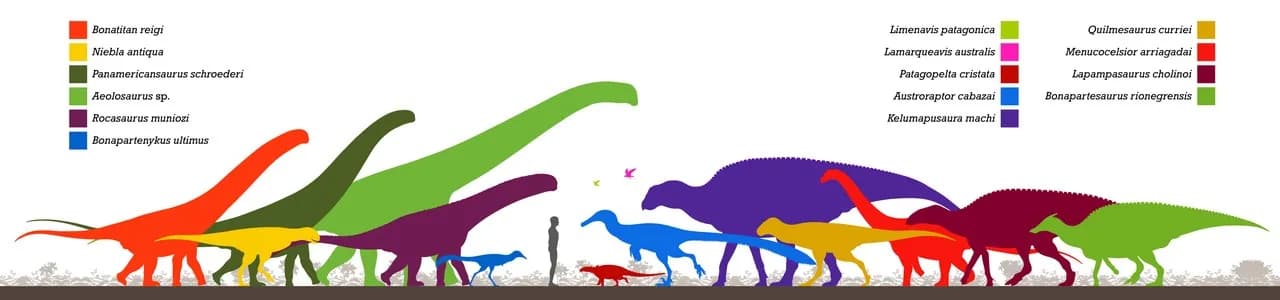
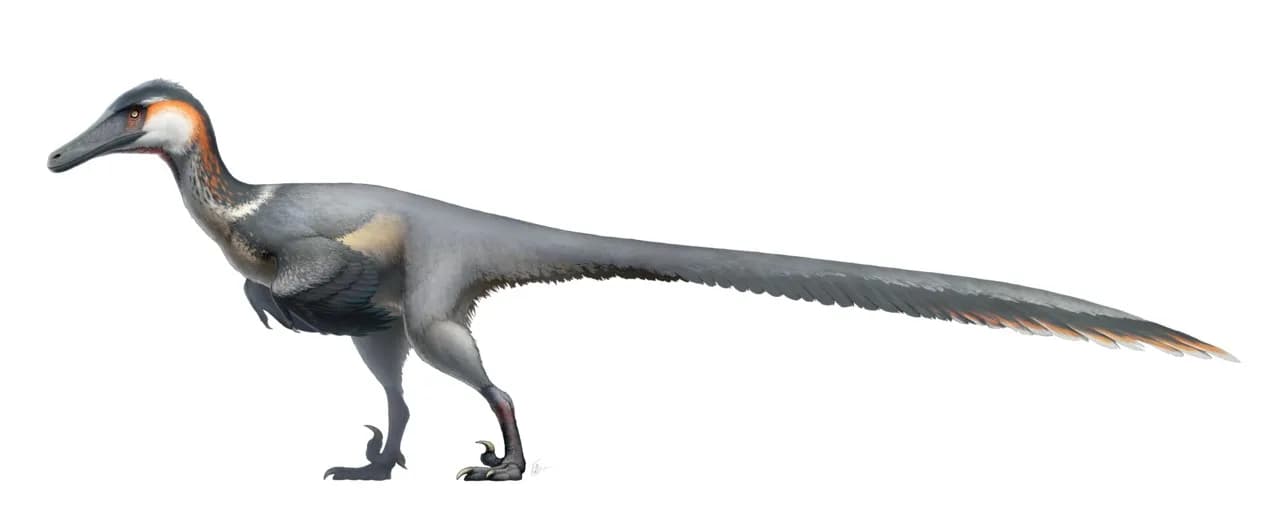
Austroraptor was an impressive raptor dinosaur, measuring approximately 5 to 6 meters in length, making it the largest dromaeosaurid discovered in the Southern Hemisphere and one of the largest raptors in the world, rivaling the North American Utahraptor. Its weight is estimated between 200 and 370 kilograms, a considerable mass for a raptor. Its hip height reached approximately 1.5 to 1.7 meters. Its proportions were unusual for a dromaeosaurid: an elongated, low skull reminiscent of spinosaurids, surprisingly short arms relative to its body size, and long, powerful hind legs. This unique combination of traits distinguishes it from all other known raptors.
An active carnivore, Austroraptor had a feeding strategy probably different from that of typical dromaeosaurids. Its elongated snout and relatively small, slightly curved conical teeth suggest a primarily piscivorous diet, similar to that of spinosaurids like Baryonyx. This evolutionary convergence is remarkable because it implies that Austroraptor occupied an ecological niche usually filled by much larger theropods. Its conical teeth were well adapted for grasping slippery prey like fish, unlike the blade-like teeth of typical raptors designed for slicing flesh. It also probably hunted small terrestrial vertebrates and lizards, adopting an opportunistic diet.
Austroraptor inhabited the alluvial plains and coastal zones of what is now southern Argentina, in the Patagonia region. The Late Cretaceous environment in this region was characterized by a temperate to subtropical climate, with winding rivers, lakes, and marshy areas bordered by conifer and angiosperm forests. The Allen Formation, where the holotype was discovered, represents an ancient fluvio-lacustrine environment rich in fish and aquatic fauna, which is consistent with the hypothesis of a partially piscivorous diet. Austroraptor coexisted with titanosaur sauropods, hadrosaurs like Secernosaurus and ankylosaurs, as well as other theropods such as abelisaurids.
Austroraptor's anatomy presents a striking mix of primitive and derived characteristics. Its skull, long and low, is very different from that of typical dromaeosaurids — measuring approximately 80 centimeters, it more closely resembles that of a spinosaurid than a classic raptor. The teeth are conical and non-serrated, unlike the blade-like teeth characteristic of Dromaeosauridae. The arms are remarkably short for a dromaeosaurid of this size, recalling the reduced proportions of tyrannosaurs rather than the long prehensile arms of Deinonychus. The hind legs, long and muscular, bore the characteristic sickle claw of raptors on the second toe, though proportionally smaller than in Laurasian dromaeosaurids. Plumage is assumed but not confirmed by direct fossil evidence.
Austroraptor was probably an agile and versatile predator, capable of hunting both in water and on land. Its morphology suggests a mixed hunting strategy: using its long snout to capture fish in shallow waters, similar to modern herons, and actively pursuing small terrestrial prey thanks to its long hind legs. Despite its short arms, it still possessed the retractable sickle claw typical of raptors, although proportionally smaller. Biomechanical studies suggest it was a fast runner, capable of reaching considerable speeds thanks to its elongated hind limbs. Its intelligence, estimated from the relative size of its brain, was probably comparable to that of other dromaeosaurids, meaning among the highest of all dinosaurs.
Austroraptor cabazai was discovered in 2008 in the Allen Formation, Río Negro Province, in Argentine Patagonia. The holotype (MML 220) was described by Fernando Novas and colleagues, comprising a partial skull, vertebrae, forelimb and hindlimb elements, and pelvic fragments. The genus name means 'southern thief' (from Latin austro and raptor), while the species honors Alberto Cabaza, founder of the Museo Municipal de Lamarque where the fossil is housed. This discovery was a major surprise for paleontologists, as no dromaeosaurid of this size was known from the Southern Hemisphere. The find reinforced the idea that Gondwanan dromaeosaurids (Unenlagiinae) had followed a radically different evolutionary trajectory from their northern cousins.
| Period | Crétacé supérieur / Late Cretaceous |
| Era | Mésozoïque / Mesozoic |
| Age | ~70 Ma |
| Location | Argentine (Patagonie) / Argentina (Patagonia) |
| Length | 5-6 m |
| Height | ~1.7 m |
| Weight | 200-370 kg |
| Diet | Piscivore |
| Discovery | 2008 |
Austroraptor cabazai measured 5 to 6 meters long and weighed 200 to 370 kilograms, making it the largest dromaeosaurid from the Southern Hemisphere and one of the largest raptors in the world, rivaling the North American Utahraptor. Described by Fernando Novas in 2008 from a holotype (MML 220) found in Argentine Patagonia, it was a major surprise: no dromaeosaurid of this size was previously known from the Southern Hemisphere.
Austroraptor cabazai had a long, low skull of approximately 80 centimeters with non-serrated conical teeth — very different from the typical dromaeosaurid skull. This morphology converges with that of spinosaurids like Baryonyx and suggests a partially piscivorous diet: its conical teeth were well-adapted for grasping slippery prey like fish in the shallow waters of the Allen Formation (Patagonia, ~70 Ma).
Austroraptor cabazai belongs to the Unenlagiinae, an exclusively Gondwanan group that includes Buitreraptor and Unenlagia. Isolated in South America for tens of millions of years, these raptors evolved separately from their Laurasian cousins (Velociraptor, Deinonychus), developing unique traits: elongated skulls with conical teeth, short arms, and powerful legs. Austroraptor illustrates a radically different evolutionary trajectory within Dromaeosauridae.
Austroraptor cabazai life reconstruction
Wikimedia Commons
Reconstructed Austroraptor skeleton
Wikimedia Commons