Attercopus
Attercopus fimbriunguis is the oldest known silk producer: this one-centimetre arachnid, barely half a gram, lived around 380 million years ago at Gilboa, in New York State. Filed among spiders for seventeen years, it was reclassified when a synchrotron scan showed it lacked true spinnerets. Its name comes from « attercop », the Old English word for spider.
Attercopus fimbriunguis lived during the Middle to Late Devonian (Givetian), approximately 380 million years ago. This tiny arachnid is considered the oldest known silk-producing creature and one of the oldest terrestrial arachnids. Long classified as the oldest spider (Araneae), it was reclassified in 2008 into a distinct extinct order (Uraraneida) after the discovery that it did not possess true spinnerets. Attercopus testifies to the very first steps of arthropod life on land, at a time when Archaeopteris forests were beginning to colonize the continents.
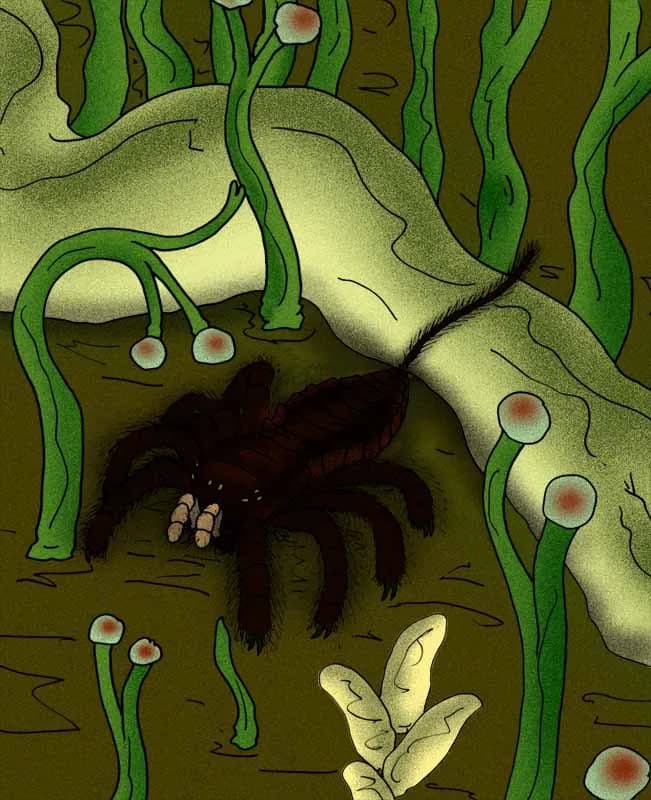
Attercopus fimbriunguis measured approximately 1 centimeter in body length, a tiny animal even for an arachnid. Its body was divided into two main regions: the prosoma (cephalothorax) and opisthosoma (abdomen), like modern spiders. The legs were relatively long compared to the body. Structures called spigots (silk taps) were present on the ventral surface of the abdomen, but arranged differently from true spider spinnerets. The body bore fringed claws at the leg tips, hence the species name fimbriunguis (fringed claws).
Attercopus was a predator that hunted small arthropods and terrestrial invertebrates of the Devonian. Like modern arachnids, it probably possessed chelicerae (fangs) for seizing and subduing prey. Its silk probably did not serve to weave capture webs like modern spiders, but rather to line its burrow, create guidewires, or protect its eggs. Its small size limited it to tiny prey: springtails, mites, small myriapods, and other micro-arthropods of the Devonian forest floor litter.
Attercopus inhabited the first terrestrial forest ecosystems of the Devonian in what is now New York State (Gilboa, Schoharie County). The Gilboa site is famous for containing remains of one of the oldest known forests in the world — a forest of Archaeopteris and other primitive plants. Attercopus lived in the forest litter, among decomposing plant debris that constituted the first forest soils. This humid, shaded environment was ideal for a small terrestrial arachnid requiring protection from desiccation.
Attercopus's anatomy is known from fossil fragments including claws, spigots (silk-producing organs), and abdominal pieces. The most important feature is the presence of silk-producing spigots on the ventral surface of the abdomen — but arranged on ventral plates rather than on true articulated spinnerets. This crucial distinction, identified in 2008 by Selden, Shear, and Sutton, led to removing Attercopus from Araneae and placing it in the extinct order Uraraneida. Fringed claws at leg tips were perhaps adapted for gripping plant surfaces. The overall picture suggests a basal silk-producing arachnid, a predecessor but not direct ancestor of spiders.
Attercopus produced silk but probably did not weave capture webs. Its silk likely served to line a burrow or shelter in the forest litter, create guidewires to find its way (like modern wolf spiders), and possibly protect egg sacs. This silk production without capture webs is considered the ancestral state in silk-producing arachnids — the elaborate orb webs of modern spiders are a much later innovation. Attercopus was probably nocturnal and solitary, actively hunting in the humid leaf litter.
Attercopus fimbriunguis was described in 1991 by Shear, Selden, and Rolfe from fossils found in Devonian sediments at Gilboa, New York State (Panther Mountain Formation, Givetian). The name Attercopus derives from 'attercop,' an old English word for spider (from Anglo-Saxon ator = poison, coppe = head). In 2008, a reanalysis by Selden, Shear, and Sutton using synchrotron tomography revealed that the silk organs were not true spinnerets but spigots on ventral plates, leading to the creation of the new order Uraraneida. This reclassification is a classic example of the importance of new technologies in paleontology.
| Period | Dévonien moyen-supérieur / Middle-Late Devonian |
| Era | Paléozoïque / Paleozoic |
| Age | ~380 Ma |
| Location | États-Unis (Gilboa, New York) / USA (Gilboa, New York) |
| Length | ~1 cm |
| Height | ~0.5 cm |
| Weight | <0.5 g |
| Diet | Carnivore / Insectivore |
| Discovery | 1991 |
For 17 years after its description in 1991 by Shear, Selden, and Rolfe, Attercopus fimbriunguis was classified as the oldest known spider. In 2008, a reanalysis by Selden, Shear, and Sutton using synchrotron tomography revealed that its silk organs were not true articulated spinnerets but spigots on ventral plates. This led to the creation of the new extinct order Uraraneida — so it is not a true spider in the strict sense.
Attercopus fimbriunguis produced silk but probably did not weave capture webs like modern spiders — elaborate orb webs are a much later innovation. Its silk likely served to line a burrow in the Devonian forest floor at Gilboa (New York), create guidewires, or protect egg sacs. This behavior is considered the ancestral state in silk-producing arachnids.
Gilboa in New York State is famous for harboring remains of one of the oldest known forests on Earth — a forest of Archaeopteris and primitive plants dating to the Middle Devonian (~380 Ma). It is in these sediments of the Panther Mountain Formation (Givetian) that Attercopus fimbriunguis was discovered, testifying to the very first steps of terrestrial arthropods in these nascent forest environments.
Attercopus fimbriunguis life reconstruction
Wikimedia Commons