Atrociraptor
Atrociraptor marshalli was a dromaeosaurid from Alberta, described in 1995 from fossils at Horseshoe Canyon and dated to 68.5 million years ago. At 2 metres and 15 to 20 kilograms, it stands out for a short, deep jaw. Its name means savage thief, and it owes its recent fame to the Malta street chase in Jurassic World Dominion.
Atrociraptor lived during the Late Cretaceous period, approximately 68.5 million years ago, in what is now the province of Alberta, Canada. This period corresponds to the final millions of years of the age of dinosaurs, just before the great Cretaceous-Paleogene mass extinction that would end the reign of non-avian dinosaurs. Alberta at this time was a coastal region bordered by the Western Interior Seaway, offering a humid subtropical climate favorable to exceptional biodiversity. Atrociraptor shared its environment with many other iconic Late Cretaceous North American dinosaurs, including tyrannosaurs, ceratopsians, and hadrosaurs.
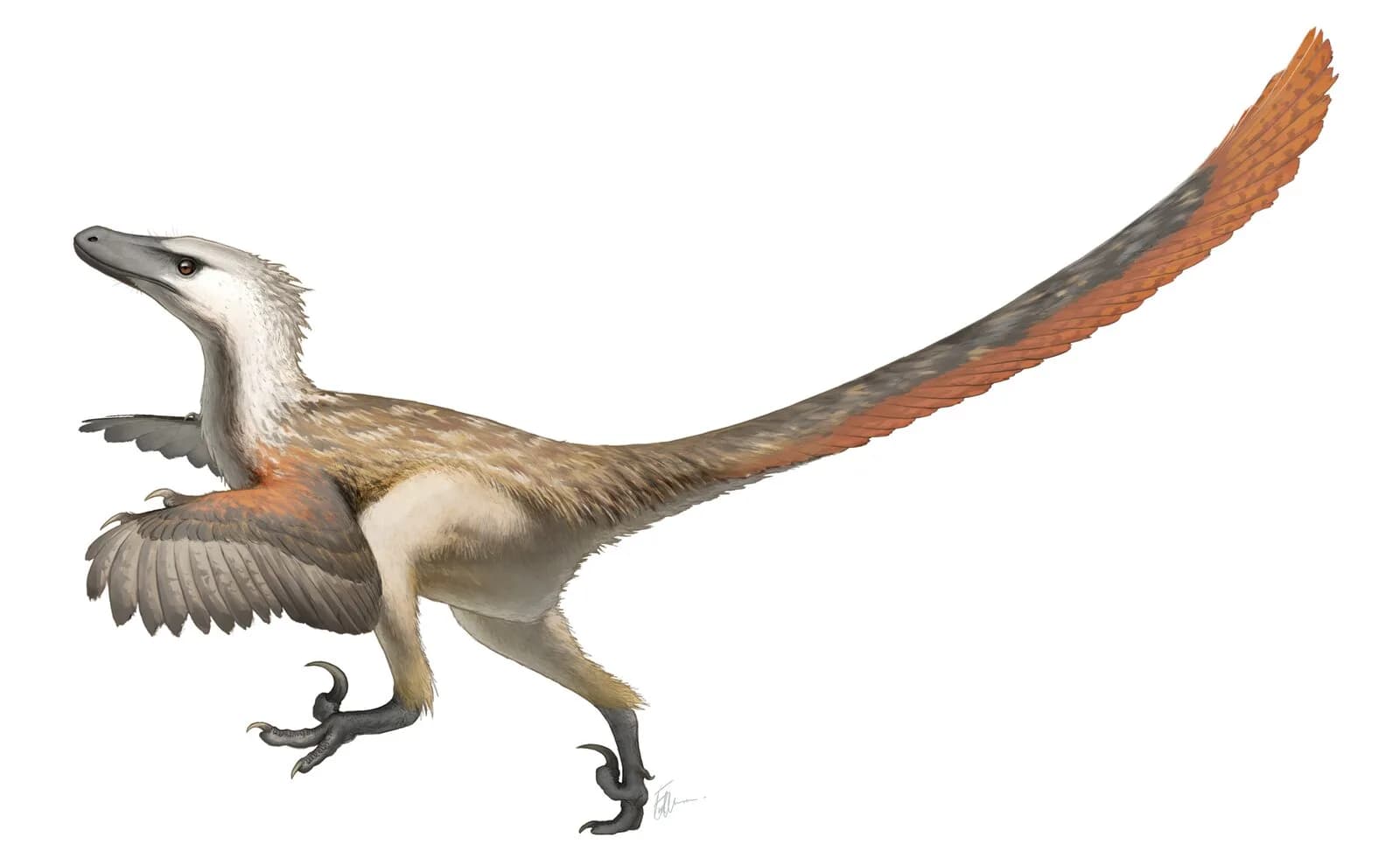
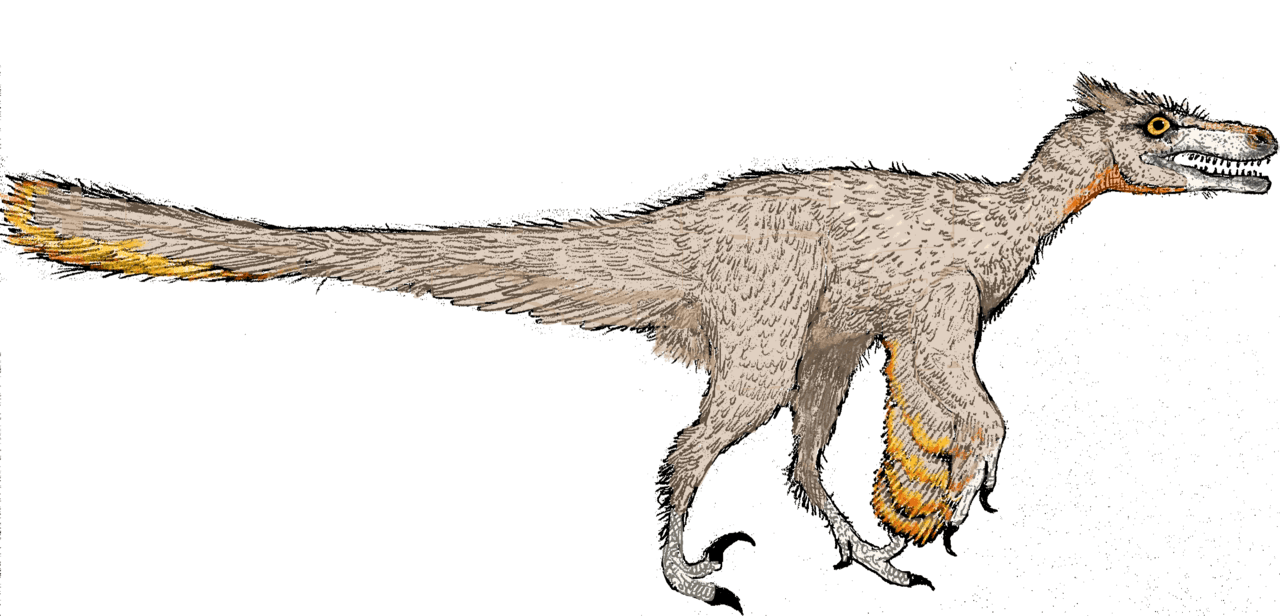
Atrociraptor was a small dromaeosaurid measuring approximately 2 meters in total length, with an estimated weight of about 15 kilograms. Compared to other members of its family such as Velociraptor or Deinonychus, Atrociraptor was distinguished by a noticeably shorter and more robust morphology. Its head was proportionally wider and deeper than that of other raptors of similar size, giving it a stocky and powerful appearance. Its hindlimbs were well-developed, adapted for agile bipedal locomotion, while its relatively short arms likely bore plumage similar to that of other related dromaeosaurids. Despite its small size, Atrociraptor was a formidable predator thanks to its exceptionally powerful jaw.
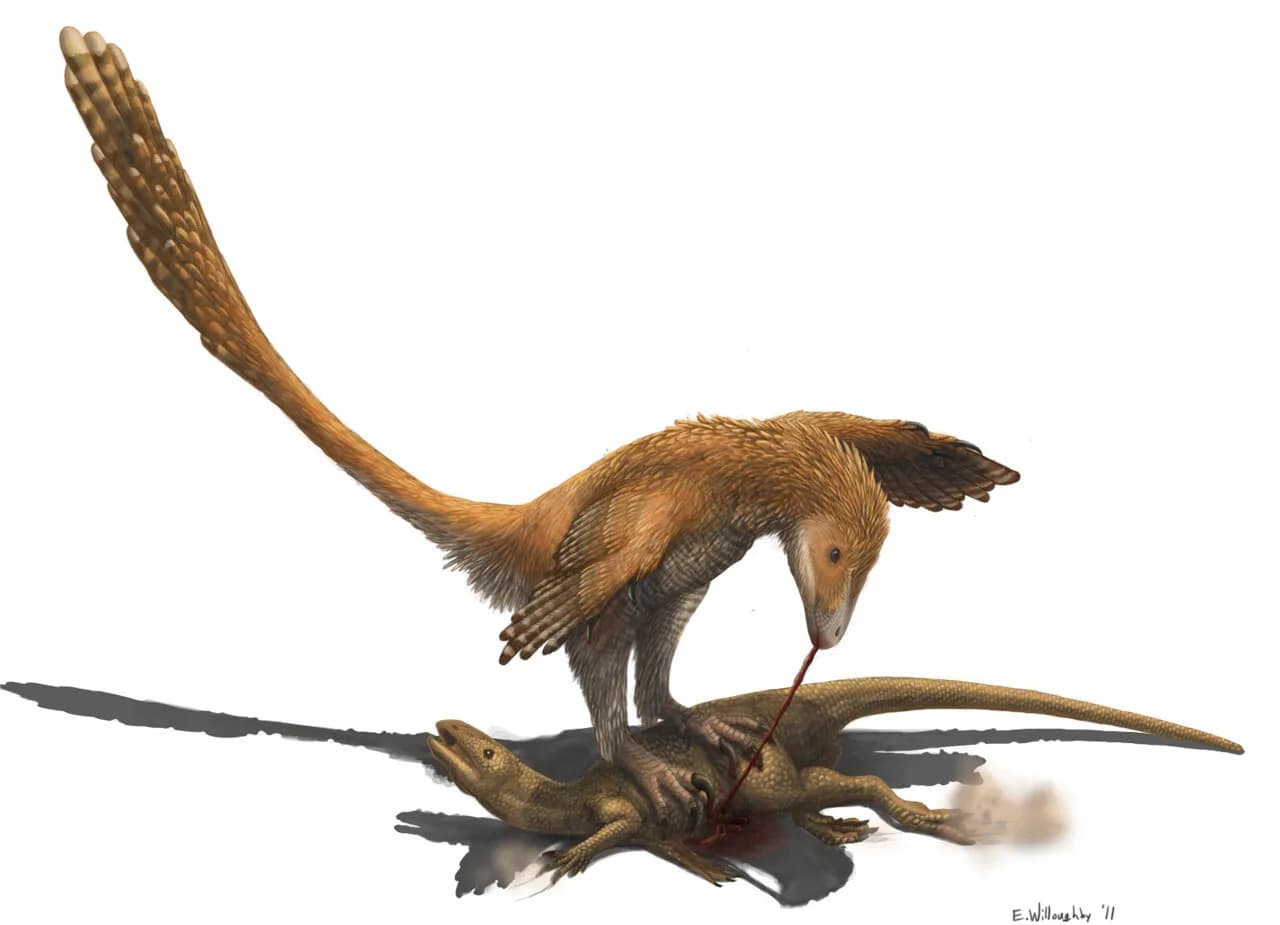
Atrociraptor was a carnivore whose diet likely included small vertebrates, lizards, primitive mammals, and possibly young dinosaurs. What distinguished Atrociraptor from other dromaeosaurids was the remarkable power of its bite, made possible by its unusually short and deep snout. This cranial configuration allowed a bite force superior to that of most raptors of comparable size, suggesting it could tackle more resistant prey. Its teeth, relatively large and robust for a dromaeosaurid of this size, were adapted for efficiently slicing flesh. The unique morphology of its jaw indicates a feeding strategy distinct from other raptors, favoring force over speed of grip.
Atrociraptor inhabited the forests and alluvial plains of the Horseshoe Canyon Formation in present-day Alberta, Canada. This Late Cretaceous environment was characterized by dense wooded areas alternating with floodplains crossed by meandering rivers draining into the Western Interior Seaway. The climate was subtropical, with well-defined seasons and abundant rainfall supporting lush vegetation composed of conifers, primitive angiosperms, and ferns. The forests of the Horseshoe Canyon Formation sheltered a diverse fauna including tyrannosaurs, ornithomimosaurs, ankylosaurs, and numerous small theropod species. This rich ecosystem provided Atrociraptor with numerous hunting opportunities.
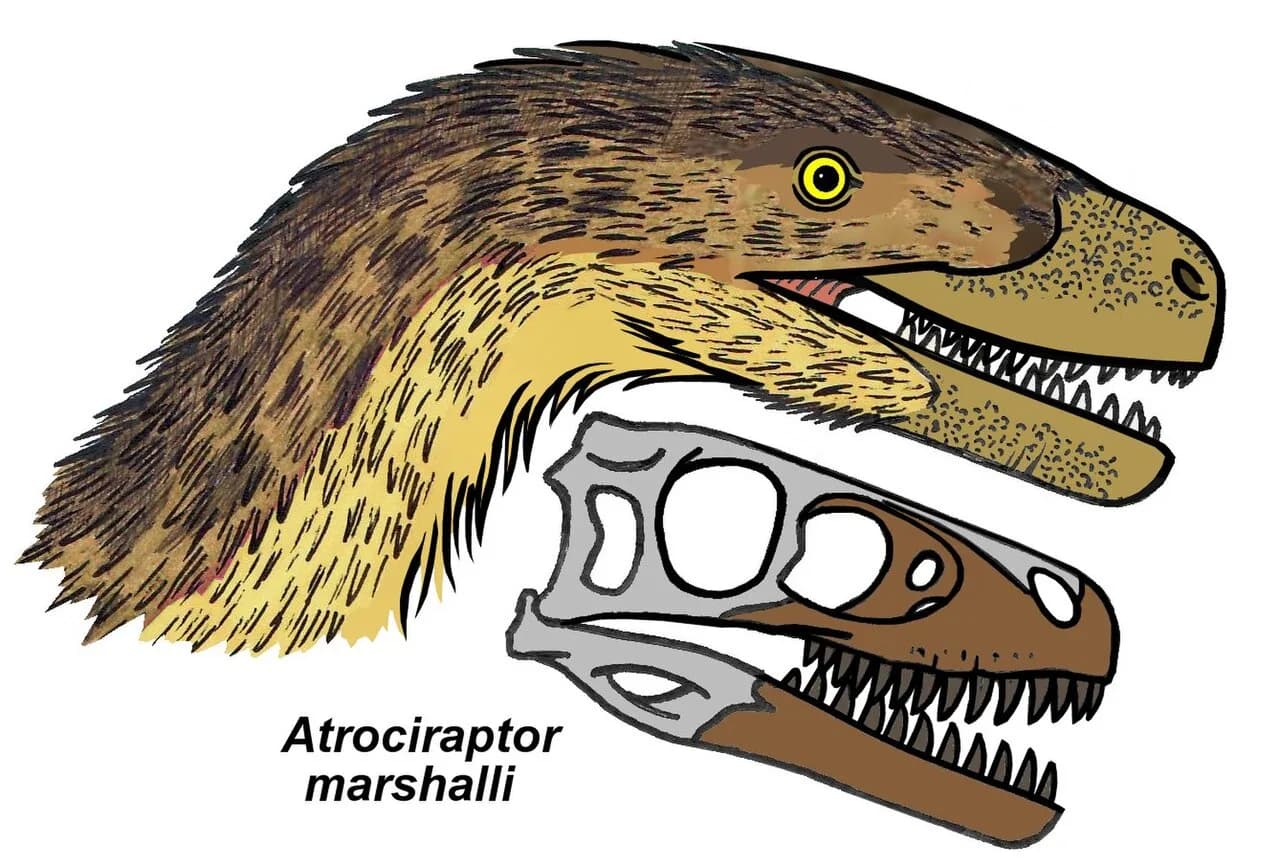
Atrociraptor's anatomy is primarily known from cranial fragments that nevertheless reveal remarkable and unique characteristics among dromaeosaurids. The most distinctive trait was its unusually short and deep skull, very different from the elongated snout typical of other raptors like Velociraptor or Deinonychus. This compact cranial morphology suggests powerful jaw muscles and a proportionally high bite force for a dinosaur of this size. The teeth were large, robust, and slightly recurved backward, adapted for grasping and holding moving prey. Like all dromaeosaurids, Atrociraptor very likely possessed the characteristic retractable sickle claw on the second toe of each foot, used as the primary weapon during hunting.
Atrociraptor's behavior can be inferred from its unique anatomy and comparisons with other dromaeosaurids. The exceptional power of its jaw, combined with its short and deep snout, suggests a hunting strategy different from other raptors. While most dromaeosaurids favored rapid attacks with their sickle claws, Atrociraptor appears to have adopted an ambush-based predation style, using its powerful bite to quickly neutralize prey. This hypothesis is reinforced by comparison with modern short-snouted predators, which tend to be ambush hunters rather than long-distance pursuers. Atrociraptor thus represents a noteworthy example of hunting strategy diversification within Late Cretaceous dromaeosaurids.
Atrociraptor was discovered in 1995 in the Horseshoe Canyon Formation, near Drumheller in Alberta, Canada. The fossil was found in sediments dating to approximately 68.5 million years ago, corresponding to the very last stages of the Late Cretaceous. The species was officially described and named in 2004 by paleontologists Philip Currie and David Varricchio. The genus name Atrociraptor means 'savage robber' in Latin, referring to the aggressive morphology of its jaw. The species name marshalli honors Wayne Marshall, a technician at the Royal Tyrrell Museum who prepared the specimen. Unfortunately, Atrociraptor is known only from cranial fragments, limiting our understanding of its complete anatomy and precise phylogenetic relationships within Dromaeosauridae.
| Period | Crétacé supérieur / Late Cretaceous |
| Era | Mésozoïque / Mesozoic |
| Age | 68,5 Ma |
| Location | Horseshoe Canyon, Alberta, Canada / Horseshoe Canyon, Alberta, Canada |
| Length | 2 m |
| Height | ~0.7 m |
| Weight | 15-20 kg |
| Diet | Carnivore |
| Discovery | 1995 |
Atrociraptor marshalli is distinguished by an unusually short and deep skull, very different from the elongated snout typical of other raptors like Velociraptor or Deinonychus. This compact morphology suggests powerful jaw muscles and a bite force superior to comparably sized raptors. Philip Currie and David Varricchio described the species in 2004 from cranial fragments found near Drumheller, Alberta.
Atrociraptor marshalli's short, deep jaw suggests an ambush strategy rather than the long-distance pursuit characteristic of many raptors. Its powerful bite allowed it to quickly neutralize prey — small vertebrates, lizards, or primitive mammals — unlike classic dromaeosaurids that favored their sickle claws. This specialization resembles modern short-snouted predators such as certain felids.
Atrociraptor marshalli was discovered in 1995 in the Horseshoe Canyon Formation near Drumheller, Alberta, Canada, in sediments dating to approximately 68.5 million years ago. The species was formally described in 2004 by Currie and Varricchio. Its species name honors Wayne Marshall, a Royal Tyrrell Museum technician who prepared the specimen. Unfortunately, only cranial fragments are known.
Atrociraptor marshalli restoration
Wikimedia Commons
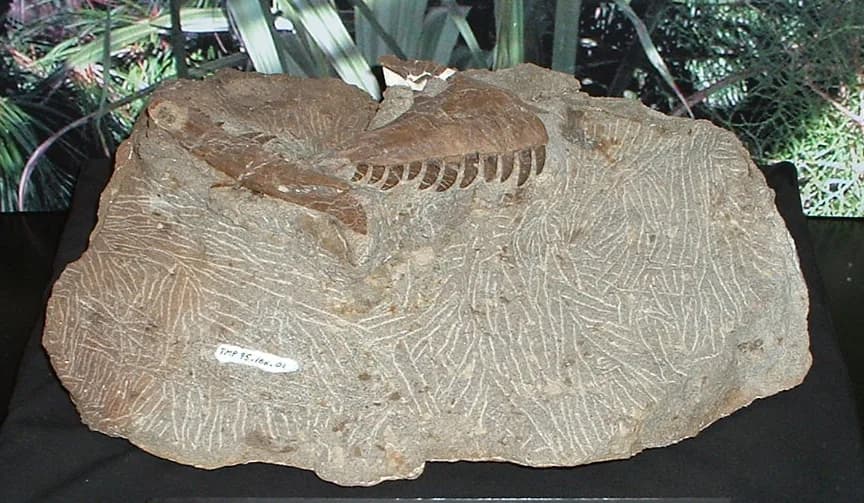
Atrociraptor fossil at Royal Tyrrell Museum
Wikimedia Commons