Achélousaure
Achelousaurus horneri was a herbivorous ceratopsian from Montana, described in 1995 and dated to around 74 million years ago. At 6 metres and 1.5 to 3 tonnes, it carried bony bosses where its relatives had horns. Its name recalls the Greek river god Achelous, whose horn Heracles tore off; it marks a stage between Einiosaurus and Pachyrhinosaurus.
Achelousaurus lived in the Late Cretaceous, approximately 74.2 million years ago, during the Campanian stage. This period corresponds to an era of great diversity among ceratopsians in North America, with numerous genera coexisting in varied ecological niches. Achelousaurus belongs to the subfamily Centrosaurinae, a group of ceratopsids characterized by elaborate nasal ornamentations and relatively short frills. It represents a noteworthy intermediate evolutionary stage between Einiosaurus and Pachyrhinosaurus in the Montana centrosaurine lineage. The Campanian climate was warm and humid, with dense forests and floodplains supporting a rich community of herbivorous dinosaurs.
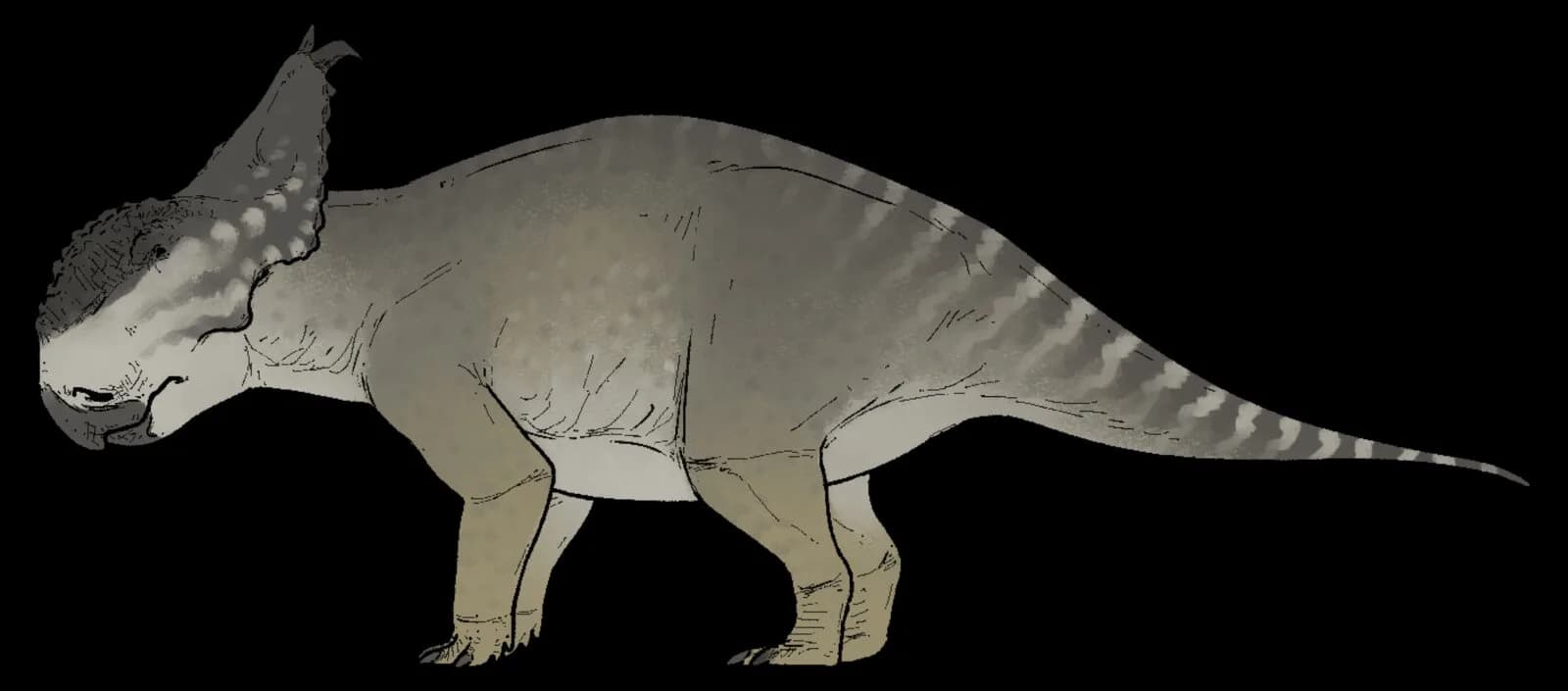
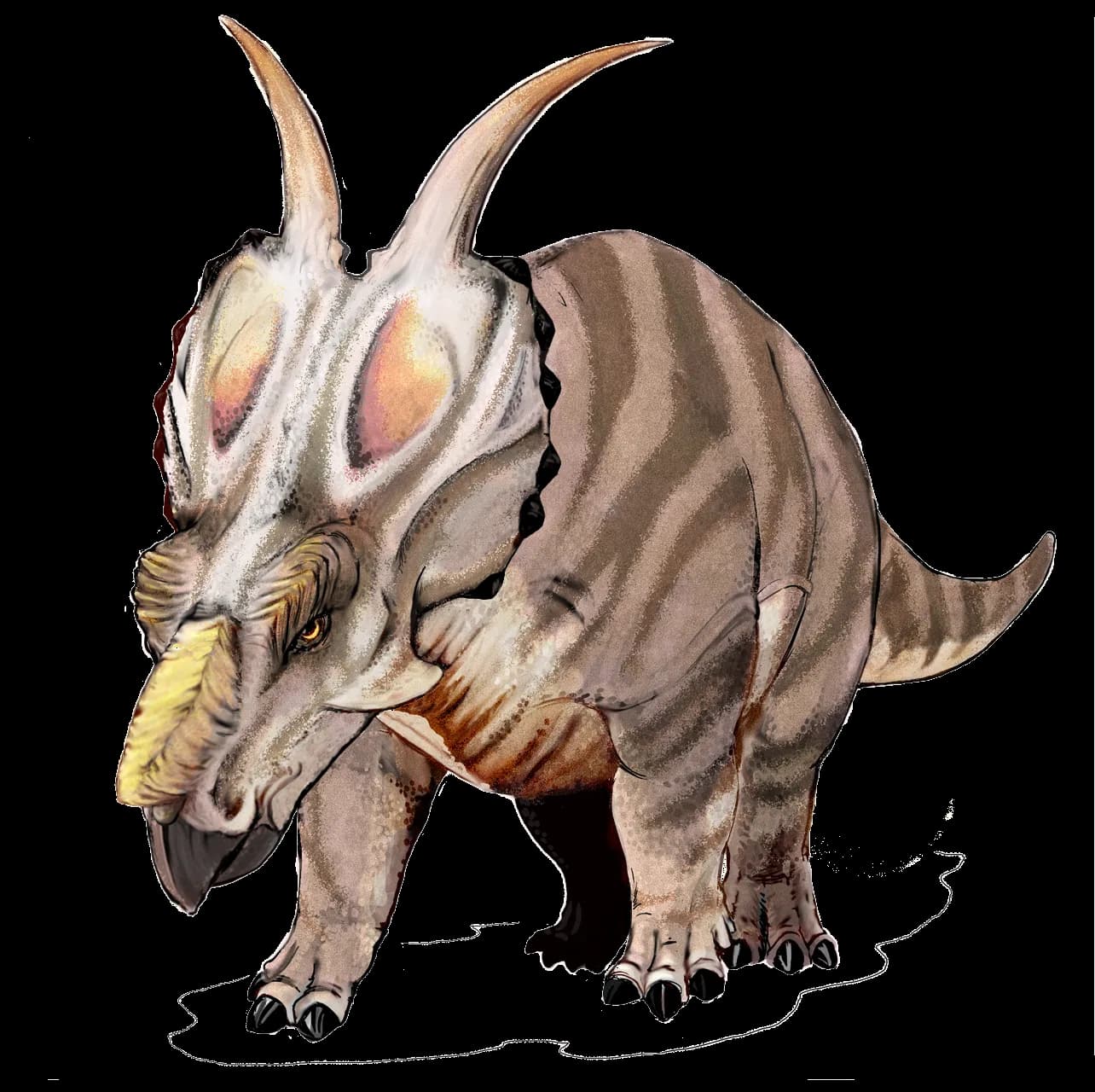
Achelousaurus measured approximately 6 meters in length, with a height of about 2 meters at the hips and an estimated weight between 1.5 and 3 tonnes. Its size was comparable to that of a modern white rhinoceros, making it a medium-sized herbivore among the ceratopsids of its time. Its massive skull, characteristic of ceratopsians, measured about 1.5 meters long including the frill. The most striking feature of its skull is the absence of true nasal horns — instead, it possessed rough bony bosses covered in keratin on the nose and above the eyes. The frill, adorned with two long forward-curving spines at its apex, likely served for visual display and protection.
A strict herbivore, Achelousaurus fed on the low, fibrous vegetation that dominated the Late Cretaceous plains. Its powerful horny beak at the front of the jaw was perfectly adapted for cutting the tough stems of ferns, cycads, and early angiosperms. The dental batteries at the rear of the jaw, composed of hundreds of teeth stacked in columns and continuously replaced, ensured efficient grinding of the most resistant plant material. Like other ceratopsids, Achelousaurus was a browser specialized in near-ground vegetation, with its head naturally positioned at less than two meters in height. Its powerful jaw musculature allowed it to process plants that other herbivores could not efficiently consume.
Achelousaurus inhabited the alluvial plains and coastal zones of western North America, in what today corresponds to Montana. The Campanian environment in this region was characterized by a humid subtropical climate, with winding rivers, swamps, and forests bordering the Western Interior Seaway that divided the North American continent. The Two Medicine Formation, where all specimens have been discovered, represents a coastal plain environment with fluvial and lacustrine deposits. Achelousaurus coexisted with other ceratopsids like Einiosaurus and Brachyceratops, as well as hadrosaurs, ankylosaurs, and theropods like Daspletosaurus. The abundant vegetation of conifers and ferns supported a rich and diverse herbivore community.
The cranial anatomy of Achelousaurus is its most distinctive and intriguing feature. Instead of the typical conical horns of ceratopsids, it possessed rough bony bosses (pachyostoses) on the nose and above the eyes, suggesting that the horns of its ancestors had been replaced by massive bony structures covered in thick keratin. The parietal frill bore two long forward-curving bony spines, a characteristic shared with other centrosaurines like Einiosaurus. The body was robust and quadrupedal, with forelimbs shorter than the hindlimbs, a typical ceratopsid posture. The feet possessed small hooves rather than claws, an adaptation for terrestrial locomotion. The tail was relatively short and muscular, serving as a counterweight to the massive skull.
Achelousaurus was probably a gregarious animal, living in medium to large herds, as suggested by bone beds discovered in the Two Medicine Formation. This herding behavior offered increased protection against large predatory theropods like Daspletosaurus. The nasal bosses and frill spines probably served during ritualized combat between males for access to females and dominance within the herd, similar to the confrontations of modern bison or deer. Adults likely protected juveniles by forming defensive formations facing predators. Individual variation in cranial ornamentation suggests marked sexual dimorphism, with males bearing more developed bosses and spines.
Achelousaurus horneri was discovered and described in 1995 by paleontologist Scott Sampson, from fossils found in the Two Medicine Formation in Glacier County, Montana. The holotype (MOR 485) includes a nearly complete skull discovered by Jack Horner and his team from the Museum of the Rockies. The genus name references the Greek river god Achelous, from whom Heracles tore off a horn during combat — an allusion to this dinosaur's hornless bosses. The species honors Jack Horner, the famous paleontologist who greatly contributed to the study of Montana dinosaurs. Several specimens have been discovered, including partial skulls and postcranial elements, allowing a reliable reconstruction of the animal. Achelousaurus's phylogenetic position between Einiosaurus and Pachyrhinosaurus in the centrosaurine lineage is considered one of the best-documented evolutionary sequences among dinosaurs.
| Period | Crétacé supérieur / Late Cretaceous |
| Era | Mésozoïque / Mesozoic |
| Age | ~74 Ma |
| Location | Amérique du Nord (Montana) / North America (Montana) |
| Length | ~6 m |
| Height | ~2 m |
| Weight | 1.5-3 tonnes |
| Diet | Herbivore |
| Discovery | 1995 |
Achelousaurus horneri, described in 1995 by Scott Sampson, had rough bony bosses (pachyostoses) instead of typical nasal horns. These keratin-covered structures represent an evolutionary trend in Montana's centrosaurine lineage: Einiosaurus had a curved nasal horn, Achelousaurus had bosses, and Pachyrhinosaurus had massive rugosities — one of the best-documented evolutionary sequences among dinosaurs.
Achelousaurus horneri measured approximately 6 meters and weighed 1.5 to 3 tonnes — comparable to a white rhinoceros. Its bony bosses and the curved frill spines likely served in ritualized combat between males. In herds, adults formed defensive formations against theropods like Daspletosaurus, predator of Montana's Two Medicine Formation.
A strict herbivore, Achelousaurus horneri browsed low-growing vegetation: ferns, cycads, and flowering plants diversifying during the Campanian (~74 Ma). Its horny beak cut tough stems, while its dental batteries ground the most resistant fibers. Its head naturally positioned below 2 meters restricted feeding to ground-level vegetation on Montana's coastal plain.
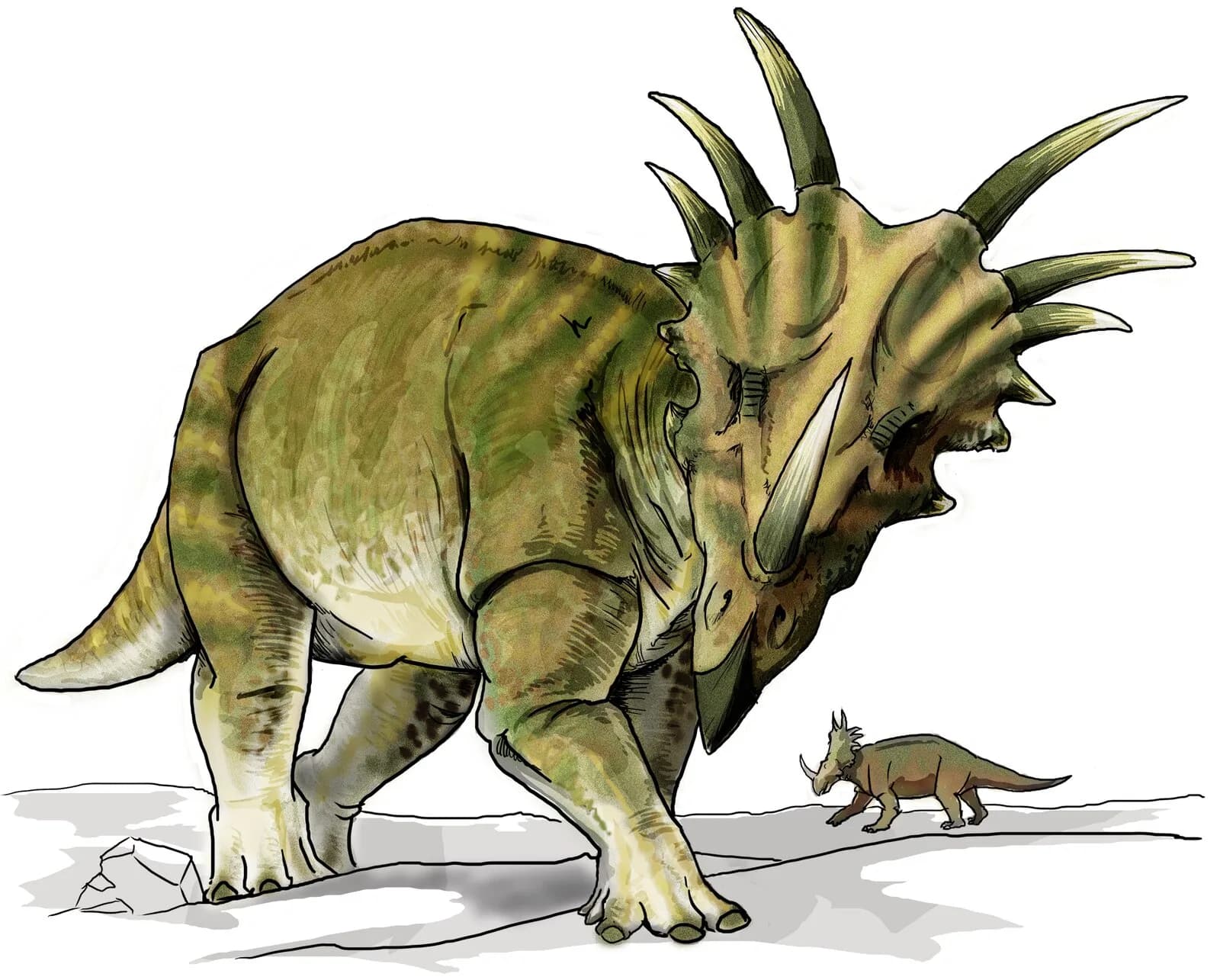
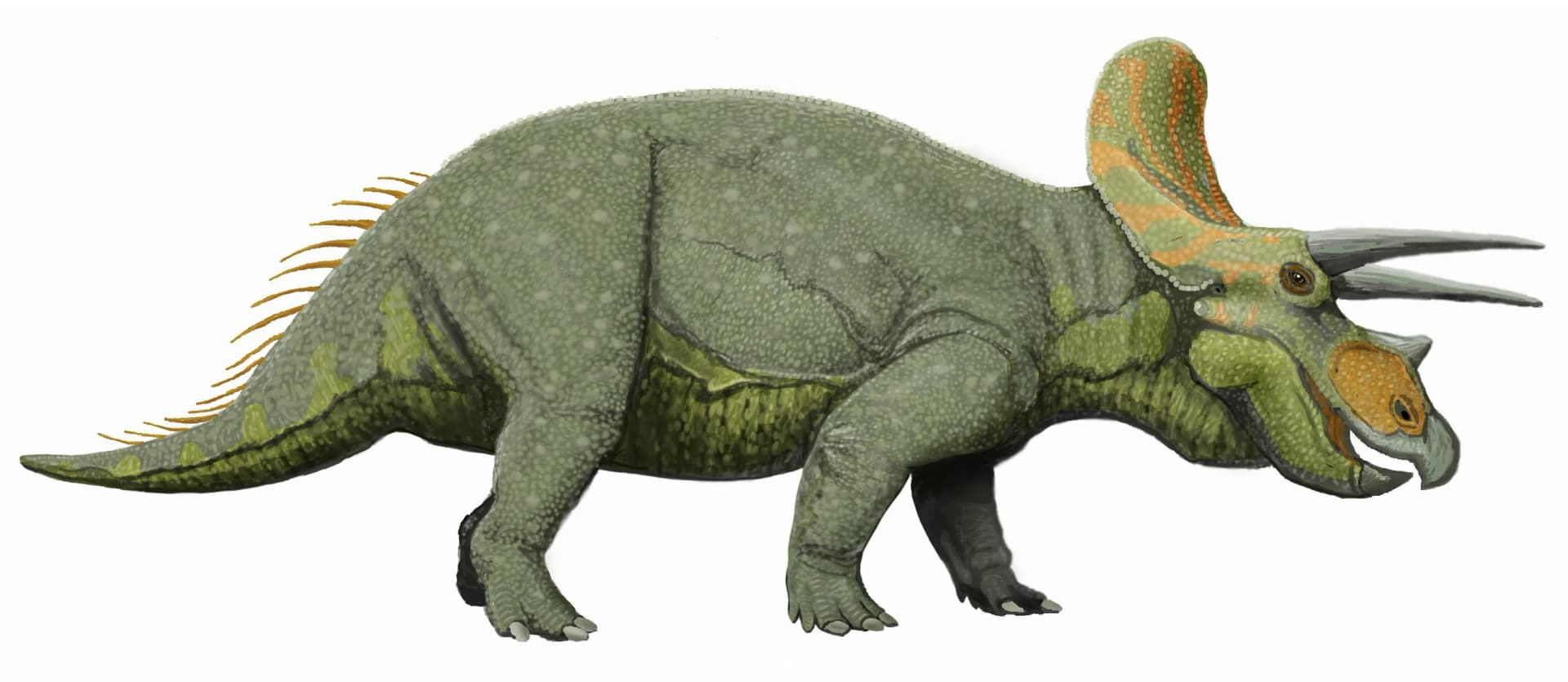
Achelousaurus horneri life reconstruction
Wikimedia Commons
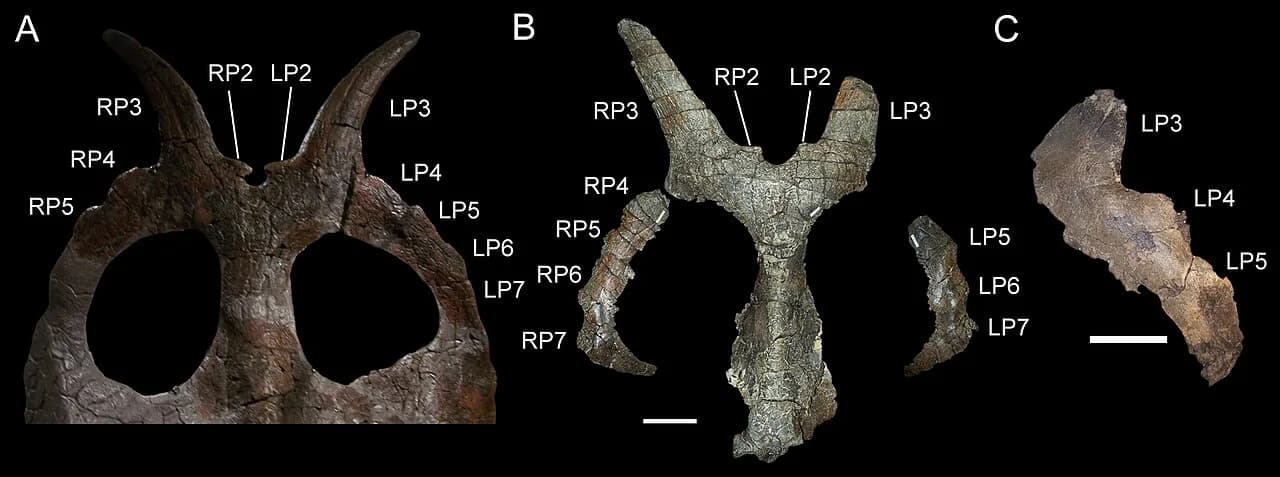
Achelousaurus skull at the Museum of the Rockies
Wikimedia Commons