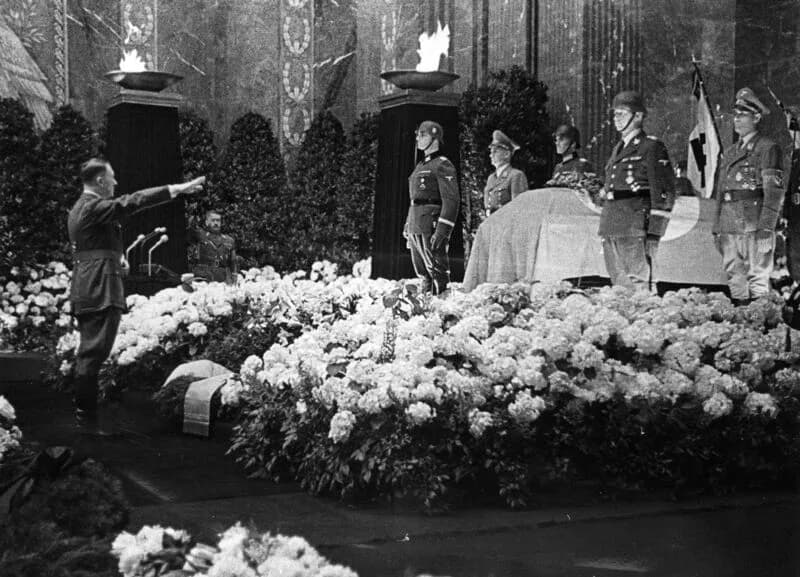
Reinhard Heydrich, nicknamed the 'Butcher of Prague,' was one of the most feared architects of the Nazi terror machine. Head of the RSHA and organizer of the Wannsee Conference that planned the 'Final Solution,' he was assassinated in Prague in May 1942 during Operation Anthropoid, the only high-ranking Nazi leader eliminated by the Resistance.
Reinhard Tristan Eugen Heydrich was born on March 7, 1904 in Halle an der Saale, Saxony, into a family of the cultured bourgeoisie. His father, Bruno Heydrich, was a renowned composer and opera singer, founder of the Halle Conservatory. His mother, Elisabeth Anna Maria Amalie Krantz, was an actress and pianist. Young Reinhard grew up in a refined musical environment and developed a precocious talent for the violin that he maintained throughout his life — an artistic sensitivity that disturbingly contrasted with the cruelty he would later deploy. During his childhood, persistent rumors about supposed Jewish origins of his father — based on an error in a registry mentioning the name 'Süss' in the family lineage — tormented young Heydrich and fueled in him a compensatory antisemitism and an obsession with racial purity. Tall, blond, and athletic, he excelled in fencing and swimming, physically corresponding to the Aryan ideal. After World War I, the teenager joined Freikorps in Halle, immersed in the atmosphere of political violence and extreme nationalism that characterized Weimar Germany. In 1922, he joined the German Navy (Reichsmarine), where he served as a signals officer. His naval career was cut short in 1931 when he was dismissed for 'conduct unbecoming an officer' after breaking a promise of engagement, a scandal that left him bitter and disoriented. It was in this state of disgrace and resentment that Lina von Osten, his fiancée and fervent Nazi, pushed him to join the Nazi party and present himself before Heinrich Himmler.
The meeting between Heydrich and Himmler on June 14, 1931 marked the beginning of a meteoric rise within the SS. Himmler, seeking to create an intelligence service for the SS, asked Heydrich to draft in twenty minutes a plan for organizing such a service. Impressed by the precision and efficiency of the proposal, inspired by the spy novels Heydrich had read, Himmler hired him immediately. Heydrich created the Sicherheitsdienst (SD), the SS intelligence service, which he developed with formidable efficiency. Methodical, intelligent, and ruthless, he built an internal espionage network that monitored not only the regime's enemies but also Nazi party members themselves. In 1934, he played a key role in the Night of the Long Knives, providing the dossiers — often fabricated — that served as pretexts for eliminating the SA leadership. In 1936, he was appointed chief of the Sicherheitspolizei (Sipo), combining the Gestapo and Kripo (criminal police). In 1939, the creation of the Reichssicherheitshauptamt (RSHA), the Reich Main Security Office, placed under his authority the entire police and intelligence apparatus of the Nazi regime: the SD, Gestapo, Kripo, and later the Einsatzgruppen. At only 35, Heydrich controlled the most efficient terror machine the world had known. Hitler nicknamed him 'the man with the iron heart' and considered him one of the regime's most capable members. Even within the Nazi hierarchy, he inspired fear: Canaris, head of the Abwehr, and Himmler himself were wary of the devouring ambition of this man whom many considered Hitler's potential successor.
Heydrich's role during the war was central to the implementation of Nazi genocidal policy. From September 1939, he organized the Einsatzgruppen, mobile death squads that followed the Wehrmacht into Poland and then the Soviet Union, systematically massacring Jews, Soviet political commissars, Roma, and other targeted groups. In the USSR, the four Einsatzgruppen (A, B, C, and D) murdered approximately 1.5 million people between June 1941 and the end of the war, primarily through mass shootings before common graves. The Babi Yar massacre on September 29-30, 1941, where 33,771 Jews from Kiev were executed in two days, illustrates the industrial scale of these killings. On January 20, 1942, Heydrich chaired the Wannsee Conference, a meeting of senior Nazi officials in a villa on the shores of Lake Wannsee in Berlin, where the 'Final Solution of the Jewish Question in Europe' was coordinated. In 90 minutes, the fifteen participants coldly discussed the logistics of exterminating eleven million European Jews. In September 1941, Hitler appointed Heydrich Acting Reich Protector of Bohemia and Moravia (the protectorate of occupied Czechoslovakia), replacing Konstantin von Neurath deemed too lenient. Heydrich applied a policy of brutal terror in Prague: summary executions, mass arrests, dissolution of Czech organizations, while combining repression with populist measures designed to maintain industrial production. His chilling efficiency earned him the nickname 'Butcher of Prague.' The Czech government in exile in London, led by Edvard Beneš, decided to organize his assassination to demonstrate that Czech resistance was active and to provoke reprisals that would galvanize opposition to the Nazi regime.
Reinhard Heydrich's decisions rank among the most criminal in human history. His decision to organize the Einsatzgruppen and systematize mass killings on the Eastern Front made him one of the principal executors of the genocide. The Wannsee Conference, which he organized and chaired, transforming a dispersed murder program into a centralized industrial enterprise of extermination, represents perhaps the most criminal meeting in history. His ability to coordinate the Reich's different bureaucracies — Transport Ministry for deportation trains, Interior Ministry for racial definitions, SS for extermination camps — revealed an organizational talent in service of absolute evil. In Bohemia-Moravia, his decision to combine terror with social concessions — increased food rations for Czech workers, improved working conditions — demonstrated a sophisticated Machiavellianism that made his regime more dangerous than pure brutality. Paradoxically, one of his last decisions — riding through Prague in an open car without armed escort, from displayed contempt toward Czech resistance — caused his downfall. On May 27, 1942, Corporal Josef Gabčík and Sergeant Jan Kubiš, Czechoslovak paratroopers trained in England, attacked him at a bend in the road leading to Prague Castle. Gabčík's Sten submachine gun jammed, but Kubiš threw a modified anti-tank grenade that exploded near the car, projecting metal shrapnel and seat upholstery fragments into Heydrich's body. Wounded but conscious, Heydrich attempted to pursue his assailants before collapsing. He died on June 4, 1942, eight days after the attack, from septicemia caused by infected fragments.
Heydrich's death triggered reprisals of appalling brutality that illustrated the criminal nature of the Nazi regime. The villages of Lidice and Ležáky were entirely razed: at Lidice, on June 10, 1942, all 173 men of the village were shot, the women sent to Ravensbrück camp, and the children, after racial selection, were either 'Germanized' or gassed at Chelmno. The village was burned, dynamited, and leveled. These massacres, far from breaking resistance as Hitler hoped, galvanized worldwide opposition to Nazism and made Lidice a universal symbol of Nazi terror. Heydrich's assassins, Gabčík and Kubiš, along with five other paratroopers, took refuge in the crypt of the Church of Saints Cyril and Methodius in Prague, where they were betrayed by a comrade, Karel Čurda. Besieged by 700 SS men on June 18, 1942, they resisted for hours before committing suicide rather than be captured. The church is today a national memorial. Operation Anthropoid is considered one of the most audacious acts of resistance of World War II and the only successful assassination of a high-ranking Nazi leader. It has inspired numerous films, including 'Anthropoid' (2016) and 'HHhH' (2017). Heydrich's own legacy is that of bureaucratic evil incarnate: a man of superior intelligence who put his capabilities in service of the industrial extermination of millions of human beings. His trajectory illustrates how ideological fanaticism, personal ambition, and the absence of moral conscience can transform a cultured man into one of history's greatest criminals.
Reinhard Heydrich was head of the Reichssicherheitshauptamt (RSHA), the Reich Main Security Office, controlling the Gestapo, SD, and Einsatzgruppen. On January 20, 1942, he chaired the Wannsee Conference where fifteen senior Nazi officials coordinated the logistics of exterminating eleven million European Jews in 90 minutes. He was nicknamed the 'Butcher of Prague' for his brutal administration of the Bohemia-Moravia protectorate.
On May 27, 1942, Czechoslovak paratroopers Josef Gabčík and Jan Kubiš, trained in England by the SOE, attacked Heydrich at a bend in the road leading to Prague Castle. Gabčík's Sten submachine gun jammed, but Kubiš threw a grenade that projected shrapnel into Heydrich's body. He died of septicemia on June 4, 1942, eight days later — the only high-ranking Nazi leader eliminated by the Resistance.
The reprisals were of extreme brutality. On June 10, 1942, the village of Lidice was entirely razed: all 173 men were shot, women sent to Ravensbrück camp, and children either 'Germanized' or gassed at Chelmno. The village of Ležáky suffered the same fate. These massacres galvanized worldwide opposition to Nazism and made Lidice a universal symbol of Nazi terror.
Information cross-checked against Wikipedia and reference historical works.
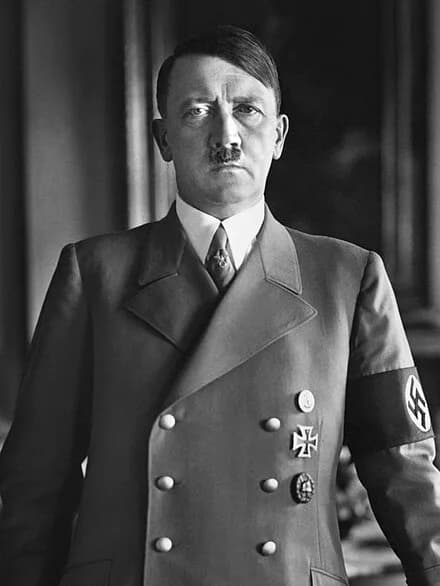
Adolf Hitler
Dictator of Nazi Germany from 1933 to 1945, Adolf Hitler was the primary instigator of World War II and the Holocaust. His racist and expansionist ideology caused the deaths of tens of millions of people worldwide. Appointed chancellor on 30 January 1933, he had dismantled the Weimar Republic within eighteen months and taken absolute power.
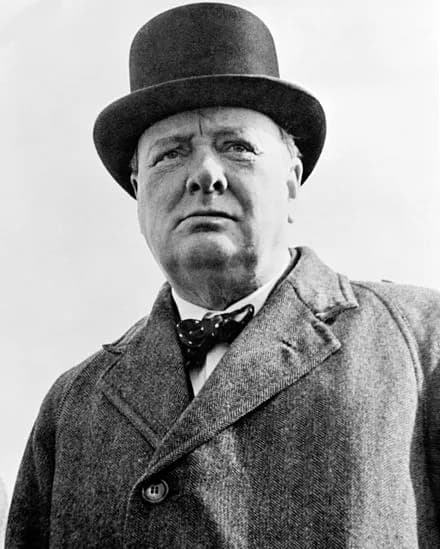
Winston Churchill
Prime Minister of the United Kingdom from 1940 to 1945, Winston Churchill embodied British resistance to Nazi Germany. His rousing speeches and unwavering leadership were instrumental in sustaining British morale through the darkest hours of the war. He refused any negotiated peace after the fall of France.
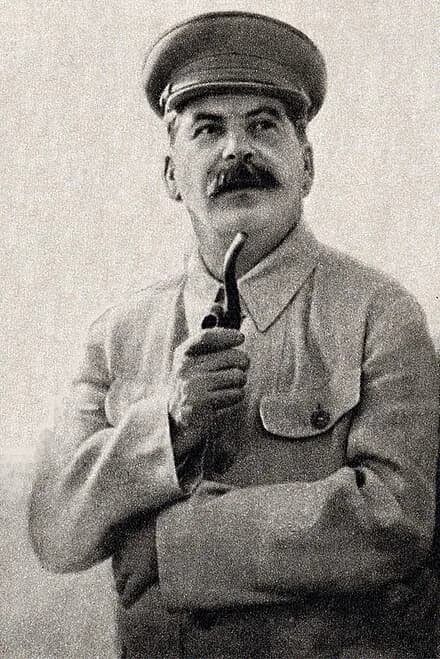
Joseph Stalin
Leader of the Soviet Union from 1924 to 1953, Joseph Stalin transformed the USSR into an industrial and military superpower. His leadership during the Great Patriotic War was decisive in defeating Nazi Germany, but his totalitarian regime caused millions of deaths among his own people.
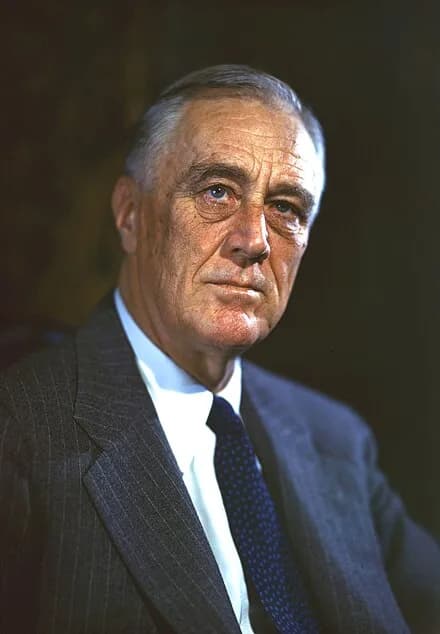
Franklin D. Roosevelt
32nd President of the United States, Franklin D. Roosevelt led the country through the Great Depression and most of World War II. His Lend-Lease program and diplomacy with Churchill and Stalin were decisive in the Allied victory, though he died just weeks before Germany's surrender.
