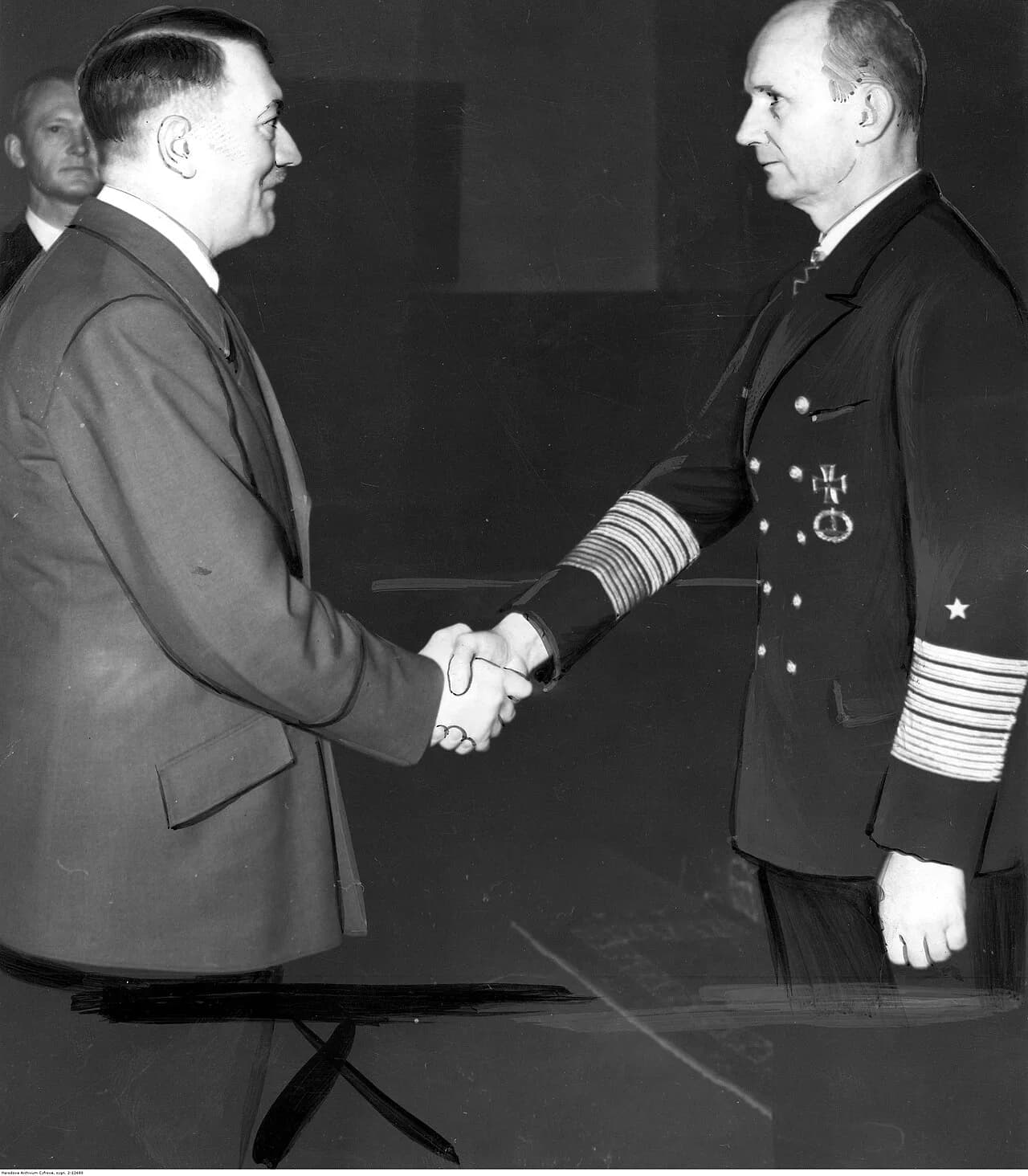
Karl Dönitz commanded the German submarine force, then became the last head of state of the Third Reich after Hitler's suicide. Strategist of the Battle of the Atlantic, he devised the wolfpack tactic, which inflicted devastating losses on Allied convoys between 1940 and 1943. He presided over the unconditional surrender of May 1945. Sentenced to ten years at Nuremberg, he was released in 1956.
Karl Dönitz was born on September 16, 1891, in Grünau, near Berlin, into a middle-class family. His father, Emil Dönitz, was an engineer at Carl Zeiss in Jena. Raised in a disciplined and patriotic environment, young Karl entered the Imperial German Navy in 1910 as a cadet. During World War I, he first served on the cruiser Breslau in the Mediterranean, then volunteered for submarine service in 1916, fascinated by this new weapon. Commander of UB-68 in the Mediterranean in 1918, he was captured by the British after his submarine surfaced due to a technical malfunction during an attack on a convoy. A prisoner of war in England, he feigned madness to be repatriated more quickly and spent his captivity reflecting on submarine tactics. This direct experience of submarine warfare and its technical limitations nourished his strategic thinking for decades to come.
After World War I, Dönitz remained in the Weimar Republic's navy, the Reichsmarine, serving on torpedo boats and surface vessels. When Hitler denounced the Treaty of Versailles and began rearmament in 1935, Dönitz was appointed commander of the first submarine flotilla of the new Kriegsmarine. He then developed his revolutionary tactical doctrine: the Rudeltaktik or wolfpack tactic. Instead of operating in isolation as in World War I, U-boats were to coordinate in groups to overwhelm convoy defenses through simultaneous night surface attacks. He trained his crews with exceptional intensity and rigor, creating a remarkable esprit de corps in the submarine arm. Before the war, he argued for building 300 submarines, but when conflict erupted in September 1939, he had only 57 U-boats of which only 22 were suitable for Atlantic operations. Despite these limited means, he immediately launched the submarine war against British maritime commerce.
The Battle of the Atlantic waged by Dönitz was the longest continuous campaign of World War II. From 1940 to 1943, his wolfpacks inflicted terrifying losses on Allied convoys crossing the North Atlantic, threatening to sever the vital supply line between North America and Britain. The year 1942 was particularly devastating, with the 'Second Happy Time' when U-boats sank millions of tons of merchant shipping off the American coast. However, from May 1943 onward, the turning point of the Battle of the Atlantic arrived. The introduction of centimetric radar, the Allied decryption of Enigma at Bletchley Park, long-range aircraft closing the Atlantic 'Black Gap,' and hunter-killer groups made the oceans deadly for U-boats. In May 1943, Dönitz lost 41 submarines in a single month and temporarily withdrew his forces from the North Atlantic. Appointed Commander-in-Chief of the Kriegsmarine in January 1943 after Raeder's disgrace, he continued the submarine war with new Type XXI submarines, but these arrived too late to change the course of the conflict.
Dönitz's fundamental strategic decision was to bet on submarine warfare as a means of starving Britain and forcing it to sue for peace. This strategy nearly succeeded in 1942-1943, when Allied losses exceeded the capacity to build replacement ships. His decision to continue submarine operations despite catastrophic losses after May 1943, sending thousands of young submariners to near-certain death, remains one of the most controversial of his career. Of 40,000 men who served in U-boats, approximately 30,000 were killed, the highest casualty rate of any German military branch. His decision to accept the position of head of state after Hitler's suicide and to continue the war for a few additional days had the stated objective of allowing as many German soldiers and civilians as possible to flee westward to surrender to the Western Allies rather than to the Soviets. His last significant decision was to order unconditional surrender on May 7, 1945, at Reims and May 8 in Berlin, ending the war in Europe.
At the Nuremberg trial, Dönitz was charged with crimes against peace and war crimes, notably for waging unrestricted submarine warfare. His defense received unexpected support when American Admiral Chester Nimitz testified that the United States had waged similar submarine warfare in the Pacific. Sentenced to ten years in prison, a relatively light sentence compared to other defendants, he was imprisoned at Spandau Prison and released on October 1, 1956. After his release, he lived in retirement in Aumühle, near Hamburg, refusing to renounce Nazism while denying any knowledge of the Holocaust. He published his memoirs and remained a respected figure in certain naval circles. He died on December 24, 1980, at the age of 89. His military legacy is that of a brilliant submarine tactician whose doctrinal innovations profoundly influenced modern naval warfare. The Battle of the Atlantic he waged remains one of the most studied campaigns in naval schools worldwide.
Grand Admiral Karl Dönitz of the Kriegsmarine developed the Rudeltaktik (wolfpack): coordinating several U-boats to simultaneously attack a convoy at night on the surface, making submarines undetectable by ASDIC sonar. He took command of the Kriegsmarine in January 1943 after Raeder's disgrace. His reign as head of state lasted only three weeks in May 1945, after Hitler's death, before Germany's surrender on May 8, 1945.
Karl Dönitz was sentenced to ten years in prison by the Nuremberg tribunal — a relatively lenient sentence compared to other defendants. His defense received unexpected support when American Admiral Chester Nimitz testified that the United States had waged similar submarine warfare in the Pacific. Imprisoned at Spandau, Dönitz was released on October 1, 1956, and died on December 24, 1980, at age 89.
The human toll for German submariners was appalling. Of the 40,000 men who served in U-boats during World War II, approximately 30,000 were killed and 5,000 taken prisoner, a mortality rate of about 75% — the highest of any German military branch. Karl Dönitz continued sending his submarines on missions despite catastrophic losses after May 1943, a decision that remains controversial.
Information cross-checked against Wikipedia and reference historical works.
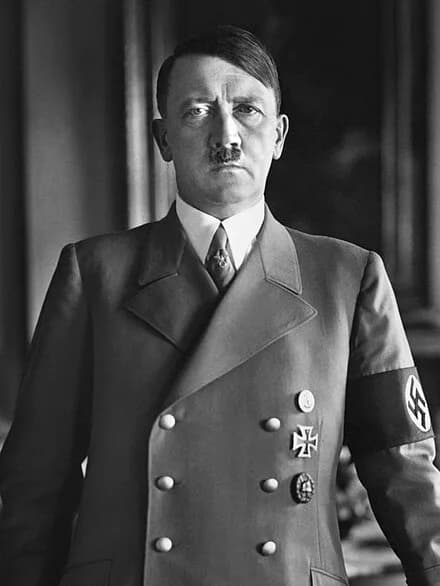
Adolf Hitler
Dictator of Nazi Germany from 1933 to 1945, Adolf Hitler was the primary instigator of World War II and the Holocaust. His racist and expansionist ideology caused the deaths of tens of millions of people worldwide. Appointed chancellor on 30 January 1933, he had dismantled the Weimar Republic within eighteen months and taken absolute power.
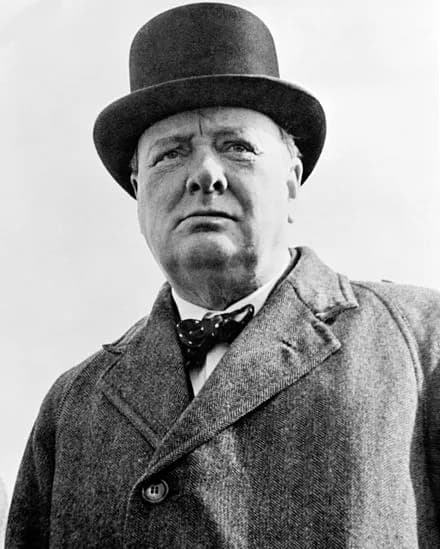
Winston Churchill
Prime Minister of the United Kingdom from 1940 to 1945, Winston Churchill embodied British resistance to Nazi Germany. His rousing speeches and unwavering leadership were instrumental in sustaining British morale through the darkest hours of the war. He refused any negotiated peace after the fall of France.
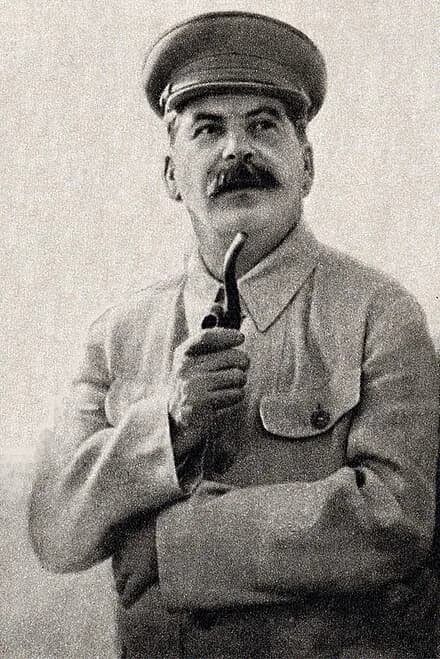
Joseph Stalin
Leader of the Soviet Union from 1924 to 1953, Joseph Stalin transformed the USSR into an industrial and military superpower. His leadership during the Great Patriotic War was decisive in defeating Nazi Germany, but his totalitarian regime caused millions of deaths among his own people.
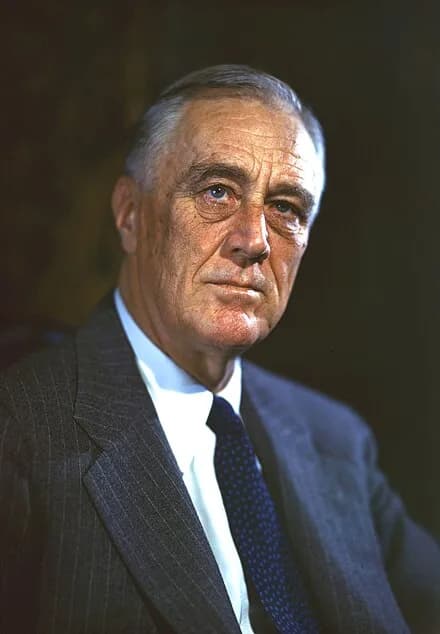
Franklin D. Roosevelt
32nd President of the United States, Franklin D. Roosevelt led the country through the Great Depression and most of World War II. His Lend-Lease program and diplomacy with Churchill and Stalin were decisive in the Allied victory, though he died just weeks before Germany's surrender.
