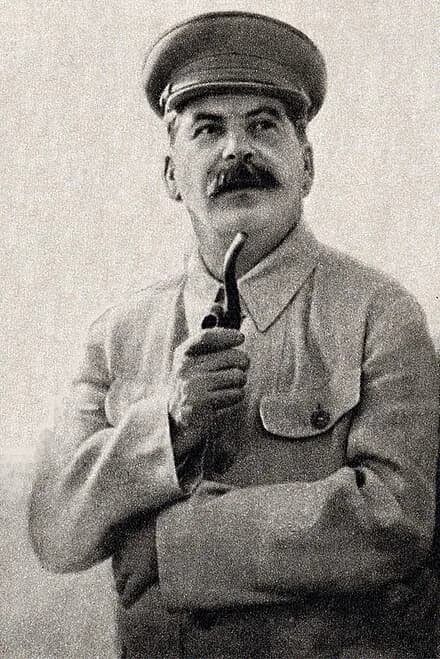
Leader of the Soviet Union from 1924 to 1953, Joseph Stalin transformed the USSR into an industrial and military superpower. His leadership during the Great Patriotic War was decisive in defeating Nazi Germany, but his totalitarian regime caused millions of deaths among his own people.
Born Iosif Vissarionovich Dzhugashvili on December 18, 1878, in Gori, Georgia, then part of the Russian Empire, Stalin grew up in poverty. His father, an alcoholic cobbler, beat him regularly. His mother, a pious and determined woman, enrolled him in the Orthodox seminary in Tiflis (Tbilisi) in 1894, hoping he would become a priest. It was at the seminary that the young Iosif discovered clandestine Marxist writings and joined the revolutionary movement. Expelled in 1899, he became a professional revolutionary, organizing strikes and bank robberies to finance the Social Democratic Party. He adopted the pseudonym "Stalin" (man of steel). Between 1902 and 1913, he was arrested and exiled to Siberia on multiple occasions, escaping each time except the last. He joined Lenin's Bolshevik faction and participated in the October Revolution of 1917. Although his role in the revolution was minor compared to that of Trotsky or Lenin, he skillfully positioned himself within the party apparatus, accumulating administrative power.
After the revolution, Stalin was appointed People's Commissar for Nationalities and then General Secretary of the Communist Party in 1922. This seemingly bureaucratic post allowed him to control appointments and build a network of loyalists throughout the party. Lenin, shortly before his death in 1924, wrote a "testament" warning against Stalin's excessive power, but this document was suppressed. Stalin methodically eliminated his rivals: Trotsky was exiled and then assassinated in 1940, while Zinoviev and Kamenev were executed during the Great Purges. Between 1936 and 1938, the Moscow Trials and the Great Terror decimated the Soviet party elite, military, and intelligentsia — an estimated 750,000 people were executed and millions sent to the Gulag. The forced collectivization of agriculture (1929-1933) caused a devastating famine in Ukraine (the Holodomor), killing 3 to 5 million people. At the same time, the Five-Year Plans transformed the USSR from an agrarian country into a major industrial power. In August 1939, Stalin signed the Molotov-Ribbentrop Pact with Hitler, a secret non-aggression agreement that divided Poland and the Baltic states between them.
The German invasion of June 22, 1941 (Operation Barbarossa) caught Stalin by surprise despite numerous warnings from his intelligence services. The first weeks were catastrophic: the Red Army lost millions of men and vast territories. Stalin, after a brief breakdown, regained control and refused to evacuate Moscow, galvanizing the resistance. His Order No. 227, "Not One Step Back," issued in July 1942, forbade any unauthorized retreat under penalty of death. The purge of the army in the 1930s had eliminated a large portion of competent military command, but Stalin gradually learned to trust his best generals — Zhukov, Konev, and Rokossovsky. The turning point came at Stalingrad (1942-1943), where the encirclement and destruction of the German 6th Army marked the beginning of the Soviet counteroffensive. The Battle of Kursk (July 1943), the largest tank battle in history, confirmed Soviet superiority. The Red Army advanced inexorably westward, liberating Eastern Europe and reaching Berlin in April 1945. The human cost for the USSR was staggering: 27 million dead, including 8.7 million military personnel.
Stalin's wartime decisions were a mixture of brutal pragmatism and costly errors. The Molotov-Ribbentrop Pact of 1939 gave him two years of respite to strengthen military industry, but his refusal to heed warnings of an imminent attack in 1941 cost millions of lives. His scorched-earth policy during the initial retreat, relocating 1,500 entire factories to the Ural Mountains, was a logistical feat that saved the Soviet industrial base. The decision to defend Stalingrad at all costs, partly for symbolic reasons as the city bore his name, proved strategically decisive. He skillfully managed inter-Allied diplomacy, securing from Roosevelt and Churchill the second front in Normandy and massive supplies via Lend-Lease, including over 400,000 American trucks. At the Tehran and Yalta conferences, he firmly negotiated Soviet influence over Eastern Europe. His decision to race toward Berlin in April 1945, sending Zhukov and Konev in competition with each other, aimed as much at capturing the German capital before the Western Allies as at securing German nuclear research. The cost of this haste: 80,000 Soviet soldiers killed in the Battle of Berlin alone.
The 1945 victory made Stalin and the USSR a global superpower. The Soviet Union now controlled Eastern Europe, establishing communist satellite regimes from Poland to Bulgaria. The "Iron Curtain" descended across Europe, inaugurating four decades of Cold War. Stalin continued his policies of repression after the war, with new purges, the deportation of entire peoples (Chechens, Crimean Tatars), and the antisemitic campaign of the "Doctors' Plot." He died on March 5, 1953, likely from a stroke, under circumstances that still provoke debate. In 1956, Khrushchev denounced Stalin's crimes in his "secret speech" at the 20th Party Congress, launching de-Stalinization. Stalin's legacy remains deeply divisive: in Russia, he is still admired by part of the population for the 1945 victory and industrialization, while being condemned for the Gulag and the purges. Historians estimate that the Stalinist regime was responsible for 6 to 20 million deaths. His legacy illustrates the paradox of a leader who defeated Nazism while committing comparable crimes against his own people.
This article draws on historical works, military archives and recognized academic publications.
Despite an initial collapse against Operation Barbarossa of June 22, 1941, Joseph Stalin refused to evacuate Moscow, galvanizing resistance. His scorched-earth policy and displacement of 1,500 factories to the Urals saved the Soviet industrial base. At Stalingrad (1942-1943), he authorized Operation Uranus which encircled the German 6th Army. The USSR lost 27 million dead, including 8.7 million military personnel, to achieve victory.
Between 1936 and 1938, the Moscow Trials and the Great Terror of Joseph Stalin decimated the Soviet military command elite: three of five marshals and thousands of senior officers were executed or imprisoned. An estimated 750,000 people were executed in total. This decapitation of command largely explains the catastrophic losses of the Red Army during the first weeks of Operation Barbarossa in 1941.
At the Tehran (November 1943) and Yalta (February 1945) conferences, Joseph Stalin firmly negotiated Soviet influence over Eastern Europe, obtaining major territorial concessions from Roosevelt and Churchill. He also secured the Allied commitment to a second front in Normandy and massive Lend-Lease supplies, including over 400,000 American trucks. The USSR then controlled Eastern Europe until 1989-1991.
Information cross-checked against Wikipedia and reference historical works.
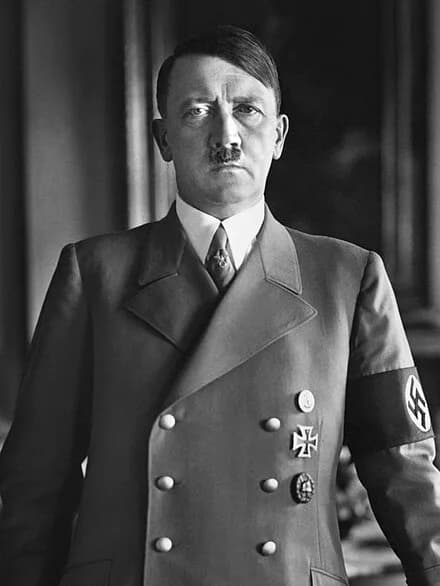
Adolf Hitler
Dictator of Nazi Germany from 1933 to 1945, Adolf Hitler was the primary instigator of World War II and the Holocaust. His racist and expansionist ideology caused the deaths of tens of millions of people worldwide. Appointed chancellor on 30 January 1933, he had dismantled the Weimar Republic within eighteen months and taken absolute power.
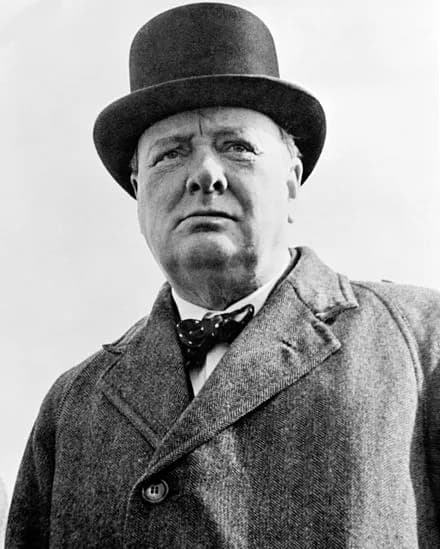
Winston Churchill
Prime Minister of the United Kingdom from 1940 to 1945, Winston Churchill embodied British resistance to Nazi Germany. His rousing speeches and unwavering leadership were instrumental in sustaining British morale through the darkest hours of the war. He refused any negotiated peace after the fall of France.
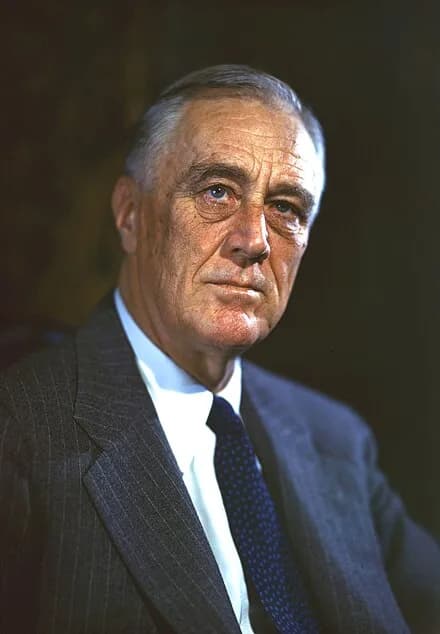
Franklin D. Roosevelt
32nd President of the United States, Franklin D. Roosevelt led the country through the Great Depression and most of World War II. His Lend-Lease program and diplomacy with Churchill and Stalin were decisive in the Allied victory, though he died just weeks before Germany's surrender.
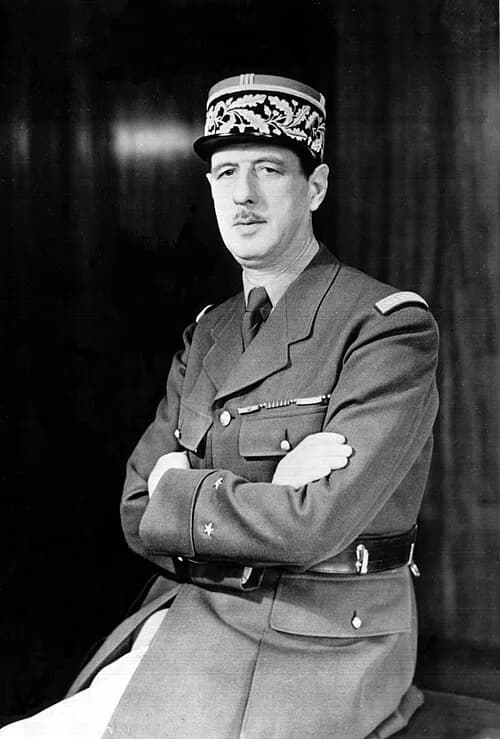
Charles de Gaulle
Leader of Free France from London starting June 1940, Charles de Gaulle refused capitulation and embodied French resistance. Through his determination and political skill, he succeeded in having France recognized as a victorious power at the war's end, preserving its place among the great nations.
