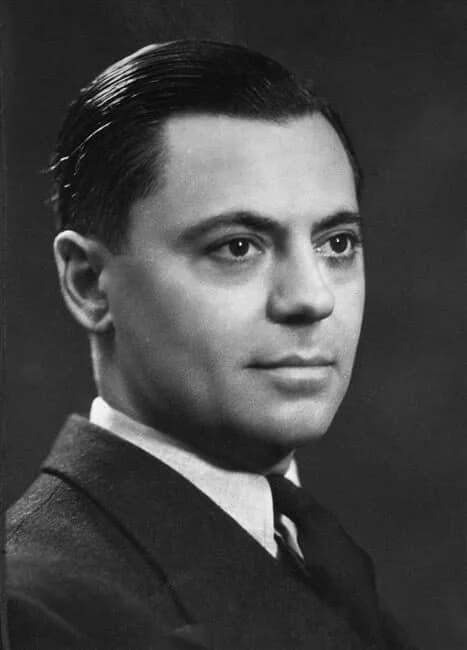
Jean Moulin is the iconic hero of the French Resistance. A prefect dismissed by Vichy, he was tasked by General de Gaulle with unifying resistance movements in both southern and northern zones, creating the National Council of the Resistance. Arrested at Caluire in June 1943 and tortured by Klaus Barbie, he died without having talked.
Jean Moulin was born on June 20, 1899 in Béziers, Hérault, into a family of the republican bourgeoisie of southern France. His father, Antoine-Émile Moulin, a history and geography teacher and radical-socialist general councilor of Hérault, transmitted to his son the values of the secular Republic and a deep civic engagement. His mother, Blanche Pègue, from a family of landowners, provided him with a cultured and loving family environment. Young Jean grew up in a setting where the republican ideal, attachment to democracy, and sense of public service were fundamental values. A brilliant student at the Montpellier lycée, he developed early on a remarkable artistic talent, particularly for drawing and caricature, which he practiced throughout his life under the pseudonym Romanin. In 1917, at age eighteen, he enrolled at the Montpellier law faculty while beginning a career in the prefectoral administration as an attaché to the cabinet of the Hérault prefect. With World War I drawing to a close, he was mobilized in April 1918 and assigned to the 2nd Engineer Regiment, but the November 1918 armistice spared him front-line experience. After the war, he resumed and successfully completed his law studies while continuing his administrative career. His progression was remarkably rapid: cabinet chief to the prefect of Alpes-Maritimes at twenty-five, sub-prefect of Albertville in 1930 at thirty-one, he became the youngest sub-prefect in France. His political engagement alongside Pierre Cot's Radical-Socialist Party led him to the position of cabinet chief to the Air Minister in 1936, during the Popular Front government.
Jean Moulin's prefectoral career reached its peak when he was appointed prefect of Eure-et-Loir in 1939, at age forty, making him one of France's youngest prefects. It was in this capacity that the war caught up with him. During the exodus of June 1940, he remained at his post in Chartres as the city was bombed and the population fled. On June 17, German troops entered Chartres and attempted to force Moulin to sign a document falsely accusing Senegalese tirailleurs of the French army of committing atrocities against civilians. Moulin categorically refused, suffering brutality from German soldiers. Imprisoned and fearing he would yield under pressure, he attempted to cut his throat with a piece of glass. Saved in extremis, he carried a scar for the rest of his life that he concealed beneath a scarf, an image that became iconic. This act of solitary resistance, from the very first days of the Occupation, foreshadowed his future engagement. Dismissed from his prefect duties by the Vichy regime in November 1940, Moulin retired to southern France and began establishing contacts with nascent resistance movements. He met the leaders of the three main movements in the southern zone: Henri Frenay (Combat), Emmanuel d'Astier de la Vigerie (Libération-Sud), and Jean-Pierre Levy (Franc-Tireur). Convinced of the need to unify these scattered and often rival movements under General de Gaulle's authority, he clandestinely made his way to London in September 1941, crossing Spain and Portugal. His meeting with de Gaulle on October 25, 1941 was decisive: the general entrusted him with the historic mission of unifying the French interior Resistance.
Parachuted into southern France on January 2, 1942 under the code name 'Rex,' then 'Max,' Jean Moulin began the most perilous and most important mission of the French Resistance. Armed with plenipotentiary powers from General de Gaulle, he had to unify resistance movements, often rival and mutually suspicious, under a common authority recognized by Free France. His task was immensely complex: he had to convince charismatic and independent leaders like Frenay, d'Astier, and Levy to subordinate their movements to a centralized structure, while maintaining operational security against the Gestapo and Vichy police. Moulin deployed extraordinary diplomatic skills, combining firmness and persuasion, distributing funds sent from London to gain the movements' trust and cooperation. In January 1943, he succeeded in merging the three major southern zone movements into the United Resistance Movements (MUR), the first step toward national unification. His masterwork was the creation of the National Council of the Resistance (CNR), which met for the first time on May 27, 1943 in Paris, on Rue du Four, under his presidency. This council brought together representatives of eight resistance movements, six political parties, and two trade unions, achieving the union of all forces of the interior Resistance. The CNR recognized General de Gaulle's authority as leader of Fighting France, thus countering American attempts to marginalize de Gaulle. This political unification was a masterstroke that gave the French Resistance international legitimacy and prepared the political reconstruction of liberated France.
Jean Moulin's decisions, taken in the most total clandestinity and under the permanent threat of arrest and death, shaped the destiny of Free France. His fundamental decision to rally to de Gaulle rather than joining another pole of resistance, such as the Giraud network supported by the Americans, had major historical consequences. By bringing Gaullist authority to the heart of the interior Resistance, Moulin guaranteed that the liberation of France would be conducted under the sign of national sovereignty rather than Anglo-American trusteeship. His decision to create the CNR, despite the considerable security risks of a meeting gathering all Resistance leaders in one place, demonstrated his ability to assess that the political benefits justified the danger. The CNR program, adopted on March 15, 1944 after his death, served as the basis for the social and political reconstruction of postwar France, including Social Security, nationalizations, and women's suffrage. His management of rivalries between resistance movements, notably tensions between Frenay and d'Astier, required remarkable political skill. Moulin constantly had to arbitrate between the personal ambitions of resistance leaders, London's demands, security imperatives, and operational necessities. His decision to attend the Caluire meeting on June 21, 1943, despite indications suggesting a possible trap, remains debated. Some historians believe he could have avoided this meeting, while others consider his presence was indispensable to resolve an internal crisis in the Secret Army command.
Jean Moulin's legacy transcends the history of the Resistance to become central to French national identity. Arrested at Caluire, near Lyon, on June 21, 1943 during a clandestine meeting that was betrayed — probably by René Hardy, though the question remains controversial — he was handed over to Klaus Barbie, head of the Lyon Gestapo, nicknamed the 'Butcher of Lyon.' Tortured for several days with extreme brutality, Moulin revealed no information and betrayed none of his comrades. Transferred toward Germany, he died on July 8, 1943, probably on the train near Metz, from injuries sustained through torture. He was forty-four years old. On December 19, 1964, his presumed ashes were transferred to the Panthéon in a grand ceremony. The speech by André Malraux, Minister of Culture, remains one of the most famous in French history: 'Enter here, Jean Moulin, with your terrible cortege...' These words definitively inscribed Moulin in national memory as the symbol of the French Resistance. His iconic photograph, wearing scarf and hat, is one of the most recognized images in French history. Hundreds of streets, squares, schools, and public buildings bear his name throughout France. The trial of Klaus Barbie in 1987 in Lyon, convicted of crimes against humanity, revived Moulin's memory and allowed the nation to confront the darkest hours of the Occupation. Moulin's political legacy, through the CNR and its program, continues to influence French public debate, with the CNR program regularly invoked as a model of national consensus and social justice.
Parachuted into France on January 2, 1942 under the code name Rex then Max, Jean Moulin was tasked by General de Gaulle with unifying French resistance movements under the authority of Free France. He succeeded in creating the National Council of the Resistance (CNR), which held its first meeting on May 27, 1943, in Paris, bringing together eight movements, six political parties, and two trade unions under common authority.
Jean Moulin was arrested at Caluire, near Lyon, on June 21, 1943, during a clandestine meeting that was betrayed — probably by René Hardy, though the question remains debated. Handed over to Klaus Barbie, head of the Lyon Gestapo nicknamed the 'Butcher of Lyon,' he was tortured for several days with extreme brutality without betraying any comrade. Transferred toward Germany, he died on July 8, 1943, from injuries through torture, probably on the train near Metz.
On December 19, 1964, Jean Moulin's presumed ashes were transferred to the Panthéon in a national ceremony. The speech by André Malraux, Minister of Culture, remains one of the most famous in French history: 'Enter here, Jean Moulin, with your terrible cortege...' This ceremony definitively inscribed Moulin in national memory as a symbol of the Resistance and republican values against Nazi occupation.
Information cross-checked against Wikipedia and reference historical works.
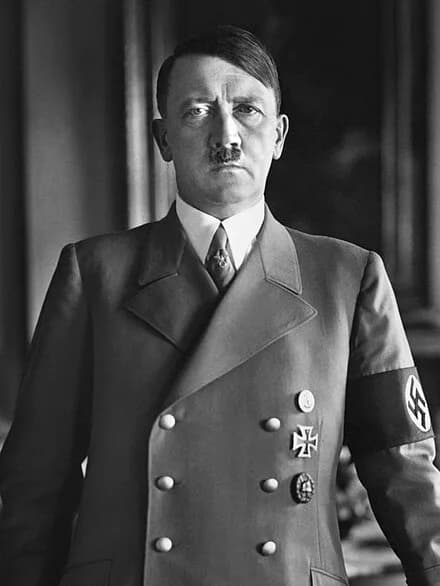
Adolf Hitler
Dictator of Nazi Germany from 1933 to 1945, Adolf Hitler was the primary instigator of World War II and the Holocaust. His racist and expansionist ideology caused the deaths of tens of millions of people worldwide. Appointed chancellor on 30 January 1933, he had dismantled the Weimar Republic within eighteen months and taken absolute power.
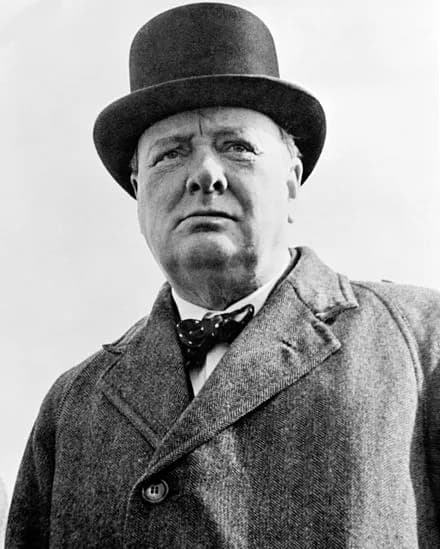
Winston Churchill
Prime Minister of the United Kingdom from 1940 to 1945, Winston Churchill embodied British resistance to Nazi Germany. His rousing speeches and unwavering leadership were instrumental in sustaining British morale through the darkest hours of the war. He refused any negotiated peace after the fall of France.
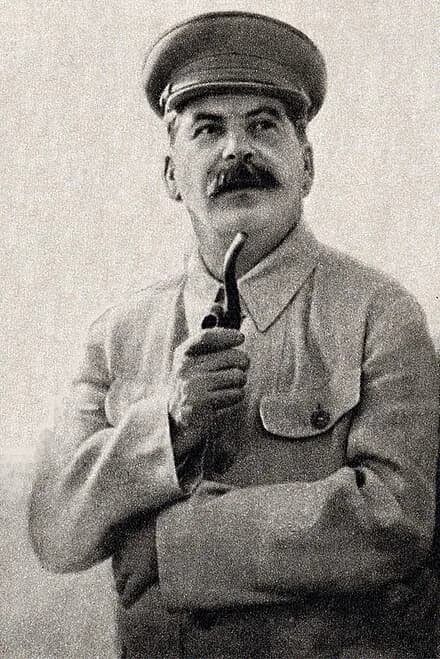
Joseph Stalin
Leader of the Soviet Union from 1924 to 1953, Joseph Stalin transformed the USSR into an industrial and military superpower. His leadership during the Great Patriotic War was decisive in defeating Nazi Germany, but his totalitarian regime caused millions of deaths among his own people.
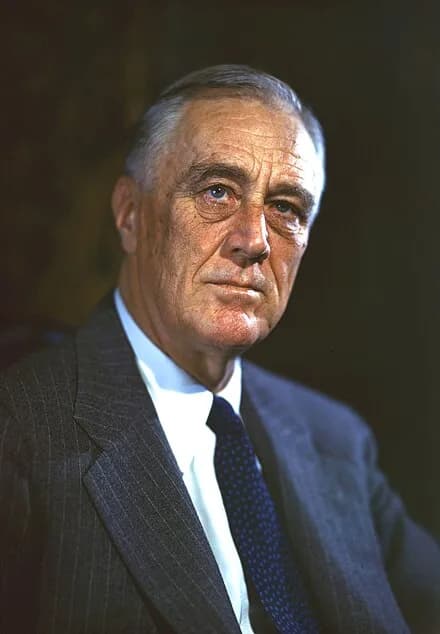
Franklin D. Roosevelt
32nd President of the United States, Franklin D. Roosevelt led the country through the Great Depression and most of World War II. His Lend-Lease program and diplomacy with Churchill and Stalin were decisive in the Allied victory, though he died just weeks before Germany's surrender.
