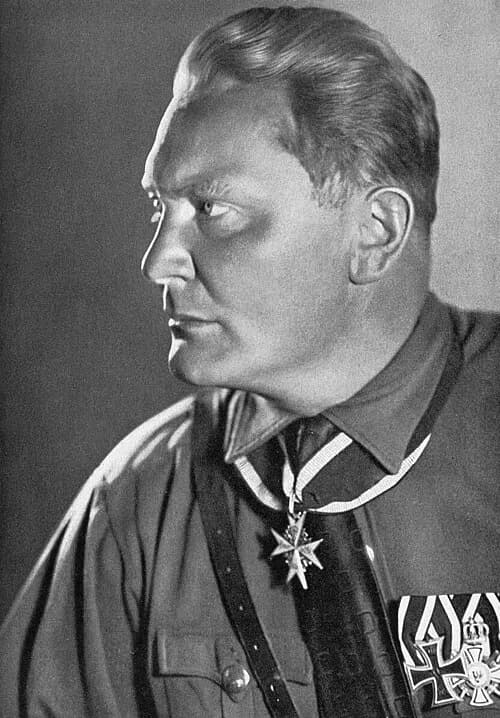
Hermann Göring held the posts of Commander-in-Chief of the Luftwaffe, Minister of Aviation, President of the Reichstag and Hitler's designated successor. A flying ace of 1914-1918 and a veteran of the von Richthofen squadron, he played a decisive part in the Nazi rise to power. His handling of the air war, at the Battle of Britain and then the Stalingrad airlift, weighed heavily in the defeat. Sentenced at Nuremberg, he killed himself the night before his execution.
Hermann Wilhelm Göring was born on January 12, 1893, in Rosenheim, Bavaria, into a family of the upper colonial bourgeoisie. His father, Heinrich Ernst Göring, was a former consul general in Haiti and governor of German South-West Africa. Young Hermann grew up in a castle near Nuremberg belonging to his mother's godfather, the wealthy physician Hermann von Epenstein, a Jewish convert to Christianity with whom his mother had an affair. Raised in an aristocratic and militaristic environment, Göring entered cadet schools and showed an adventurous and bold character. During World War I, he first served in the infantry then obtained a transfer to aviation, where he became an accomplished fighter pilot. He achieved 22 confirmed aerial victories and received the prestigious Pour le Mérite medal. In 1918, he took command of the famous Richthofen squadron after the death of the Red Baron, which gave him considerable prestige in postwar Germany.
After the war, Göring worked as a demonstration pilot in Sweden where he met his first wife, Baroness Carin von Kantzow. Back in Germany, he joined the Nazi Party in 1922, attracted by Hitler's charisma and the promise of restoring German greatness. His stature as a former war hero brought crucial respectability to the Nazi movement. Wounded during the Beer Hall Putsch in 1923, he developed a morphine addiction during his convalescence in Austria and Sweden. Elected to the Reichstag in 1928, he became president of that assembly in 1932, using this position to facilitate Hitler's accession to the chancellorship. After the seizure of power in 1933, he accumulated positions: Minister-President of Prussia, creator of the Gestapo, Commissioner for Aviation, and Commander-in-Chief of the Luftwaffe. He launched the Four-Year Plan for economic rearmament in 1936 and played a major role in the Aryanization of Jewish businesses, amassing a considerable personal fortune through corruption and systematic looting.
Göring's Luftwaffe achieved spectacular initial successes during the campaigns in Poland, Norway, and France, where blitzkrieg relied heavily on German air superiority. However, the Battle of Britain in the summer of 1940 marked the first major failure. Göring promised Hitler he would bring the Royal Air Force to its knees but gravely underestimated British defensive capabilities, notably the radar system and accelerated Spitfire production. His decision to switch from bombing airfields to the Blitz on London gave the RAF a crucial respite. On the Eastern Front, the Luftwaffe gradually wore down against the immensity of the theater of operations. The Stalingrad disaster of 1942-1943, where Göring guaranteed an impossible airlift to supply the encircled 6th Army, sealed his disgrace with Hitler. The Luftwaffe proved unable to defend German territory against Allied strategic bombing that leveled German cities. In April 1945, when Göring attempted to assume power by invoking the succession decree, Hitler had him arrested for treason.
Göring's decisions had considerable consequences on the course of the war. His decision to divert bombing from airfields to British cities during the Battle of Britain is considered one of the most costly strategic errors of the war, allowing the RAF to reconstitute and win the air battle. His unrealistic promise to resupply Stalingrad by air, with only 100 tons per day delivered out of 500 needed, condemned General Paulus's 6th Army to destruction. As head of the Four-Year Plan, his failures in coordinating war production contributed to Germany's inability to sustain a prolonged conflict. His passion for looting artworks across occupied Europe, amassing one of the largest stolen collections in history, reveals the deep corruption of the Nazi regime. His management of the Luftwaffe, favoring tactical bombers at the expense of defensive fighters, left Germany vulnerable to Allied strategic raids.
At the Nuremberg trial, Göring proved the most combative defendant, defending the Nazi regime with intelligence and arrogance, standing up to American prosecutor Robert Jackson during memorable cross-examinations. Found guilty of conspiracy, crimes against peace, war crimes, and crimes against humanity, he was sentenced to death by hanging. On October 15, 1946, just hours before his execution, he committed suicide by biting a cyanide capsule whose origin remains mysterious. His body was cremated and his ashes scattered in the Isar River to prevent any Nazi pilgrimage site. Göring's legacy is that of a brilliant but deeply corrupt opportunist, whose vanity and growing incompetence contributed to Germany's defeat. The art collection he had looted, comprising thousands of works, is still the subject of restitution to despoiled families. His role in creating the Gestapo and in antisemitic persecution makes him one of the principal criminals of the Nazi regime.
In Hearts of Iron IV, Hermann Göring appears as the Reich's Air Force Chief with 'Administrator' and 'Air Strategist' traits. The Panzer Division 'Hermann Göring' is recreated in-game as an elite armored unit unlocked via the SS focus branch. If Germany follows the historical path, the Luftwaffe's defeat in the Battle of Britain (1940) reduces Göring's influence over the air command tree. Late game, the 'Nuremberg Trials' event can be triggered if the Allies capture Berlin, penalizing national stability by 5%.
During the Battle of Britain in summer 1940, Hermann Göring switched from bombing Royal Air Force airfields to the Blitz on London. This error gave the RAF a crucial respite to reconstitute: the RAF had lost 295 pilots killed in August 1940 and was running short of replacements. By targeting cities, Göring allowed the RAF to recover and doomed Operation Sea Lion, the planned invasion of Britain.
In November 1942, when General Paulus's 6th Army was encircled at Stalingrad, Hermann Göring promised Hitler that the Luftwaffe could supply the 300,000 soldiers by airlift. In reality, the Luftwaffe delivered only 100 tons per day instead of the 500 tons needed. This unrealistic promise condemned the 6th Army to destruction: it surrendered on February 2, 1943, with 91,000 prisoners including 24 generals.
Hermann Göring was the most combative defendant at the Nuremberg trial (1945-1946), defending the Nazi regime arrogantly against American prosecutor Robert Jackson. Found guilty of conspiracy, crimes against peace, war crimes, and crimes against humanity, he was sentenced to death. On October 15, 1946, just hours before his scheduled execution by hanging, he committed suicide by biting a cyanide capsule of mysterious origin.
Information cross-checked against Wikipedia and reference historical works.
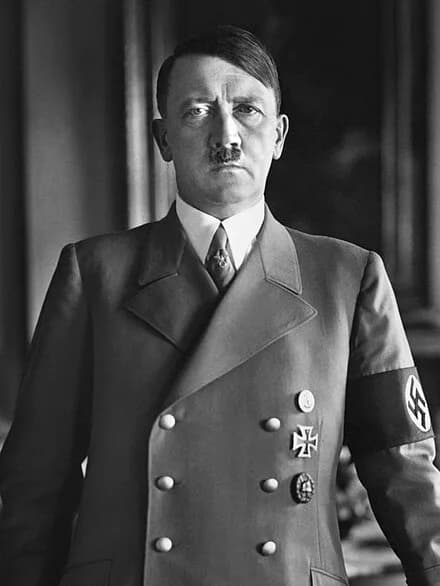
Adolf Hitler
Dictator of Nazi Germany from 1933 to 1945, Adolf Hitler was the primary instigator of World War II and the Holocaust. His racist and expansionist ideology caused the deaths of tens of millions of people worldwide. Appointed chancellor on 30 January 1933, he had dismantled the Weimar Republic within eighteen months and taken absolute power.
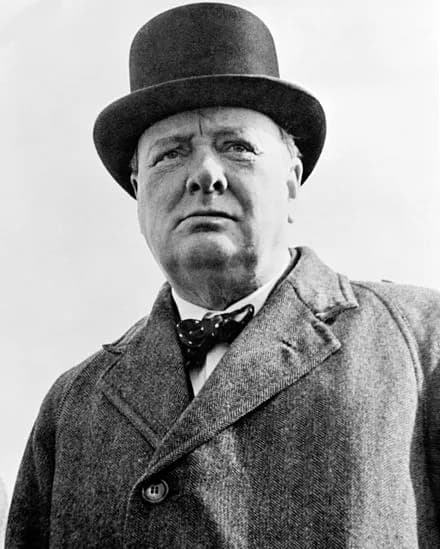
Winston Churchill
Prime Minister of the United Kingdom from 1940 to 1945, Winston Churchill embodied British resistance to Nazi Germany. His rousing speeches and unwavering leadership were instrumental in sustaining British morale through the darkest hours of the war. He refused any negotiated peace after the fall of France.
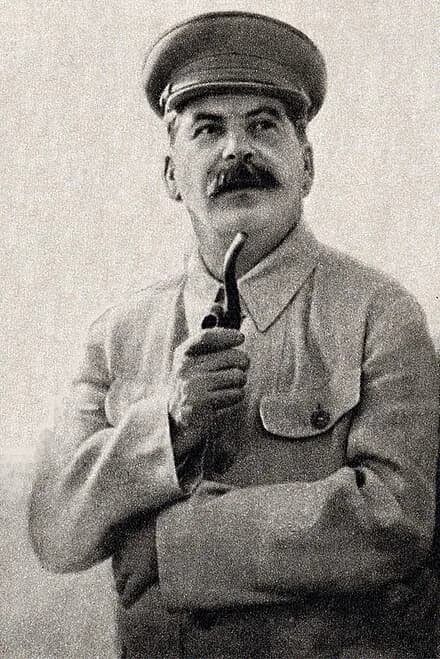
Joseph Stalin
Leader of the Soviet Union from 1924 to 1953, Joseph Stalin transformed the USSR into an industrial and military superpower. His leadership during the Great Patriotic War was decisive in defeating Nazi Germany, but his totalitarian regime caused millions of deaths among his own people.
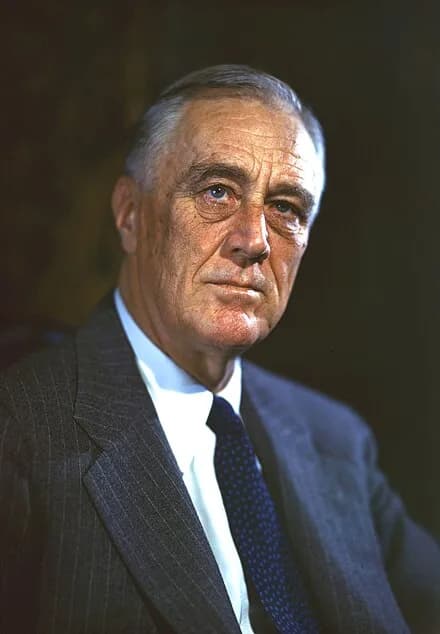
Franklin D. Roosevelt
32nd President of the United States, Franklin D. Roosevelt led the country through the Great Depression and most of World War II. His Lend-Lease program and diplomacy with Churchill and Stalin were decisive in the Allied victory, though he died just weeks before Germany's surrender.
