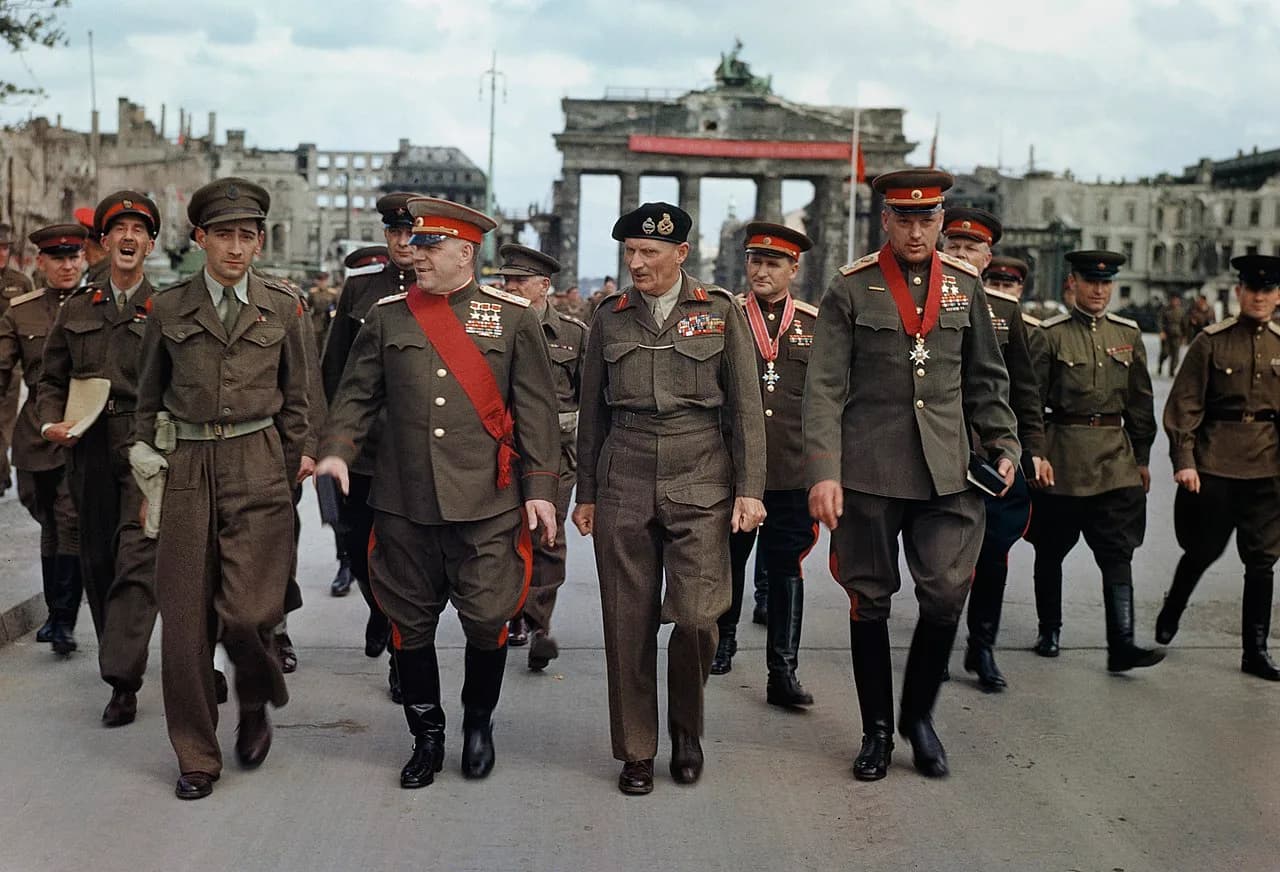
Georgy Zhukov is the most decorated Soviet general of World War II and the architect of the victories at Moscow, Stalingrad, Kursk and Berlin. Born into a poor peasant family, he rose through every rank of the Red Army. His speciality lay in large-scale encirclement manoeuvres, combining armour, artillery and infantry. It was he who accepted the German surrender in Berlin, on 8 May 1945.
Georgy Konstantinovich Zhukov was born on December 1, 1896, in the village of Strelkovka, Kaluga Province, into a poor peasant family. His father, Konstantin, was a cobbler and his mother worked in the fields. Sent to Moscow at the age of eleven as an apprentice furrier, he discovered urban life and worker exploitation. Conscripted into the Imperial Russian Army in 1915 during World War I, he served in a dragoon regiment and distinguished himself through combat courage, receiving two Crosses of St. George, the highest decoration for enlisted men. After the Bolshevik Revolution of 1917, he joined the Red Army in 1918 and fought during the Russian Civil War against White armies and foreign intervention forces. These years of combat forged his determination and instinctive understanding of mobile warfare that would characterize his entire military career.
During the interwar period, Zhukov studied Soviet military theory and became an adherent of the deep operations doctrine developed by Tukhachevsky. He survived the Great Stalinist Purges of 1937-1938 that decapitated the Red Army's command, eliminating three of five marshals and thousands of senior officers. In 1939, he made his name at the Battle of Khalkhin Gol in Mongolia, where he inflicted a crushing defeat on the Japanese Kwantung Army using a double envelopment tactic with massive armored forces. This victory, which deterred Japan from attacking the Soviet Union thereafter, propelled him to the rank of general. In January 1941, he was appointed Chief of the General Staff of the Red Army, but his warnings about the imminence of a German attack were ignored by Stalin. When Operation Barbarossa struck on June 22, 1941, the Red Army suffered catastrophic losses, and Zhukov was relieved as Chief of Staff in July to become Stalin's crisis troubleshooter, sent to the most critical fronts.
Zhukov became the indispensable commander of the Soviet war effort. In September 1941, he organized the defense of Leningrad, stabilizing the front. In October-December 1941, he commanded the defense of Moscow and launched the winter counteroffensive that pushed back the Wehrmacht, inflicting Hitler's first major land defeat. In 1942, he coordinated with Vasilevsky the Stalingrad encirclement plan, Operation Uranus, which trapped Paulus's German 6th Army and led to its surrender in February 1943. In July 1943, he supervised the defense in depth at Kursk, the largest tank battle in history, where Soviet forces definitively broke the Wehrmacht's offensive capability. In 1944, he planned and coordinated Operation Bagration, the massive offensive in Belarus that destroyed the German Army Group Center and represents the greatest military defeat in German history. In April-May 1945, he commanded the 1st Belorussian Front that took Berlin in an apocalyptic battle, raising the red flag over the Reichstag on May 2, 1945.
Zhukov's decisions shaped the course of the war on the Eastern Front. His decision to launch the counteroffensive before Moscow in December 1941 with fresh Siberian reserves, despite his troops' exhaustion, saved the Soviet capital and shattered the myth of German invincibility. His encirclement plan at Stalingrad, which exploited flanks weakly defended by Romanian and Italian armies, is considered a masterpiece of operational strategy. At Kursk, his decision to absorb the German offensive in defense in depth before launching massive counterattacks demonstrated exceptional mastery of defensive-offensive warfare. However, Zhukov was also known for his indifference to human losses, ordering costly frontal assaults when more subtle maneuvers could have saved lives. The Battle of Berlin in particular was waged with considerable brutality and Soviet casualties, motivated in part by the rivalry between Zhukov and Marshal Konev to be the first to reach the Reichstag.
After the war, Zhukov was the most popular hero in the Soviet Union, which aroused Stalin's jealousy. Appointed commander of the Soviet occupation zone in Germany, he was quickly relegated to remote provincial commands. After Stalin's death in 1953, he played a key role in the arrest of Beria and was appointed Minister of Defense by Khrushchev in 1955. However, in 1957, Khrushchev, fearing his influence, dismissed him and forced him into retirement. Partially rehabilitated under Brezhnev, Zhukov published his memoirs in 1969. He died on June 18, 1974, in Moscow and received a state funeral. His military legacy is immense: he is considered the greatest commander of World War II on the Allied side, having won the most decisive battles of the conflict. Four times Hero of the Soviet Union, decorated with dozens of orders and medals, his equestrian statue stands before the Historical Museum in Moscow on Red Square, an eternal symbol of the Soviet victory against Nazism.
Georgy Konstantinovich Zhukov won the decisive victories on the Eastern Front: defense of Moscow (December 1941), the Stalingrad encirclement via Operation Uranus (November 1942), supervision of Kursk (July 1943), and planning of Operation Bagration in Belarus (1944). He commanded the 1st Belorussian Front that captured Berlin on May 2, 1945, and accepted Germany's surrender on May 8, 1945.
After 1945, Georgy Zhukov was the most popular military hero in the Soviet Union, which aroused Stalin's jealousy. Stalin relegated him to remote provincial commands. In 1957, Khrushchev, fearing his growing influence since Zhukov had been Minister of Defense since 1955, dismissed him and forced him into retirement. Partially rehabilitated under Brezhnev, Zhukov published his memoirs in 1969 before dying in 1974.
In 1939 in Mongolia, Georgy Zhukov employed a double envelopment maneuver with massive armored forces to inflict a crushing defeat on the Japanese Kwantung Army. This victory at Khalkhin Gol deterred Japan from attacking the Soviet Union from the northeast — a strategic decision that allowed Stalin to transfer Siberian reserves to Moscow in December 1941 to halt the Wehrmacht.
Information cross-checked against Wikipedia and reference historical works.
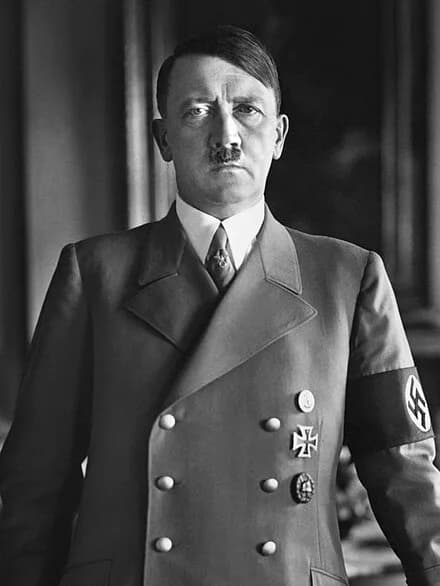
Adolf Hitler
Dictator of Nazi Germany from 1933 to 1945, Adolf Hitler was the primary instigator of World War II and the Holocaust. His racist and expansionist ideology caused the deaths of tens of millions of people worldwide. Appointed chancellor on 30 January 1933, he had dismantled the Weimar Republic within eighteen months and taken absolute power.
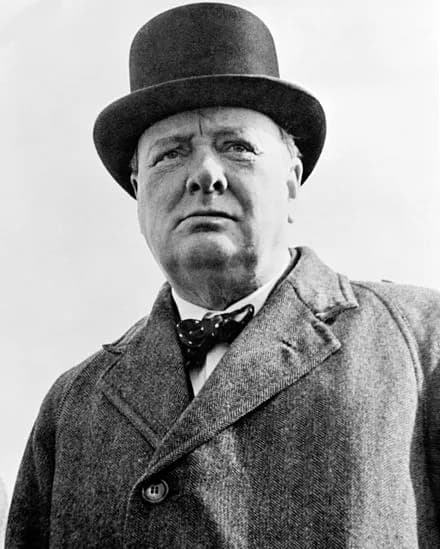
Winston Churchill
Prime Minister of the United Kingdom from 1940 to 1945, Winston Churchill embodied British resistance to Nazi Germany. His rousing speeches and unwavering leadership were instrumental in sustaining British morale through the darkest hours of the war. He refused any negotiated peace after the fall of France.
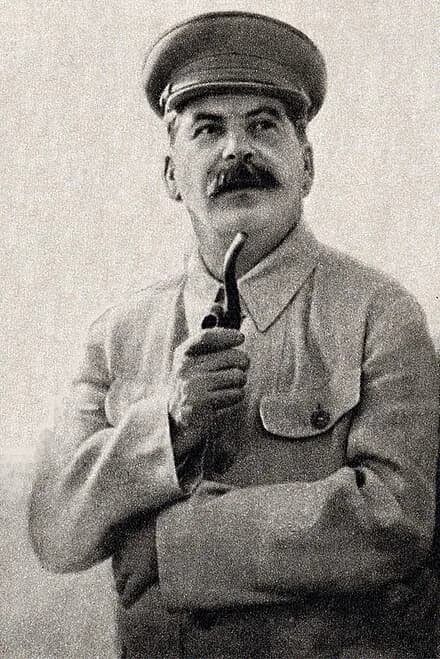
Joseph Stalin
Leader of the Soviet Union from 1924 to 1953, Joseph Stalin transformed the USSR into an industrial and military superpower. His leadership during the Great Patriotic War was decisive in defeating Nazi Germany, but his totalitarian regime caused millions of deaths among his own people.
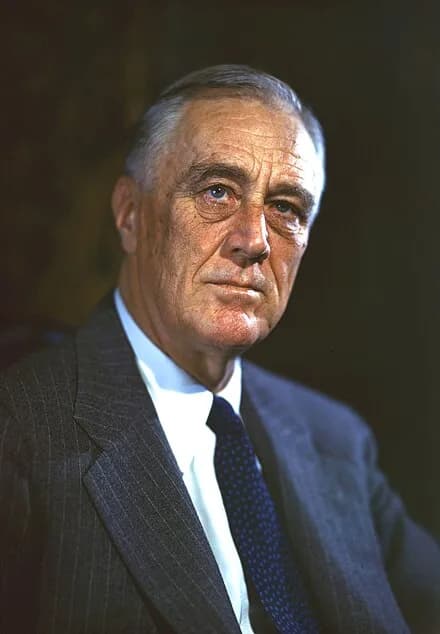
Franklin D. Roosevelt
32nd President of the United States, Franklin D. Roosevelt led the country through the Great Depression and most of World War II. His Lend-Lease program and diplomacy with Churchill and Stalin were decisive in the Allied victory, though he died just weeks before Germany's surrender.
