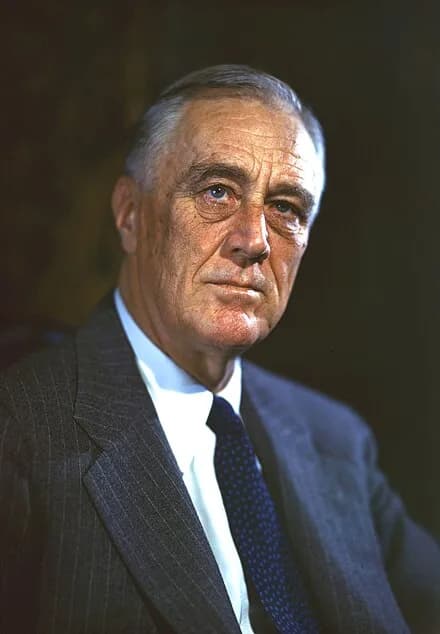
32nd President of the United States, Franklin D. Roosevelt led the country through the Great Depression and most of World War II. His Lend-Lease program and diplomacy with Churchill and Stalin were decisive in the Allied victory, though he died just weeks before Germany's surrender.
Born on January 30, 1882, in Hyde Park, New York State, Franklin Delano Roosevelt belonged to one of the oldest and wealthiest families of the American aristocracy. A distant cousin of President Theodore Roosevelt, he grew up in a privileged environment, educated by private tutors before attending the prestigious Groton School and then Harvard University. He subsequently studied law at Columbia. In 1905, he married Eleanor Roosevelt, Theodore's niece, who would become one of the most active and influential First Ladies in American history. Elected to the New York State Senate in 1910, he was appointed Assistant Secretary of the Navy by President Wilson in 1913. In 1921, at the age of 39, he was struck by poliomyelitis, which left him paralyzed in both legs. This ordeal forged his character and remarkable resilience. Through extraordinary willpower, he continued his political career, concealing the full extent of his disability from the public. Elected Governor of New York in 1928, he positioned himself as the ideal Democratic candidate for the presidency.
Roosevelt was elected president in 1932 in the midst of the Great Depression, promising a "New Deal" for the American people. His first hundred days in office saw an unprecedented avalanche of reforms: the creation of the Federal Deposit Insurance Corporation, the Civilian Conservation Corps, the Tennessee Valley Authority, and dozens of other agencies. The New Deal did not end the Depression, but it restored confidence and established the American social safety net. Roosevelt remains the only American president elected four consecutive times (1932, 1936, 1940, 1944). On the international stage, he faced the rise of fascism in Europe and militarism in Japan with an overwhelmingly isolationist American public opinion. Despite the neutrality laws passed by Congress, Roosevelt sought ways to support the European democracies. His "Quarantine" speech in 1937 tested public opinion, but it was the fall of France in 1940 that changed the equation. He secured the Lend-Lease program in March 1941, providing massive aid to the United Kingdom and then the USSR, while officially maintaining American neutrality.
The Japanese attack on Pearl Harbor on December 7, 1941 — "a date which will live in infamy" — thrust the United States into the war. Roosevelt obtained Congress's declaration of war the very next day. He adopted the "Europe First" strategy, concentrating the main effort against Nazi Germany while waging a defensive war in the Pacific. Roosevelt proved to be an exceptional commander-in-chief, knowing how to delegate to competent military leaders: he appointed General Marshall as Chief of Staff and Eisenhower as Supreme Allied Commander in Europe. His ability to mobilize the American economy was astonishing: war production transformed the United States into the "arsenal of democracy," producing more military materiel than all the Axis powers combined. He participated in the major Allied conferences — Casablanca (1943), Cairo, Tehran (1943), and Yalta (February 1945) — where the postwar world order was shaped. His relationship with Churchill was close and warm, while his dealings with Stalin were marked by pragmatism. Roosevelt authorized the Manhattan Project to develop the atomic bomb, a secret kept even from his Vice President Truman.
Among Roosevelt's major decisions, the Lend-Lease Act of March 1941 was perhaps the most important: it transformed the United States into the Allies' arms supplier even before officially entering the war, delivering over 50 billion dollars' worth of materiel (equivalent to 600 billion dollars today). His "Germany First" strategy was controversial in a country shocked by Pearl Harbor, but militarily sound. He imposed the doctrine of "unconditional surrender" at Casablanca in 1943, ruling out any separate negotiations with the Axis. Roosevelt supported the landings in North Africa (November 1942) and then in Normandy (June 1944), despite Churchill's preference for a Mediterranean approach. His most controversial decision was the internment of 120,000 Japanese Americans after Pearl Harbor — now regarded as one of the worst civil rights violations in American history. At Yalta, weakened and ill, he made concessions to Stalin on Poland and Eastern Europe that some historians criticize. Nevertheless, he secured the Soviet commitment to declare war on Japan and the USSR's participation in the future United Nations Organization.
Franklin Roosevelt died on April 12, 1945, from a cerebral hemorrhage at Warm Springs, Georgia, barely three weeks before Germany's surrender. His death plunged America and the world into mourning. Harry Truman succeeded him and inherited the final decisions of the war, including the use of the atomic bomb. Roosevelt's legacy is immense and multifaceted. In domestic policy, the New Deal redefined the role of the federal government and created the American social security system. On the international stage, he was the architect of the postwar world order: the United Nations, the International Monetary Fund, and the World Bank are direct products of his vision. The Lend-Lease program and American industrial mobilization were decisive for the Allied victory — the USSR itself acknowledged that without American trucks, food, and materiel, the war on the Eastern Front would have lasted far longer. Roosevelt is regularly ranked among the three greatest American presidents alongside Lincoln and Washington. His leadership during the gravest crisis of the twentieth century illustrates how a visionary politician can transform an isolationist nation into the leader of the free world.
In Hearts of Iron IV, Franklin D. Roosevelt is the US head of state with 'Economist' and 'Captain of Industry' traits. His 'Arsenal of Democracy' focus branch enables Lend-Lease from 1940 (50 convoys to the UK) and unlocks the 'War New Deal' industrial bonus (+15% production capacity). At his historical death in April 1945, a HOI4 event triggers the transition to Truman and modifies available decisions for the atomic bomb. In alternate history, maintaining US neutrality requires avoiding the Pearl Harbor event (December 1941).
This article draws on historical works, military archives and recognized academic publications.
The Lend-Lease Act of March 1941 transformed the United States into the Allies' arms supplier before officially entering the war. Over $50 billion in materiel (approximately $600 billion today) was delivered to Great Britain, the USSR, China, and other allies. The USSR itself acknowledged that without 400,000 American trucks, food, and materiel, the Eastern Front war would have lasted far longer. The program represented approximately 11% of American wartime industrial production.
Franklin D. Roosevelt is the only American president elected four consecutive times: in 1932, 1936, 1940, and 1944. He died of a cerebral hemorrhage on April 12, 1945, in Warm Springs, Georgia, barely three weeks before Germany's surrender. His Vice President Harry Truman succeeded him and inherited the war's final decisions, including the use of atomic bombs on Hiroshima and Nagasaki in August 1945.
Roosevelt's most controversial decision was Executive Order 9066 of February 1942, ordering the internment of some 120,000 Japanese Americans in detention camps after Pearl Harbor. Motivated by espionage fears and anti-Japanese racism, this measure was validated by the Supreme Court (Korematsu v. United States, 1944), before being unanimously condemned as a major injustice. In 1988, the US government paid reparations to survivors.
Information cross-checked against Wikipedia and reference historical works.
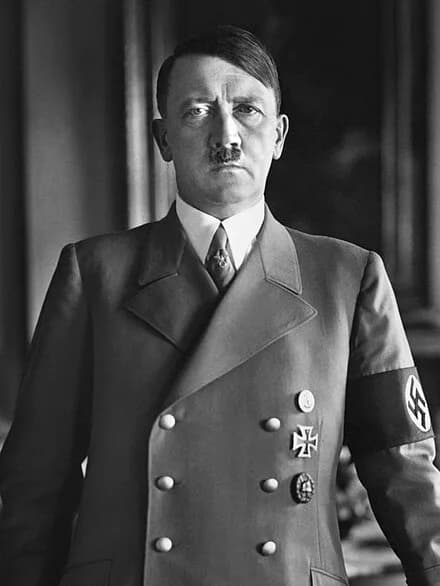
Adolf Hitler
Dictator of Nazi Germany from 1933 to 1945, Adolf Hitler was the primary instigator of World War II and the Holocaust. His racist and expansionist ideology caused the deaths of tens of millions of people worldwide. Appointed chancellor on 30 January 1933, he had dismantled the Weimar Republic within eighteen months and taken absolute power.
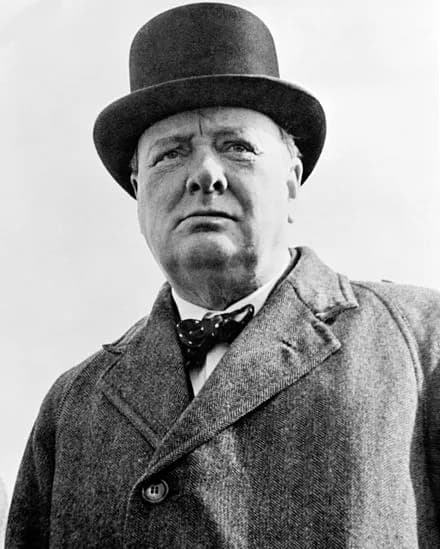
Winston Churchill
Prime Minister of the United Kingdom from 1940 to 1945, Winston Churchill embodied British resistance to Nazi Germany. His rousing speeches and unwavering leadership were instrumental in sustaining British morale through the darkest hours of the war. He refused any negotiated peace after the fall of France.
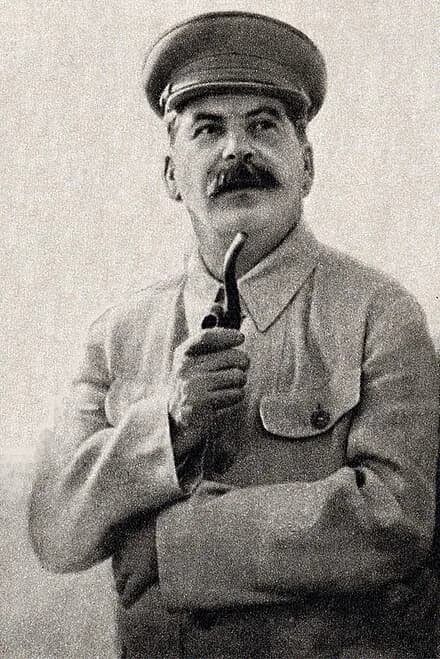
Joseph Stalin
Leader of the Soviet Union from 1924 to 1953, Joseph Stalin transformed the USSR into an industrial and military superpower. His leadership during the Great Patriotic War was decisive in defeating Nazi Germany, but his totalitarian regime caused millions of deaths among his own people.
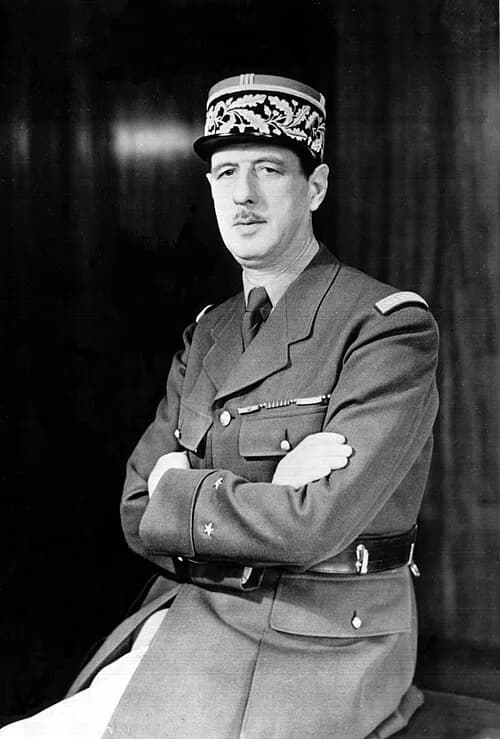
Charles de Gaulle
Leader of Free France from London starting June 1940, Charles de Gaulle refused capitulation and embodied French resistance. Through his determination and political skill, he succeeded in having France recognized as a victorious power at the war's end, preserving its place among the great nations.
